To Study the Effect of Municipal Treated Effluent on Groundwater Quality Near Sewage Treatment Plant, Davangere
Pallavi R1 , Nagarajappa D.P2 , Bhagyashree H N31Pallavi R: PG Student, Department of Studies in Civil Engineering, University of B D T College of Engineering, Davangere, Visvesvaraya Technological University, Belagavi, Karnataka, India
2Nagarajappa D.P: Professor, Department of Studies in Civil Engineering, University of B D T College of Engineering, Davangere, Visvesvaraya Technological University, Belagavi, Karnataka, India
3Bhagyashree H N: Research scholar, Department of Studies in Civil Engineering, University of B D T College of engineering, Davangere, Visvesvaraya Technological University, Belagavi, Karnataka, India
Abstract - The work was performed to examine the treated effluent mannerismanditsimpactongroundwateraroundthe Sewage treatment plant. The main objectives of this work are to appraise the effectivenessofthetreatmentprocedureandto identify the potential hazards related to release of treated effluent into the environment The findings will help environmental authorities, wastewater treatment facilities, and local communities create more sensible plans for managing wastewater sustainably and safeguarding soil and groundwater resources. The release of effluent to ground it reaches ground water, as a result, groundwaterpotability and usability can be harmed. It is advised to conduct further investigations to monitor the broader implications and put essential precautions in place to reduce potential hazards to the environment and public health
Key Words: Sewage treatment plant, Treated effluent, Groundwater
1. INTRODUCTION
Water,foodandenergyareimportantandarevitalissueface bywholeworld.Mostofrevers,canalsandothersurfaceand subsurfacewatersourcesaremajorlypollutedandaretoxic for usage their experiencing moderate to severe water shortageacrosstheglobeandtheireffectingurbanization, industrialization and agriculture growth. The per capita waterconsumptionhasbeenincreasedsignificantlydueto rapidgrowthofpopulationandstandardofliving[2].Waste water or low-quality water are major source of demand managementafterthetreatmentforgeneralusagesuchas for gardening, washing, and for coolant for an industrial application Water which is adversely affected by anthropogenic influence are termed as waste water. The liquid waste that is discharged from household and other commercialpropertiesaretermedhaswastewater[1].Due to rapid urbanization, growth of population, standard of livinganddevelopmentofindustriesleadstoseverchallenge for the disposal of sewage or sewage treatment plant effluent.Duetoensuringdemandforwater,thepracticeof domestic sewage in farming became more common or practicing way of handling sewage or sewage effluent.
Irrigation with sewage is important in arid and semiarid region, whichiseconomical tofreshwater.The benefits of sewageirrigationaremorebutpreventionarymeasuresare to be taken in order to avoid environmental risk. Sewage irrigationorfarmingisnofthetechniquestodecreasethe load on recycle and reuse. Available natural resources, sewagefarmingisawaytomeetthedemandforfreshwater. Sewagewillimprovethephysiochemicalcharacteristicsof soi,sincesewagecontainsessentialnutrientsuchasN,P,K andmacronutrientswhichwillpromoteplantsgrowth
1.1 Repercussion of Effluent on Groundwater

Groundwaterisnaturalwatersourcewhichplaysimportant roleinsatisfyingthewaterdemandforvariouspurposein dry and droughty regions. Quality of groundwater is considered as finer than surface water, since soil columns purifies the water through various processes such as anerobic decomposition, filtration, ion exchange etc., Over exploitationofgroundwaterleadstoloweringofwatertable and quality deterioration. The groundwater is recharged mainlythroughrainfallandseepageofsurfacewaterbodies suchasriverslakesetc.,Contaminationofgroundwaterwill damagetheecosystemsthatdependonit,suchaswetland habitat rivers, and lakes, which will lead to loss of biodiversity and hazardous ecosystems. Individuals who ingestcontaminatedgroundwaterorcomeintoconnection with it will catch waterborne diseases such as cholera, typhoid, hepatitis, and gastroenteritis via pathogens that inhabitsewage.Significantamountsofnutrientslikenitrogen andphosphorusareoccasionallydetectedinsewage.These nutrientsarecapableofcausingeutrophicationwhenthey accomplishgroundwater,whichdisruptsaquaticlifeleading to in algal blooms and oxygen depletion in surface water bodiesthatreceiveflowfromthegroundwater[3].
2. METHODODLOGY
The methodology involves the selection of study area and thesamplecollectionandanalysisofthevariousparameters byvariouslaboratorymethod.
2.1 Study Area
Davanagere, a city in the heart of Karnataka, is being developedasgovernment'sSmartCityinitiative.TheSewage treatment plant is existed in Davangere and it is 5 km far away to the Davangere city. Sewage The villages like B. Kalpanahalli, Shivanagara, Doddaboodihal, Chikkaboodihal are located near the treatment plant. Doddaboodihal and Chikkaboodihalarechosenforsamplingandanalysiswhichis near to the Sewage Treatment Plant. The communities of Doddaboodihal and Chikkaboodihal use this treated wastewaterastheirprimesourceofwaterforfarming
2.2 Gathering Samples
The effluent samples are gathered from Doddaboodihal, Chikkaboodihal villages at the distance 100m, 200, 300m, 350m,400mandlabelledassample1,sample2,sample3, sample4,andsample5accordingly.Theundergroundwater samples are collected in plastic bottles and are stored in refrigerator to avoid ingrowth of organic material care should be taken such that samples were not allowed for freezingsinceithasaneffectontheequilibriumofsample
2.3 Experiment Conduction
Inthisstudythe parametersanalyzedforthe effluentand groundwaterarepH,ElectricConductivity,Color,Alkalinity, Total Dissolved Solids, Turbidity, Dissolved Oxygen, Chloride,BiologicalOxygendemandandChemicalOxygen Demand.
ThepH,EC,TurbidityandTDSismeasuredusingapHmeter, Conductivity meter, Turbidimeter and TDS meter respectively.Colorisdeterminedbyspectrophotometerand ChlorideisdeterminedusingtheMohr’smethod.Alkalinity andDOaredeterminedusingstandardtitrationmethod,for BODanalysisthesampleisincubatedfor3daysandforCOD determination COD digester is used to heat the sample to oxidizeorganicandinorganicsubstances,andfollowedback titration.
3 RESULTS AND DISCUSSIONS
Theoutcomesoftheanalysisofthestudyarepresentedin this chapter for various parameters of the sample are discussedalongwithgraphs
3.1 Analyzed Characteristics of Disposed Treated Effluent
The analyzed various parameters of the disposed treated effluentsoffivesamplesandtheiroutcomesaretabulatedin thebelowtable3.1.SomeparameterslikeEC,Color,TDSare reducingwiththeflowofeffluent.
3.2 Analyzed Characteristics of Groundwater
Theanalysisoftheundergroundsampleswhicharecollected nearthesewagetreatmentplantforagriculturalperspective parameters.Theoutcomesoftheanalysisaretabulatedin thebelowtable3.2.
ThepHofallthesamplesanalyzedarewithinthelimit6.5–8.5.ThepHresultsofsamplesare7.12,7.22,7.24,7.28,7.34 for sample 1, sample 2, sample 3, sample 4 and sample 5 respectivelyareshowninfigure3.1below.Allthesamples arefitforhumanconsumptionandirrigation.ThepHofall thesamplesisalkalineinnature
TheECofanalyzedsamplearerepresentedinbelowfigure 3.2.Electricalconductivityofsamplesiswithinthelimits3 prescribedbyBIS3.5mS/cm.TheECofsamples1,sample2, sample 3, sample 4, and sample 5 are 2.09mS/cm, 1.68mS/cm, 1.59mS/cm, 1.54 mS/cm and 1.17mS/cm respectively. Water dissolves wide range of substances, including salts, acids and bases. When these substances dissolve in water, they break down into ions, which are positivelyornegativelycharged.Theseionsallowtheflowof electricchargesthroughit,leadingtoelectricalconductivity ofwater

TheAlkalinityofevaluatedGWsamplesgatheredareshow inbelowfigure3.4.Alkalinityofthesamplesarewithinthe acceptablelimitof600mg/lwhichcanbeutilizedfordinking purpose. The alkalinity of sample 1, sample 2, sample 3, sample 4, and sample 5 are 464 mg/l, 456mg/l, 397mg/l, 384mg/l,and280mg/lasCaCO3 respectively.

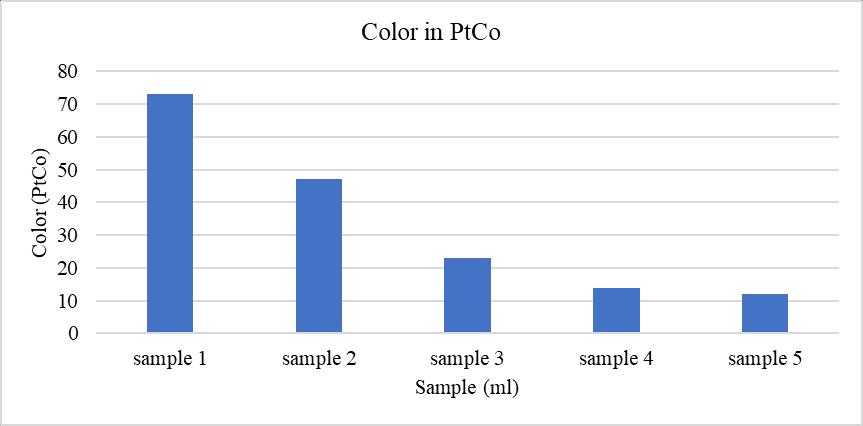
The color of analyzed groundwater samples is shown in belowfigure3.3.Thecolorofsample1,sample2,sample3 are73PtCo,47PtCo,and23PtCoaremorethanpermissible limitof15PtCoprescribedbyBISareaestheticallyunfitfor drinkingpurposeandcanbeutilizedforirrigation,washing, gardening etc., The color of sample 4 and sample 5 are 14PtCoand12PtCorespectivelyareaestheticallyaccepted fordrinkingpurpose.

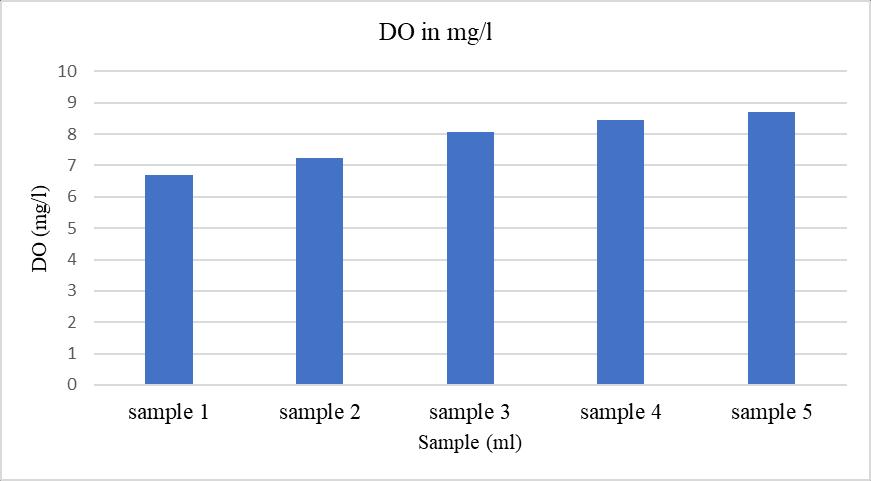
TheresultsofDOofanalyzedundergroundwatersamples are given in below fig 3.5. The DO of analyzed samples is withinthepermissiblelimit6-9mg/l,soallthewaterarefit forhumanconsumptionandposesnoimmediatehealthrisk tohumanhealth.TheDOof sample1,sample2,sample 3, sample4andsample5are6.71mg/l,7.24mg/l,8.06mg/l, 8.46mg/land8.7mg/lrespectively.
The chloride content of evaluated GW samples is representedinfig3.6.Thechloridecontentofallthesample is within the permissible limit of 250mg/l. Thus, makes waterfitfordrinkingpurposeaswellforirrigationpurpose. Thechloridecontentofsample1,sample2,sample3,sample 4 and sample 5 are 263.48mg/l, 240mg/l, 223.93mg/l, 151.95mg/land147.98mg/lrespectively

REFERENCES
[1] Nagarajappa. D. P, Nowsheen G S, P. ShivaKeshava Kumar,“StudyonQualityAnalysisofSewageWaterfor Southern Zone of Davanagere City”, International JournalofInnovativeResearchinScience,Engineering andTechnology,Volume9,Issue8,August2020.
[2] Megha H Koppad and Priyanka Kambali, “Effects of SewageFarmingonGroundWaterandSoil”,Journalof emergingtechnologiesandinnovativeresearch,Volume 10,Issue5,May2023.
[3] S Thirumala, “Groundwater Quality Analysis in Davangere City of Karnataka, India’s”, International JournalofInnovativeResearchinScience,Engineering andTechnology,Volume3,Issue5,May2014.
[4] Shivam Mani Tripathi and Dr.GovindPandey(2016), “Analysis of Performance Evaluation and Efficiency of Sewage Treatment Plant of Naini Plant Allahabad”, International Journal for Research in Applied Science andEfficiencyofSewageTreatmentPlantofNainiPlant Allahabad,vol.04,Issueno.04,pp.674-680.
[5] NagrajS.Patil,H.Vijaya KumarandNanjundiPrabhu, “AnalysisofWaterQualityParametersofGroundwater Near Ranebennur Industrial Area, Haveri District, Karnataka, India”, 2nd International Conference on Emerging Research in Civil, Aeronautical and MechanicalEngineering,AIPConf.Proc.2204,0200251–020025-8;https://doi.org/10.1063/1.5141562.
[6] S.SyedEnayathali,“StudyofTreatedEffluentinSewage Treatment Plant in Tiruchirappalli”, International JournalofEngineeringResearch&Technology,Volume 10,Issue10,October2021.
4. CONCLUSIONS
The analysis of treated effluent and groundwater in the studies area indicates that the majority of the parameters remained within the limits are employed for agricultural applicationandsuitablefortheirrigation.Theuseoftreated effluent for agricultural use and irrigation will help to conservefreshwaterresourceandrecyclewaterforfarming. As long-term use of treated effluent for irrigation, the location closer to the sewage treatment facility has more contaminatedgroundwaterthanthesitefartheraway.The groundwater'sEC,color,TDS,alkalinity,andhardnessareall over the allowable limit Regular water quality testing, monitoring adherence to regulatory requirements are crucial to guarantee the secure of ground water near the sewagetreatmentplantforagriculture.Assessingthesafety and viability of using groundwater so close to sewage treatment facility will be done with assistance of local authoritiesandwatermanagementspecialists.
[7] Ravish Kumar Chauhan (2014), “Physico-Chemical AnalysisofUntreatedSewageWaterofLadwatownof Kurukshetra District of Haryana and Need of Waste Water Treatment Plant”, International Journal of CurrentmicrobioogyandAppliedSciences,vol.03,Issue no.03,pp.326-333.