
Pharmaceutical Wastewater Treatability Studies by SAT with Conjunction with Natural Adsorbents
 Suraj R Naik1 , Dr. Nagarajappa D.P2, Mr. Sateesh G Muttagi3
1PG Student, Department of Civil Engineering, UBDT College of Engineering, Davanagere, Visvesveraya Technological University, Belagavi – 590018, Karnataka, India
2Professor, Department of Civil Engineering, UBDT College of Engineering, Davanagere, Visvesveraya Technological University, Belagavi – 590018, Karnataka, India
3Research scholar, Department of Civil Engineering, UBDT College of engineering, Davanagere, Visvesveraya Technological University, Belagavi – 590018, Karnataka, India ***
Abstract - Waterservesasanindispensableelementforthe preservation of life. However, mismanaging wastewater can pose substantial health hazards as it has the potential to transportandpropagateamultitudeofdiseases.Totacklethis challenge, techniques like Soil Aquifer Treatment (SAT) are employedtorechargegroundwaterwithcontaminatedwater. In this process, the unsaturated zone and aquifer act as natural filters, employing physical, chemical, and microbiological processes to alleviate the concentration of pollutants. SAT has gained prominence due to its costeffectiveness and sustainability. A recent research endeavor has shed light on the effectiveness of the SAT system in eliminatingspecificpollutants, includingChloride,Hexavalent Chromium, Copper, Nickel, and Zinc. This study focused on leveragingtheadsorptioncapabilitiesof BananaPeelpowder to enhance the removal process. Notably, the research underscoredthatBananaPeelsexhibitedagreateradsorption capacity for Zinc, thus highlighting their potential as a proficientadsorbent.Furthermore,theinvestigationunveiled disparitiesintheefficiencyof removingvariousheavymetals, with Zinc displaying the highest rate of removal when compared to Copper, Nickel, and Hexavalent Chromium.
Key Words: Soil Aquifer Treatment, Banana Peels, Soil, Adsorbent,Zinc.
1. INTRODUCTION
Water stands as a crucial liquid essential for humanity's survival.Whiledomesticwaterholdsimpurities,industrial wastewater contains a combination of impurities and pollutants.Thesecontaminantshavethepotentialtotrigger various illnesses and render water unsuitable for consumption. With the nation's progress, rapid industrialization amplifies water usage, resulting in an escalated demand. Unfortunately, industries frequently release untreated wastewater into natural water sources, groundwaterreservoirs,andfreshwaterbasins,leadingto widespreadpollution.
Toaddressthisconcern,SoilAquiferTreatment(SAT)has emergedasaviablestrategy,showcasingitseffectivenessin
eliminating heavy metals from wastewater. This method involves replenishing groundwater with contaminated water.Throughoutthisprocess,theunsaturatedzoneand aquiferserveasnaturalfilters,employingphysical,chemical, andmicrobialmechanismstodecreasetheconcentrationof pollutants.SAT'sattractivenessliesinitscost-efficiencyand sustainability.
However,it'simportanttorecognizelimitations,suchasthe potential for clogging to occur following wastewater treatment. This project revolves around the study of soil columns, soil attributes, and adsorbents. The emphasis is placedonsecondaryeffluent,withthegoalofelucidatingsoil behaviorandachievingoptimalremovalefficiency.Therole ofsoiltextureispivotal,asdistincttexturesexhibitvarying removal capacities. Adsorbents play a role in enhancing removalefficiency.
2. MATERIALS AND METHODOLOGY
2.1 Collection of Soil Samples
Soilsampleswerecollectedfromthetwodifferentlocation thatisinandaroundBangalore.SiltSoilwerecollectedfrom an open ground in Yelhanka and the Clayey Soil was collected from the lake in Hebbal. These two Soil samples weretestedandthenintroducedinthecolumns.
2.2 Preparation of Adsorbent
Bananapeelsweretheadsorbentthatiscollectedfromthe hotels, local market, tea shops, fruit shops. These banana peelswerewashedwithdistilledwaterandthensundried. After complete drying of the peels, it was grinded and powderedandthensieved.Thesesievedpowderswereused intheexperimentation.
2.3 Experimental Setup
The experimental setup involves a PVC column with dimensionsof1.5metersinlengthandadiameterof6inches. At the base of the column, a fine mesh with a pore size of 60µmispositioned.Thebottomofthecolumnisdesignedin
afunnelshapetofacilitatethecollectionoftreatedwater.The flowofwastewaterintothecolumnisregulatedusingaflow regulator.Tomaintainconsistency,apondingdepthof35cm is maintained, and any excess water is guided out of the columnthroughanoverflowsystem.Thecolumn,including themesh,isthoroughlycleanedaftereachtrial.
2.4 Collection of Wastewater
Theprimarygoalofthisstudyistoassesstheefficiencyofthe (SAT) system in treating wastewater from the PharmaceuticalIndustry.Thesourceofthiswastewateristhe IndustrialArealocatedinPeenya,Bangalore.
3 RESULTS AND DISCUSSIONS
Theexperimentswereconductedwiththeaimofevaluating the efficiency of Soil Aquifer Treatment (SAT) in the treatment of industrial wastewater. The investigation encompassed both scenarios: with and without the incorporationofanadsorbent.
The industrial wastewater used in the study was obtained from a specific industrial source. Two distinct soil types, namely clayey soil and silty soil, were utilized in the experiments. Additionally, an adsorbent, represented by bananapeelpowder,wasintroducedintotheexperimental setup.
The results obtained from the experimentation and the deductionsderivedfromtheseoutcomeswillbethoroughly discussedhere.
Asperexperimentationconducted,thesoiltexturefoundout to be sandy clayloam soil. It has some goodabsorptionof metals andsmall amount ofremoval efficiency.In thissoil maximumabsorptionofheavymetalisHexavalentchromium ofabout61%.LeastabsorbedisZincandChlorideofabout 51%and28%respectivelyandtabulatedinTable.2.
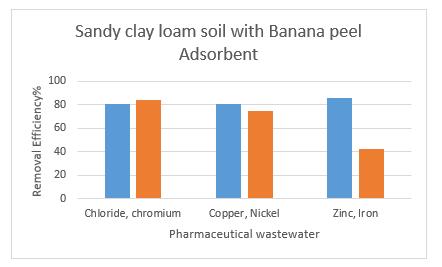
IntheTable3.,wehaveseenforonlysoilused,butin this case,wehaveusedbananapeelpowderasanadsorbent.pH canbeobservedneutral,conductivityandTotal Dissolved Solids in the water is reduced as it a good sign. In here, maximum removal efficiency is observed to be Zinc with about86%andminimumremovalisseentobeIronof42%. HencewithBananapeelsasanadsorbent,zincremovalwas observedfromwastewater.Removalefficiencyincreasedue toBananaPeelsisobserved.
InTable4,Clayeysoilshowedveryleastinremovingheavy metals,asrepresentintheTable4,ariseinChloride.Highest removalissaidtobeZincof51%.Reducedtoalesserextent aretheotherheavymetals.
As we discussed, clayey soil showed very less amount of removalefficiencybutduetopresenceofAdsorbentZincwas removedfromthewastewaterabout78%asshowninTable 5.
2:GraphicalRepresentationforEfficiencyofSAT
4. CONCLUSIONS
Experimentsinvolvingcolumnswereundertakentoevaluate efficiency, particularly concentrating on the performance related to both soil and the adsorbent and conclude as follows
The SAT system offers the possibility of treating wastewaterfromdiverseindustriesandthetreated watercouldbeutilizedforsecondarypurposes.
Theutilizationoftheadsorbentincombinationwith sandy clay loam soil demonstrates superior performancewhencomparedtoclayeysoil.
UsingSandyclayloamsoilwithBananaPeelsasan adsorbentshowedthemaximumremoval ofZinc about 86% and minimum removal of Nickel of about75%.

UsingClayeysoilwithBananaPeelsasanadsorbent showedmaximumremovalofZincabout78%.Due tothepresenceoftheAdsorbent.
Theutilizationofclayeysoilisassociatedwiththe observationofaquiferclogging.
PresenceofAdsorbentwillincreasetheEfficiencyof SAT.
REFERENCES
[1] AbeerAlBsoul,(2014).“Theuseofeucalyptusleavesas adsorbent for copper ion removal, Desalination and WaterTreatment”.vol.52,pp.7838 7844.
[2] Atif Khan, Hassan Jived Naqvi, Shabana Afzal, (2017). “Efficiency Enhancement of Banana Peel for Waste Water Treatment through Chemical Adsorption” Pakistan Academy of Sciences. Physical and ComputationalSciences54(3):329–335.
[3] Babel S, Kurniawan T A, (October 2003). “Various treatmenttechnologiestoremovearsenicandmercury from contaminated groundwater: an overview, In: Proceedings of the First International Symposium on SoutheastAsianWaterEnvironment,Bangkok,Thailand, October:pp433-440.
[4] BesançonM,PidouP,JeffreyB,JeffersonandLeCorreK. S(2017),Impactofpre-treatmenttechnologiesonsoil aquifer treatment. Journal of Water Reuse and Desalination,7.1.
[5] DavidM.Quanrud,RobertG.Arnold,GrayWilsonL.And MarthaH.Conklin(1996).“Effectofsoiltypeonwater quality improvement during soil aquifer treatment.” watersci.tech.,page419
431.
[6] Renu,MadhuAgarwal,K.Singh,(2017).“Heavymetal removalfromwastewaterusingvariousadsorbents:a review”.
[7] HemaKrishnaR,SwamyAVVS(2012),“Studiesonthe RemovalofNifromAqueousSolutionusingPowderof Mosambi Fruit peelings as a Low-Cost Sorbent”, ChemicalSciencesJournal,CSJ-31,pp.1-13.
[8] Kavitha R.V., Krishna Murthy, Roshan Makam, (March 2012).“Physico-chemicalanalysisoftheeffluentsfrom pharmaceutical industry and its efficiency study”: International Journal of Engineering Research and Applications (IJERA) ISSN: 2248-9622 Vol. 2, Issue 2, pp.103-110.
[9] MetcalfE,AsanoT,BurtonF,LeverenzH,TsuchihashiR, and Tchobanoglous G. Water Reuse: Issues,
Technologies,andApplications,Mc-GrawHill.NewYork, USA.2007.
[10] Pranav D Pathak, Sachin A. Mandavgane, Bhaskar D. Kulkarni,(July2015).“Fruitpeelwasteasanovellowcost bio adsorbent”. ArticleinReviews in Chemical Engineering.