Mechanical Properties of Concrete by Partial Replacement of Recycled (Coarse & Fine) Aggregate
Yogesh Gaur1 , Dr. Abhilash Shukla21Post Graduation Student, Department of Civil Engineering, MITS Gwalior, Madhya Pradesh, India
2 Assistant Professor, Department of Civil Engineering, MITS Gwalior, Madhya Pradesh, India ***

Abstract - Concrete is essential for any infrastructure development One of the genuineportions utilized in the concrete generation is aggregate, which is going to diminutive. To support development activities, it is basic to discover options in contrast to the natural aggregate. On the contrary side, the rate of worthlesswaste is increasing step by step, while the issue of dumping is also extending due to the lack of landfill site availability.Thisprojectaims to find recycled aggregate as a sustainable alternate of (coarse and fine) aggregate in concrete mix of M-40 grade. Thiswillprovideasaferfuturefortheupcominggenerations, asdemolitionwasteisinhugequantityandneedstobereused orrecycled.Todothis,theprojectattemptstomixadesignof M40 concrete replacing (coarse and fine) aggregate with constructiondemolishedmaterial.Replacing25-75%ofcoarse and fine aggregate by recycled concrete waste, testing its propertiestherewasnosignificantchangesinthestrengthof concrete. also, this method will be cheaper and not compromisingwiththedesigncompressivestrength.
Key Words: recycled(coarse&fine)aggregate,recycled aggregates replacement ratio, mix design method, mechanicalproperties.
1. Introduction
AccordingtotheresearchbyB.M.VinayKumar,H.Ananthan, andK.V.A.Balaji(2017),recycledmaterialslikeCRCAand FRCA from concrete waste may be utilised as a 20% substitute for HPC mixes. The findings indicate that the strengthsofHPCmixescontaining20%CRCA,20%FRCA, and20%arerespectively0.98,1.18,and1.02timesgreater thanthoseofHPCCM.Strengthgainiscompensatedforby both CRCA and FRCA content. A 20% FRCA content SCC blendproducessuperioroutcomes.Undersulphateattack, HPCmixwith20%CRCAandFRCAperformsOK,butwhen exposed to H2SO4 solution, considerable strength loss is seen [1]. The usage of fibres like SF, PPF, BF, and GF in improvingtheworkabilityandstrengthofFRACisdiscussed inthisreviewpaperbyWisalAhmedandC.W.Lim(2020). Thearticle'sconclusionisthatrecyclingC&DwasteasRCAis an environmentally benign and sustainable practice that supportstheconstructionindustry'sadoptionofthecircular economy paradigm. In weaker RAC, fibre reinforcing enhancesfractureenergy,ductility,crackpattern,andother strengthqualities.ThemostbasicmaterialisSF,whichgains compressivestrengthwithvolumefractionsupto0.7%and
flexuralstrengthandsplittingtensilecapacitywith1.5%.In cementitious composites supplemented with this type of fibre, PPF, a well-known polymeric fibre, increases mechanicalperformanceandpreventsshrinkagefractures.A green,non-pollutingfibrecalledBFefficientlyfillsinweak RACfracturestoincreaseitscompressivestrength,flexural loadingstrength,andbreakingtensilecapacity.Compressive strength in RAC is enhanced by GF, which has a volume composition of 0.04%. But the inclusion of fibres in RAC mightresultinanetworkstructure,whichmakesconcrete lessworkable [2].AccordingtoPreetiSaini(2015),research on recycled concrete aggregates in second-generation concrete needs an easy and affordable technique. The quantityandcaliberofadheringmortarareessentialfactors for determining ultimate strength. For the preparation of high-strengthconcrete,atechniquetakingthesefactorsinto account is crucial. If there is over 65% attached mortar present, the influence on concrete qualities has not been assessed, however a 25–30% recycled aggregate may not haveamajorimpactonconcretecharacteristics.Calculating %replacement basedonpercentageadhering mortarand understandingthetoleranceofadherentmortarpercentages onrecycledconcreteaggregatesareessential [3].Thereis potential to enhance the intrinsic qualities of building materialsmadefromsolidwastematerialssuchasplastic, wood,metal,paper,glass,andcrushedconcrete,accordingto researcherOriyomiM.,Okeyinka (2015),Itstatesthatthe actual use of these materials is constrained. To further understand their behavior and performance in the formulation of concrete's standard mix design, more research is required. Research should concentrate on enhancingrecycledwastematerials'acceptabilitytopublic andinternationalstandardsinordertoincreasetheirusein building.Thegoalofthisresearchistocreatealightweight, cement-free, ecologically friendly building block from recycledwastepaperthathastherightqualitiesfornon-load bearing walling units. The findings will be verified by laboratorytesting,energy-efficientmachinery,andcomputer modelling. If this experiment is successful, it may help to reduce environmental pollution, save important landfill space, conserve energy and natural resources, use less Portland cement, and lower construction costs [4]
AccordingtoL.EvangelistaandJ.deBrito(2013),theuseof FRA in the manufacturing of concrete is now viewed as inappropriate by several scientific societies. But if done properly,itisfeasibletoproducehigh-performanceconcrete using FRA that behaves much like high-performance
concrete.TheutilizationofFRAisaknownfactthatrequires additional research. Before it can be employed at an industrial scale without limitations, though, several challenges must be addressed. These include establishing constitutive relations, stress-strain connections, and mechanical characteristics as well as creating a standard techniqueforcalculatingtheprocessesofwaterabsorption andmixing [5] Thecharacterizationandstructuralusesof fRCAarereviewedinthisarticlebyMarijaNedeljkovicand JeanetteVisser(2021),withanemphasisonthephysicaland chemical features, composition, and qualities of 43 concrete/mortarmixtures.Theinitialdesignandhistoryof theconcrete,therecyclingprocess,andstorageallaffectthe physico-chemicalpropertiesofFRCA.Thesevariablesaffect howwellconcretemixandcuredconcreteperform.There arecurrentlynorecommendationsforthebestusageoffRCA in new concrete and insufficient understanding about it. Uncertainhazardsonpredictedconcreteperformanceand increasingcementcontentstocompensateforwaterneeds hinderthelarge-scaledeploymentandbestuseoffRCA.Itis difficulttoemployfRCAandlowercementcontentsincethe reuseoffRCAisnowexperimentallyoptimized.Itisvitalto havepracticalknowledgeofappropriatesuperplasticizers and rheology modifiers for concrete containing fRCA. AdvancedqualitycontroloffRCAduringandafterseparation calls for quantitative and qualitative characterization methodologies and recommendations. Priority areas for research should include the relationship between fRCA treatments and physical and chemical properties, ideal cementpackingandinteraction,andthemicrostructureand expectedlong-termbehaviorofnewconcrete [6]
2. Literature Review
RecycledAdmixtures:StrengthandDurabilityPropertiesby P. Saravanakumar (2013). To evaluate the strength and durabilityofaggregateconcrete,fourseriesofmixeswere created, replacing Natural Aggregate (NA) with Recycled Aggregate (RA) 0
25
50
100% of the time. Chemical and mineraladmixtureswereutilizedaspartialreplacementsfor cementineachseriesatquantitiesrangingfrom40to60% ofthecement'sweight.WhenNAisreplacedwithRAfrom 25to100%attheageof28days,therateofcompression strengthlossvariesfrom20to37%.Similarly,whenNAis replacedwithRAfrom25to100%attheageof28days,the rateofdeclineintensilestrengthvariesfrom12to32% [7]. JeonghyunKim(2021)developedthepropertiesofrecycled aggregate concrete using an equal mortar volume mix design. Conclusion: By enhancing the mechanical and durabilityfeaturesofRACandusinglessrawmaterialsthan traditionalmixdesign,theuseoftheEMVmixdesignlooks toprovideapotentialcontributiontosustainablegrowthin the building sector. Self-compacting concrete, steel fibre concrete,andreinforcedconcretebeamsarenowincludedin theapplicationoftheEMVmixdesignapproach [8]. Mayara Amario,CarolineSantanaRangel,MarcoPepe,andRomildo Dias Toledo Filho (2017) optimized regular and high
strengthrecycledaggregateconcretecompositionsusingthe packingmodel.Likewithregularconcrete,theshapeofthe aggregate,thedistributionofthegrainsizes,andtheamount offreewaterpresentinthemixtureallplayamajorrolein theRAC'sworkability.Thiscanbeascribedtothefactthat RCAhavearoundershapethannaturalaggregateduetothe crushingmethodusedtoproducethem,aswellasthefact that RCA have fewer fine particles than natural aggregate [9]. Bo Wang, Libo Yan, Qiuni Fu, and Bohumil Kasal's comprehensivereview of recycledaggregate and recycled aggregateconcretewaspublishedin(2021).Inthispaper, recycled aggregate (RA) and recycled aggregate concrete (RAC) are thoroughly reviewed in terms of their history, processesforrecycling,reusing,andmanufacturing,inherent flaws (such as the presence of extra interfacial transition zonesinRAC),andphysicalcharacteristicsofthematerials. Mechanical characteristics, such as elastic modulus, compressive,flexural,andsplittingtensilestrength,aswell aslong-termperformance(suchascreepanddryshrinkage resistance, alkali-silica reaction resistance, and freezingthawing resistance), areimportant [10]. SalomonM. Levy andPauloHelene's(2004)durableconcretewithrecycled aggregatesisasafepathtosustainabledevelopment.20% recycledaggregatefromoldconcreteormasonryisusedin placeofnaturalaggregatewhenreplacingnaturalaggregate. When compared to the reference concrete manufactured withnaturalaggregatesintermsofthequalitiesexaminedin this inquiry, the resultant recycled concrete will probably behavesimilarly,andinsomecasesevenbetter.Thisfeature motivatestheattemptstoemploytheseconcretes,whichcan helptosavetheenvironmentandcanaccomplishthesame end performance with perhaps lower costs than conventional concretes [11]. Dan Meng, Xuemin Wu, Hongzhu Quan, and Chongji Zhu (2021) developed a strength-basedmixdesignapproachforrecycledaggregate concrete, which resulted in improved durability performance. For the regression study of associations between various factors, a total of 30 mixes with cement contentsrangingfrom300kg/m3to500kg/m3andvarying percentages of recycled coarse aggregate were created. Results reveal that the freeze-thaw resistance, drying shrinkage, chloride penetration, and carbonization of recycled coarse aggregate concrete matching to this approachareall negativelyimpacted byaddingmoreofit [12].Fresh-stateR.V.Silva,J.deBrito,andR.K.Dhir's(2018) performance of recycled aggregate concrete. Analyses are also conducted on the impact of mineral additions and water-reducingadmixturesontheinitialcharacteristicsof recycledaggregateconcrete.Thestability(i.e.,bleedingand segregation), temperature of hydration, air content, and freshdensityofrecycledaggregateconcreteinitsfreshform arealsocovered.Ausualconclusionofusing100%coarse RCA is an average density loss of 5%, which would be advantageous from the standpoint of reducing one's own weight [13]. Properties of concrete by Bassam A. Tayeh, MohammedW.Hasaniyah,A.M.Zeyad,andMorufOlalekan Yusuf (2019) using recycled seashells as cement partial
replacement.Thestudydemonstratesthataddingseashell ashtoconcretedecreaseditsinitialcompressivestrength. Concretecreatedwiththeadditionofseashellashstillhas adequatestrengthsforavarietyofstructuralandplastering purposes,evenifthecompressivestrengthismostlyreduced byutilizingseashellsasacementreplacement [14].Concrete made using recycled aggregate is durable, according to a (2013) study by C. Thomas, J. Setien, J.A. Polanco, and M. Sanchez de Juan. Despite a decrease in the effective water/cementratio,recycledaggregateconcretesprepared with unsaturated recycled aggregate had lower densities thanthecontrolconcrete.Additionally,thehigherporosity of these aggregates is isolated by this action. With the additionofrecycledaggregate,thedensityofconcretewith thesameeffectivewater/cementratiodrops.Densityvalues are around 5% lower with the inclusion of 20% recycled aggregatethanwiththecontrolconcrete [15].GuoliangBai, Chao Zhu, Chao Liu, and Biao Liu (2020) evaluated the recycled aggregate characteristics and the mechanical parametersofrecycledaggregateconcrete.Inthisreview, thequantitativecorrelationsbetweenRAperformanceatthe materiallevelandtheamountofoldconnectedmortarwere depicted.Byusingseveralstraightforwardandinexpensive methods,suchasalteringthewater-cementratio,aggregate watercontent,mixingtechnique,andadditive,theconcretes may be enhanced to a certain extent. To meet the quality standardsofengineeringpairsofconcrete,RACperformance canbemodified [16].
2.1 Recycled (Coarse & Fine) Aggregate
Ferronickelslagisusedasfineaggregateinrecycledaggregate concrete,andJiuwenBao,ZihaoYu,JinWang,PengZhang,and XiaomeiWan(2021)havestudiedtheimpactsontransport characteristics. The fine and coarse aggregates in concrete maybemadefromferronickelslag(FNS),anindustrial byproduct,andrecycledconcreteaggregates(RCAs),whichare madefromdemolitionandbuildingdebris.Investigatingthe compressive strength and transport behaviour of RAC containingFNSasfineaggregateisthegoalofthiswork.The resultsofanexperimentalexaminationintothetransportand compressive characteristics of FNS-RAC specimens were presented.Theseconclusionscanbederivedfromthefindings and debates given here. FNS, an industrial by-product, is anticipated to become a popular and sustainable building material [17]. Sumaiya Binte Huda and M. Shahria Alam (2014) examined the mechanical behaviour of three generationsofconcreteusingjustrecycledcoarsematerial. Constructionanddemolition(C&D)debrisfromdemolished concretehasenormouspotentialforuseascoarseaggregate in concrete. This study examines the fresh and hardened qualities of this form of green concrete and repeatedly explorestheusageofrecycledcoarseaggregateinconcrete. First,second,andthirdgenerationsofrepeatedlyrecycled concrete were created. RCA1, RCA2, and RCA3 had bulk densitiesthatwererespectively13.9%,22.9%,and26.3% lower than normal. The number of repeats resulted in a
reductioninthebulkdensityandspecificgravityofvarious generations of concrete. At 56 days, all the considered concrete,apartfromtheRC3,reachedthedesiredstrength (32MPa) [18].AlaaM.Rashad(2016)providesathorough analysisofrubberrecyclingasareplacementforfine-four aggregate in conventional cementitious materials. RCA1, RCA2,andRCA3hadbulkdensitiesthatwere13.9%,22.9%, and26.3%lessthannormal,respectively.Withincreasing repetitions,thebulkdensityandspecificgravityofseveral generations of concrete dropped. Apart from the RC3, all evaluatedconcretereachedthedesiredstrength(32MPa)at theageof56days [19]. ByGombosurenChinzorigt,Myung KwanLim,andMyoungyoulYu(2020),strength,shrinkage, creep,anddurabilityfeaturesofconcreteusingCO2treated recycled fine aggregate. Durability, strength development, shrinkage, and creep behaviour of recycled aggregate concretewerestudied.Investigationswerealsoconducted onelementslikecarbonationandchlorideionpenetration. RecyclingfineaggregatewithCO2treatmentincreasedthe strength of recycled aggregate concrete by up to 15%, although shrinkage showed minimal improvement. In standard strength recycled aggregate concrete, the use of both recovered coarse aggregate (RCA) and recycled fine aggregate(RFA)wasinvestigated.Recycledfineaggregate absorbs less water while having a higher density. When comparedtosimilarRCA,thecarbonationresistanceofRAC withCRFAisfurtherdecreased [20].
3. Methodology
It is possible to develop the methodology for upcoming research projects by analyzing the literature review. The experimentalworktobeundertakencomprisesaproposed techniquethathasoutlinedinthissection.Everycomponent used to create required concrete mixes, including fine aggregate(riversand),coarseaggregates,cement,etc.,will beputthroughtestinginaccordancewithIndianStandards. Forstandardsandtestingaggregatesforvariousphysical& mechanicalpropertiestodeterminetheireligibilityascoarse aggregate,IS383:2016andIS2386:1963shallbeused.For specifying and testing cement for various qualities to determineapplicabilityascement,theIS4031:1996andIS 269:2015standardswillbeused.Forconcretemixdesign,IS 456: 2000 and IS 10262: 2019 will be used as references. The waste materials such as recycle (coarse and fine) aggregate waste will be collected from institute waste materiallikeconcretesamplesetc.Thereceivedrawwaste will get break down into pieces by manual hammering action.Then theprocessed recyclecoarsematerial having the appearance of coarse aggregates will be subjected to sievingthrough20mmand4.75mmISsieves.Andrecycled fineaggregateswillbesubjectedtosievingthrough4.75mm IS sieves. Now, this converted waste will be called as recycled coarse aggregates (RCA) and recycled fine aggregates (RFA). The experimental work will be done in three steps. First NAC will get partially replaced by RCA 25%,50%,75%.Second,NFAwillgetpartiallyreplacedby
RFA 25%, 50%. 75%. Third, NCA & NFA will get partially replacedbybothRCA&RFAupto20%and30%.Themix designofM40gradeconcreteistakenasreferenceconcrete. Thecalculationofvariousingredientstobeusedinconcrete mixes will be kept constant for all mixes except coarse aggregates. The substitution of coarse aggregates will be done by volume. The total of 9 concrete mixes must be preparedforthiswork.Therewillbe162specimenstocast, cureandtestat7&28daysforvariousstrengthproperties suchasworkability,concretedensity,compressivestrength, splittingtensilestrength,andflexuralstrength.Outof180 specimens,60cubesof100mmX100mmX100mmsize,60 cylinders of 100 mm diameter & 200 mm height, and 60 beamsof100mmX100mmX500mmsizewillbeusedto find hardened properties such compressive strength, splittingtensilestrength,andflexuralstrengthat7&28days tochecktheeffectonpartialsubstitutionofNCA&NFAwith RCA&RFA.Allthecompositionofvariousconcretemixes aregivenbelowintableno.1 Table
4. The testing of the recycled aggregate proportion on the mechanical properties of concrete

4.1 The compressive strength
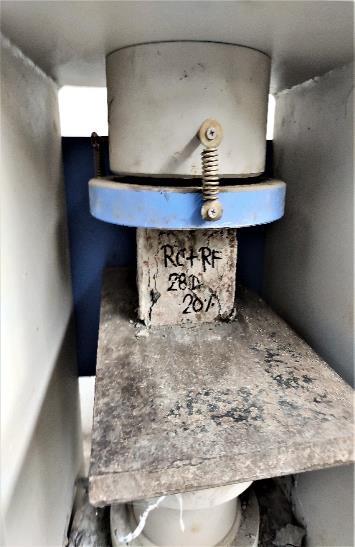
According to the guidelines provided in IS 516: 1959, the compressive strength was calculated. Concrete cubic specimens of 100 mm in height were used to measure compressivestrengthaftercuringfor7,28,and90days.The specimensweretakenoutofthecuringtankandevaluated right away using a compression testing equipment while they were still wet on the surface. Before the specimen failed,theloadingwasappliedwithoutshockandincreased graduallyatarateof140Kg/cm2/minute.Tocalculatethe compressive strength, the failure load was measured and dividedbythecross-sectionalarea.Compressivestrengthis determinedbytakingtheaverageofthreevaluesthroughout allcuringages.
Notation
Compressive Strength Test of Cube
4.2 The Split Tensile Strength
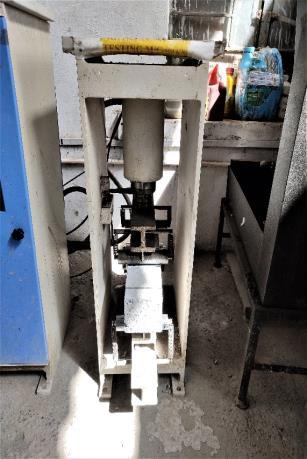
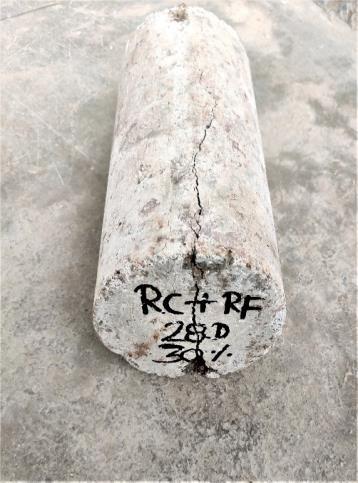
Concretespecimenswithcylindricalshapes(diameter=100 mm,height=200mm)wereusedtotestthesplittingtensile strength in accordance with the guidelines provided in IS 5816:1999.Withaspeedrangingfrom1.2N/mm2/minto 2.4N/mm2/min,thecylinderswereexaminedat7and28 daysaftercuring.Afailureloadwasrecordedwhentheload wasgraduallyintroducedwithoutshock.Attheageofcure, theaverageofthreevalueshasbeenusedasaresult.
The splitting tensile strength was calculated using below expressionf

4.3 The Flexural Strength
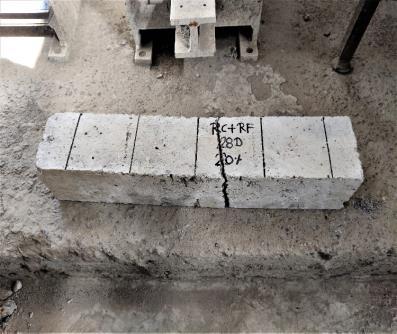
Todeterminetheflexuralstrengthageof7and28daysin accordancewithIS516:1959,beamswithacrosssectionof 100mmX100mmand500mminlengthwereemployed. Withnoshockapplied,aloadof100KNwasappliedusinga flexuraltestingequipment,whichsteadilyincreasedatarate of180Kg/min.Recordedwasthefailureload. Theflexural strength of the specimen (fb) was determined using the followingexpressions:
a) If the distance between the fracture line and nearer support ‘a’ measured on the tension face (in cm) is more than13.3cm.Then

fb =
b)Ifa<13.3cmbuta>11.0cm.Then
fb =
5. Conclusion

Thefollowingconclusionsaretakenfromtheexperimental study'sfindings:
Thenumberofrecyclingfacilitiesthatgeneratehigh-quality recycledaggregatesforconcreteandthenumberoffacilities that have earned quality certifications for recycled aggregates for concrete are both increasing. Rising all the time.Consequently,thequalityofrecycledaggregatesisno longer a significant barrier to broad adoption. However, unfavourable public opinions brought on by the usage of unlawful dumping and insufficiently treated recycled aggregate of building trash still exist as an issue. Furthermore, the absence of specific recycled aggregate specifications Products are a common barrier cited by construction workers. practitioners and is one of the obstaclestorecyclingrecycledaggregates.Thisexperimental investigation led to the general conclusion that recycled elements, such as RCA and RFA recovered from concrete waste,maybeusedat20%and30%replacementlevelsfor creatingHighPerformanceConcretemixes.Theappropriate range of workability seems to be, concerns for concrete wasterecyclingarestrengthandavailability.
6. Outcome
Casting of multiple concrete samples and testing their properties. Decreasing cost of construction by utilizing recycled waste. Reusing the waste and hence getting an optiontoachievesustainability.

References
[1]. Vinay Kumar, B. M., Ananthan, H., & Balaji, K. V. A. (2018). Experimental studies on utilization of recycled coarse and fine aggregates in high performance concrete mixes. Alexandria Engineering Journal, 57(3), 1749–1759. https://doi.org/10.1016/j.aej.2017.05.003
[2]. Ahmed, W., & Lim, C. W. (2021). Production of sustainable and structural fiber reinforced recycled aggregate concrete with improved fracture properties: A review.In JournalofCleanerProduction (Vol.279).Elsevier Ltd.https://doi.org/10.1016/j.jclepro.2020.123832
[3].Saini,P.,&Ashish,D.K.(2015).AReviewonRecycled ConcreteAggregates.In SSRG International Journal of Civil Engineering(SSRG-IJCE www.internationaljournalssrg.org
[4]. A_Review_on_Recycled_Use_of_Solid_Wastes.(n.d.).
[5].Evangelista,L.,&deBrito,J.(2014).Concretewithfine recycled aggregates: A review. In European Journal of Environmental and Civil Engineering (Vol. 18, Issue 2, pp. 129–172).https://doi.org/10.1080/19648189.2013.851038
[6]. Nedeljković, M., Visser, J., Šavija, B., Valcke, S., & Schlangen, E. (2021). Use of fine recycled concrete aggregates in concrete: A critical review. In Journal of Building Engineering (Vol. 38). Elsevier Ltd. https://doi.org/10.1016/j.jobe.2021.102196
[7].Saravanakumar,P.,&Dinakaran,G.(2013).Strengthand Durability Characteristics of Recycled Aggregate Concrete withAdmixtures.JournalofMaterialsinCivilEngineering, 25(8),1127–1133.https://doi.org/10.1061/(asce)mt.19435533.0000645.
[8].Kim,J.(2021).Propertiesofrecycledaggregateconcrete designed with equivalent mortar volume mix design. In ConstructionandBuildingMaterials (Vol.301).ElsevierLtd. https://doi.org/10.1016/j.conbuildmat.2021.124091
[9].Amario,M.,Rangel,C.S.,Pepe,M.,&ToledoFilho,R.D. (2017).Optimizationofnormalandhighstrengthrecycled aggregateconcretemixturesbyusingpackingmodel. Cement and Concrete Composites, 84, 83–92. https://doi.org/10.1016/j.cemconcomp.2017.08.016
[10]. Wang, B., Yan, L., Fu, Q., & Kasal, B. (2021). A ComprehensiveReviewonRecycledAggregateandRecycled AggregateConcrete.In Resources,ConservationandRecycling (Vol. 171). Elsevier B.V. https://doi.org/10.1016/j.resconrec.2021.105565
[11].Levy,S.M.,&Helene,P.(2004).Durabilityofrecycled aggregatesconcrete:Asafewaytosustainabledevelopment. Cement and Concrete Research, 34(11), 1975–1980. https://doi.org/10.1016/j.cemconres.2004.02.009
[12].Meng,D.,Wu,X.,Quan,H.,&Zhu,C.(2021).Astrengthbased mix design method for recycled aggregate concrete and consequent durability performance. Construction and Building Materials, 281. https://doi.org/10.1016/j.conbuildmat.2021.122616
[13].Silva,R.v.,deBrito,J.,&Dhir,R.K.(2018).Fresh-state performance of recycled aggregate concrete: A review. In Construction and Building Materials (Vol. 178, pp. 19–31). Elsevier Ltd. https://doi.org/10.1016/j.conbuildmat.2018.05.149
[14].Tayeh,B.A.,Hasaniyah,M.W.,Zeyad,A.M.,&Yusuf,M. O. (2019). Properties of concrete containing recycled seashellsascementpartialreplacement:Areview.In Journal of Cleaner Production (Vol. 237). Elsevier Ltd. https://doi.org/10.1016/j.jclepro.2019.117723
[15]. Thomas, C., Setién, J., Polanco, J. A., Alaejos, P., & SánchezDeJuan,M.(2013).Durabilityofrecycledaggregate concrete. Construction and Building Materials, 40, 1054–1065.https://doi.org/10.1016/j.conbuildmat.2012.11.106
[16].Bai,G.,Zhu,C.,Liu,C.,&Liu,B.(2020).Anevaluationof the recycled aggregate characteristics and the recycled
aggregateconcrete mechanical properties.In Construction and Building Materials (Vol. 240). Elsevier Ltd. https://doi.org/10.1016/j.conbuildmat.2019.117978
[17]. Bao, J., Yu, Z., Wang, L., Zhang, P., Wan, X., Gao, S., & Zhao, T. (2021). Application of ferronickel slag as fine aggregateinrecycledaggregateconcreteandtheeffectson transport properties. Journal of Cleaner Production, 304 https://doi.org/10.1016/j.jclepro.2021.127149
[18]. Huda,S.B.,&Alam,M.S.(2014).Mechanicalbehavior of three generations of 100% repeated recycled coarse aggregateconcrete. ConstructionandBuildingMaterials, 65, 574–582.
https://doi.org/10.1016/j.conbuildmat.2014.05.010
[19]. Rashad,A.M.(2016).Acomprehensiveoverviewabout recyclingrubberasfineaggregatereplacementintraditional cementitious materials. In International Journal of Sustainable Built Environment (Vol. 5, Issue 1, pp. 46–82). ElsevierB.V.https://doi.org/10.1016/j.ijsbe.2015.11.003
[20]. Chinzorigt,G.,Lim,M.K.,Yu,M.,Lee,H.,Enkbold,O.,& Choi,D.(2020).Strength,shrinkageandcreepanddurability aspects of concrete including CO2 treated recycled fine aggregate. Cement and Concrete Research, 136. https://doi.org/10.1016/j.cemconres.2020.106062