Comparative Study of Biodegradable Plastic Film from Potato and CCR
Aashi Patidar Ganga Nainsi Bhargava1,2,3,4,5 Student, Department of Chemical Engineering, Indore Institute of Science & Technology, Indore
6 Assistant Professor, Department of Chemical Engineering, Indore Institute of Science and Technology, Indore

Abstract - There has been an increase in the use and application of plastic due to its lighter weight and mostly cost effectiveness as compared to other materialssuchasmetalsor ceramics. The indecomposable nature of the plastic leads to increase in environmental pollutiondayby day. Thepurposeof this study is to compare and investigate the possible contribution of bio-plastic film to sustainability and in developing a new plastic free environment, where plastics perform their useful function without causing negative externalities. In this study we are focusing on bio-plastic film obtained from potato and equal mixture of CCR (i.e. corn, coconut, rice) this bio-plastic film focus on sustainable and greener environment with the reduction of conventional plastic uses the starch used in research was extracted from potato and from CCR (i.e. corn, coconut, rice) and combined with gelatin as an additive to give strengthtobio-filmandalso the mechanical properties such as tensile aberrationhardness and biodegradability test were analyzed surface tension and elasticity were also estimated and studied. Use of Starch gives high modulus and quick biodegradability that makes it most suitable for disposable packaging application. As a result, the research discusses the various parameters to influence and improvise the adoption of biodegradable plastics, as well as a sustainable framework for improvingbio-degradable plastic’s long-term viability.
Key Words: Bioplastic; Bio-degradable; Sustainability; Environment;Plasticfilm
1.INTRODUCTION
Welcome to a comprehensive exploration of the world of biodegradable plastic films derived from two fascinating sources:potatoesandtheCCRblendofcorn,coconut,and rice. In this comparative study, we delve into the unique attributes, environmental impact, production processes, andpotentialapplicationsofthesebioplastics.
In recent years, the growing concern for environmental sustainability has prompted extensive research into alternative materials, particularly in the realm of plastic films.Theexplorationofthesebiodegradableplasticsoffers aglimpseintoinnovativesolutionsaimedatmitigatingthe ecologicalhazardsposedbyconventionalpetroleum-based plastics.
Potato-basedbioplasticshavegarneredsignificantattention duetotheirrenewabilityandpotentialforreducingwaste. Meanwhile, the amalgamation of corn, coconut, and rice materialspresentsauniqueavenueforcreatingcomposite biodegradable films, harnessing the distinct properties of each component. This study seeks to delve into the properties, degradation rates, mechanical strengths, and overall environmental impact of both potato and CCR biodegradableplasticfilms.
2.MATERIALS REQUIRED TO CONDUCT THE STUDY:
To conduct a comprehensive comparative study of biodegradable plastic films derived from potatoes and a blend of corn, coconut, and rice (CCR), the following materialswillberequired:
1.1 Raw Materials:
Potatoes(forpotato-basedbiodegradableplastic)
Cornstarch(forcorncomponentofCCRblend)
Coconutcoir(forcoconutcomponentofCCRblend)
Ricestarch(forricecomponentofCCRblend)
Table 1: SampleDataforRawMaterials
1.2 Chemicals and Additives:
Glycerol(plasticizer)-20ml/100gm
Aceticacidorcitricacid(tomodifystarchforbetter film-formingproperties)-10ml/100gm
Water(solventanddiluent)
Biodegradation-promoting enzymes (if testing degradationrates)
Colorants or dyes (optional, for visual differentiation)
1.3 Laboratory Equipment:
Weighingbalance
Blenderorgrinder
Mixingbowls
Stirringrods
Hotplateormicrowave(forheatingandblending)
Film-castingframeorMold
Ovenordryingchamber
1.4 Safety Gear:
Labcoatsorprotectiveclothing
Gloves
Safetygoggles
1.5 Notebooks and Documentation:
Research notebooks for recording procedures, observations,andresults
Datasheetsfordatacollectionandanalysis
2. METHOD REQUIRED TO CONDUCT THE STUDY:
Certainly, here is a simplified step-by-step method for conducting a comparative study of biodegradable plastic films from potatoes and a blend of corn, coconut, and rice (CCR):
2.1
Preparation of Raw Materials:
Washandpeelthepotatoes.Cutthemintosmallpieces andblendtoobtainasmoothpaste.
Collectcornstarch,coconutcoir,andricestarch.Grind or process each material separately to obtain fine powders.
2.2 Preparation of Plastic Film Solutions:
1 For Potato-Based Bioplastic:
a. Inamixingbowl,combinethepotatopastewithwater (adjustratiofordesiredconsistency).
b. Heatthemixtureonahotplateorinamicrowavewhile stirring until a homogeneous solution is obtained (T= 423Kapprox.).
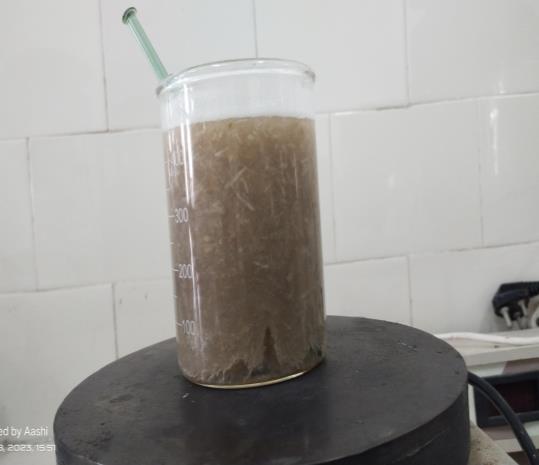
c. Addglycerolasaplasticizerandaceticacidorcitricacid tomodifystarchproperties.Mixthoroughly.
2 For CCR-Based Bioplastic:
a. Mixtheappropriateratiosofcornstarch,coconutcoir, andricestarchinabowl.
b. Graduallyaddwaterwhilestirringtocreateaslurry.
d. Heattheslurryandstiruntilitformsaconsistentpaste (T=423Kapprox.).
c. Addglycerolandaceticacidorcitricacid,andcontinue mixing.
3. Film Casting and Drying:
a. Placeafilm-castingframeormoldontoaflatsurface.
b. Pourthepotato-basedorCCR-basedplasticsolutioninto themold,spreadingitevenly.
c. Allowthefilmstoairdryorplacetheminanovenata controlledtemperatureuntilfullydried.
d. CarefullyremovethedriedfilmsfromtheMold.
4. DATA COLLECTION AND INTERPRETATION:
a. Recordobservations,measurements,andtestresultsin researchnotebooksanddatasheets.
b. Analyze and compare the properties, microstructure, mechanical strength, and thermal behavior of potatobasedandCCR-basedbioplastics.
5. Observation
5. RESULT AND DISCUSSION
The comparative study aimed to analyze the properties of biodegradableplasticfilmsproducedfrompotatoandcorn coconut rice (CCR) starch. Both materials were processed intofilmsusingacastingmethod.Theresultsindicatedthat thepotatostarchfilmexhibited bettertensilestrengthand elongation properties compared to the CCR starch film. However, the CCR starch film demonstrated higher water resistanceandlowerwatervaporpermeability,suggestingits potentialformoisture-sensitiveapplications.

Intermsofbiodegradability,bothfilmsdisplayedsignificant degradation over a 60-70 days period in simulated soil conditions. The CCR starch film exhibited slightly faster degradation,indicatingitspotential asanenvironmentally friendlyalternative.
Overall,thestudyhighlightedthesuitabilityofbothpotato and CCR starch for producing biodegradable plastic films, eachwithdistinctadvantages.Potatostarchofferedbetter mechanicalproperties,whileCCRstarchexhibitedenhanced waterresistanceandfasterbiodegradation.Furtherresearch could explore optimization techniques to enhance specific attributes for various applications in the sustainable packagingindustry.
6. Conclusion
Inconclusion,thecomparativestudybetweenbiodegradable plastic films derived from potato starch and CCR (Corn Coconut Rice) starch revealed several significant findings. Both materials demonstrated promising potential as environmentallyfriendlyalternativestotraditionalplastics
The potato starch-based film exhibited commendable mechanicalproperties,displayinggoodtensilestrengthand flexibility. It also exhibited a rapid degradation rate under naturalconditions,makingitasuitableoptionforshort-term applications.Ontheotherhand,theCCR starch-basedfilm demonstrated comparablemechanical strength, while also benefitingfromtheincorporationofcoconutricebyproducts, whichcancontributetowastereductionandsustainability.
Intermsofbiodegradability,bothfilmsexhibitedpromising results,breakingdownintonon-toxiccomponentsovertime. Thepotatostarchfilmshowcasedslightlyfasterdegradation, potentiallymakingitpreferableforapplicationswithminimal useduration.
However,it'sessential toconsiderthescalabilityandcosteffectivenessofproduction.Potatostarchavailabilitycould beinfluencedbyfooddemand,whileCCRstarchmayrequire further refinement processes. Moreover, factors such as water and energy consumption during production should alsobeconsideredforacomprehensiveassessment.
Inconclusion,bothpotatoandCCRcorncoconutricestarchbased biodegradable plastic films offer viable alternatives, each with its own set of advantages. Further researchand developmentarenecessarytooptimizeproductionprocesses, address scalability challenges, and explore diverse applications,ultimatelycontributingtoa moresustainable future
7. References
JohnMichael(2021).Bio-plasticmadefromstarchasa better alternative to commercially available plastic, "ScienceandEducation"ScientificJournal/ISSN21810842,2,4,257-77.
[2] Amanda B. Dias, Cermen M.O. Muller- Biodegradable filmsbasedonricestarchandriceflour
[3] comparative to the regular plastic, “Creative common attribution license”,1-3. Harvey Sinead (2022). Plastic pollution is one of the most pressing global environmental challenges., “IAEA office of Public informationandcommunication”,1-3.
[4] GautamR.,etal.,(2008).BiodegradationofAutomotive Waste Polyester Polyurethane Foam using PseudomonasChlororaphisATCC55729.International Biodeterioration&Biodegradation.
[5] Greene J. (2007). Biodegradation of Compostable PlasticsinGreenYard-WasteCompostEnvironment. J PolymEnviron.
[6] GurjarSuman,PandelBartik,JethooA.S.(2014).Effectof plasticize on mechanical and moisture absorption properties of eco-friendly Corn starch –based Bioplastic,Naturalenvironmentalandpollutiontechnology ISSN0972-6268,13,2,425-28.
[7] HelenOneyeaka,GoldenMakaka–Currentresearchand application of starch-based Biodegradable Films for FoodPackaging
[8] KyrikouJandBriassoulisD.(2007).Biodegradationof Agricultural Plastic Films: A Critical Review. J Polym Environ.
[9] MarichelvamM.K.,JawaidMohammad,AsimMohammad (2019). Corn and rice starch-based bio-plastics as alternativePackagingMaterial,“Fibre”7,32,1-13.
[10] Mohee R and Unmar G. (2007). Determining BiodegradabilityofPlasticMaterialsunderControlled and Natural Composting Environments. Waste Management.
[11] Momotaz Farahana, Sarkar Aniruddha, Hasan Naimul (2021). Development of biodegradable plastic from potato starch with enhanced physico-mechanical properties
[12] Praveen Soni- Comparison between corn and potato starch-basedbioplastic
[13] Siracusa V.,etal.,(2008).Biodegradable Polymersfor FoodPackaging:AReview.TrendsinFoodScienceand Technology.
[14] Bourtoom,T.andChinnan,M.S.2008.Preparationand propertiesofricestarch-chitosanblendbiodegradable film.LWT-FoodScienceandTechnology41:1633-1641.
[15] Gunaratne,A.andCorke,H.2007.Functionalproperties of hydroxypropylated cross linked, and hydroxypropylatedcrosslinkedtuberandrootstarches. CerealChemistry84:30-37.
[16] Kaur, L., Singh, J. and Singh, N. 2006. Effects of crosslinkingonsomepropertiesofpotatostarches.Journalof ScienceFoodAgricultural86:1945-1954
[17] Kaur, L., Singh, J. and Singh, N. 2006. Effects of crosslinkingonsomepropertiesofpotatostarches.Journalof ScienceFoodAgricultural86:1945-1954
[18] ASTM. 1993b. Standard test method for water vapor transmission rate through plastic film and sheeting usingamodulatedinfraredsensor:D1249-90.In:ASTM. Annual book of American Standard Testing Methods (Vol.15.09,pp.1168-1172).Philadelphia,PA.
[19] Esen Gökçe Özdamara,*, Murat Ateşb “Rethinking sustainability:Aresearchonstarchbasedbioplastic”
[20] DepartmentofArchitecture,FacultyofFineArts,Design and Architecture, Namık Kemal University, Tekirdağ 59030,TurkeyDepartmentofChemistry,FacultyofArts andSciences,NamıkKemalUniversity,Tekirdağ59030, Turkey.May30,2018
[21] Noor Fatimah Kader Sultan1, Wan Lutfi Wan Johari1 “The Development of Banana Peel/Corn Starch Bio plastic Film: A Preliminary Study”Department of Environmental Science, Faculty of Environmental Studies,UniversityPutraMalaysia,43400UPMSerdang, Selangor,Malaysia.(2017)
[22] RahulSen,AdityaMaan,UpenderPandel“Synthesisand TestingofCornStarchBasedBiodegradablePlasticand Composite”Malaviya National Institute of Technology, Jaipur,302017,India(March2017)
[23] M.K.Marichelvam,MohammadJawaid,andMohammad Asim “Corn and Rice Starch-Based Bio-Plastics as Alternative Packaging Materials” Department of Mechanical Engineering, Mepco Schlenk Engineering College,Sivakasi,Tamilnadu626005,India(April2019)
[24] CesareAccinelli,andHamedK.Abbas“Newperspectives for the application of bio plastic materials in the bio control of Aspergillus flavus in corn” Department of Agro-EnvironmentalScienceandTechnology,University of Bologna, Bologna, Italy and 2USDA-ARS, Biological Control of Pests Research Unit, Stoneville, MS, USA(2011)
[25] LeahDollyGirao,RolandoGiancarloInciong,Emanuelle Jacinto,BambiiJoanneMagbuhat,SherwinLouieSayson
“BIODEGRADABLEPLASTICFROMCASSAVA(Manihot esculenta) STARCH”,DEPARTMENT OF SCIENCEAND TECHNOLOGY,PhilippineScienceHighSchool,Diliman, QuezonCity.
[26] YugSaraswat1,MishaPatel2,TejasSagar3,Sharmishtha Shil4 1,2,3,4 “Bio plastics from Starch” Chemical EngineeringDepartment,InstituteofTechnology,Nirma University,Ahmedabad,India,IJRSI,VolumeIIssueVIII
[27] S.L.EzeohaandJ.N.EzenwanneBiodegradablePlastic Packaging Film from Cassava 1,2Department of AgriculturalandBioresourcesEngineering,Universityof Nigeria,Nsukka(IOSRJENOctober.2013)
[28] V. Sharon Keziah, R. Gayathri, V. Vishnu Priya
“Biodegradable plastic production from corn starch” Department of Biochemistry Saveetha Dental College, Saveetha Institute of Medical and Technical Science, Saveetha University160, Poonamallee High Road, Chennai-600077,TamilNadu,India.(April2018)