Design and Development of Motion Based Continuous Sign Language Detection
Vijayaraghavan R, Hrishi S Kakol, Mithun TPStudent, Dept. of ETE, R V College of Engineering, Bengaluru, Karnataka
Student, Dept. of ETE, R V College of Engineering, Bengaluru, Karnataka
Assistant Professor, Dept. of ETE, R V College of Engineering, Bengaluru, Karnataka

***
Abstract - Sign language, a structured form of hand gestures incorporating visual motions and signals, is utilised as a communication mechanism to assist the deaf and speechimpaired communities in their daily interactions. Many previous works make use of simpler algorithms rather than efficient ones like MediaPipe holistic to extract features. Also the use of pre-existing data set can limit the accuracy as opposed to developing a custom based one. Real time feed is captured from the webcam and preprocessed by excludingthe user’s facial features and enhancing only the hands. It is userfriendly because no extra hardware is used. This image is then passed through several layers of a Convolutional Neural Network(CNN) with the usage of an advanced pooling layer, for detection of signs. Gesture recognition is executed withthe use of MediaPipe Holistic whose major functionality is detecting feature points of hands and face of the user. The extracted feature points are used to detect the gestures with the help of a Hidden Markov Model (HMM) and Long ShortTerm Memory (LSTM) model. Using this methodology, we achieve an epoch categorical accuracy of 91%. With the help of this system, the communication gap between the hearingand speech-impaired and the general public is meant to be closed.
Key Words: ISL, CNN, HMM, MediaPipe Holistic, Image Processing, Machine Learning, Sign Language.
1. INTRODUCTION
Theinternationalfederationofthedeafestimatesthatover 300signlanguagesareusedby70milliondeafindividuals worldwide.Thedeafandspeech-impairedcommunityuses sign language as a structured form of hand gestures incorporating visual motions and signals to aid with daily contact.Recognitionofsignlanguageswouldaidinlowering social obstacles for sign language users. Using this technology,thespeechandhearingimpairedcommunitycan communicatewiththerestoftheworld.
Likespokenlanguage,signlanguageisnotuniversalandhas itsownregional variations. Someofthemostwidelyused signlanguagesworldwideareAmericanSignLanguage(ASL), BritishSignLanguage(BSL),IndianSignLanguage(ISL),etc. Since most ASL signs aremade with a single hand and are thereforesimpler,themajorityofstudiesinthisfieldfocus onASLrecognition.ThefactthatASLalreadyhasausable

standard database is another appealing aspect. ISL is differentfromsignlanguagesspokeninothercountriesin termsofsyntax,phonology,morphology,andgrammar.The Rehabilitation Council of India authorised the teaching materials, ISL grammar, ISL teaching programmes, ISL teachertrainingcourses,andISLteachertrainingin2002. Therehasn'tbeenmuchstudydoneonISLrecognitionsince the language was just recently established and because tutorials on ISL gestures weren't readily available. Indian SignLanguage(ISL)ismoredependentonbothhandsthan AmericanSignLanguage(ASL),makinganISLrecognition systemmorecomplicated.Theimpetusfordesigningsucha useful application sprang from the fact that it would be extremelybeneficialforsociallyassistingindividualsaswell as raising social awareness. . Systems for sign language developmenthavebeencreatedusingavarietyofmethods. These may be broadly divided into sensor-based systems andvision-basedsystems.Datawascollectedfromvarious sources and processed in a similar manner in both procedures.Thealgorithmsforextractingindicationsfrom photosvaried.
Hand shape and hand motions will be retrieved for sign language.Asaresult,handcharacteristicsarecrucialinhand identification. Fingertips, knuckles, and the palm's centre willbesensed.Varioussoftcomputing-basedalgorithmsfor gesturedetection,suchasneuralnetworks,hiddenmarkov models,andlongshort-termmemory(LSTM)models,willbe employedusingthedatasetbuiltparticularlyforISL.Fig1 representsallthesignsthatareintheISL.
2. PROPOSED WORK
To classify dynamic motions, a real-time capture from the webcam at 30 frames per second will be obtained and examined frame by frame. For extracting the hand region from the input video frame, the system will utilise a skin filter.SinceHSVcolourspaceislesssusceptibletovariations inlighting,theimageframewillalsobetransformedintothe HSVcoloursystem.Fromthevideoframethatwasobtained, theROIwillbeextracted,andnoisewillberemoved

Toimprovetheaccuracyanddetectionspeedofthesystem andtoaidinsubsequentphasesofclassification,thecollected videoframeistransformedtoabinarypicture.Thisinputis fedthroughaCNNmodelthatistrainedwithcustomdataset, todetectthesign.
ISLincludescomplexandcompoundmotionbasedgestures thatusebothhandsandasetofvariationswithinineach.In ordertotrackthemotion,twomethodswereconsidered.One isthegridbasedmethod,wherethemotionistrackedusing relativepixellocationoftheROIandsubsequentlytraininga HMMmodelwiththisdata.Theothermethodutilizesfeaturepoints that are extracted using MediaPipe Holistic, which markstheROIsuchasfingers,palmsandwristsandtrackthe motionofthesefeaturepointsinasequenceofframes,and trainaLSTMmodelbasedoffofthisdata,whichisusedfor gesturedetection.
Another proposed is translation of English to ISL where a sequence of the signs required to convey the entered message,isdisplayedtotheuser.
3. METHODOLOGY
The methodology of the project can be divided into three subsectionsbroadly.Theyareasfollows:
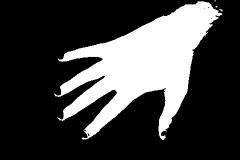
• Image Processing - The first subsection deals with featureextractionfromtheinputimageorsequenceof images.Inordertobeabletodetecthandsings,skin maskingisdone.Acolourfulimageistransformedinto abinaryskinmaskusingthistechnique.Toproperly determine if the current pixel is into the skin colour space or not, we employ colour components. As a consequence, a binary image called skin mask is produced.Figure2showstheresultafterskinmasking isdone.
Forgesturerecognition,therelativepositionofhands and fingers is essential. Thus feature points such as fingertips, knuckles, palms and wrist are extracted usingMediaPipeHolistic,tofurthertrainaLSTMmodel basedonthesefeature-points
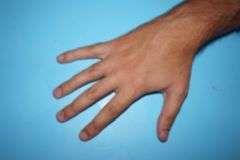
AsseeninFigure3,therearefourbasicfeature-points, also known as landmarks that we use to orient and classify the image data. They are Pose landmarks,Face landmarks,RighthandandLefthandlandmarks.
• Training of Model -Thepresentsignsarecategorized and labeled for future detection, constituting a label map.FurtherwecreateTFrecordsforthelabelmap laidout.TFrecordsstorethelabelmapinasequenceof binaryrecordsThereal-timeimagedataisamassedto build a robust data set with real-world scenarios in consideration, in order to make the model more practical and not constrained to formulated testing conditions. It acquires a collection of 100 images for eachlabel–alphabetsandnumbers,whereeachimage is flipped to make detection more universal. These images are then segmented and labeled to create corresponding “.npy” files which essentially map out theROIfromtheentireimageintoamorecomputable array format. Tensorflow library is used to create a CNNmodelwiththeconfigurationthatissetandusing the dataset that was just created, with labels. The dataset is split in a ratio of 70:30 where 70% of the dataset images are used for training the model and 30%oftheimagesareusedfortestingthemodel.In order to track the motion, two methods were considered.Oneisthegridbasedmethod,wherethe motion is tracked using relative pixel location of the ROIandsubsequentlytrainingaHMMmodelwiththis data.Theothermethodutilizesfeature-pointsthatare extracted using MediaPipe Holistic, which marks the ROI such as fingers, palms and wrists and track the motionofthesefeaturepointsinasequenceofframes, andtrainaLSTMmodelbasedoffofthisdata.Basedon trialruns,LSTMmethodprovedtobemoreaccurate. Here,thedatasetiscreatedbyconsideringanumberof
gestures from ISL,and for each gesture – a set of50 framesiscollectedinsequencewiththefeature-points markedandthisisiterated50timesforeachgesture. The extracted feature-points (key-points) are formulated in the form of an array with the corresponding co-ordinates of each feature-point. Similartohandsignrecognition,alabelmapwiththe gestureschosenfortrainingiscreated.Theextracted data, in the form of an array, that contain the coordinates of the feature-points are labelled by associating each frame-sequence data with correspondingentityinthelabelmap.
• User Interface and Translation of English to ISL - In ordertomakethisworkcomplete,itonlymadesense toincludetranslationofEnglishtoISLaswell.Here,the programtakesatextinput(stringinput)andbreaksit down into phrases and words. Further, it checks if thereisagestureavailableintherepositoryoftheISL gesturesthatisstoredlocally,foreachphraseandthen breaks down words into individual characters. Once thisisdone,awindowpopsuptodisplaythegestures and signs required to represent the input text, in accordance with ISL. This is done using the OpenCV module,byusingalocallysavedrepositoryofallthe signs and gestures available in ISL. Using GUIZero,a minimalisticuserinterfacewasdeveloped.Eachofthe abovementionedcomponentscanbeeasilyaccessed throughthisUI,withoutfacinganytrouble.
4. IMPLEMENTATION AND RESULTS
Theresultsobtainedfromhandsigndetectionforindividual alphabetsandnumbersisasshownbelow.Figure4shows some of the alphabets recognized with a practical background.
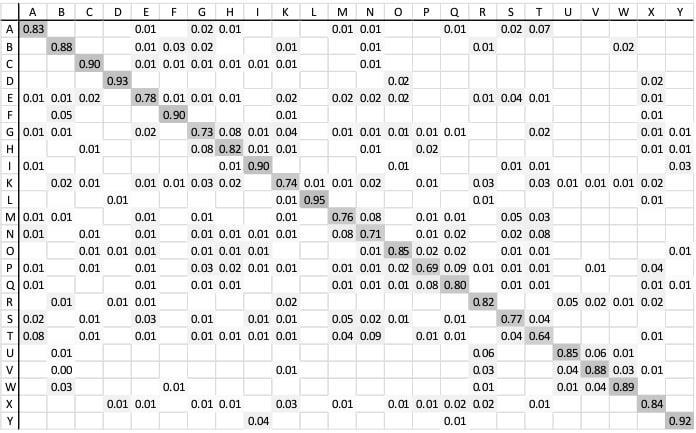
is achievable. Some things to be noted to achieve ideal accuracy is to maintain distinctive colors, emphasis on displayingthehandgesturesmorethanthewholebodyand toeradicateanydisturbancesthatmayarise.Figure5shows theconfusionmatrixforallthealphabetsoptimizedfortrue positive values which are continually passed through the modelforthebettermentofresults.
Fig-4: Alphabetsasdetectedbytheprogram
Inconjunctionofidealsurroundings,backgroundandproper presentationofhandgestures,accuracylevelsofabove90%
The results obtained from compounded hand gestures detection in a motion based scenario is as shown below. SomeofthegesturesrecognizedareshownbelowinFigure6
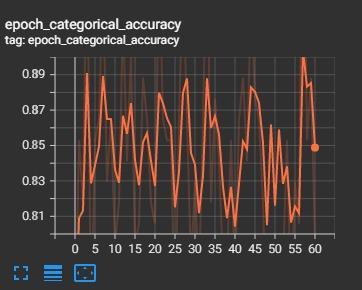

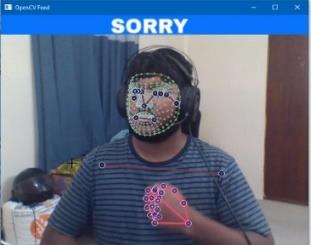
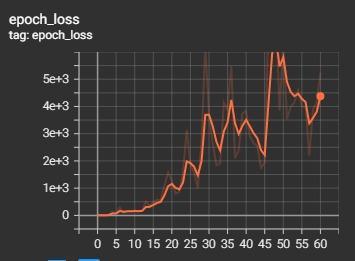
WeobservethatmanyofthegesturesinISL,takecuesfrom experiencesofrealitytosimplifysomeofthecommonlyused phrases.Thesemayincludephraseslike“Goodafternoon”, “Goodmorning”,“Sorry”,“Stress”,“Happybirthday”,etc.Thus we can observe that the usage of pre-trained alphabets cannot be implemented here and a new model was developed.Thisnewmodelhasamaximumepochsettingof5 passesper50orientationsoffeaturepointarrays.Theepoch accuracyandepochlossvaluesobtainedusingTensorboard, areshownbelowinFigure7

5. RELATED WORK
Therehasbeensignificantamountofworkinthissectorin order to tackle the difficulties faced by the speech and hearingimpaired.Existingsolutionshavethelimitationsof requiringtheusertoweardataglovesorcolourfulglovesand requiringaclearbackgroundwithonlytheuser'shandinthe frame.Mostsystemsrelysolelyonhandgestures,whileother sign languages additionally include facial expressions to representsomephrases.Thisremainsasignificantdifficulty inthefieldofsignlanguagerecognition.Morefocusshouldbe placed on identifying elements that can completely distinguisheachsignregardlessofhandsize,distancefrom the source, colour features, or lighting circumstances[1][2].Another present work employs inception, a CNN (convolutional neural network) for detectingspatialinformation,andanRNN(recurrentneural network)fortrainingontemporalvariables.Itsolelyutilises theAmericanSignLanguagedataset.Whenshownpicturesof users with various skin tones or wearing a wide range of clothing colours, the model suggested here performs less accurately.[3]Thealphabetisrecognisedbysegmentingthe handinthecollectedframesandanalysingthepositionofthe fingers.Thecharacteristicsofeachfinger,includingtheangle between them, the number of them that are totally open, entirely closed, or partially closed, and their individual identity, are used to identify each finger[4][5]. A support vector machine was used to classify the gestures after extractingthehu-momentsandmotiontrajectoriesfromthe pictureframes.BothawebcamandanMSKinectwereused to test the system[6]. Additionally, evaluation of several models is performed and well discussed. The models that employ convex hull for feature extraction and KNN (Knearest neighbours) for classification have the greatest accuracy of all the ones that were evaluated, coming in at roughly65%.Additionally,byemployingalargerdatasetand amoreeffectiveclassifier,theaccuracymaybeimproved.[7]. Another system that detects in real-time using grid-based characteristics was proposed. The then-current methods eitherofferedonlymoderateaccuracyordidnotoperatein real-time, whereas this system focused primarily on increasingaccuracyandutilisingreal-timeimages.Itcanonly accurately recognise poses and movements made with a single hand and employs a grid-based feature extraction approach.
6. CONCLUSION AND FURTHER PROSPECTS
Aspreviouslymentioned,thereexistsashortagemodelsand researchtomodernisetheusageofISLwithinIndiaaswellas inaglobalplatform.Thustheefforttowardsitincreatinga robust system to detect ISL was an impeding necessity. Thereforetheoriginalobjectivetodevelopsuchasystemto automaticallydetectandclassifyISLwasdevelopedwithout the need of any physical aids. This was achievable to a satisfactoryaccuracywiththeusageofalgorithmslikeCNN, LSTM,HMMandmodernfeatureextractiontechniqueslike the media pipe holistic. In addition to this a custom
repositoryofdatatowardstheISLwasdevelopedtofurther aidthelearningprocess.Muchimprovementcanbemadein developing the system to handle various kind of unsupportive scenarios, grow and train the datasets to a much more accurate percentage and to make the system moreaccesibleandcondusivetohandleit.
ThesystempresentedislimitedtoIndianSignLanguage.This couldbeexpandedtovariousothersystemsofsignlanguage aroundtheworld.Itcanalsobemadetoextendsupportfor translation of Sign languages into vernacular languages. Anotherdefiningfactorforthespeechandhearingimpaired individualsistobeabletorecognizeandcomprehendspeech throughlipmovements.Includingthisfeatureinthesystem, wouldmakeitmorerobustandconvenient.Thetranslation ofEnglishintosignlanguagecanbeimprovedbycustomizing a repositoryofmotiongesturesincorporatedintheIndian SignLanguagetobeusedforitstranslation.
REFERENCES
[1] Gilorkar,NeelamK.andManishaM.Ingle.“AReviewon Feature Extraction for Indian and American Sign Language.” International Journal of Computer Science andInformationTechnologies,2014,pp.314-318
[2] V.Nair, Anuja & V, Bindu. “A Review on Indian Sign Language Recognition.” International Journal of ComputerApplications,2013,pp.0975–8887
[3] K. Bantupalli and Y. Xie, "American Sign Language RecognitionusingDeepLearningandComputerVision," 2018 IEEE International Conference on Big Data (Big Data),2018,pp.4896-4899K.Elissa,
[4] R. K. Shangeetha., V. Valliammai. and S. Padmavathi., "Computer vision based approach for Indian Sign Language character recognition," 2012 International Conference on Machine Vision and Image Processing (MVIP),2012,pp.181-184
[5] Tavari,NehaV.andProf.A.V.Deorankar.“IndianSign LanguageRecognitionbasedonHistogramsofOriented Gradient.” International Journal of Computer Science andInformationTechnologies,2014,pp.3657-3660
[6] Raheja, J.L., Mishra A. & Chaudhary A. “Indian sign languagerecognitionusing SVM.”PatternRecognition andImageAnalysis,2016,pp.434–441
[7] K. Amrutha and P. Prabu, "ML Based Sign Language RecognitionSystem,"2021InternationalConferenceon InnovativeTrendsinInformationTechnology(ICITIIT), 2021,pp.1-6
[8] K.Shenoy,T.Dastane,V.RaoandD.Vyavaharkar,"RealtimeIndianSignLanguage(ISL)Recognition,"20189th InternationalConferenceonComputing,Communication andNetworkingTechnologies(ICCCNT),2018,pp.1-9