From Pixels to Understanding: Deep Learning's Impact on Image Classification and Recognition
Kush Mehta1 , Venu Chaudhari21Student, Computer Engineering, K.J. Somaiya Institute of Technology, Sion, India

2Student, Computer Engineering, K.J. Somaiya Institute of Technology, Sion, India
Abstract - This paper discusses the crucial role that machine learning, and particularly deep learning, play in artificial intelligence. It emphasizes the importance of deep learning for classifying and identifying photos. The study compares deep learning progress to that of traditional machine learning methods. Other deep learning network topologies are addressed in depth, including deep belief networks, convolutional neural networks, and recursive neural networks. The application of deep learning for image recognition and classification is explained, along with issues and solutions. The paper's conclusion summarizes and projects the current state of deep learning for image recognition and classification. Overall, deep learning has shown exceptional performance in tasks like photo categorization and has great potential for improving image recognition in computer vision thanks to its neuralnetworksimulationofthehumanbrain.
Key Words: Deep Learning, Computer vision, Artificial Intelligence, Image Recognition and Classification
1.INTRODUCTION
Asignificantnumberofphotosareproducedineveryfield every day due to the expanding variety of image capture equipment and the ongoing technological maturation of image processing, which causes the images to exist in a vast form [1]. A significant area of study in the field of computervisionisimageclassification.Toachievethegoal of identifying various categories of images, an image classification algorithm organizes the features taken from the original image. Artificial intelligence is widely used in manyfacetsofsociety,whichnotonlyraisesthedegreeof industrial modernization and intelligence but also significantly enhances the quality of life for people [2]. Many unlabeled picture data flow onto the network as a resultofthedevelopmentofInternettechnology,anddeep learning algorithms may extract abstract feature representation from these unlabeled data by utilizing multi-layer nonlinear transformation for image classification.Deeplearningisanessentialpartofmachine learning and has a significant impact on the advancement of contemporary artificial intelligence. Deep learning is being used to classify images more accurately, and in certain cases, its performance is even better than that of humans. The massive volume of calculations is what
allows for an improvement in accuracy. The amount of computation required by the training network likewise dramatically increases as the number of layers and the numberofnodesineachlayergrows.
Strengthening the research on image recognition technology is essential for the advancement of artificial intelligence and computer vision, and deep learning is a key technical tool in the field of image recognition with a widerangeofapplicationpossibilities.Deeplearning,inits simplestform,isatechnologythatsimulatesandanalyzes the human brain through the creation of deep neural networks, or that learns and interprets pertinent data by imitating the human brain. After examining, comprehending, and processing connected images, image recognition is a technology that can identify distinct patterns of objects and targets. Traditional picture classification techniques, such those relying on manual annotationandkeypointdescription,arenotonlytedious and time-consuming, but they are also significantly influencedbysubjectivehumanvariables,whichresultsin low classification accuracy. The multi feature fusion and deep learning-based image classification algorithm can producemoreeffectiveimageclassificationresults.Images nowplayasignificantroleinhowpeoplereceiveandsend information since they are vital information carriers. It is crucial to locate the users' required photos quickly because, for big photographs, the number of images that each user actually needs is quite low. For quick and efficient extraction and analysis of image semantic information, an efficient deep learning technique has significant scientific significance. The goal of this work is to further improve the application effect of deep learning so that it can play a bigger role in the field of picture recognition. It does this by analyzing the research and applicationsofdeeplearninginimagerecognition.
2.TYPICAL DEEP LEARNING NETWORK STRUCTURE
2.1 Deep Belief Network
Deep belief networks, one of the most used frameworks for deep learning algorithms, were first presented by Geoffrey Hinton in 2006. Several layers of restricted boltzmann machines are built on top of one another to create a deep belief network by using the hidden layer of
the previous layer as the visible layer of the subsequent layer.TwolayersmakeuptheBoltzmannmachinemodel. Theupperlayeristhehiddenlayer,andthelowerlayeris thelayerthatisvisible.Bi-directionalconnectionslinkthe twolayers
feature differentiation is simulated using a convolution layer, and the number of weights is decreased using a network structure that allows for weight sharing and pooling. This reduces the complexity of image feature extractionanddatareconstruction.Fullyconnectedneural networks,whichcan
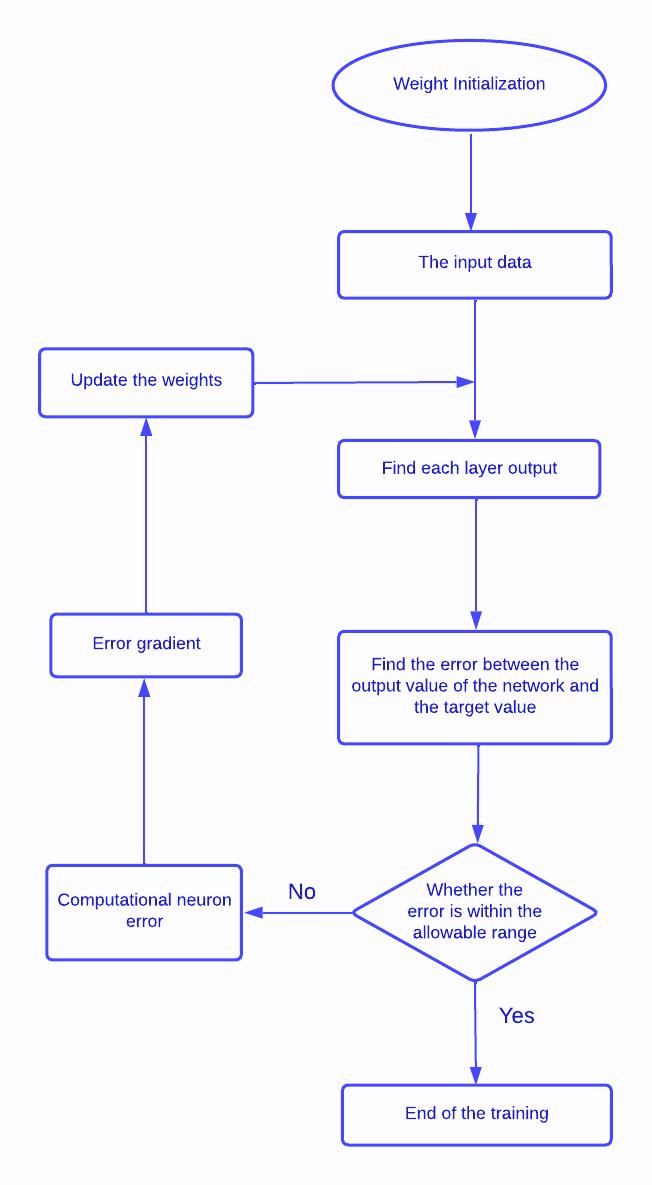
together. There is no connection between neurons in the same layer, yet there is connectivity between all neurons inneighboringlayers.The maingoal ofRBMtrainingisto identify the probability distribution that has the highest probability for a training sample. Through RBM training, wediscovertheidealweight.whenpre-training,stackthe RBMinasubsequentmanner.Specifically,whenRBM1has beentrained,thehiddenlayerofRBM1isemployedasthe visiblelayerofRBM2totrainRBM2.AfterRBM2hasbeen trained,RBM3istrainedusingthevisiblelayerofRBM3's hiddenlayer.Afterward,conditionalprobabilityisusedfor back propagation, the weights and bias values of the neurons are changed, and global fine-tuning is performed to create a neural network and deep belief network that learns through probability size. View Fig. 1. Given their great degree of flexibility and ease of growth, deep confidence networks are frequently utilized in picture identificationandclassification.
2.2 Convolutional Neural Network
A feedforward neural network called a convolutional neural network uses the convolution calculation method andhasadeepstructure.Oneofthemostsignificantdeep learning algorithms, it is also. In the area of image identification and classification, convolutional neural networks are a popular research topic. The three main components of a convolutional neural network are the local sensor field, weight sharing, and pooling layer. As part of the image recognition and processing process,
connect all of the neurons in the upper and lower layers, and must process a large number of parameters while processing high-pixel images. The convolution neural networkusesasparseconnectiontechniqueandaweightsharing network structure with a "convolution kernel" actingasanintermediary,drasticallyloweringthenumber of parameters from the picture input layer to the hidden layer.Convolutionlayer,poolinglayer,andfullconnection layer make up the fundamental structure of a convolutionalneuralnetwork.Toextractfeatureslayerby layer, the convolutional layer and pooling layer use numerous coil units. The final full connection layer completes picture categorization. The convolution kernel,
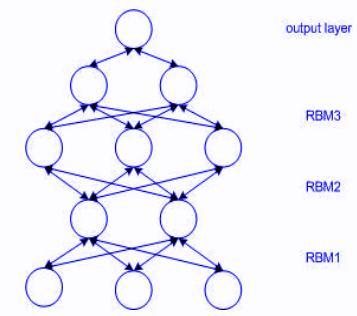
which has been trained, is employed as a filter in the imageclassificationprocesstofiltereachsmallpartofthe picture and determine its eigenvalues. The size of the convolution kernel is a restriction, thus the final image is stillratherbig.Wenowneedtopooltheimage,orsample down, so lowering the data dimension. In Fig. 2, the deep learning convolutional neural network's training procedureisdisplayed.
Training is broken down into two stages: forward propagation and back propagation. First, the network's weights are set, and the input image data that has to be processed is convolved with the convolution kernel to create a local sensor field. The output of the convolution layer is then attained through the activation function and convolutionalgorithm.
2.3 Recurrent Neural Networks
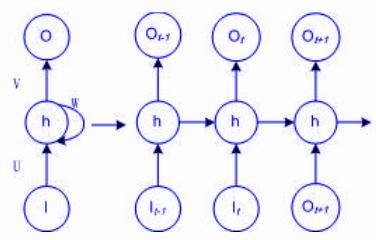
Oneofthedeeplearningtechniquesistherecursiveneural network,whichhasahierarchicalstructurelikeatree.The network nodes in this artificial neural network iteratively process an entire sequence of input in the order of their connections.
unsupervised learning to learn structural information features.Theprimarydifferencebetweenfeedforwardand recurrent neural networks is that recurrent neural networks contain a specific "memory" in comparison to feedforward neural networks. This has the advantage of processing input data that is obviously relevant to the context and handling the input that isn't necessarily long. It requires a lot of the training parameters and lacks the typicalabilitytolearnnewthings.
3.APPLICATION OF DEEP LEARNING IN IMAGE CLASSIFICATION AND RECOGNITION
3.1 Image Recognition
Image preprocessing, image feature extraction, picture category labeling, and image classifier design are only a few of the technologies used in image classification, all of whichhaveanimpactontheresults.DuringRBMtraining, the network model converges more and more as training timesareprolonged.
Fig.
Its network structure is shown in Figure 3. The output layer, hidden layer, and hidden layer with a closed loop areconstructedontopoftheconventionalinputlayer.Itis evident thatthe inputtothe buriedlayerisa summary of its prior memories and other input. Recursive neural networks include both a temporal and a structural recursiveneuralnetwork.Whiletheneuronsofatemporal recursive neural network are connected to generate a directed graph, those of a structural recursive neural network are replicated using a similar neural network topology to produce a more complex neural network. Recurrent neural networks can be trained using theoretical frameworks for both supervised and unsupervisedlearning.Whensupervisedlearningistaking place,theweightsareupdatedusingthebackpropagation process. A recursive neural network is utilized for
When the error rate declines, it shows that the current learning rate is more appropriate. If the learning rate is arbitrarily increased, the error may increase once more and the network may oscillate. If remote sensing photos can be classified using deep learning technology, creating the deep learning model rationally and employing the right optimization method may considerably improve the classification result. In the operation of image classificationmethodsbasedon deeplearningalgorithms, there are many significant technologies, but features and classifiers are the most important. For large-scale photos, the SVM's classification effect is poor, and it doesn't alwaysseemtobeabletoclassifyimages accurately.Built ontheframeworkoftraditionalneuralnetworks,thedeep learning algorithm is a revolutionary type of machine learning algorithm. It has a wide range of applications in speech recognition, biological data, and other areas and hasthecapacitytolearnmassivevolumesofdatathrough multilevel networks and speed up modeling. The weight update mechanismtakes intoaccountinertia, whichgives the RBM model exceptional local mining ability with a reduced weight in the latter stages and excellent global searchabilityintheearlystages.
The error increment is introduced to reduce the effect of error increment on learning rate, and the error control factorisemployedtoadaptivelyaltertheattenuationrate of learning rate in each iteration. The inertia factor is set simultaneously. Large inertia weight is used early in the algorithm to have strong global search ability, and small weight is used later to have good local mining ability, which improves the convergence speed and stability of RBM training. In a real-world application, the stacked automated encoder runs layer by layer, with a unique method for processing and expressing data in each layer.
Data preparation is made feasible by studying and compiling the features of the data that these variances result in. Currently, ImageNet categorization is becoming more and more important for deep learning, and AlexNet hasestablisheditselfasanetworkstructure.Comparedto the traditional convolution network, this network structure provides many benefits. In order to achieve sparse neuron output and reduce processing costs, AlexNetisuseful.Also,Recursiveneuralnetworksinclude bothastructuralrecursiveneuralnetwork.
3.2 Image Classification
Globalfeaturesandlocalfeaturesarethetwocategoriesof features that are employed in picture categorization the most.Thegeneralqualitiesofanimageincludethingslike structure,color,andtexture.Therangeofapplicationsfor image recognition technology has expanded further with the rapid development of modern civilization, and it is now widely used in the transportation industry. With the help of lane departure warning, license plate identification, and traffic sign recognition, this kind of image recognition technology for traffic also makes it easierforpeopletotravel.Thecoloroftheimage'ssurface actstodescribethecolorfeature.Thehistogramapproach uses this global feature as the cornerstone for classifying images, but because it's difficult for an image feature to gather enough local data on its own, it needs to be combined with other features. Deep learning has been successfullyemployedinvideoimageanalysis,albeitbeing initsearlystages.Sincetherequireddeeplearningmodel is available on ImageNet, it is straightforward to characterizevideostaticimagesusingdeeplearning.
Whenexaminingtheextremespeedlearningmachinewith class limitations, distributed expression features are examined. In this case, the data can be dispersed across many geographical domains and, by feature combination, a distributed expression a feature expression with discriminatory information can be produced. A weak classification impact is produced as a result of the insufficientcharacterizationpowerofunderlyingfeatures. Feature extraction is necessary to accurately classify images.
The deep learning algorithm has the highest accuracy in image classification, and the results are very stable, in large part because of the generalized regression neural network algorithm's capacity to distinguish between various categories of image classification and precisely describe the mapping relationship between input feature vectorsforimageclassificationandimagecategories.Deep learningcanbeusedtobuildamovingpicturerecognition model, which will improve the efficiency of the moving image identification process. The technical standard for athletes'trainingmayalsoberaisedbyusingthisstrategy. Deeplearningisnowusedforquitesophisticatedlevelsof
image classification and recognition. Rock features can be retrieved with the use of a model, which will enable intelligent categorization and increase the accuracy of the imagefindings.Examininghowdeeplearningisappliedto picture identification might advance research in related fields. This positively affects both the development of linked fields and the effective usage of various technologies.
4.PROBLEMS AND SOLUTIONS
A number of challenges that need our notice and debate have arisen as a result of the widespread usage of deep learning-based picture identification and classification in computer vision. These issues include an increase in the volumeandcomplexityofthedatathatmustbehandled.
4.1 Fall into Local Optimization
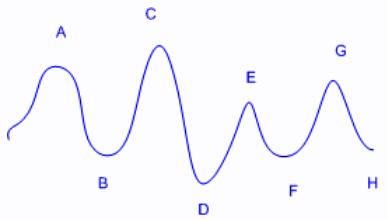
Exploring the problem of local optimization from several perspectives is made straightforward by the use of a multi-layer neural network. When executing gradient descent, as seen in Fig. 4, for instance. Of course, D is wherethefunction'sminimumoccurs,andB,F,andHare all local minima. We are shackled to local optimization if we are unable to locate D and halt once we find B. The saddle point problem also applies to multidimensional spaceinadditiontolocaloptimization.Whentrainedwith sparse input, deep level networks usually perform worse than shallow level networks when caught in local optimization. To prevent slipping into the local ideal condition, weights can be initialized, and different beginningweightscanbeusedfortraining.Theimpulseis set up to be able to cross some locally optimal conditions by using stochastic gradient descent rather than true gradient descent or simulated annealing. These methods onlymarginallyreducethechanceoffallingvictimtolocal optimization, which restricts the development of deep structure and calls for greater investigation and study of morepotentmethods.
4.2 Gradient Disappearance Problem
The gradient disappears primarily due to the incorrect activation function selection. For deep learning, particularly the back propagation method, there are too manynetworklevels.Theerrorfromtheoutputlayermay begin to decay if we employ a sigmoid function or similar functionwithachainderivative.Thetrainingofthelower fundamentallayersmaybelesssuccessfuliftherearealso extra back layers, which will impact the network's ability to operate regularly. The gradient disappearing issue has found effective solutions. The ReLu function can successfully prevent the gradient disappearance problem for the CNN network. LSTM also resolves the gradient vanishingproblemforRNNnetworks.
4.3 Overfitting Problem
Inspiteofexcellinginthetrainingsample,adeeplearning modeloverfitswhenitperformsbadlyonthetestsample. This problem arises when there are not enough training samples in relation to the complexity of the model to sufficiently train the model. The traits of the training sampleandthetestsamplearedifferentfromoneanother. Either there is too much noise in the training sample or there have been too many training sessions. As a result, whenthetrainedmodelistestedwithasampleinput,itis unable to accurately match input and output since it still exhibits the characteristics of the noise. Given the aforementionedproblems, wecan increasethe number of training samples by simplifying the model while decreasing the number of training samples by reducing thelossfunction,batchloss,etc.Ifthetrainingsamplehas too much noise, we can utilize the pretreatment strategy toreducethequantityofnoise.
If over-fitting is a result of insufficient training samples, we can increase the number of samples by rotating, scaling, cutting, and performing other operations on the picture samples. This will reduce the frequency of overfitting.
5. CONCLUSIONS
The investigation of deep learning's application to image identificationcanadvanceresearchinrelatedareas,andit has a very positive influence on the growth of those industries as well as the effective application of various technologies.Thispaperlooksatdeeplearningingeneral, analyzes the issues this technology has with categorizing images, and makes some recommendations for practical applications.Theaforementionedpositioningandrotation operations gave the database-stored images translation and rotation invariance. Scale invariance still does not appear in these images, according to established image processing theory. The extended regression neural network of the deep learning algorithm is introduced to produce an image classifier as part of a deep learning-
based image classification approach that is proposed. The high likelihood of misclassification, one problem with the present picture classification process, is something that our deep learning approach tries to remedy. The classification effect is poor due to the inadequate characterization power of underlying features. Feature extraction is necessary for accurate image classification. The redundant and complementary information is taken out of the multi-feature description of the image in order to improve the image classification effect. Deepening current research in related disciplines through the study of deep learning's application to image recognition can have a very positive effect on the effective use of various technologiesandtheexpansionofrelatedfields.
6. REFERENCES
[1] J. V. Rissati, P. C. Molina, C. S. Anjos, “Hyperspectral image classification using Random Forest and Deep Learning Algorithm ”,2002 3rd International Conference on Computer Vision, Image and Deep Learning and International Conference on Computer Engineering and Applications,May2022
[2] Dong Yu-nan, Liang Guang-sheng, “Research and Discussion on Image Recognition and Classification Algorithm Based on Deep Learning”,2021 IEEE AsiaPacific Conference on Image Processing, Electronics and Computers(IPEC),June2019
[3] Zhiping Wang, Cundong Tang, Xiuxiu Sima, Lingxiao Zhang, ”Research on Application of Deep Learning Algorithm in Image Classification”,2021 IEEE Asia-Pacific Conference on Image Processing, Electronics and Computers,April2021
[4] Zhongnan Zhao, ”Research on single-character image classification of Tibetan ancient books based on deep learning”,February2022
[5]ShivamAggarwal,Ashok KumarSahoo,ChetanBansal, ”ImageClassificationusing DeepLearning:AComparative StudyofVGG-16,InceptionV3andEfficientNetB7Models”, 20233rdInternationalConferenceonAdvanceComputing andInnovativeTechnologiesinEngineering,July2023
[6]ZhonglingHuang,MihaiDatcu,ZongxuPan,BinLei, “A Hybrid and Explainable Deep Learning Framework for SARImages”,February2021
[7] Raj Gaurang Tiwari; Alok Misra; Neha Ujjwal,”Image Embedding and Classification using Pre-Trained Deep Learning Architectures”, 2022 8th International Conference on Signal Processing and Communication, January2023
[8] Yu-nan Dong, Guang-sheng Liang,”Research and Discussion on Image Recognition and Classification
Algorithm Based on Deep Learning”,2019 International Conference on Machine Learning, Big Data and Business Intelligence,November2019
[9] Tianyuan Yue, ”Deep Learning Based Image Semantic FeatureAnalysis and Image Classification Techniques and Models”,2022 International Conference on Data Analytics, ComputingandArtificialIntelligence,December2022
[10] Yanping Zhang,”Improved Leaf Image Classification Using Topological Features and CNN With Attention Module”,2021 6th International Conference on Signal and ImageProcessing,December2021
[11] Pallavi Ranjan, Ashish Girdhar, ”A Comparison of Deep Learning Algorithms Dealing With Limited Samples in Hyperspectral Image Classification”,2022 OPJU International Technology Conference on Emerging TechnologiesforSustainableDevelopment,February2023
[12] Konstantinos Makantasis, Konstantinos Karantzalos, AnastasiosDoulamis,NikolaosDoulamis,”DeepSupervised Learning For Hyperspectral Data Classification Through Convolutional Neural Networks”, 2015 IEEE International Geoscience and Remote Sensing Symposium, November 2015
[13] Deepak Upadhyay, Mridul Gupta, Aditya Verma, SakshamMittal,”AComparativeStudyontheEffectiveness of Various Machine Learning Paradigms in Image Recognition and Predictive Modelling”,2023 International Conference on Device Intelligence, Computing and CommunicationTechnologies,(DICCT),November,2023
[14] Erdal TaSci, Aybars Ugur, ”Image classification using ensemblealgorithmswithdeeplearningandhand-crafted features”,2018 26th Signal Processing and CommunicationsApplicationsConference,July2018
[15] Hengjie Zhu, Xuyao Wang, Renxing Chen,”Deep Learning Algorithm Based Remote Sensing Image Classification Research”,2023 IEEE 3rd International ConferenceonElectronicTechnology,Communicationand Information(ICETCI),May2023
[16] Paulchamy B, K.Maharajan, Ramya Srikanteswara,”Deep Learning Based Image Classification Using SmallVGG Net Architecture”,2022 IEEE 2nd Mysore SubSectionInternationalConference,December2022
[17] Abebaw Alem, Shailender Kumar,”Deep Learning Models Performance Evaluations for Remote Sensed ImageClassification”,August2022
[18]FlorinC.Ghesu, EdwardKrubasik,BogdanGeorgescu, Vivek Singh,”Marginal Space Deep Learning: Efficient Architecture for Volumetric Image Parsing”,IEEE TransactionsonMedicalImaging,Vol.35,No.5,May2016
[19] El Abassi Fouzia, Darouichi Aziz, Ouaarab Aziz,”Images Segmentation using Deep Learning Algorithms and Metaheuristics”,2022 8th International Conference on Optimization and Applications, October 2022
[20] Atul Sharmaa,Gurbaksh Phonsa,”Image Classification Using CNN”,International Conference On Innovative Computing and Communication(ICICI 2021), April 2021