I-sand: An Environmental Friendly Sand used in Reinforced Cement Concrete Construction
 1Shreya Sanjeev Yadav, 2Dr. D.V. Wadkar
Department of Civil Engineering, AISSMS COE PUNE, India
Abstract - Now a day’s erosion of rivers and considering environmental issues, there is a scarcity of river sand. The demand of natural sand is very high in developing countries to satisfy the rapid infrastructure growth. Hence it is necessary to find alternative to ‘River Sand’. Benefits of using I sand: Cost reduction; social benefits; Mass utilization of waste material is possible in construction by using steel slag as a partial replacement material for fine aggregates in concrete. Waste or discarded materials produced commonly in industries, factories or mechanical plants are increasing daily thereby constituting increased pollution in environment. Global ferrous scrap availability stood at 750 MT in 2017, 630 MT of which was recycled. Even after recycling, around 120 MT (16% of total) scrap disposed in landfill. The scrap is expected to reach about 1 BT in 2030 and 1.3 BT in 2050. Concrete using ISand gives equal or more compressive strength than concrete using River Sand. Therefore to reduce threat to environment as well as society due to rapid extraction of sand from river bed, we can use iron waste as partial replacement to river sand.
Key Words: Concrete, Compressive strength, Industrial sand(I-Sand),FineAggregate,Riversand(RS).
1. INTRODUCTION
The increasing demand for construction materials, coupled with the depletion of high-quality river sand, has promptedresearchersandengineerstoexplorealternative materials that can effectively replace or supplement traditional aggregates. One such material that has gained attentionisironsand,alsoknownasironoresand,duetoits uniquecompositionandpotentialbenefitsinconstruction applications.
Traditionally, river sand has been a key component in concrete production, providing a fine aggregate that contributestotheworkability,strength,anddurabilityofthe material. However, the extraction of river sand has raised environmental concerns, including ecosystem disruption, habitatdestruction,andalterationofrivercourses.Thishas ledtotheneedforsustainablealternativesthatcanmaintain orimprovetheperformanceofconcretewhilereducingthe ecological impact associated with sand extraction. This paper aims to provide an overview of the current state of researchanddevelopmentregardingtheutilizationofiron sand as a partial replacement for river sand in concrete production.Itwilldelveintothekeycharacteristicsofiron
***
sand,itsinfluenceonthefreshandhardenedpropertiesof concrete, and its potential economic and environmental advantages. By exploring this innovative approach, we contributetothegrowingbodyofknowledgesurrounding sustainable construction materials and their role in addressingthechallengesofmodernconstructionpractices.
2. OBJECTIVES
1. To cast the concrete blocks using I-Sand as partial replacementtoriversand.
2. To find out the compressive strength of the concrete blocksusingIsandandriversand.
3.ToanalyzethecomparativecoststudyofriversandandI Sand.
3. MATERIALS AND METHODS
3.1 Material
3.1.1 Cement
FormakingconcreteOPC43gradecement(JPcement)was usedintheresearch.
3.1.2 Fine aggregate
Theaggregatesizeislesserthan4.75mmisconsideredas fine aggregate. The sand used for the experimental programmerswaslocallyavailablesandandconformedto gradingzoneIIasperIS:383-1970.Thespecificgravitywere foundtobe2.645
3.1.3 Coarse Aggregate
CoarseaggregatesarethosewhichareretainedonISsieve size4.75mm.Crushedstoneangularshapedof10mmand 20 mm size from a local source was used as coarse aggregate.Thespecificgravitywasfoundtobe2.85for20 mmsizeaggregateand2.80for10mmaggregate.
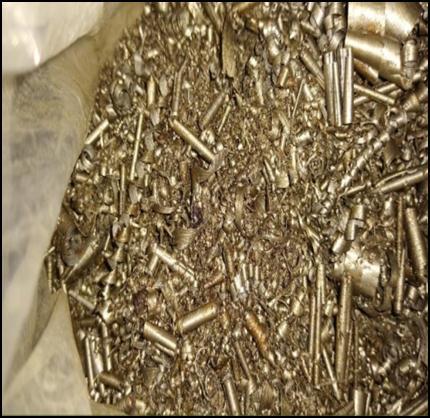
3.1.4 Iron waste
Iron waste is collected from Shree Sai agencies, Bhosari Pune. Cost = 15 Rs/kg This waste is generated from automobilespart.
Characteristics Values
1 Colour Greyishblack
2 SpecificGravity 3.66

3 Density 2040kg/
4 Solubility Insolubleinhotandcold water
3.2 MIX PROPORTION
The two types of mixture were prepared in this investigation.Thereferenceconcretemixturecomposedof cement(360kg/m3),fineaggregate(573.86kg/m3),coarse aggregates(1233.54kg/m3)andwatertocementratiois0.5. The other concrete mixtures were prepared with the iron slagreplacing10%,20%and30%offineaggregateswith the same amount of cement, coarse aggregates and same water cement ratio. The curing period of all the concrete mixeswas7,28and56days.
3.3 TEST PROCEDURE AND RESULTS
Testspecimensofsize150×150×150mmwerepreparedfor testingthecompressivestrengthconcrete.Theconcretemixes withvaryingpercentages(0%,10%,20%and30%)ofironslag aspartialreplacementoffineaggregate(sand)werecastinto cubesfortesting.
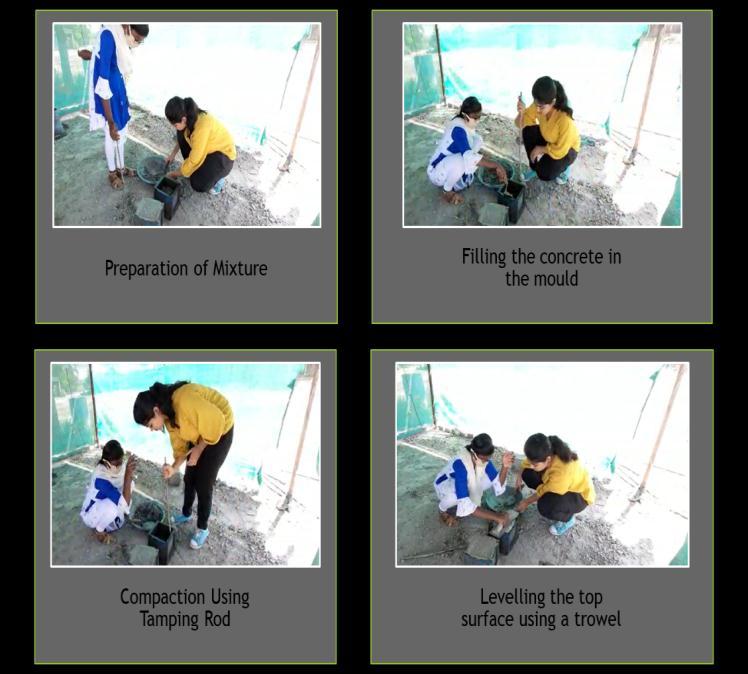
Inthisstudy,tomakeconcrete,cementandfineaggregatewere firstmixeddrytouniformcolourandthencoarseaggregate was added and mixed with the mixture of cement and fine aggregates.Waterwasthenaddedandthewholemassmixed. Theinteriorsurfaceofthemouldsandthebaseplatewereoiled
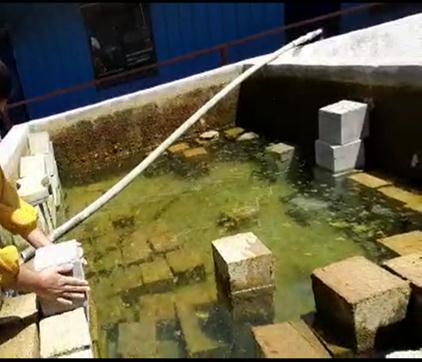
beforeconcretewasplaced.After24hoursthespecimenswere removedfromthemouldsandplacedincleanfreshwaterata temperatureof270±20C.
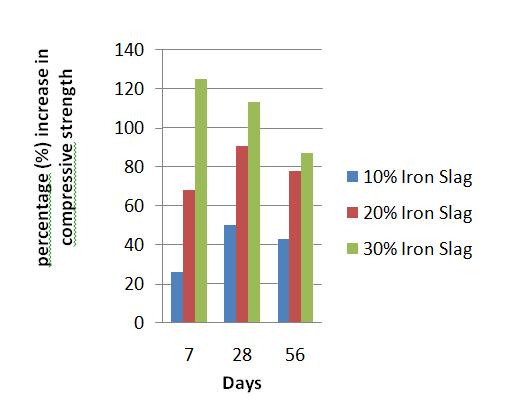
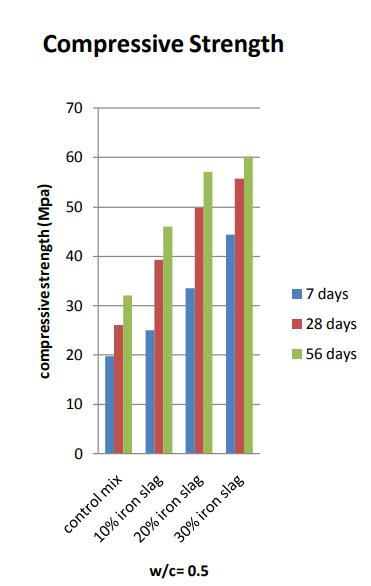
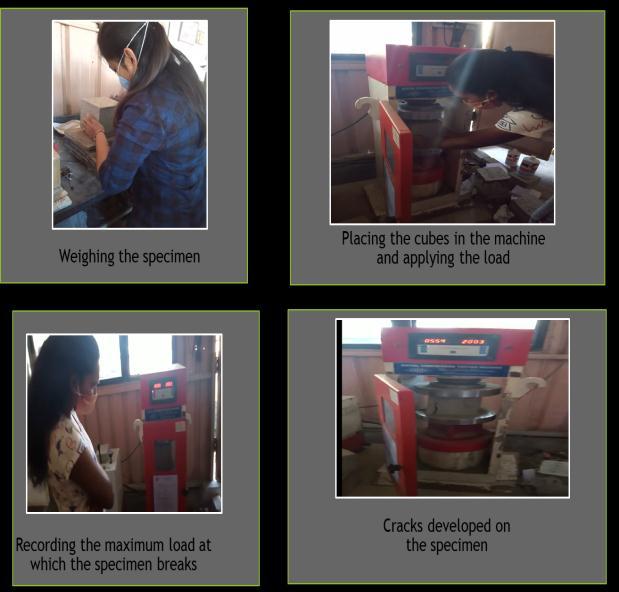
Thespecimenssocastweretestedafter7,28and56daysof curingmeasuredfromthetimewaterisaddedtothedrymix. Fortestingincompression,nocushioningmaterialwasplaced betweenthespecimenandtheplatesofthemachine.Theload was applied axially without shock till the specimen was crushed.Resultsofthecompressivestrengthtestonconcrete withvaryingproportionsofironslagreplacementattheageof 7,28and56daysaregivenintheTableII.Thecubestrength resultsofconcretemixarealsoshowngraphicallyinFigure3.2. Thecompressivestrengthincreasesascomparedtocontrolmix asthepercentageofironslagwasincreased.Afteradding10% ironslaginthemix,therewasanincreaseof26%after7days, 50%increaseafter28daysand43%increaseafter56daysas comparedtothecontrolmix.Byadding20%and30%ironslag ,therewas largeamountofincreaseinpercentagei.e.68%, 91%, 78% and 125%, 113% , 87% after 7, 28 and 56 days respectively.
Table
Compressive strength of concrete mixes of specimen size 150 × 150 × 150 with iron slag
Chart 2 shows the variation of percentage increase in compressivestrengthwithreplacementpercentageofironslag. Theresultsalsoindicatethatstrengthgainatearlyagefor7and 28dayswashigherwhencomparedtothecontrolmixif30%of fineaggregateisreplacedbyironslag.
Chart
Percentage (%) increase in compressive strength of iron slag concrete
4. WORKABILITY OF CONCRETE
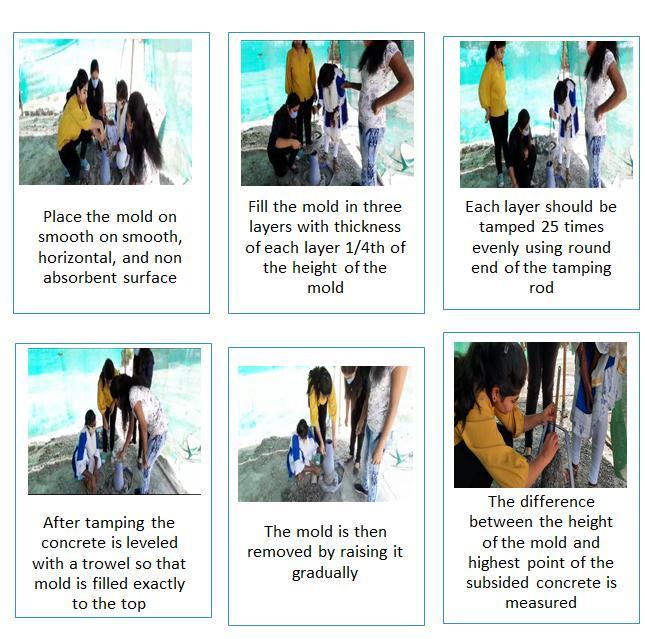
Testadoptedformeasurementofworkabilityinthepresent investigationwasSlumpconeTest
4.1
4.2 RESULT
5. CONCLUSION
TheuseofIronsand,awastecheapmaterialusedas fineaggregatesinthepartialsubstitutionofnaturalaggregates with steel slag aggregates permits the following: Gain of compressive strength, Tensile strength, Flexural strength , Modulus ofelasticityofconcreteuptoanoptimumvalueof replacement.Massutilizationofwastematerialispossiblein construction by using Iron sand as a partial replacement materialforfineaggregatesinconcrete.
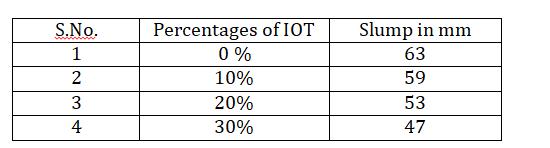
With the reference of above research papers compressivestrengthofconcrete:Ironwastecanbereplaced upto15%of riversand,Above15%thestrengthis slightly decreasing.(Asperpropertiesofironwaste)Asthepercentage of iron waste increases in concrete the workability is decreasing.
After adding 10% iron slag in the mix, there was an increaseof26%after7days,50%increaseafter28daysand 43%increaseafter56daysascomparedtothecontrolmix.By adding 20% and 30% iron slag , there was large amount of increaseinpercentagei.e.68%,91%,78%and125%,113%, 87%after7,28and56daysrespectively.Withtheincreaseof percentagesofironslagintheconcretemix,thecompressive strengthalsoincreases.Theearlyagestrengthgainishigher ascomparedtolateragesif30%offineaggregateisreplaced byironslag.
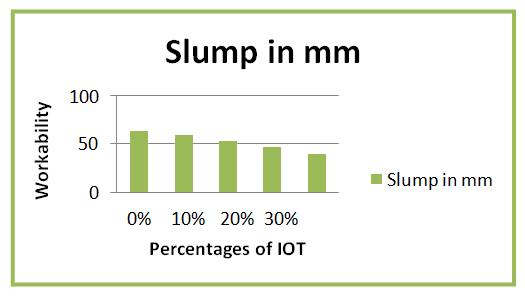
Astheironsandpercentageincreasestheworkabilityofmix reduces hence for better workability use of super plasticizersisrecommended.
Ironsandasareplacementtothesandwillsolvetwo problemswithoneeffort,namely,eliminationofsolidwaste problemononehandandprovisionofaneededconstruction material on other hand. The Iron sand reduces the cost productionofconcrete.
6. REFFERENCESS
A] Technical Papers:
1.Mr.GunalanVasudevanPerformanceonUsedIronSandas ConcreteAdmixture3rdInternationalConferenceonCivil, BiologicalandEnvironmentalEngineering(CBEE2016)Feb. 4-5,2016Bali(Indonesia).
2. Gulnur Maden Olmez, Filiz B. Dilek are, "The environmentalimpactsofironandsteelindustry:alifecycle assessmentstudy",Elsevier:JournalofCleanerProduction
3.Mr.MayurGohel.Mr.DeepJethava"DevelopmentofHigh Strength Concrete by using Industrial Iron Waste". FIRST International Joumal for Innovative Research in Science &Technology
4. Ali N Alzaed, 2014 "Effect of Iron Filings in Concrete Compression and Tensile Strength URL" International Journal of Recent Development in Engineering and Technology
5. Dr. V. Ravindra, Anil Kumar Buraka "Mechanical Properties of Concrete with Marine Sand as Partial ReplacementofFineAggregate".Dr.V.RavindraInt.Journal ofEngineeringResearchandApplications
6. PS.Kothai, Dr.R.Malathy, Utilization Of Steel Slag In Concrete As A Partial Replacement Material for Fine Aggregates".InternationalJournalofInnovativeResearchin Science,EngineeringandTechnology,
7.ZainabZ.Ismail,EnasA.AL-Hashmi,"Reuseofwasteiron asapartialreplacementofsandinconcrete". ScienceDirect
8. Akshay C. Sank, Praveen M. Biradar, Prof. J Naghathan, ManjunathB.Ishwargol,"RecentTrendsinReplacementof Natural Sand With Different Alternatives" IOSR Journal of MechanicalandCivilEngineering(IOSR-JMCE).
B] IS Codes:
1. IS 10262 (2009): Guidelines for concrete mix design proportioning(CED2:CementandConcrete).
2.IS4031-1(1996):Methodsofphysicaltestsforhydraulic cement, Part 1: Determination of fineness by dry sieving [CED2:CementandConcrete).