Utilizing LabVIEW for Varied Control Strategies in Data Acquisition Systems
Er. Walse Ayush Rajesh1, Dr. Walse Rajesh Sudhakar21 Ex. Student, Instrumentation department, AISSMS IOIT, Pune, INDIA

2Assistant Professor (Comp- Sci) & Head, Deptt of Dairy Business Management, CDTW, Pusad, (M.A.F.S.U, Nagpur) , INDIA (Corresponding author)
***
Abstract - LabVIEW is a perfect tool for real-time data acquisition because it is simple to learn, deploy, and develop prototype models. It also has the ability to perform complex algorithms in real-time. This article focuses on the fundamental idea behind LabVIEW's development environment as wellas illustrations ofvarious controlactions and simulation results. LabVIEW application is used to easily create computer connection. Different control actions are studied through simulation, and the results can be seen in the LabVIEW graphical interface. The software's graphical icon source code makes it incredibly user-friendly. The LabVIEW front panel's GUI and ability to pick or set the desired type set point allow it to assist with a variety of measurement outcomes.
Key Words: pressurecontrol,trafficlightcontrol,integral control,proportionalcontrol,andLabVIEW.
1. INTRODUCTION
LabVIEWstandsasawidelyembracedsoftwareplatform withintherealmoftheprocessindustry.Itspopularitystems fromitscapacitytodeliveranintuitivegraphicalinterface, adept data acquisition and analysis tools, as well as a versatileprogrammingenvironment[1].WithLabVIEW,the development of real-time monitoring and control systems becomes feasible across an array of processes, spanning chemical manufacturing, power generation, and water treatment[2].Thissoftwareplatformexhibitstheabilityto seamlesslyinterfacewithdiverseinstrumentsandsensors, therebyenablingthecollectionandanalysisofprocessdata. Moreover,LabVIEWempowerstheprovisioningofcontrol signals to regulate process variables [3]. Through its adaptablenature,LabVIEWfacilitatesthereal-timecapture andscrutinyofprocessdatafromanassortmentoforigins, encompassingsensors,controllers,andotherinstruments. This platform can be tailored to effectuate real-time data analysis,presentingengineersandoperatorswithgraphical andstatisticaltoolsessentialforinformeddecision-making [4].
LabVIEW also emerges as a potent tool for the development of remote monitoring and control systems. This capability empowers engineers and operators to oversee and regulate processes remotely. This attribute
proves especially valuable within hazardous or remote settingswheredirectaccessibilityisconstrained.
Theimpetusdrivingthisresearcharisesfromthedemand forprecisemethodologiestofashionlow-costinstruments catering to signal analysis, encompassing parameters like temperature,pressure,level,displacement,andstrain.The aim is to enhance the performance of a multitude of instruments across aspects such as acquisition, linearity, sensitivity,accuracy,andresolution.Employingthesystem engineering prowess inherent in the Laboratory Virtual Instrument Engineering Workbench, improvements are soughtinsignalconditioningcircuits,bolsteredbyremote indicationtechnologypoweredbyLabVIEW.
2. CONTROLLERS
LabVIEW-based instruments present an economical, reliable,andversatilesolutionforcapturingandanalyzing an array of process signals, encompassing temperature, level, pressure, and displacement. Among these, pressure holdsparamountimportanceasapivotalprocessparameter warrantingmeticulousmeasurementandregulationacross diverse sectors. Manufacturing applications specifically necessitate robust, high-performing, and interoperable software solutions. In this context, the integration of a proportional controller emerges as a noteworthy avenue, promising heightened precision and accuracy in process variablecontrol,surpassingtheefficacyofmanualoversight. This augmentation bears the potential to yield enhanced product quality, heightened operational efficiency, and curtailedwastage.
2.1 Proportional Controller
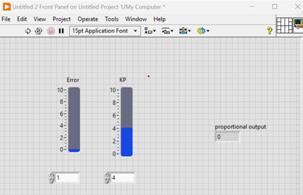
Aproportionalcontrollerrepresentsacategoryofcontrol systems wielded within industries to govern a process variable, be it temperature, pressure, flow rate, or others, aligned with a designated set point [5]. The controller's functionality hinges on imparting a control signal that maintains proportionality with the disparity between the established set point and the actual measured process variable. The block diagram in Figure 1 delineates the schematicvisualizationofaproportionalcontroller.
The proportional controller plays a pivotal role in upholding a steady set point, a critical necessity for industries reliant on unwavering process parameters to ensurebothproductqualityandsafety.
Moreover, the deployment of a proportional controller contributestoenhancedenergyefficiencythroughprecise regulationoftheprocessvariable.This,inturn,engenders cost reductions and a consequent diminution of carbon emissions. Leveraging a proportional controller facilitates process automation and optimization, culminating in heightenedproductivityanddecreasedlaborexpenses.
Adistinctivetraitofproportionalcontrollersliesintheir reliability and low maintenance requirements, thereby mitigating downtime and curbing maintenance expenditures.
P=KPe(t)dt equation… (2.1)
Furthermore,aPIcontrollerexhibitsenhancedefficacyin addressingprocessfluctuations,suchasloaddisturbances, byadeptlyadjustingtheoutputtocounterbalancedeviations fromthedesignatedsetpoint.Controlleractionandbehavior areenumeratedinTable1.
K
P
istheconstantrelatingerror
1.1 Integral Controller
A proportional controller embodies the fundamental archetype of a control system, employing solely the proportionaltermtomodulatetheoutputbasedontheerror signal.Intherealmofcontrol,thePIcontrollerintroducesan integral component aimed at rectifying any persistent deviationwithinthesystem'ssteady-statecondition[6].
Mathematically,thePIcontrollerisexpressedas:
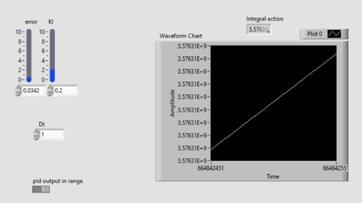
P=KI∫e(t)dt+P(0)
(Equation2.2)
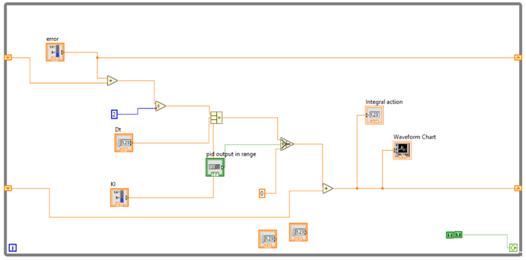
Here,KIrepresentstheconstantthatlinkstheerrorand the initial output of the controller (P(0)) when integral action commences. While a proportional controller might sufficetomeetprocessrequisitesandfurnishstablecontrol in certain instances, more intricate processes may necessitate the incorporation of a PI controller. The latter augmentsprecisionincontrol,curbssteady-stateerrors,and heightensstability.IntegralactionisdepictedinFigure2.
2.1 PressureController
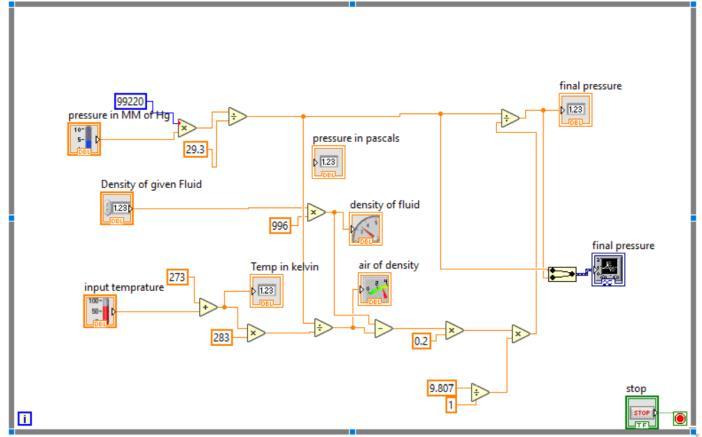
LabVIEW incorporates robust tools for data acquisition andanalysis,empoweringuserstogather,manipulate,and scrutinizedataoriginatingfromthepressurecontrolsystem. This capability proves instrumental in enhancing comprehensionoftheprocess,detectingpatterns,andfinetuningcontrolparameterstoelevateoverallperformance.
Facilitating tailored solutions, LabVIEW permits the configuration of the pressure control system to precisely alignwiththeuniquedemandsofthegivenapplication[7]. Moreover, LabVIEW affords users the creative latitude to forgebespokecontrolalgorithmsanduserinterfaces,thus facilitating seamless adaptation to evolving process prerequisites.
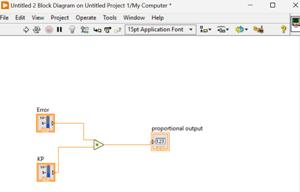
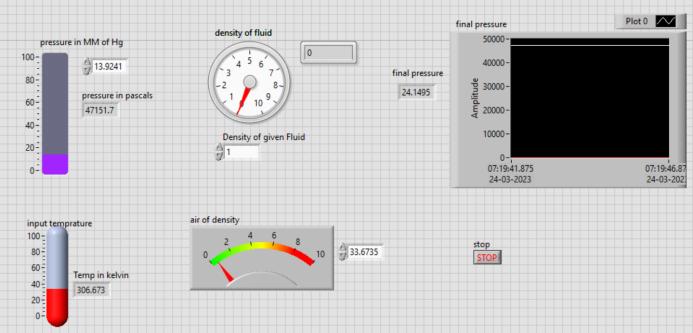
Enablingreal-timeoversight,LabVIEWempowersusers withtheabilitytoswiftlydetectandrespondtoshiftswithin theprocessdynamics,afacetthatprofoundlyrefinesprocess controlwhilemitigatingtheperilsoferrorsoroperational interruptions [8]. Refer to Figure 3 for a depiction of the pressuremeasurementcomponent.
LabVIEW seamlessly integrates with diverse hardware and software components, facilitating the effortless assimilation of the pressure control system into an interconnectedframework ofsystemsandprocesses.This cohesiveintegrationstandstoenhancetheholisticsystem performancewhileconcurrentlystreamliningintricacies.
2.2 Traffic Signal Controller
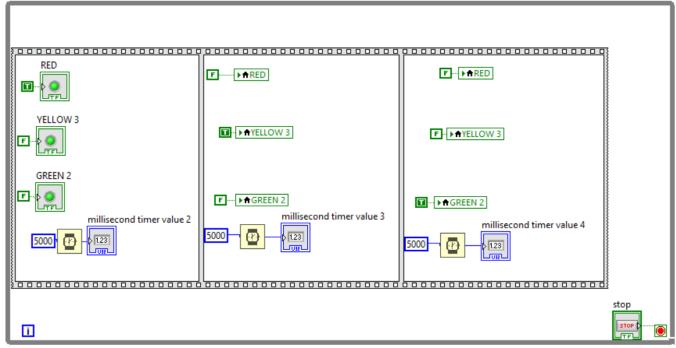
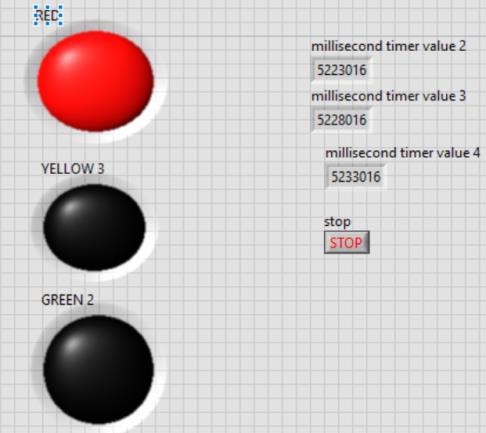
Implementing traffic light control through LabVIEW softwarecanbearelativelyuncomplicatedendeavor.Begin byestablishingaconnectionbetweenthetrafficlightsanda dataacquisitiondeviceormicrocontroller,bothamenableto LabVIEW's control [9]. This intermediary device should subsequently link to the LabVIEW-operated computer through a communication protocol like serial, USB, or Ethernet.EmployLabVIEWtodevelopaprogramprimedfor traffic light management. This program necessitates the capacitytodispatchdirectivestothedataacquisitiondevice or microcontroller, orchestrating the activation and deactivation of traffic lights in accordance with a preestablishedsequence[10].
functionality of the traffic light control program through testing, rectifying any anomalies that emerge during this phase. Subsequently, introduce the traffic light control system to the operational environment, confirming its consistentandsecureoperation.
Refer to Figure 4 for a visual representation of the LabVIEWblockdiagramillustratingthetrafficlightcontrol mechanism.
3. RESULTS
Inproportionalcontrol,thecontrollingsignalvariesindirect proportion to the error signal, whereas integral action involves combining the proportional error signal with the integral of the error signal. Additionally, distinct pressure variablesareemployedtoregulatepowerplantoperations, underscoringthesignificanceoftailoringdiversecontroller actionstosuitvaryingapplications.
3.1 Proportional and Integral Control Mechanic
Leverage LabVIEW to enact the traffic signal sequence, commonlyencompassingarotationofgreen,yellow,andred lightsforeachtrafficdirection[11].Thissequenceoughtto incorporatetimingparameterstofacilitatelighttransitions in response to traffic dynamics. Rigorously assess the
ByutilizingthevisualprogramminglanguageLabVIEW,it becomes feasible to devise a system aimed at addressing dailytrafficchallenges.Amongthearrayofavailableoptions, thewidelyusedLabVIEWfromNationalInstrumentsstands out as a versatile general-purpose programming
environment. Its graphical code development interface empowerssystem-leveldeveloperstoswiftlyprototypeand experimentwithnovelconcepts.
3.2 Pressure Control
Thesustainedfunctioningofathermalpowerplanthinges on the meticulous regulation and management of temperatureand pressure. Thiscomprehensiveprocessis bifurcated into two primary segments, both employing dedicatedtemperatureand pressuresensors,overseenby real-timecontrolprograms.
4. CONCLUSION
3.3 Management Traffic Signal Control
The pressing demand for pioneering technology and advanced equipment is evident, aiming to enhance traffic control algorithms. This imperative arises from the escalatingchallengesposedbyurbantrafficcongestionand thesurgeinroadaccidents.TheLabVIEWsimulationmodel facilitates the precise timing of traffic signal operations withinthiscontext.
Furthermore, this model serves as a foundation for potentialexpansion,enablingtheadjustmentoftrafficlight intervalsinresponsetovaryingtrafficdensitiesorthrough alternativepracticalapproaches.
The efficacy of pressure control was explored through LabVIEWexperimentation.Presently,amajorityofprocess industriespossessthecapabilitytoconcurrentlyoverseeand govern an extensive array of processes within their manufacturing operations. This comprehensive global monitoring and control framework holds the potential to enhancebothplantsafetyandprocessefficiency.Centralized monitoring plays a pivotal role in upholding plant safety. The inclusion of a proportional controller contributes to heightenedsystemstabilitybymitigatingsteady-stateerrors. LabVIEW facilitates a user-driven interface for equipment interaction,laboratorymeasurements,datavisualization,and analysis, bolstered by an extensive collection of preconfigured library functions and programmed tools. VirtualinstrumentsconstructedusingLabVIEWofferarange ofbenefits,encompassingalarmmanagement,historicaldata tracking, security measures, networking capabilities, industrialinput/outputsupport,andbusinessconnectivity. Thisversatilefunctionalityenablesseamlessconnectiontoa diverse spectrum of industrial devices, spanning PLCs, industrialnetworks,anddataacquisitionboards.Thispaper outlines the methodology employed in designing and regulating the control model for a Cross-type Intersection. Theprecisionincraftingmodelsthatfaithfullyrepresentrealworld traffic processes is indispensable for the effective designandcontroloftrafficmodels.
5. REFERENCES
[1]. Mao,J.,Cheng,X.,Zhao,H.,Sheng,H.,Zhou,C.,&Zhang, B. (2019, June). Design of Data Acquisition and Processing System Based on LabVIEW for a Mie lidar. In201914th IEEE Conference on Industrial Electronics and Applications (ICIEA) (pp.1942-1946).IEEE.
[2]. Dhanraj, J. A., Ramanathan, K. C., Priyadharsini, S., Jayaraman,P.,&Sankar,M.J.(2020,December).Boiler temperature and pressure monitoring system for thermal power plant through LabVIEW. In IOP Conference Series: Materials Science and Engineering (Vol.988,No.1,p.012079).IOPPublishing.
[3]. Jianyu, L., & Jing, C. (2019, August). Design and Implementation of Provincial Meteorological ObservationEquipmentTestandMaintenancePlatform Software Based on LabVIEW. In 2019 International Conference on Smart Grid and Electrical Automation (ICSGEA) (pp.121-123).IEEE.
[4]. Hernandez-de-Menendez, M., Escobar Díaz, C. A., & Morales-Menendez,R.(2020).Engineeringeducationfor smart4.0technology:areview. InternationalJournalon InteractiveDesignandManufacturing(IJIDeM), 14, 789803.
[5]. Calvo, I., Barambones, O., Chouza, A., Abrahams, S., Beckers,G., Slechten, D.,& Velasco,J.(2019).Building wireless control applications with XBee and LabVIEW Applied Sciences, 9(11),2379
[6]. Matía, F. (2020). Transient response comparison of feedback and feed‐forward compensation methods in systems with zero steady state error. Asian Journal of Control, 22(5),1791-1800.
[7]. Jacob,A.,&Ashok,B.(2020).Aninterdisciplinaryreview oncalibrationstrategiesofenginemanagementsystem for diverse alternative fuels in IC engine applications. Fuel, 278,118236.
[8]. Mohapatra, B. N., Barwade, N., Walse, A., &Patil, D. (2023). Data Acquisition System of Temperature Measurement Using LabVIEW Application. Andalasian InternationalJournalofAppliedScience,Engineeringand Technology, 3(01),26-31.
[9]. Sivaranjani,S.,Velmurugan,S.,Kathiresan,K.,Karthik, M., Gunapriya, B., Gokul, C., & Suresh, M. (2021). VisualizationofvirtualenvironmentthroughlabVIEW platform. Materials Today: Proceedings, 45, 2306-2312.
[10]. Dumka,A.,&Sah,A.(2020).Smartambulancetraffic managementsystem(SATMS) Asupportforwearable and implantable medical devices. In Wearable and implantable medical devices (pp. 215-228). Academic Press.
[11]. Majumder, P., &Chaudhury, S. (2020). Vehicle detection and counting the number of vehicles for intelligent traffic control using labview an image processing approach. In Energy Systems, Drives and Automations: Proceedings of ESDA 2019 (pp.503-513). SpringerSingapore.