MECHANICAL, DURABILITY AND THERMAL STUDIES USING DIFFERENT BINDERS IN HEMPCRETE
G G Subanesh1 , V Nivetha 2 , Dr. K. NITHYAPRIYA 31 PG Scholar, Department of Civil Engineering, Coimbatore Institute of Technology, Tamil Nadu, India
2 PhD Scholar, Department of Civil Engineering, Coimbatore Institute of Technology, Tamil Nadu, India

3 Assistant Professor, Department of Civil Engineering, Coimbatore Institute of Technology, Tamil Nadu, India ***
Abstract - Theconstructionindustryhasshownsignificant interest in Hempcrete, an eco-friendly composite material, due to its minimal environmental impact and promising thermal insulation characteristics. However, the effectiveness of Hempcrete relies heavily on the choice of binders employed to bind the hemp fibers together. This research paper seeks to examine the mechanical strength, longevity, and thermal properties of different Hempcrete samples formulated with a variety of binders. The study involves the creation of distinct Hempcrete specimens, each utilizing a different type of binder. By conducting mechanical assessments, such as compressive and flexural strength tests, a comparative analysis is performed. Additionally, measurements of thermal conductivity and thermal resistance are conducted to evaluate the insulation efficiency of each binder variation. The primary objective of this study is to pinpoint the most suitable binder that offers optimal mechanical performance, improved durability, and superior thermal insulation in Hempcrete applications. The insights gained from this investigation are anticipated to provide valuable information to the construction sector, promoting the responsible and eco-conscious utilization of Hempcrete as a viable and sustainable construction material.
Key Words: Hempcrete, binders, lime, mechanical strength, durability, thermal properties, sustainable construction,thermalinsulation
1.INTRODUCTION
Lime-hempconcrete,composedofa lime-based binder, hemp, and water, is an environmentally sustainable and carbon-negative building material commonly used alongside load-bearing frames due to its lightweight and non-structuralnature.However,itslowstrength,typically ranging from 0.05-1.2 MPa in compressive failure and 0.06-1.2 MPa in flexural strength, has been a subject of investigation by various researchers.[9] The properties of thecompositedependonbindertype,aggregatetobinder ratio, size and porosity of the aggregates, and level of compaction.[7] The use of waste materials not only helps to get them used in cement, concrete, and other building materials, but it also offers a number of indirect advantages,suchaslowerinlandfillcosts,energysavings, and environmental protection from pollution. It also aids
inthereductionofconcretemanufacturingcosts.[11] This researchaimsto explorethepotential ofpozzolans,finely divided siliceous and aluminous materials that react with lime in the presence of water to form cementitious properties, as a suitable addition to lime-hemp concrete. By formulating a binder using only hydrated lime and pozzolans, the study seeks to create a more environmentally friendly alternative to imported commercial binders or on-site cement-based binders. Parameters influencing the mechanical behavior of the hemp-basedmaterial:
• curingconditions
• contentofbinder
• Hemphurdscharacteristics[1]
The objectives of the research include examining the chemical and physical properties of nine selected pozzolans to identify the most appropriate ones for incorporation into lime-hemp concrete.[2] Additionally, thestudy will investigatemethods tominimizeanydelays insettingandearlystrengthdevelopmentcausedbyhemp in the lime-pozzolan binder. Comparative analysis of the microstructure and crucial physical properties of the resulting concrete, utilizing the lime-pozzolan binder, will be conducted against binders containing cement and commercialbinders.
The hydration and carbonation reactions of the binder cause an increase in the density of the specimens and therefore in the thermal conductivity of the hemp concretes.Thematerialisthenalesseffectiveinsulator.[3] Ultimately, this research endeavours to enhance the propertiesoflime-hempconcrete,makingitamoreviable andsustainableoptionforeco-friendlyconstruction,while reducing the environmental impact associated with traditional binders. Hemp shivs used in lime-hemp concretemustbeproperlyprocessedandpre-treated.The shivs are usually cut or crushed to the desired size and cleanedofdustandimpurities.Thepre-treatmentensures thattheshivsarecompatiblewiththelimebinderandthat thefinalmaterialexhibitsthedesiredproperties.[6]
2. Materials and Methods
2.1 Materials
Hempcreteisproducedwithamixofgroundhurdsorshiv, binders in different proportions and water. Cement had been used as the binder, but currently, hydrated lime, hydraulic binders and pozzolanic binders like metakaolin are commonly used. Hydrated lime can set through the absorption of CO2 during carbonation [4]. The binder is the most important component of every concrete. Hemp concrete is made with a lime-based binder. Lime, on the other hand, is better than cement for hemp shiv. Lime absorbs a large amount of water and obstructs hydraulic movement. Metakaolin consists of an artificial pozzolan obtained by calcining and micronizing kaolinite clay from the region of Charentes Basin in France. Called “ARGICALM 1000′′ and has a chemical formula of Al2O3.2SiO2, it is an amorphous non-crystallised material with a maximum particlesizeof0.063mm.[8]Thismaterialexhibitsahigh potentialforuseasadditivein binderconsideringitshigh pozzolanic reactivity. The range is quite wide because hempcrete is a porous material, and the density can vary based on the amount of lime and water used in the mixture, the density of the hemp hurds, and the level of compactionduringinstallation.
2.2.2 MIXING, MOULDING AND CURING
2.2 Methods
2.2.1 Composition of Hempcrete
Thechoiceoflime-basedbinderiscrucialinlime-hemp concrete. Typically, two types of lime binders are used: hydrauliclimeandhydratedlime.Hydrauliclimesetsand hardens through a chemical reaction with water, while hydratedlimerequirescarbonation(absorptionofcarbon dioxidefromtheair)togainstrength.Theselectionofthe appropriate lime binder depends on the specific applicationandclimateconditions.
The hemp shivs and lime binder are mixed together with water to create a lime-hemp composite. The mixing process must be thorough to ensure even distribution of the binder and proper encapsulation of the shivs. Sometimes,additionalnaturaladditives,suchaspozzolans or clay, may be included to enhance the material's performance. Once the lime-hemp mixture is prepared, it is placed into formwork to shape it into the desired structure, such as walls or panels. The material requires sufficient time to cure, during which the lime binder carbonates, gaining strength as it absorbs carbon dioxide fromtheatmosphere.Curingtimevariesdependingonthe binder type, thickness of the material, and environmental conditions.[10]
2.2.3 MECHANICAL PROPERTIES
2.2.3.1 COMPRESSIVE STRENGTH
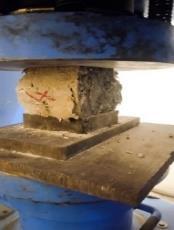
Compressive Strength is the most widely researched property of lime-hemp concretes. Lime hemp concretes typically have low compressive strengths and are therefore not a load bearing construction material. Compressive strength however gives an indication of the performance of the concrete and typical strengths for 2:1 (binder: hemp by weight) range from 0.05-1.2 MPa depending on density, mix composition, binder type, age, water content and curing conditions. Hempcrete has a compressivestrengthof3.5Mpaatitsmaximum.[5]
2.2.3.2 FLEXURAL STRENGTH
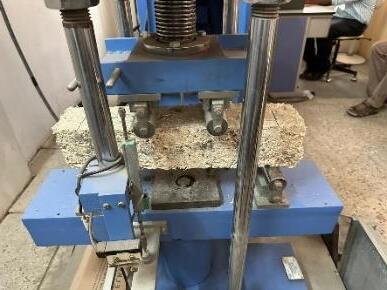
It'simportanttonotethathempcreteisoftenused in non-structural applications, where its thermal insulation, moisture regulation, and sustainability properties are more significant than its mechanical strength. Hempcrete is commonly used for wall infill, insulation, and partition walls, where the low flexural strengthmaynotbealimitingfactor
hemp concrete walls. The interior of the chamber was heated by a radiator and the temperature controlled by a thermocouple temperature sensor to activate a relay. The average interior and exterior temperatures were 27 °C and 16 0C respectively. Although allowed to cure for 13.5 monthspriortotesting,itwaslikelythatthewallshadnot fully dried at the time of testing (they lost a further 10% waterinthefollowing3months)TheU-valueofeachwall wascalculatedastheaverageoftheaveragedailyU-value recordedintherange.between0.3and0.7W/(m^2)
3. RESULTS AND DISCUSSION
3.1. MECHANICAL PROPERTIES
3.1.1 COMPRESSIVE STRENGTH
From this study it was found that replacement of metakaolinupto20%withlimeincreasesthecompressive strength of hempcrete. The mechanical performance of hempcrete is relatively modest with very ductile elasticplasticbehaviourincompression. Mostresearchersreport thatthislightweightporousmaterialshowsacompressive strengthoflessthan1MPathoughfewpiecesofliterature claim it to range up to 3.6 MPa after 28 days with a variableYoung'smodulus
2.2.4 DURABILITY
The water absorption test, can determine how much water hempcrete absorbs and retains. This test helpsevaluateitsresistancetomoistureanditsdurability over time. Water absorption testing is a common method used to assess the porosity and moisture-related properties of materials like hempcrete. The test involves exposing a sample of hempcrete to water and measuring the amount of water absorbed over a specific period of time. This test helps to understand how quickly and to whatextenthempcreteabsorbswater,whichisimportant forevaluatingitsdurabilityandperformanceinreal-world conditions.
2.2.5 THERMAL CONDUCTIVITY
The thermal conductivity was assessed by measuring the thermal transmittance (U-value) of the walls using a Hukseflux TRSYS01 measurement system and a Loggernet software for in situ measurement complying with ISO 9869 and ASTM C1155. An insulated chamber was built of, 300 mm (6 * 50mm) thick, PIR insulation boards and the two opposite ends fitted with
3.1.2. Flexural Strength
This paper examined the flexural strength of varioushempcomposites.Atvariedvolumetriclime-hemp ratios, the composites were prepared with hydrated lime. Thissuggeststhatthelime-hemp linkagesmay contribute tothemix’sflexuralstrength
3.2 WATER ABSORPTION
The results indicate that there is a statistically significant difference in capillary water absorption depending on the binder The metakaolin binder has a high-water absorption coefficient due to its lower hydraulic additions and also its slightly higher mixing watercontent.
Thermal conductivity
3.3 THERMAL CONDUCTIVITY
Testing the thermal conductivity of hempcrete is important to determine its insulation properties and suitability for use in building applications. Thermal conductivity, often denoted by the symbol "λ" (lambda), measures how well a material conducts heat. A lower thermal conductivity value indicates better insulation properties. Thermal conductivity increases with moisture andtemperature,whereasmechanicalpropertiesimprove withdensity
3. CONCLUSIONS
Thestudyonmechanical,durability,andthermal properties of hempcrete using different binders provides valuable insights into the material's performance and suitability for various construction applications. The results of these studies offer a comprehensive understanding of how different binders impact hempcrete's structural integrity, resistance to environmental factors, and ability to regulate heat transfer.Basedonthefindings,severalconclusionscanbe drawn.
The mechanical properties of hempcrete are influenced by the choice of binder. The study demonstrates that different binders lead to varying compressive strengths, tensile strengths, and flexural strengthsofhempcrete.Thissuggeststhattheselectionof abindercansignificantlyimpacttheload-bearingcapacity andoverallstrengthofhempcretestructures.Inthisstudy I found that replacement of metakaolin up to 20% will increase the strength of hempcrete. The thermal studies reveal the impact of different binders on hempcrete's insulation capabilities. Variations in thermal conductivity demonstratehowbinderscanaffectheattransferthrough hempcrete walls and structures. Certain binders might enhance hempcrete's ability to regulate indoor temperature, contributing to energy efficiency and
occupant comfort. These findings emphasize the role of binders in optimizing hempcrete's thermal performance and highlight its potential as a sustainable building material for reducing energy consumption. In conclusion, the mechanical, durability, and thermal studies using differentbindersinhempcretedemonstratethematerial's multifaceted performance characteristics. The findings highlighttheinterplaybetweenbinderchoice,mechanical properties,durability,andthermalefficiency.
REFERENCES
[1] SalimBarbhuiya ,BibhutiBhusanDas (2022)–“ Acomprehensivereviewontheuseofhempinconcrete“
[2] Fabien Delhomme , Elodie Prud’homme , Clara Julliot ,TinaGuillot ,SofianeAmziane ,SandrineMarceau (2022) – “Effect of hemp on cement hydration: Experimental characterization of the interfacial transition zone”
[3] MihailsBirjukovs ,MarisSinka ,AndrisJakovics , Diana Bajare (2022) – “ Combined in situ and in silico validationofamaterialmodelforhempcrete“
[4] A T M Faiz Ahmed, Md Zahidul Islam, Md Sultan Mahmud, Md Emdad Sarker, Md Reajul Islam (2022) “ Hemp as a potential raw material toward a sustainable world:Areview”
[5] RedouaneZerrouki ,AmarBenazzouk ,Matthieu Courty, Haikel Ben Hamed (2022) “ Potential use of matakaolinasapartialreplacementofpreformulatedlime bindertoimprovedurabilityofhempconcreteundercyclic wetting/dryingaging“
[6] C.Chinnaraj,M.Kaarthik,P.Muthupriya,M.Senthi l Rajan,M.Arun kumar(2022) “ Experimental and analyticalstudyoncoconutinfilledconcreteblocks”
[7] M. Paz Saez-Perez , Monika Brummer , Jorge A. Duran-Suarez (2021) “ Effect of the state of conservation of the hemp used in geopolymer and hydraulic lime concretes”
[8] R. del Valle-Zermeno , J.E. Aubert , A. LaborelPreneron ,J.Formosa ,J.M.Chimenos(2015) “Preliminary study of the mechanical and hygrothermal propertiesofhemp-magnesiumphosphatecements“
[9] Florence Collet , Julien Chamoin, Sylvie Pretot, Christophe Lanos (2013) – “ Comparison of the hygric behaviourofthreehempconcretes”
[10] Eboziegbe Patrick Aigbomian , Mizi Fan (2012) –“Development of Wood-Crete building materials from sawdustandwastepaper”
[11] T. Colinart , P. Glouannec, P. Chauvelon (2011) “ Influenceofthesettingprocessandtheformulationonthe dryingofhempconcrete”