
"Predictive Modelling for Overweight and Obesity: Harnessing Machine Learning Methods"
Sai Vignesh Chintala1 , Lohith Vattikuti2 , SrinivasaRao Tummalapalli3, Sohith Malyala4123UG student Dept of Artificial Intelligence and Data science, VVIT, Andhra Pradesh, India

4UG student Dept of Computer Science, SRM, Andhra Pradesh, India ***
Abstract -The science of machine learning (ML), which is now in fast growth, has the potential to completely alter how we approach the obesity problem. Predictive models that can recognise persons who are at risk of becoming fat have been created in recent years using machine learning (ML). These models may be used to assist individuals make better decisions and focus treatments to those who need them the most. The development of individualized therapies is one of the most fascinating uses of ML for obesity. ML models may be used to design personalized therapies that have a greater probability of success by grasping the specific risk variables that apply to each individual. A person who is at risk of obesity owing to a sedentary lifestyle may be encouraged to join a walking club, whereas a person who is at risk due to a poor diet may be provided with access to healthy meal planning options. The establishment of real-time monitoring systems is a promising additional use for machine learning in the fight against obesity. These systems can monitor people's physical activity, food, and other health markers using wearable technology and other sensors. The information gathered through this may then be utilized to identify early indicators of obesity, as well as to offer feedback and encouragement.
Keywords Machine Learning, obesity, methods, overweight
1. INTRODUCTION
Practitioners in medicine must determine a patient's level of obesity. Only a few of the chronic illnesses for which obesity is a risk factor include type 2 diabetes, heart disease, and various cancers. When you become awareofyourweightissue,youcould feelmoreinspired to act. Additionally, losing weight intentionally lowers theriskofsicknessandenhanceshealth.Despitethefact that the Body Mass Index, also known as the BMI, alone isinsufficientforaccuratelydefiningobesitysinceitfails to account for all body-type factors, the World Health Organization (WHO) has defined criteria for obesity. Every place and person have different dietary requirements. For the purpose of correctly describing body type, anthropometric data is sought. Conventional anthropometric methods, however, cannot be applied in daily life since they require trained specialists., inquiry into the application of a 3D scanner for measuring the
human body is now being undertaken. Computed tomography, also known as CT, or dual-energy X-ray absorptiometry(DXA),thegoldstandardtoestimatethe proportion of body fat in people, carry a threat of radiation exposure when used often. A 3D scanner doesn't subject the human body to irradiation way a CT or DXA system does26. Furthermore, there are several approaches can may be utilized to assess or anticipate health risks rather than a single, ideal one. Due to this, this study acquired coupled 3D body scan and DXA data from Koreans to help classify obesity using anthropometric parameters. The adverse outcomes of obesityaffectsocietyasawhole;patientsaswellasloved ones are not the only ones who experience the consequences.Undernourishmentandfathaveincreased inincidenceinSoutheastAsia,therebyrenderingitmore difficult to deal with issues associated with nutrition there. In the academic literature, the use of ML techniquesfor modellingepidemiological data isgaining popularity. These methods could help in the comprehension of illness prevalence, early disease detection,thecausesofdiseases,andpotentialtreatment or prevention strategies. On data relevant to obesity, a variety of machine learning (ML) methods and algorithms have been evaluated 8). It is vital to create a precise information categorization to support the process of identifying predicted risk factors from the information offered in order to mitigate the morbidity and mortality put on by obesity.ML has been used to arrive at predictions concerning the possibility of developing obesity based on data encoding dietary advice compliance and other variables. Other applications of ML involve foreseeing childhood obesity before the age of two using electronic health records, anticipating obesity-promoting circumstances for children, and modelling medication dosage responses using aggregated metabolomics, lipidomic, and other clinical data. Based on data being dietary compliance with requirements and other factors, ML has been applied to predict the possibility of obesity. The use of electronic health records for predicting childhood obesity before the age of two the prediction of obesitycausing circumstances for children and the modelling of medication dosage responses using aggregated metabolomics, lipidomic, and other clinical data are furtherusesofML
2. LITERATURE REVIEW
2.1 CUBIC SVM: Aninstanceofmachinelearningmethod called cubic support vector machines (SVM) can be beneficial for both regression and classification programmers. They can accurately predict obesity and are particularly well-suited for jobs where the data cannot be segmented linearly. Researchers employed cubicSVMinastudythatwasacceptedforpublicationin the journal Advances in Intelligent Automation and Soft Computing to predict obesity in a dataset of 1000 patients.Accordingtothefindings,cubicSVMwasableto predictobesitywithanaccuracyof90%,whichisonpar with other machine learning algorithms that have been implementedinthisfieldofstudy.[1]
The researchers additionally discovered that cubic SVM coulddeterminethemostimportanttraitsforpredicting obesity. They included the circumference of the waist, the waist-to-hip ratio, and body mass index (BMI). Overall, the findings of this study indicate that the cubic SVM machine learning method is a viable one for predicting obesity. It is accurate, successful, and is worthyofrecognizingthekeyindicatorsofobesity.
Sincetheyear1980,obesityhasemergedasasignificant social and public health issue that calls for greater awareness.Thisleadstoanongoingflowofstudyonthe origins, repercussions and methodologies for predicting the emergence of the pediatric obesity epidemic. In this study,avarietyofclassificationmethodswereemployed to identify the severity of obesity. Based on the assessment criteria, the outcomes of several machine learning approaches are compared. We were able to reach a 97.8% success rate by meticulously choosing problem-specific features and implementing the Cubic SVMproximity.[2,1]
2.2 K-NEAREST NEIGHBOUR (KNN): The k closest neighbors(KNN)serveasan excellent machinelearning approach for tasks which includes regression and classification. It functions through recognizing the k training set instances that are most similar to a new instance, and then predicting the label of the new instance using the k closest neighbors’ labels. For instance, you would initially train a KNN model on a dataset of individuals who have previously been classified as either obese or not fat if you were attemptingtopredictifapersonisobese Thealgorithm would next consider a new individual's physical attributes, such as height, weight, and waist circumference, and identify the k training set respondents who were most like the new person. then, themodelwouldforecast,whileasmallervalueofkwill give the labels of the further neighbors more weight. KNN is a non-parametric technique, therefore it doesn't make any assumptions about how the data are distributed. Because of its extreme adaptability, it may
be used to predict obesity even when theS data is not regularlydistributed.KNNisastraightforwardalgorithm that is simple to comprehend and apply. Understanding the variables that lead to obesity can be helped by this. [3]
2.3 XGBoost:xgboostisapowerfulcollectionofmachine learningrulesthatcanbeappliedtobothregressionand classification problems. It is a method for ensemble learningthatmixesboostinganddecisiontrees.Itiswell known that xgboost is extremely accurate and fast. In order to forecast the target variable, a succession of decision trees is built as part of XGBoost. A boosting techniqueisthenusedtomergethedecisiontrees,which implies that each tree is instructed to remedy the flaws of the ones that came before it. This method is applied periodically until the desired precision is achieved [4] The extremely flexible algorithm XGBoost can forecast obesityusingarangeoffactors.
The commonly utilized indicators for predicting obesity include:
BMI, or body mass index waist dimension hip to waist ratio dietary practices amounts of physical activity geneticinfluences[5]
2.4 LOGISTIC REGRESSION:Astatisticalmodelthatmay be utilized for binary classification tasks is logistic regression.Itfunctionsbymodellinghowlikelyitisthat an instance belongs to a specific class. Although logistic regression is a relatively simple method, it has a great deal of potential for predicting obesity. Logistic regression might be applied in the context of obesity prediction to estimate the possibility that a person would be fat, given a collection of characteristics. The characteristics might be things like BMI, waist size, age, gender,anddietarypreferences.Usingthevaluesforthe characteristics,thelogistic regressionmodel wouldthen beusedtoforecastthelikelihoodthatanewpersonwill befat.[6]
The following are some benefits of using logistic regressiontopredictobesity:
Itisclearandstraightforwardtocomprehend.
It can be used to predict obesity fast because it is relativelyeffective.
It is interpretable, which implies that the model's outcomesmaybecomprehendedandjustified[7]
The following are some drawbacks of using logistic regressiontopredictobesity:
It might not be as accurate as other machine learningmethodslikeXGBoostordecisiontrees.
Theselectionofhyperparametersmayaffectit. Overall,themachinelearningapproachknownaslogistic regression is straightforward and useful for predicting obesity. Although it is not as precise as other machine learning algorithms, it is straightforward and simple to comprehend.
Here are a few illustrations of factors that may be incorporatedintologisticregressiontopredictobesity:
BMI,orbodymassindex
waistmeasurement
hiptowaistratio
dietarypractices
amountsofphysicalactivity
geneticinfluences
obesity can also be predicted using logistic regression. The characteristics in this situation are probably factors like height, weight, age, gender, and eating habits. The potenttooloflogisticregressionmaybeusedtoforecast obesity. It's crucial to remember that no one model will be able to accurately predict obesity, though. Utilising a number of variables and combining logistic regression with other machine learning techniques is the best methodtoutiliseittopredictobesity.[5]
1. Data collection: Compile a dataset with the goal variable (obesity status) and pertinent traits (independent variables). Age, gender, height, weight, food habits, degree of physical activity, and any other characteristics that could be connected to obesity are examplesofcharacteristics.
2. Cleanse and prepare your data by preprocessing it. This includes coping with missing data, eliminating outliers,and,ifrequired,translatingcategoricalvariables into numerical representations(using methodslikeonehotencoding).
3.DataSplitting:Partitionyourdatasetintoatrainingset andatesting/validationset.Thelinearregressionmodel will be trained using the training set, and its performance will be assessed using the testing/validationset.
4.ModelEvaluation:Evaluateyourmodel'sperformance using the testing and validation dataset. Mean Squared Error (MSE), Root Mean Squared Error (RMSE), Mean Absolute Error (MAE), and R-squared are common metricsforevaluatingforregressionissues.
5. Interpretation: Analyse the model's coefficients to see how every factor affects the projected obesity status. When the coefficients are positive, there is a positive association with obesity, and when they are negative, thereisanegativelink.
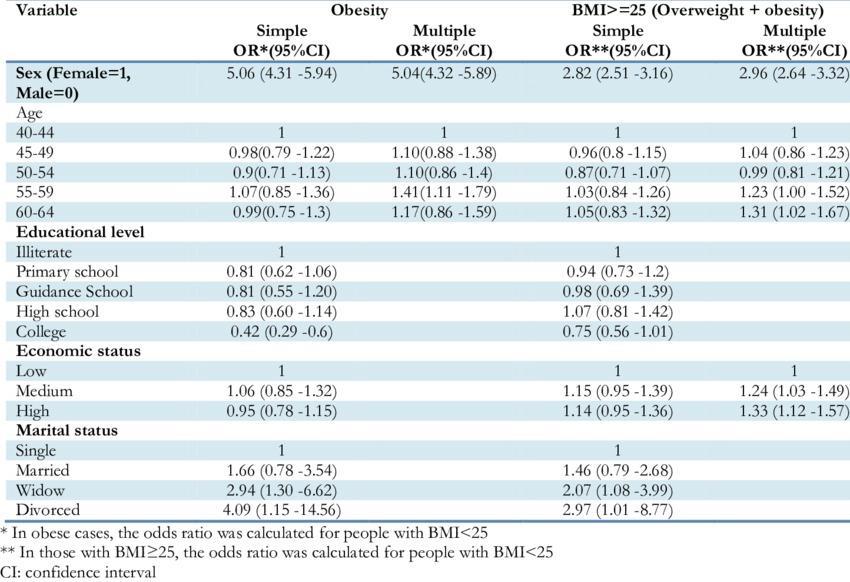
6. Improving the Model: If the first linear regression model isn't successful, you may attempt enhancing it by including additional pertinent traits utilising polynomial regressiontoidentify non-linear correlations,orlooking intoothercomprehensiveregressionmethods.Asobesity is a complex health condition impacted by several genetic, environmental, and lifestyle variables, it is important to keep in mind that while linear regression can offer insights and predictions, it may not fully captureallthenuancesofobesityprediction.Asaresult, theaccuracyof yourmodel maydiffer depending on the type and volume of your data as well as the intricacy of thehyperlinksyou'retryingtorepresent
2.5 DECISION TREES: Giventhat binary trees are a sort of decision tree method that may be used for classification problems, using them to predict obesity maybeanintriguingstrategy.Thefollowingisastrategy forutilisingbinarytreestopredictobesity:
2.4 LINEAR REGRESSION: Ifyouhavetherightdataand characteristics at hand, you can apply linear regression to predict obesity. How would you go about utilising linearregressiontopredictobesity?
1.Data Collection and Preprocessing: Compile a dataset with pertinent labels and characteristics for the prediction of obesity. Age, gender, body mass index (BMI), daily calorie intake, amount of physical activity, genetic susceptibility, and others may all be characteristics. Labels (binary categorization) would statewhetherornotapersonisfat.
2.Data splitting into tests and training sets is step two. The binary tree model will be created using the training data, and its performance will be assessed using the testingset.
3.Decisiontreealgorithm:Binarytreesarecreatedusing the decision tree algorithm by recursively splitting the data according to chosen characteristics and thresholds. The decision tree method begins by calculating which feature will best divide the data depending on certain criteria (such as Gini impurity or information gain, for example). The dataset is then split into two subsets at a certain feature threshold value. Until a stopping requirementisfulfilled,suchasreachingaspecificdepth or having a minimum amount of samples in a node, this processcontinues.
4.Model construction: Make use of your training dataset to train the binary tree model. At each node, the model will makea binarychoice,resultingina route thatleads to a leaf node. The forecast will be the label put on that leafnode.
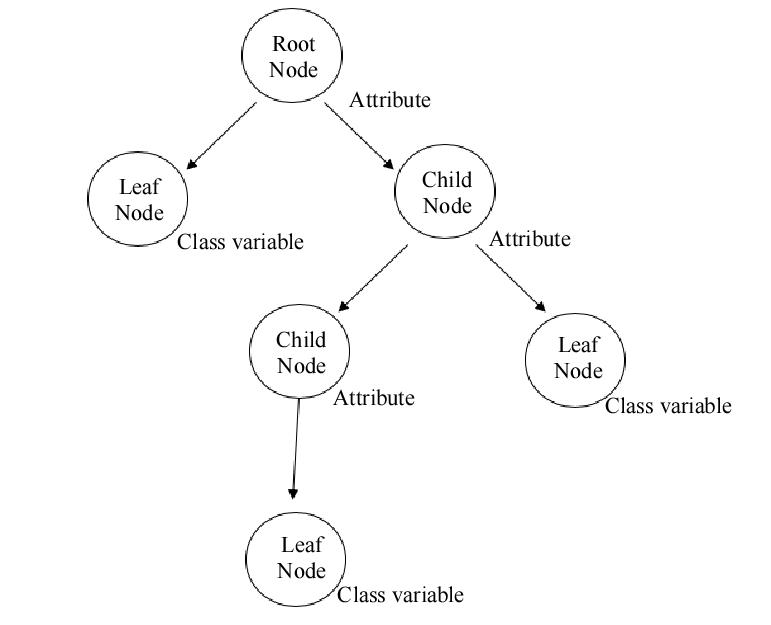
5.Hyperparameter Tuning: Binary trees feature hyperparameters,suchasmaximumtreedepth,baseline samplesperleaf,andsplittingcriterion,whichcan affect their complexity and efficiency. In order to enhance the efficacy of the model, experiment with various hyperparametersettings.
6.Interpretability: One benefit of decision trees, especially binary trees, is that they are easy to understand. The tree structure is simple to grasp, and eachnode'sconclusionsare clear. This canshed light on whichcharacteristicsarecrucialforpredictingobesity.
7.Adressoverfitting: Decision trees, particularly binary trees, are susceptible to overfitting, especially when the tree turns too deep. Overfitting can be reduced by regularisation approaches such limiting the maximum depthorthenumberofsamplesperleaf.
Bearin mind that while binarytrees may be economical for some types of data and situations, they may not always be the optimum approach. Try out several machine learning techniques and approaches to see which one is most effective for your particular obesity predictionquest.
Now lets look into an example decision tree for the obesityprediction.[6]
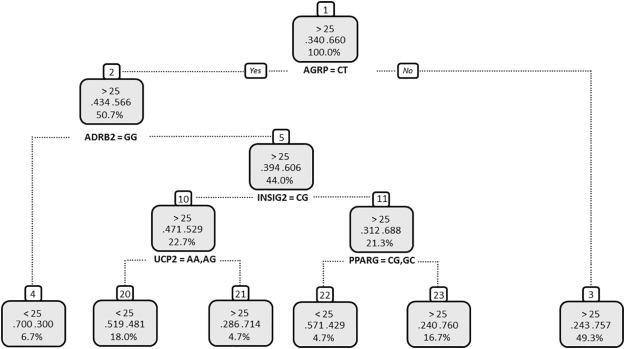
predict overweight and obesity.
2.4 NEURAL NETWORKS: The neural networks in the human brain served as the inspiration for a family of machinelearningalgorithmsknownasneural networks. They are especially effective for jobs featuring intricate data ties and patterns. Neural networks may be used to predictobesityinthefollowingways:
1.Data collection: Compile a dataset withlabelsshowing whether a person is obese or not, as well as specific details (such as age, gender, BMI, food habits, degree of physicalactivity,etc.).
2.Data preprocessing: Normalise or standardise the characteristics of the data before supplying it to the neural network. This may facilitate a faster convergence oftheneuralnetworkduringtraining.
3.Network Architecture: Create the neural network's architecture. Given that obesity prediction is a binary classification job, a straightforward design for the task
mayhaveaninputlayerwithneuronsthatcorrespondto theinputcharacteristics,oneormorehiddenlayerswith changingnumbersofneurons,andanoutputlayerwitha singleneuron.
4.Activation function:Apply the correct activation functions to the neurons in the buried layers. Rectified Linear Unit (ReLU) activation is a popular option for hiddenlayers,whereassigmoidorsoftmaxactivationisa popularoptionfortheoutputlayer.
5.Training: Start the neural network training by introducing the preprocessed data. By altering the weights and biases associated with each feature during training, the neural network learns the correlations betweentheinputcharacteristicsandtheobesitylabels.
6.Lossfunction:Determine an appropriate loss function for a binary classification, such as binary cross-entropy. The discrepancy between the expected outputs and the actuallabelsismeasuredbythelossfunction.
8.Optimisationalgorithm:Utiliseanoptimummethodsto reduce the loss function and update the network's weights and biases, such as stochastic gradient descent (SGD)oroneofitsformats,Adam.
7.Batch size and epochs:Typically, training is carried out in eras, with each epoch encompassing a full pass over the training dataset. For more effective training, data is frequently separated into batches. The amount of samplesimplementedineachweightupdatedependson thebatchsize.
8.Validationandearlystopping: Divideyourdatasetinto training and validation sets for validation and early stopping. To prevent overfitting, keep an eye on the model's performance on the validation set during training.Ifthemodel'sperformanceonthevalidationset beginstodeteriorate,earlyhaltingcanbeused.
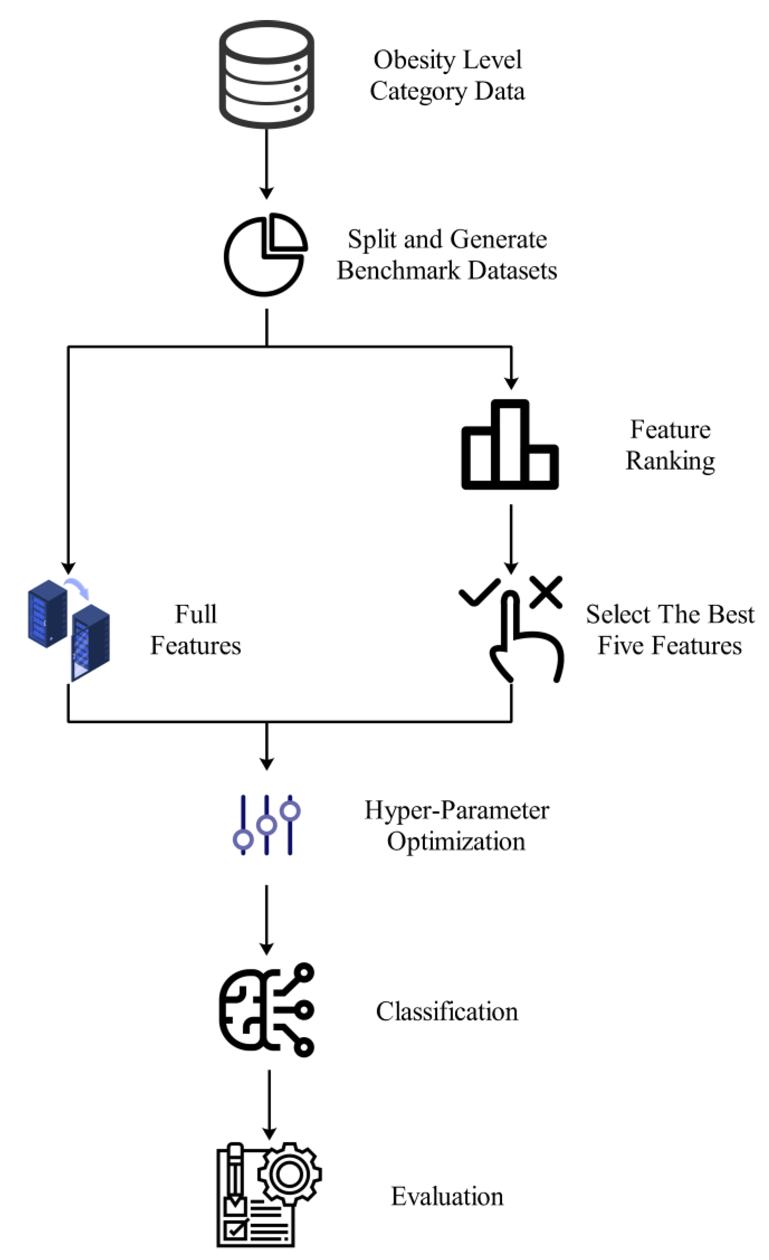
9.Tuning of Hyperparameters: To improve the performance of the model, experiment with various hyperparameters,includingthenumberofhiddenlayers, the number of neurons in each layer, the learning rate, the activation functions, and regularisation methods (dropout,L2regularisation).
10.Evaluation:Aftertraining,usemeasureslikeaccuracy, precision, recall, F1-score, and ROC-AUC to assess the trainedneuralnetworkonadifferenttestingdataset.
11. Interpretability: Because of their intricacy, neural networks can be difficult to understand. Some insights into how certain input characteristics contribute to the final prediction may be gained by using methods like layer-wise relevance propagation or gradient-based featurerepresentation.
Neural networks have the potential to be useful for anticipatingobesitybecausetheymayrecognisecomplex correlations in the data. Nevertheless, they also need enough labelled data and training computational resources. For the model to be effective and generalizable, extensive testing and assessment are required.[4]
3. CONCLUSION:
A major threat to public health that is spreading throughout the world is obesity. The rapidly evolving science of machine learning (ML) has the potential to completelychangehowwetreatandpreventobesity.We havestudiedtheapplicationofmachinelearning(ML)to overweight and obesity prediction modeling in this study. For this topic, four distinct machine learning techniques have been dealt with: cubic SVM, KNN, XGBoost, and logistic regression. We've also spoken about the advantages and disadvantages of each technique.
Thefindingsoftheresearchexaminedinthisstudypoint to the potential of machine learning as a useful tool for obesity prediction. When it comes to predicting obesity, ML models have been demonstrated to be either as accurate as or more accurate than conventional techniques. Additionally, by recognizing those who have a higher risk of obesity, machine learning models can assist focus treatments on the people who will profit from them the most. The use of ML to the prediction of obesity is not without limits, though. One drawback of machine learning models is that their accuracy might changebasedonthedatasetthatwasusedtotrainthem. Moreover, training and deploying machine learning models may be computationally costly. Notwithstanding these drawbacks, research on using machine learning to predict overweight and obesity is encouraging. ML techniqueshavethepotentialtobeanimportanttoolfor treatingand preventing obesityaslong asthey continue toadvance.
Tothefullestpossibleextentthatmachinelearning(ML) can predict obesity, a few more issues must be resolved to add to the previously listed constraints. One issue is the scarcity of sizable, excellent datasets for machine learning model training. Creating interpretable machine learning models is another difficulty, as it enables the understanding and use of the models' output to guide interventions. The integration of machine learning to predict overweight and obesity is a promising field of study, despite these obstacles. ML has the potential to completelychangehowwetreatandpreventobesityifit isdevelopedfurther.
4. REFERENCES
[1] B Singh and H. Tawfik, “A Machine Learning Approach for Predicting Weight Gain Risks in Young Adults,,” 2019 10th International Conference on Dependable Systems, Services and Technologies (DESSERT), Leeds, UK, pp.231-234,2019.
[2] y Celik, s Guney and B Dengiz, Obesity Level Estimation based on Machine Learning Methods and Artificial Neural Networks, pp.329-332,2021.
[3] S. Marsland, Machine Learning: An Algorithmic Perspective, 6000 Broken Sound Parkway NW, Suite 300, Boca Raton: Taylor and Francis Group, LLC, 2015.
[4] x. pang, C. Forrest, F. Le-Scherban and F. Masino, "Understanding Early Childhood Obesity via Interpretation of Machine Learning Model Predictions,, pp 1438-1443,2019.
[5] 0. Ben-Assuli, O. Bar, G. Geva, S. Siri, D. Tzur and G. Almoznino, Body Mass Index and Caries: Machine Learning and Statistical Analytics of the Dental, Oral, Medical Epidemiological (DOME) Nationwide Big Data Study,, vol.13,p.37,2022.
[6] S. Heydari, S. Ayatollahi and N. Zare, “Comparison of Artificial Neural Networks with Logistic Regression for Detection of Obesity,” vol. 36, pp. 2449-2454, 2012.
[7] A. Sasdelli, M. Petroni and A. Deli Paoil, “Expected benefits and motivation to weight loss in relation to treatment outcomes in group-based cognitivebehavior therapy of obesity,” vol. 23, pp. 205-214, 2018.