Use of Waste Polythene in Concrete
Aman Kumar Saral1, Gautam Bhadoriya21Post Graduation Student, Department of Civil Engineering, MITS Gwalior, Madhya Pradesh, India
2Professor, Department of Civil Engineering, MITS Gwalior, Madhya Pradesh, India ***

Abstract - Solid waste management systems across the world face a challenging issue of safe disposal of nonrecyclable thin polythene bags. The plastic uses day to day increases and make the integral part of our life style. The first part for construction in many countries is concrete, if plastic wastes can be mixed in the concrete mass in dry form, without significant change on its basic properties or slight compromise in strength, we can consume large quantities of plastic waste by mixing it in the concrete mass. This study presents a comparative study of compressive strength of concrete made using plastic bags as fibrous material and focuses the effect of polyethylene plastic bags on the workability and compressive strength of M25 concrete. This test examination completed to contemplate the appropriateness of expansion of waste plastic sacks on mechanical properties of cement. The proportions of waste plastic added in concrete are 0.25%, 0.5%, 0.75% and 1% by weight of cement and compressive strength is determined at 7, 28 and 56 d of curing. It is observed that the workability is reduced with increase in dose of polythene and the compressive strength is increased on inclusion of waste polythene in concrete at all edges up to 0.75% and thereafter it starts decreasing.
Key Words: Concrete1, waste polythene2, compressive strength3, workability4, etc
1.INTRODUCTION
We were going to throw into the rubbish because plastic wastecoversthemajorityofthearea.Soil,water,andairare allunclean.Inlightofthis,anefforthasbeenmadeinthis studytoinvestigatetheusageofwastematerialsinconcrete, suchaswastepolyethylene.Theengineeringqualitiesofthe concrete are often enhanced by the addition of discarded polyethylene. The primary benefits of economic and ecological waste and the utilization of plastic waste in concrete.
One trillion plastic bags are used worldwide each year, making the plastic sector one of the fastest expanding industries. Because plastic is long-lasting and not biodegradable,itisseentobeamajordifficultytodisposeof polythenewasteintheenvironment.Polytheneisextremely robustandhasincreasedresiliencetonaturaldeterioration due to its chemical connections. The prevalence of plastic materials in our daily lives has increased the amount of plasticwastethatisavailable,whicheithergetsmixedwith municipalrubbishorisflungacrossalandareaandhasan influenceontheecosystem.
Theuseofplasticwastetoimproveroadwaysiscurrently thesubjectofresearch.Recently,anotherconceptforusing plasticwasteasanadditionalmaterialincementblendsthat are both plain and fortified has also been developed. This investigationlooksforaviableapplicationofusedpolythene bags in cement to prevent the biological and ecological stressestheycause.[1]incorporatedplasticgarbagetofiber structuresatvaryingwater-to-concreteratios(0%to1.5% bycementvolume),combinedwithflydebris(0%to30%by cement volume). To measure the influence of substance assault and the corresponding change in the compressive strength of solid blend, various restorative circumstances were used. In a different study [2], common plastic packs withthicknessesunder20micronswereemployedasplastic strands(0%to1.2%plasticbyvolumeincement),andthe compressive strength of the building was examined. The plastic was cut and destroyed periodically. To avoid problemsduringlabor,itisassumedthattheplasticsacks shouldbeused,ideallyindamagedstructures.However,the hand-cut filaments made from plastic bags are not appropriateduetotheirlowangleproportion.Thestrength of the strands made using plastic packs that were thinner than20micronsandcontainedmoresolidvolumethan0.6% decreased. Utilizing polymer fiber in cement by weight, Kandasamy and Murugesan [12] reported an increase in compressivestrengthof 0.68%at7days and5.12%at28 days.AccordingtoNaiketal.[11],showedasthepercentage of plastic in cement increased, particularly above 0.5%plastic,thecompressivestrengthdecreased.
The functionality, compressive strength, and flexural strengthofcementatdifferentdoses(0.25%,0.50%,0.75%, and1.0%)ofwasteplasticinstringystructurearealltaken into account in this work, along with a comparison to conventionalcement.
2. MATERIAL AND METHODS
2.1Cement:
Throughout the examination, Portland Pozzolana Cement (PPC)oftheBirlabrandisused.TherealPPCcharacteristics that were chosen. The concrete satisfies an IS 1489:1991 requirement.
Table-1: Propertiesofcement
2.4 Waste Polythene: Shredded waste polythene was employedinthisinvestigation.Wastemadeofpolythenehas aspecificgravityof0.41andanaspectratioofbetween250 and500.
2.5 Super plasticizer: Forimprovingtheworkabilityand compressivestrengthofcementinthisinvestigation,0.5% weightofsuperplasticizerfromtheSicafirmisaddedtothe cement.
2.6 Concrete: AccordingtoIS10262(2009),thesolid'sblend planhasbeenfinished.Inordertoavoidtheballingeffect, theconcreteusedintheblendconfigurationhasadensityof 372kg/m3,whichmeetstheminimumrequirementof300 kg/m3. M25 grade concrete was intended for the current examination.
3. RESULTS AND DISCUSSION
Polythene waste: Shredded polythene garbage was employedinthisinvestigation.Wastemadeofpolythenehas aspecificgravityof0.41andanaspectratioofbetween250 and500.
Fineaggregateisdescribedasmaterialthatprimarilypasses through 4.75mm IS sieves. the fine aggregate's specific gravity,bulkdensity,andfinenessmodulus.
Table-2: propertiesoffineaggregate
Todeterminehowaddingwastepolythenetoconcretemay affect its workability and compressive strength, a comparativeanalysisofconcretemixesisconducted.
3.1COMPRESSIVE STRENGTH OF CONCRETE
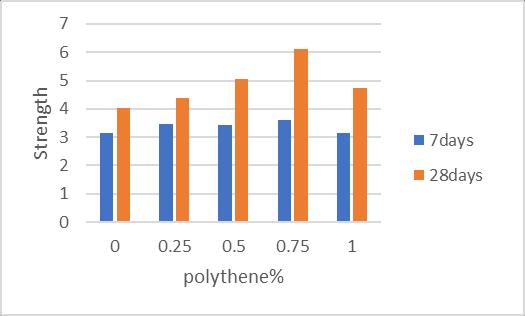
To assess the concrete's compressive quality for 7 and 28 days,acompressivestrengthtestingapparatusisused.150 mm'oftestdrivingoncementmixturesiscarriedoutusing thebearingsindicatedinIS516-1959.Examplesarerapidly testedafterbeingtakenoutofthewaterwhilestilltakinginto accountthedampenvironment.Anyprotrudingbalancesare isolated,and the exampleiscleansedofsurface waterand mud.Beforetesting,theexamplesareweighedtoestablish their thickness. The compressive burden rises until the instancesarecrushed.
Table-4: Compressivestrengthofconcrete
2.3Coarse Aggregate:
The stones that are kept in a 4.75 mm sifter are coarse totals.Locallyavailablecoarsetotalscomeintwosizes;one divisiongoesthrougha20mmsifterandtheothersection goes through a 10mm strainer. The specific coarse total gravityforthetwosectionsandthefinenessmodulusforthe coarsetotalinsizesof10mmand20mm.
Table-3: propertiesofcoarseAggregate
Graph-1: Compressivestrengthofconcrete
3.2Flexural Strength of concrete
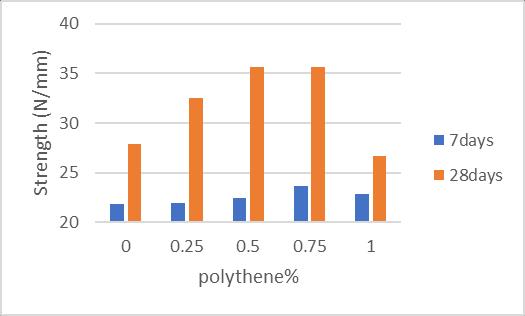
Theflexiblestrengthofthecementmadebythepolythene aftercuringperiodsof7and28daysisgiveninthetable10. Thetestoftheflexuralstrengthisshownintable5.Andall theseresultsareclearlyshownintable6.Afterperforming thetestwegetincreasetheflexuralstrengthbytheincrease thepercentagesofthepolythenedebrisinthecement.
FLEXURALSTRENGTHOFCONCRETE
4. CONCLUSIONS
Polythenebagsmadefromleftoverplasticcanbe usedeffectivelywithoutsignificantlychangingtheir mechanicalqualities.
Workability declines with increasing waste polythenecontentincementatall ages,suchas7 and28days.
Here, the ideal total amount of polythene was replaced with an equal amount of concrete while givingconsiderationtobothcompressivestrength andsplitrigidity.
After taking waste polythene in cement into account,anincreaseinbothcompressivestrength and flexural strength is observed throughout all cementperiods.
So,itstandstoreasonthattheideaofmixingtrash polythene with cement could be a very natural, peaceful methodofgettingridofseriousabuseof ourcountry
REFERENCES
[1] Bhogayata,K.D.Shah,B.A.vyas,N.K.Arora“Feasibility of wastes metallised polythene used as concrete constituent”inInternationalJournalofEngineeringand AdvancedTechnology(IJEAT),Volume-1,Issue-5,June 2012
[2] Bhogayata, K. D. Shah, B. A.vyas, N. K. Arora“PerformanceofconcretebyusingNonrecyclable plasticwastesasconcreteconstituent”inInternational Journal of Engineering and Advanced Technology (IJEAT),Vol.1Issue4,June–2012
[3] Ankit Kumar, Vikas Srivastava and Rakesh Kumar , “Effectofwastepolytheneoncompressivestrengthof concrete”,JournalofAcademiaandIndustrialResearch, Volume3,Issui3,August2014pp.152-155.
Baboo Rai,S. Tabin Rushad,2 Bhavesh Kr, and S. K.Duggal“Study of wastes plastic mix concrete with plasticizer”inInternationalScholarlyResearchNetwork ISRNCivilEngineeringVolume2012,ArticleID469272, doi:10.5402/2012/46927
[4] IS: 456. 2000. Indian Standard “Plain and Reinforced Concrete”-Codeofpractice.BureauofIndianStandards, NewDelhi
Graph-2: FlexuralStrengthofconcrete
[5] IS: 516. 1959. Indian Standard “Methods of Tests for StrengthofConcrete”-Codeofpractice.BureauofIndian Standards,NewDelhi.
[6] IS: 10262. 2009. Indian Standard “Recommended Guidelines for Concrete Mix Design”-Code of practice. BureauofIndianStandards,NewDelhi
[7] IS:383.1963.IndianStandard“SpecificationforCoarse andFineAggregatesfromNaturalSourcesforConcrete”Codeofpractice.BureauofIndianStandards,NewDelhi.
[8] K.S.Rebeiz,“Precastuseofpolymerconcreteusingun saturatedpolyesterresinbasedonrecycledPETwaste” inConstructionandBuildingMaterials,vol.10,no.3,pp. 215–220,1996
[9] MarzoukOY,DheillyRM,QueneudecM.“Valorisationof PostConsumerWastePlasticinCementitiousConcrete Composites”,PubMed,U.S.NationalLibraryofMedicine, National Institute of Health,vol. 27 (2), Issue-12, 310May,2006
[10] Naik, T.R., S.S. Singh, C.O. Huber and Broderson, 1996 “Use of postconsumer waste plastic in cement based composites”.Cem.Concr.Res26:1489-149
[11] R. Kandasamyand R. Murugesan“Fibre reinforced concrete using domesticwastes plastics as fibres” in ARPNJournalofEngineeringandAppliedSciences,Vol.6, No.3,March20
[12] D. Kornack and P. Rakic, “Cell Proliferation without NeurogenesisinAdultPrimateNeocortex,”Science,vol. 294, Dec. 2001, pp. 2127-2130, doi:10.1126/science.1065467.