Study of Effect of Variation of Filler Type and its Proportion in Bituminous Mixes
Prahallad B S1 , Jaya R
Shinganmakki2 , Swathi J3, Mohan M4
1P.H.D Scholar, Department of Highway Technology, RASTA-Center for Road Technology, Bengaluru, Karnataka, India
2Associate Professor, Department of Highway Technology, RASTA-Center for Road Technology, Bengaluru, Karnataka, India

3M-Tech Scholar, Department of Highway Technology, RASTA-Center for Road Technology, Bengaluru, Karnataka, India
4M-Tech Scholar, Department of Highway Technology, RASTA-Center for Road Technology, Bengaluru, Karnataka, India
Abstract - Bituminous mixes are vital components of modern infrastructure, and maximizing their qualities is crucial for providing long-lasting and resilient road surfaces. This study investigates the impact of changing the filler kinds and content in bituminous mixes. Mineral powders, polymers, and recyclable materials were all systematically mixed into bitumen- aggregatemixesinvariousamounts.Themechanical, rheological, and aging properties of themodified bituminous mixtures were investigated using a complete set of laboratory tests. The research exposes unexpected links between filler qualities, content levels, and overall performance. Standard tests were used to evaluate mechanical qualities such as stiffness, resistance to deformation, and fatigue behavior. The rheological properties of the mixes were also evaluated in order to better understand their workability and flow characteristics. The findings offer substantial knowledge into modifying bituminous mix formulations to achieve a balance that optimizes mechanical characteristics and long-term durability. This research contributes to the advancement of sustainable and efficient highway building materials, thereby enhancingtheoverallqualityandservice lifeoftransportation infrastructure.
Key Words: Filler1, Marshall properties2, Volumetric properties3 and Indirect Tensile Strength4.
1. INTRODUCTION
Bituminousmixes,whichareusedinroadbuildingand pavement applications, are made composed of aggregates and bitumen binder and provide transportation infrastructure with durability and structural stability. Improving their performance is in line with the changing needsofmoderntransportation.Thechangingoffillertype andcontentisamainpoint.Fillers,whicharefinelydivided materials added to improve specific characteristics of bituminousmixes,havethepotentialtoimprovemechanical, rheological,andagingqualities.Theirchangingcomposition andcontentallowforcustomizedblendattributestofulfill individualneeds.Giventhestressimposedbyelementssuch
***
as traffic loads and temperature fluctuations, ensuring the performanceofbituminousmixesiscriticalforthelong-term viabilityandsustainabilityofroadnetworks.Thisstudylooks intothe effectof fillertypeandcontent on bituminous mix performance,aswellastheinteractionsbetweenfillersand bitumen-aggregate.
1.1 Role of Fillers in Bituminous Mixes
Fillers in bituminous mixes are finely powdered ingredients that improve mechanical strength, binderaggregate adhesion, and durability. They increase rigidity, preventdeformation,andpreventcracking,whichisessential forload-bearingandminimizing pavementdistress.Fillers helptoachieveoptimalworkabilityandcompactionduring constructionbyaffectingrheology.Theirabilitytofillvacant spacesassuresdensemixes,decreasingwaterinfiltrationand increasingstability.Fillerssavemoneybysubstitutingmore expensivecomponentsandhelptheenvironmentbyusing recycledmaterials.Overall,fillers enableengineerstoalter thequalitiesofasphaltmixes,resultingindurable,flexible, andenvironmentallyfriendlyroadinfrastructure.
2. MATERIALS
Asphalt is a bituminous mix that combines aggregates (such as crushed stone, gravel, and sand) with bitumen, a sticky binder. Bitumen binds, gives flexibility, and waterproofswhileaggregatesprovideload-bearingstrength. Fillers such as limestone dust and fly ash improve cohesivenessandmoistureresistance.Thecompositionofthe mixvariesaccordingtoclimate,traffic,andpurpose,withthe goalofcreatinglong-lasting,high-qualitypavement.Weused VG-30binder,aggregates,hydrauliclime,andcementwith variablefillerproportionsof2%,4%,and6%forBCgradeII.
3. METHODOLOGY
Thestudyemphasizesthevalueofbituminouspavements thatare both economical and environmentally friendly.As alternativestoexpensivefillerslikecement,researchersare looking into alternative waste products including marble dust,stonedust,flyash,etc.Resultsthatweresatisfactoryin Marshallpropertiespointtotheirabilitytotaketheplaceof conventionalfillersandprovideagreenerpavingmethod.
Theresearchassessedflyash,stonedust,andhydrated limefillers'impactonNigerianroadasphaltquality.Hydrated lime yielded optimal stability (6% bitumen, 7% filler) and minimalairvoids/VMA(6%bitumen,10%filler),suggesting durable,cost-effectivepavementssuitableforheavytraffic. Hydrated lime is recommended as the preferred filler for improved road performance and reduced construction expenses.
The paper analyzes the impact of diverse additives on bituminous pavement characteristics, comparing conventionalfillers(flyash,brickdust)andunconventional ones(cement,lime,stonedust).Optimalbitumencontentand effectsonstability,flow,unitweight,airvoids,andVMAare studied. Unconventional fillers exhibit promises for cost reduction and eco-friendly waste disposal in pavement construction.
Theeffectsofhydratedlimeandcalciumcarbonatefillers in bitumen on microcrack behavior, healing, and flow throughout pavement temperatures are highlighted by rheological tests. Thepaper highlights effective filler uses through rheological models and bitumen microstructure hypotheses,highlightingthesignificanceofmicro-nanoscale interactions.
5.
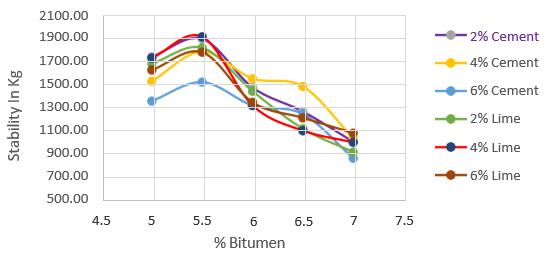
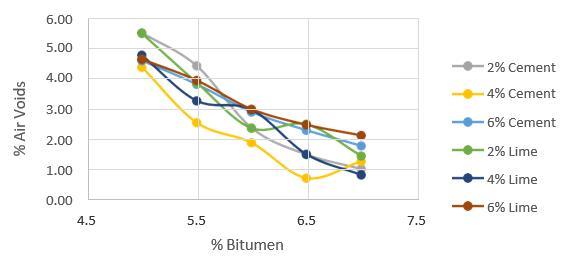
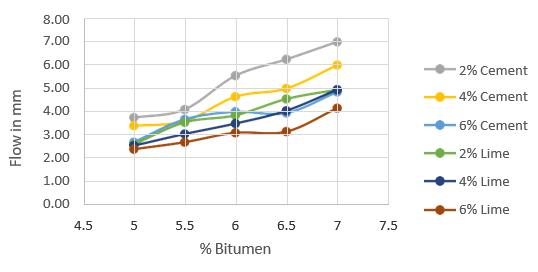
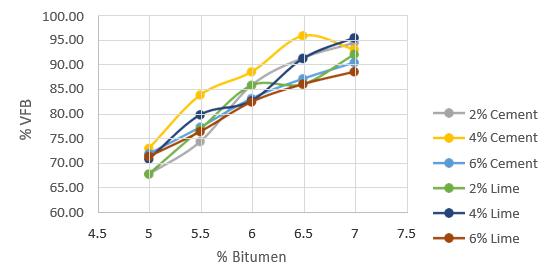
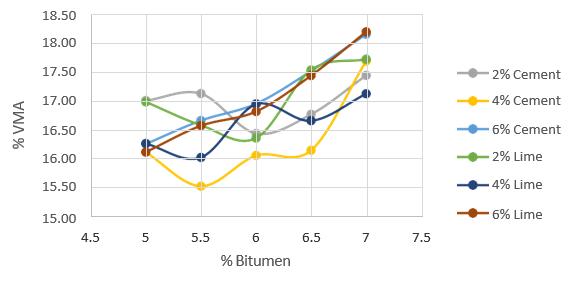
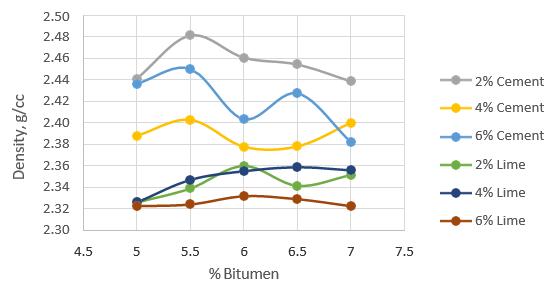
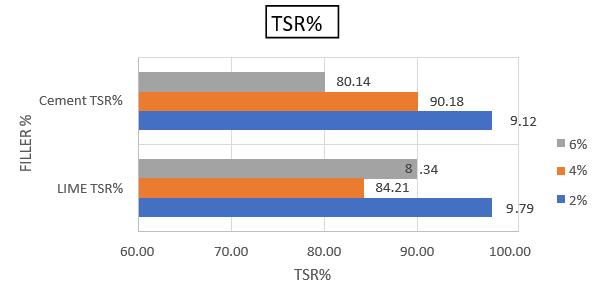
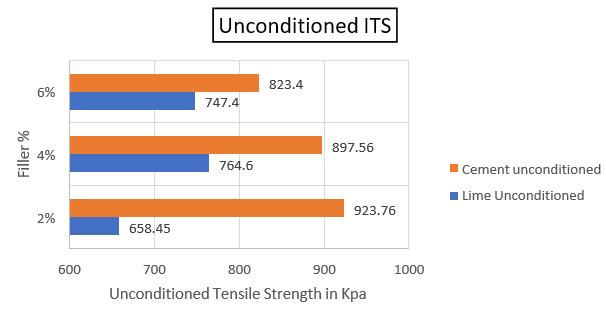
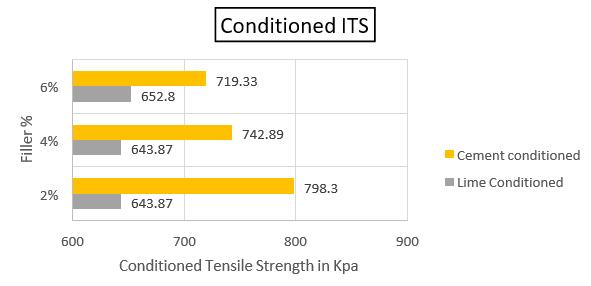
Marshall stability and performance experiments were conducted on bitumen mixes with varying filler and quantities to establish the ideal filler and percentage. The resultsofthetestsarelistedbelow.
6. CONCLUSIONS
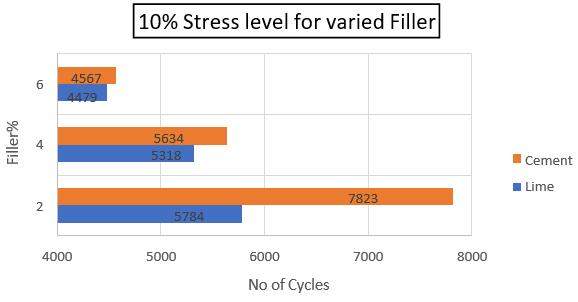
Thestudythatlookedattheeffectoffillertype and quantity in bituminous mixes yielded useful insights into the performance and attributes of asphaltmixes.Comprehensivetestingandanalysis revealed thatthefillerCement and its proportion 2% (cement 2%) had a considerable influence on themechanical,durability,andrheologicalqualities ofbituminousmixes.Thestudydiscoveredthat2% cementimprovesthecohesionandadhesionofthe mix, resulting in enhanced resistance to cracking,
Furthermore,2%cementfillermaterialhasbeen shown to play a critical role in achieving appropriate aggregate-asphalt-filler interactions. 2% cement is regarded anadequate filler fraction thathelps togreatervoid-fillinganddensification within the mixture, leading in improved loadbearing capacity and overall pavement performance.
However,moreresearchandtestingareneeded to refine and build on these findings. Additional researchcouldlookintothe long-termimpactsof different filler types and quantities under varied environmental and traffic circumstances. Overall, this researchhighlights the importance of filler material selection and proportion in constructing long-lastingandsustainablebituminousmixesfor roadconstructionandmaintenance.
REFERENCES
[1] Gazi Mohammad Harun-Or-Rashid and Mohammad MohayminulIsla,“AReviewPaperon:EffectofDifferent TypesofFillerMaterialsonMarshallCharacteristicsof BitumenHotMix”.
[2] Oladapo,S.A.andAdetoro,A.E,“ComparativeAnalysisof EffectsofFillerMaterialsonPerformanceofAsphalt”.
[3] KonReddyRajitha,TejaswiKoramutla,“EffectofFillers onBituminousPavingMixes”.
[4] DallasN.Little1andJ.ClainePetersen,“UniqueEffectsof Hydrated Lime Filler on the Performance Related PropertiesofAsphaltCements:Physical andChemical InteractionsRevisited”
[5] ASTM D 6927-15. (2015). Standard Test Method for Marshall Stability and Flow of Bituminous Mixtures. AnnualBookofAmericanSocietyforTestingmaterials ASTMStandards,1–7.
[6] ASTM D6931-17. (2017). Standard Test Method for IndirectTensile(IDT)StrengthofBituminousMixtures 1.3–7.
[7] ASTM:D2041-03a.(2003). Standard TestMethod for Theoretical Maximum Specific Gravity and Density of BituminousPavingMixtures.ASTMInternational,1–7.