International Research Journal of Engineering and Technology (IRJET) e-ISSN:2395-0056

Volume: 10 Issue: 08 | Aug 2023 www.irjet.net
Zero Shot Learning
Mudassir Ubaid1, Mohd Tanveer Hasan2
1Student, Dept. of Computer Engineering, Zakir Hussain College of Engineering and Technology, Aligarh Muslim University, Aligarh, India
2Student, Dept. of Computer Engineering, Zakir Hussain College of Engineering and Technology, Aligarh Muslim University, Aligarh, India ***
Abstract - This paper provides a comprehensive overview of zero-shot learning (ZSL), a subfield of machine learning that aims to recognize and classify new objects or concepts without prior exposure during training. ZSL utilizes semantic representations to enable models to generalize to new concepts, based on the knowledge acquired in related classes. The paper discusses the two primary types of semantic representations, attribute- based and semantic space-basedmethods,andexaminesre-centdevelopmentsin ZSL, such as generative models, novel semantic representationmethods,andmulti-modalZSL.Thepotential applications of ZSL in a variety of fields, including natural language processing, computer vision, and robotics, are also highlighted. Finally, the paper discusses the future directions and challenges of ZSL research, including the need for large-scale datasets, improved evaluation metrics, and more robust semantic representation methods. Despite facing obstacles, recent advances in ZSL have shown promising results in enabling models to recognize and classify new objects or concepts without prior exposure to themduringtraining.
Key Words: Zero-shot learning, Machine learning, Deep learning, Semantic embedding, Computer Vision, Unsupervised Learning, Image Classification, Few Shot Learning,NaturalLanguageProcessing,DataAugmentation, Embeddings, Generative Models, Transfer Learning, ConvolutionalNeuralNetworks(CNN).
1.Introduction
Zero-shotlearning(ZSL)isasubfieldofmachinelearning that aims to recognize and classify new objects or concepts without prior exposure during training. Traditional supervised learning methods require large amountsoflabeleddatatotrainmodels,whichcanbecostly andtime-consuming. ZSL,ontheotherhand,providesan alternative solution to this issue by enabling models to generalizetonewconceptsviasemanticrepresentations.ZSL is based on the concept of transfer learning, which generalizestheknowledgeacquiredinrelatedclassestonew ones. This is accomplished by employing semantic representations, which capture the relationships between classesandenablethemodeltoreasonabouttheproperties ofunseenclasses. Therearetwoprimarytypesofsemantic representations: attribute-based and semantic space-based methods. Eachclassis described byacollectionofattributes,
suchascolor,size,andshape,which areusedtoreasonabout the properties of unseen classes. Classes are mapped to a highdimensional space based on theirsemantic relationships, such asco-occurrenceandWordNethierarchy,usingsemanticspacebasedmethods.ZSL has been implemented successfully in a variety of fields, including natural language processing, computer vision, and robotics. ZSL has been utilized in natural language processing for tasks such as sentiment analysis and text classification, in which the model must recognizenewconceptsnotpresentinthetrainingdata. ZSL has beenutilizedincomputervisionfortaskssuchas image classificationandobjectdetection,inwhichthemodelmust recognize new objects or attributes not present in the training data. ZSL has been utilized in robotics for tasks suchasobjectmanipulationandgrasping,inwhichtherobot mustrecognizenewobjectsnotpresentinthetrainingdata.
Despiteitssuccess,ZSLstillfacesanumberofobstaclesthat mustberesolved.Lackoflarge-scaledatasets withsufficient labeleddatafortheseenclassesandadi-versesetofunseen classesisoneofthegreatestobstacles.Anotherobstacleisthe need for improved methods of semantic representation that can capture the complex relationships between classes. In addition, theevaluation ofZSL models remains anunresolved issue, as traditional classification metrics may not be appropriateforevaluatingtheperformanceofZSLmodels.
Recent developments in ZSL have yielded promising outcomes in addressing a number of these obstacles. For instance, generative models such as generative adversarial networks (GANs) and variational autoencoders (VAEs) have been utilized to generate synthetic data for unseen classes, therebyenhancingtheperformanceofZSLmodels.Inaddition, recentstudieshaveproposednovelse- mantic representation methods, such as knowledge graph- based and graph neural network-based methods, that cancapturethecomplexityof therelationshipsbetweenclasses.
In this paper, we provide a comprehensive overview of the currenttechniquesinZSL,includingthechallengesandrecent developments. First,wepresentthefundamental conceptsof ZSLandthevarioustypesofsemanticrepresentations. Then, we examine the most recent developments in ZSL, such as generative models, novel semantic representation methods, and multi-modal ZSL. Further- more, we discuss the potential applications of ZSL ina varietyoffields,including naturallanguageprocessing, computer vision, and robotics.
Finally,wehighlightthefuturedirectionsandchallengesof ZSL research, including the need for large-scale datasets, improved evaluation metrics, and more robust semantic representationmethods.
ZSLisapromisingareaofresearchthathasthepotential to enable models to recognize and classify new objects or concepts without prior exposure to them during training. Recent advances in ZSL have shown promising results in addressingsomeofthesechallenges,despitethepersistence of obstacles. This review paper provides a thorough understanding of ZSL and highlights its potential applicationsandfutureresearchdirections.
2. Types of Zero Shot Learning
2.1Attribute Based ZSL
Attribute-based zero-shot learning (ZSL) is a type of machine learning technique that enables a model to recognize previously untrained objects or categories. In attribute-based ZSL, the model is trained on a set of knowncategories,butitcanclassifynewcategories using the attributes associated with each category during inference.
The attributes are a collection of semantic descriptions that describe the visual qualities or characteristics of an object or category. For instance, the attribute "has wings" could be associated with the category "bird," while "four legs" could be associated with the category "dog." During inference, the model receives as input a new image and predicts its category based on the image’s attributes. Even if the model has never seen the category before, it can still make a prediction based on the category’sattributes.
Attribute-based ZSL is useful in situations where obtaining labeled data for all possible categories may be difficult or expensive. Utilizing semantic information in the form of attributes, it allows models to generalize to newcategories.
2.2Semantic embedding-based zero-shot learning
Based on Semantic Embedding Semantic embeddingbased zero-shot learning (ZSL) is a machine learning technique that enables models to recognize and classify unseenclassesusingasemanticembeddingspace.Eachclass isrepresentedasavectorofattributesorfeatures within thesemanticembeddingspace.
In ZSL based on semantic embeddings, the model is trained on a set of known classes and their respective semantic embeddings. The model predicts the class of an unseen example during inference by projecting it onto the semantic embedding space and locating the closest class vector.
Using a similarity measure, such as cosine similarity, the distance between the example and the class vector is computed.Thepredictedclassistheonethatisclosesttothe instance.
Utilizing techniques like principal component analysis (PCA) or metric learning, the semantic embedding space is typicallylearned. Byacquiringknowledgeoftheembedding space, the model can effectively generalize to new classes that werepossiblyneverencounteredduringtraining.
ZSLhasbeenappliedtoavarietyoftasks,includingimage classification, text classification, and natural language processing, on the basis of semantic embedding. It is useful whenthenumberofseenclassesislimitedand new,unseen classesmustbeidentifiedandclassified.
2.3Generalized ZSL
Generalized zero-shot learning (ZSL) is a type of machine learning approach that extends traditional ZSL methods to handle a scenario in which some of the test classes have been observed during training, in addition to new, unobservedclasses.
In generalized ZSL, the model is trained using asetof seen classes and their corresponding semantic embeddings, aswellasasetofunseenclassesforwhichnovisualexamples are available during training. During inference, themodel is evaluatedagainstbothobservedandunobservedclasses.
GeneralizedZSLaimstoteachamodelthatcaneffectively recognize and classify both seen and unseen classes. To accomplishthis,themodelmustlearntotransferknowledge from seen classes to unseen classes without overfitting the seenclasses.
There are various strategies for generalizing ZSL, such as domain adaptation and hybrid methods. The objective of domain adaptation methods is to adapt the model’s representation to unseen classes by utilizing information available from seen classes. Hybrid methods combine various ZSL techniques, such as attribute-based and semantic embedding-based ZSL, to improve performance for bothseenandunseenclasses.
Generalized ZSL is useful in situations where new classes mustbeidentifiedandclassified,butsomesimilarclasseshave alreadybeenencounteredintraining. Itenablesthemodelto utilizetheavailableknowledgefromtheseenclassestoimprove itsperformanceontheunseenclasses.
2.4Multi-modal zero-shot learning
Multi-modal zero-shot learning (ZSL) is a type of machine learningtechniquethatcombinesinformationfrommultiple modalities, such as images, text, and audio, to recognize and classifyunseenclasses.
In multi-modal ZSL, the model is trained using a collection of known classes, their corresponding semantic embeddings, and multiple modalities of data. During inference, the model predicts the class of an unseen example by analyzing its semantic embeddings and the variousdatamodalitiesassociatedwithit.
In image classification, for instance, the model may be trained on a set of classes, their corresponding image features, and textual descriptions. During inference, the model may receive an image and textual description of an unseen class. Using the image characteristics and textual description, the model can then predict the semantic embedding of the unseen class and classify the image accordingly.
Multi-modalZSLisusefulwhenmultipledatamodalities areavailableandeachprovidescomplementaryinformation abouttheobjectsorclassesbeingclassified.By integrating data from multiple modalities, the model’s ac- curacy and generalization performance on unseen classes can be enhanced.
Multiple tasks, including image classification, speech recognition,andnaturallanguageprocessing,haveutilized multimodalZSL.Itisapotentmethod thatcanbe utilized to solve a variety of real-world issues where data from multiplesourcesisavailable.
3. Challenges in Zero Shot Learning
The semantic gap between the visual and semantic domains presents one of the main difficulties in zero-shot learning. The generalization problem, which requires the modeltoapplytoclassesthathavenotyetbeenseen and maylacktrainingsamples,presentsanotherdifficulty.While some methods use semantic embeddings to fill the gap between the visual and semantic spaces, others transfer knowledgefromseentounseenclasses.
3.1Evaluation Metrics
Measurement Metrics: Zero-shot learning (ZSL) employs evaluation metrics to measure the performance of ZSL models in recognizing and classifying unseen classes. Several evaluation metrics are commonly employed in ZSL:
1. Top-1 Accuracy: This metric measures the proportionofcorrectlypredictedlabelsforagivenset of un- seen classes. The predicted label of the model must match the ground-truth label for the classificationofanexampletobeconsideredcorrect.
2. Top-5 Accuracy: Thismetricmeasuresthepercentage ofinstances for which the ground-truth label is among thetopfivelabels predictedbythe model. In other words, the model receives credit for identify-
ing the correct class, even if its prediction is not the mostconfident.
3. Harmonic Mean (H): This metric takes boththe Top-1andTop-5accuraciesintoaccountandprovides amorebalancedevaluationofthemodel’sperformance. It is the harmonic mean of the Top-1 and Top-5 precisions.
4. Area Under the Curve (AUC): Thismetricmea- sures theaccuracyofthemodel’srankingofunseenclasses.It is calculated as the area beneath the re- ceiver operating characteristic (ROC) curve where the true positive rate is plotted against the false pos- itive rate forvariousthresholdvalues.
5. Mean Average Precision (MAP): This metric measures the model’s precision across all unseen classesonaverage. Itiscalculatedasthemeanof each class’saverageprecisionscores.
In ZSL, evaluation metrics are essential because they quantify the model’s performance in recognizing and classifying unseen classes. Using these metrics, researchers are abletocomparetheperformanceofvariousZSLmod-elsand identifyimprovementopportunities.
3.2Data Bias
Databiasinzero-shotlearning(ZSL)iswhenthetrainingdata used to construct the model is not representative of the actual distribution of the classes being recognized and classified. Thiscanresultininaccuratepredictions and poor generalization performance, especially for classes that have not beenobserved.
ZSL data can be biased in multiple ways. For instance, if the trainingdataisskewedtowardcertainclasses,suchas animals or vehicles, the model may perform poorlyonclassesfrom other domains, such as food or sports. Similarly, if the trainingdataisbiasedtowardparticular regionsorcultures, themodelmayperformpoorlywhenappliedtoclassesfrom otherregionsorcultures.
When semantic embeddings used to represent classes are biasedorinsufficient,databiascanalsooccur. Forinstance, if the semantic embeddings are derived from biased sources, such as a specific language or cultural context, the model may struggle to generalize to unobserved classes in othercontexts.
ToreducetheimpactofdatabiasinZSL,researchers must design and curate their training and evaluation datasets with care. This requires ensuring that the training data is representative of the distribution of the classes being recognized and classified in the real world, and that the semanticembeddingsareexhaustiveandobjective.
In addition, data augmentation techniques can be used to artificially increase the diversity of the training data, whiledomainadaptationtechniquescanbeusedtoadaptthe model’s representation to the unseen classes. Researchers can then carefully monitor the performance of their ZSL modelsonvarioussubgroupsofclassesinordertoidentify potential biases and enhance the model’s generalization performance.
3.3Hybrid Methodologies
Hybrid approaches in zero-shot learning (ZSL) combine multiplemethodsormodalitiestoimprovetheZSLmodels’ precisionandgeneralizationperformance. Thesemethods combine data-driven and knowledge-based approaches to overcome the limitations of each and achieve superior results.
Combining data-driven approaches, such as deep learning models, with knowledge-based approaches, such as semantic embeddings or attributes, is a common hybrid strategyinZSL.Forinstance,aZSLmodelmaybetrainedusing adeepneuralnetworkonalargeamountofvisualdata,and then a knowledge-based approach, such as at- tributes or semanticembeddings,maybeusedtomapthevisualfeatures tothecorrespondingclasslabels.
Combining multiple modalities of data, such as visual and textual data, to improve the model’s precision is anotherhybridapproachinZSL.Forinstance,aZSLmodel may be trained on both visual and textual data using a multi-modaldeeplearningarchitecture,andthengeneralize tounseenclassesusingaknowledge-basedapproach.
Hybrid approaches may also employ transfer learning strategiestotransferknowledgefromrelatedtaskstothe ZSL task. For instance, a ZSL model may be pre- trained on a related task, such as image classification or object detection,andthenfine-tunedusingasmallersetoflabeled examplesfortheZSLtask.
Overall, hybrid approaches in ZSL can leverage the strengths of different methods and modalities to improve the accuracy and generalization performance of ZSL models, and are an active area of machine learning research.
4. Zero Shot Learning with semantic output codes
Zero Shot Learning through the use of semantic output codes: Zero-shot learning (ZSL) with semantic output codes is a method for classifying unseen classes using semanticrepresentations. Inthismethod,boththeseenand unseen classes’ semantic information is used to create a semantic codebook, which represents the semantic relationshipsbetweenclassesandattributes.
During training, the model is taught to predict the semanticcodeforeachobservedclassexample. Thisexample’s semantic code is a binary vector that encodes thepresence orabsenceofeachattribute.Thesemanticcodeisacondensed representationofthevisualcharacteristicsofanexamplethat capturesthemostpertinentinformationforclassification.
Oncethemodelhasbeentrained,itcanbeusedtoclassify unobserved examples by predicting their semantic codes The semantic code of an unseen example is then utilized to retrieve the semantic codebook class that is most similar. Theretrievedclassisthenusedastheclasslabelpredictionfor theunseenexample.
ZSLwithsemanticoutputcodesoffersnumerousbenefits. First,itcanhandlebothvisibleandinvisibleclasseswithina single framework, making it more applicable to real-world applications. Second, it can utilize the semantic relationships betweenclassesandattributestoenhancetheaccuracyofthe model and reduce the impact of noisy data. Lastly, it can handle the open-set problem by assigning examples that do notbelongtoanyoftheseenorunseenclassestoaseparate "unknown"class.
However,ZSLwithsemanticoutputcodeshaslimitations as well. For instance, it requires semantic annotations for both the visible and invisible classes, which is not always possible. Moreover, it may be sensitive to the quality of the semantic representations and the selection of the semantic codebook.
5. Zero Shot Learning with visual attributes
Zero-shot learning (ZSL) with visual attributes is a classification technique that employs a set of semantic attributestorepresentthevisualcharacteristicsofobjectsand classify them into unseen classes. Suppose, for instance, that we wish to categorize images of animals according to their species. To represent the visual characteristics of various animals, we can use visual attributes like "has wings,""hasfur,""hasabeak,"etc.
During training, the model is taught to predict the attributesofeachobservedclassexample.Theattributesare abinaryvectorencodingthepresenceorabsenceofeach attributefortheprovided example. Theattributevectoris a condensed representation of the visual characteristics of theexamplethatcapturesthemostpertinentinformation forclassification.
Once the model has been trained, it can be used to classify unobserved examples by predicting their attribute vector. Theattributevectorofanunseenexampleis then utilizedtoretrievetheattributespace’smostsimilar class. Theretrievedclassisthenusedastheclasslabelprediction fortheunseenexample.
ZSL with visual attributes offers numerous benefits. First,itcanhandlebothvisibleandinvisibleclasseswithina single framework, making it more applicable to realworld applications. Second, it can utilize the semantic relationshipsbetweenattributestoenhancetheaccuracyof themodelandreducetheimpactofnoisydata.Lastly,itcan handle the open-set problem byassigning examples that do not belong to any of the seen or unseen classes to a separate"unknown"class.
However, ZSL with visual attributes has limitations as well. For instance, it requires accurate visual attribute annotations for both the visible and invisible classes, which is notalwayspossible.Inaddition,itmaybeaffectedby the qualityoftheattributeannotationsandtheattributespace chosen.
6. Zero Shot Learning with Few Shot adaptation
Zero-shot learning (ZSL) with few-shot adaptation is a classification technique that combines the advantages of
ZSL and few-shot learning to classify examples into unknown classes using limited labeled data. Suppose, for instance, that we wish to classify images of birds into variousspeciesbuthaveonlyafewlabeledexamplesforeach species.
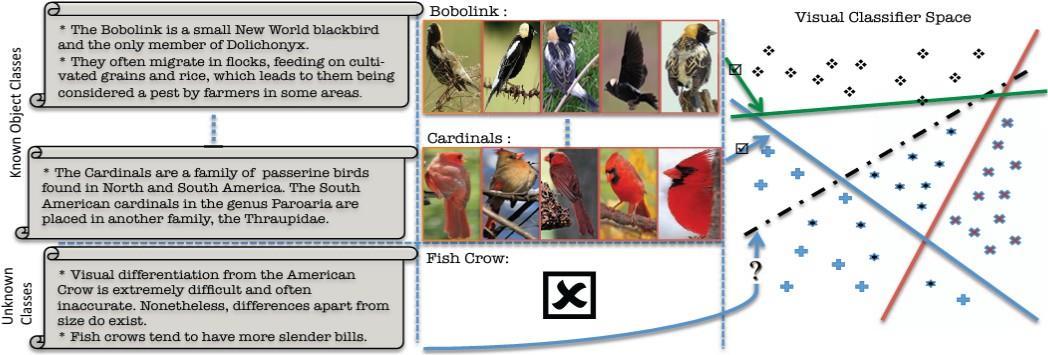
During training, both labeled examples from the seen classes and semantic representations of the unseen classes are used to train the model. Semantic representations may be attributevectorsorsemanticembeddings. Themodelisthen fine-tuned on a small number of labeled examples from the unseen classes, referred to as the support set, in order to accommodatethevisualcharacteristicsofthenewclasses.
After the model has been optimized, it can be used to classify examples from unseen classes by comparing them tothe trainingset.Inparticular,foreachunseenexample,themodel selects the semantically most similar examples from the training set. The class label for the unseen exampleisthen predictedusingtheselectedexamples.
ZSLwithfew-shotadaptationoffersnumerousbenefits.First, itcanimprovethemodel’saccuracybyutilizingthe semantic information of both the seen and unseen classes. Second,it can dealwiththefew-shotlearningproblem,inwhichtherearefew labeledexamplesfortheunobserved classes,byadaptingthe model to the new classes with a small number of labeled examples. Lastly, it can handle the open-set problem by assigning examples that do not belong to any of the seen or unseenclassestoaseparate"unknown"class.
However, ZSL with few-shot adaptation has limitations as well. It requires accurate semantic representations for both the seen and unseen classes, which is not always possible. Additionally, itmaybesensitivetothequalityof the support setandthesimilaritymetricchosen.
7. Zero Shot Learning for natural language processing
Zero-shot learning (ZSL) for natural language processing (NLP) is a technique that enables a machine learning model to predict unobserved tasks without the need for additional training data. Suppose, for instance, that we wish to train a model to classify movie reviews into different sentiment categories, such as positive or negative,withoutexplicitlytrainingonthespecifictask.
In ZSL for NLP, the model is trained on tasks that share semantic and linguistic characteristics with the unknown task. Frequently, these tasks are referred to as "auxiliary tasks." The model is trained to predict the labels of auxiliary tasks based on their inputs, such as text or audio data,duringtraining.
Once the model has been trained, it can be utilized to make predictions on the unseen task by utilizing the semantic and linguistic features learned from the auxiliary tasks. Iftheunknowntaskistoclassifymoviereviews,for instance,wecanencodethetextinputsofthereviewsintoa semantic space that represents the text’s meaning. The semantic space can be represented by a collection of semantic vectors, each of which corresponds to a particularsentimentcategory. Themodelcanthenpredictthe review’s sentiment category by selecting the vector in the semanticspacethatismostsimilar.
ZSL for NLP has multiple benefits. First, it can reduce the quantity of labeled data required for training by utilizingtheknowledgegainedfromrelatedtasks.Second, it can deal with the zero-shot learning problem, which occurs when there are no labeled examples for the unseen task, by transferring the knowledge acquired from the auxiliary tasks. Lastly, it can manage the open-set problem, in which there may be examples that do not belongtoanyoftheseenorunseenclasses,byassigningthem toadistinct"unknown"category.
8. Relevant Work
Our proposed work can be understood in terms of knowledge transfer and inductive learning. In general, the objectiveofknowledgetransferistoincreaserecognitionby utilizingsharedknowledgebetweenclasses. Themajority ofpriorresearchfocusedonknowledgesharingexclusively within the visual domain, e.g. [12]; or on exporting semantic knowledge at the level of category similarities andhierarchies[10,27].Beyondthecurrentstateoftheart, we investigate cross-domain knowledge sharing and transfer. We investigate how knowledge from the visual and textual domains can be utilized to discover crossdomain correlation, which facilitates the prediction of visual classifiers from textual description. Motivated by thepracticalneedtolearnvisualclassifiers foruncommon categories, researchers have investigated approaches for
learningfromasingleimage(one-shotlearning[18,9,11,2]) or even from no images (zero-shot learning). Recognizing objectinstances frompreviously unseen test categories (the zero-shotlearningproblem)canbeaccomplished,inpart,by leveraging knowledge about shared attributes and components. Typically, an intermediate semantic layer is introduced to facilitate the sharing of knowledge between classes and the descriptionof previously unseen classes, e.g. [22]. For example, given appropriately labeled training data, it is possible to learn classifiers for attributes occurringintrainingobjectcategories.Then,theseclassifiers can be used to identify the same attributes in instances of objects from novel test categories. The recognition process canthenproceedbasedontheseacquiredcharacteristics[17, 7]. These attribute-based "knowledge transfer" approaches utilize an intermediate visual attribute representation in order to describe categories of unseen objects. Typically, humansdefineattributesmanuallytodescribeshape,color, and surface material, e.g., furry, striped, etc. Therefore, an unseen category must be specified using the vocabulary of attributes currently in use. Rohrbach et al. [25] studied the extractionofvaluableattributesfrom large text corpora. In [23], a method for interactively defining a vocabulary of attributesthatarebothhuman- readableandvisuallydistinct was presented. Our work, in contrast, utilizes no explicit attributes.Anewcategory’sdescriptionisentirelytextual. It has been investigated how linguistic semantic representations relate to visual recognition. In [4], it was demonstrated that there is a strong correlation between Word-Net-based semantic similarity between classes and confusionbetweenclasses.Large-scaleimagedatasets,suchas ImageNet[5]andTinyImages[30],haveutilizedthelinguistic semantics of WordNet nouns [19] to collect large-scale image datasets,such as ImageNet[5] and Tiny Images [30]. It has also beendemonstratedthatWordNet-basedhierarchiesare usefulforlearningvisualclassifiers,e.g.[27].Barnardetal.[1] demonstrated that learning the joint distribution of words andvisual elements facilitates semantic clustering of images, the generation of illustrative images from a caption, and the generation of annotations for new images. Recent research that focuses on generating textual descriptions of imagesandvideos,suchas[8,16,34,14],hasdemonstrated a growing interest in the intersection between computer vision and natural language processing. This includes generating sentences about objects, actions, attributes, spatial relationships between objects, contextual information in the images, scene information, and so on. In contrast,ourworkdiffersfundamentallyintwoways. Weare not interested in generating textual descriptions from images;rather,weareinterestedinpredictingclassifiersfrom textinazero- shotsetting.Intermsofthelearningcontext, the textual descriptions we employ are at the level of the category and do not consist of image-caption pairs, as is commonindatasetsusedfortextgenerationfromimages,such as[21].
9. Problem Definition
Figure1depictsthelearningenvironment. Theinformation inourproblemcomesfromtwodistinctdomains,denoted byVandT,respectively: thevisualdomainand thetextual domain. Similar to traditional visual learning problems, trainingdataaregivenintheformV=(xi,li)N,wherexiisan imageandli1Nscis itsclasslabel. The numberofclasses availableattrainingisdenotedbyNsc, where sc stands for "seen classes." As is customary in visual classification settings,wecanlearnNscbinaryone-versus-allclassifiersfor eachoftheseclasses.Consideratypicalbinarylinearclassifier inthefeaturespacewiththeformfk(x)=cTkx,wherexis the modified visual featurevectorandckRdvisthelinear classifierparametersforclassk. Givenatestimage,l=arg maxk fk(x) deter- mines its class. Our objective is to be able to predict a classifierforanewcategoryusingonlythe learnedclassesand textual description(s) of that category. To accomplish this, the learning process must also incorporatea textualdescriptionoftheobservedclasses(as depictedinFig.1).Dependingonthedomain,eachclassmay haveafew,acouple, oras fewasonetextual description. ti Tk denotes the textual training data for class k. In this paper,weassumewearedealingwiththeextremecase of having only one textual description per class, which exacerbates the difficulty of the problem. Nonetheless, the formulation we propose in this paper applies directly to thecaseofmultipletextualdescriptionsperclass.Similarto thevisualdomain,theunprocessedtextualdescriptionsmust undergo a process of feature extraction, which will be described in Section 5. Let’s denote the extracted textual characteristic as T = tk Rdt k=1Nsc. Given a textual descriptiontofanewunseencategoryC,theproblemcan be defined as predicting one-vs-all classifier parameters c(t)thatcanbeusedtodirectlyclassifyanytestimagexas c(t). T x>0if x is a memberofC c(t). Tx 0 except if (1) Following the introduction of two potential frameworks for this problem and a discussion of their potential limitations,theproposedformulationispresented.
9.1. Regression Models
Thisproblemcanbeformulatedasaregressionproblemin which the objective is to use the textual data and the learned classifiers, (tk, ck)k=1Nsc, to learn a regression function from the textual feature domain to the visual classifier domain, i.e. a function c(): Rdt Rdv. Which regression model would be most appropriate for this problem? And would this approach to the problem yield reasonable results? A common regression model, such as ridgeregression[13]orGaussianProcess(GP) Regression [24],learnstheregressortoeachdimension of the output domain (the parameters of a linear classifier) independently, i.e. a set of functions cj (): Rdt R. Obviously, this does not account for the relationship between the visual and textual domains. A structured prediction regressor, which would learn the correlation betweentheinputandoutputdomains,wouldbepreferable.
However,evenastructurepredictionmodelwillonlylearnthe correlationbetweenthetextualandvisualdomainsfromthe input-output pairs (tk, ck). Here, the visual domain information is encapsulated in the pre- learned classifiers, and prediction lacks access to the original visual domain data. Instead, we must directly learn the correlation between the visual and textual domains and make predictionsbasedonthisinformation. Thedatapointsarethe textualdescription-classifierpairs,andthenumberofclassesis typically small compared to the dimension of the classifier space(i.e.Nscdv).Insucha context, it is inevitable that any regressionmodelwillsufferfromanunderfittingissue.Thisis bestexplainedbyGPregression,inwhichthepredictivevariance increases in regions of the input space devoid of data points. This will result in poor classification predictions in these regions.
9.2. Knowledge Transfer Models
Alternately, the problem could be stated as domain adaptation from the textual to the visual domain. In the context of computer vision, domainadaptation research has centered on transferring categories learned from a source domain with a given distribution of images to a target domain with a different distribution, such as images or videos from different sources [33, 26, 15, 6]. We require an approach that learns the correlation between the textual domain features and the visual domainfeaturesand then uses this correlation to predict a new visual classifier given the textual domain features. In particular, [15] introduced a method for learning cross- domain transformation. In this study, a regularized asymmetric transformation between two domains was discovered. The method was used to transfer learned categories between distinct visual data distributions. The source and targetdomainsdonotneedtosharethesamefeature spaces or dimensionality, which is an attractive feature of [15] over other domain adaptation models. We can formulate the zero-shot learning problem as a domain adaptation, inspiredby[15]. Thisispossiblethroughtheacquisitionofa linear (or nonlinearkernalized) transfer function W between T and V. By optimizing with a suitable regularizer over constraints of the form tTWx l if t T and x V belong to the same class, and tTWx u otherwise, the transformation matrixWcanbelearned. Herelanduaremodelparameters. This transfer function serves as a compatibility function between the textual and visual features, returning high valuesiftheybelongtothesameclassandlowvaluesifthey belong to different classes. It is evident that this transfer function can serve as a classifier. Given a textual feature t andatestimage representedbyx,aclassificationdecisioncan be obtained using the formula tT Wx b, where b is a decision boundary that can be set to (l + u)/2. Consequently, the desired predictedclassifierinEquation1canbeobtainedas c(t) =tTW(notethatthefeaturevectorshavebeenreplaced withones). DuetothefactthatWwaslearnedusingonlyseen classes, it is unclear how the predicted classifier c(t) will behave for unseen classes. There is no assurance that this
classifier will place all observed data on one side of the hyperplaneandthenew,unseenclassontheoppositeside.
10. Formulation of the Problem 10.1 Primary Objective
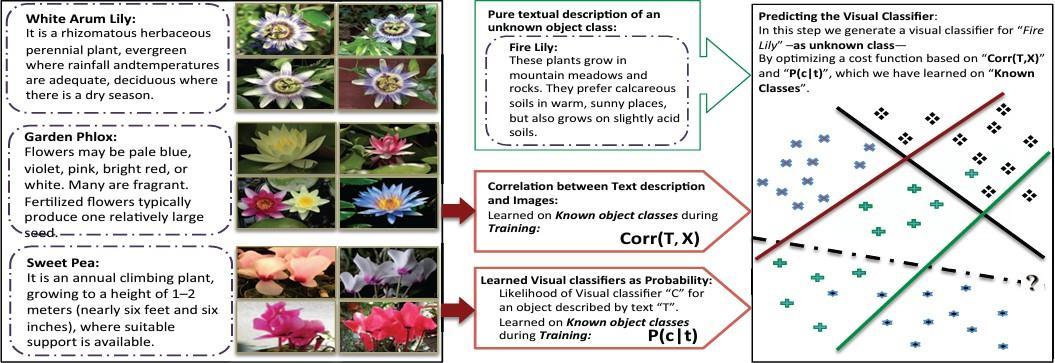
The proposed formulation aims to predict the hyperplane parameter c of a one-vs-all classifier for a new unseen class, given a textual description encoded by t and training-phaseknowledgeacquiredfromseenclasses.Our solution architecture is depicted in Fig. Three elements are taught during the training phase: Classifiers: Individual one-vs-allclassifiersckarelearnedforeachobservedclass.
Probabilistic Regressor: Given (tk, ck), a regressor is discovered thatcan beused toprovidea prior estimate for preg(c|t) (Details in Section 4.3). Transfer function for domains Given T and V, a domain transfer function, encoded in the matrix W, is learned to capture the relationship between the textual and visual domains (Details in Section 4.2). Each of these elements contains a subset of the problem’s information. How can such knowledgebecombinedtopredictanewclassifiergiven a textual description? The newly developed classifier must beconsistentwiththeobservedclasses.Thenew classifier must place all observed instances on one side of the hyperplane and adhere to the learned domain transfer function.Theresultingconstrainedoptimizationproblemis asfollows: c^(t)=argminc,i
cTc tTWc ln(preg(c|t))+ i s.t.: (cTxi) i,i 0,i=1 ···NtTWc l,,,l:hyperparameters(2)
The first term acts as a regularizer on top of the classifier c. The second term ensures that the predicted classifier is highly correlated with tT W. Given the prediction of the regressor, the third term favors a classifier with a high probability. The constraints cTxi i requireallobserveddatainstancestolieonthenegativeside of the predicted classifier hyperplane, allowing for some misclassificationviatheslackvariablesi. Theconstraintt TWc l ensures that the correlation between thepredicted classifier and t TW is no less than l, thereby ensuring a minimumcorrelationbetweentextandvisualfeatures.
10.2 Domain Transfer Functionality
To learn the domain transfer function W, we adapted the following strategy from [15]. Let T represent the textual feature data matrix, and let X represent the visual feature data matrix, with each feature vector replaced by a 1. Observe that adding a 1 to the feature vectors is necessary for our formulation, as we require tTW to function as a classifier. We must address the following optimization issue: min W r(W) + i ci(TWXT) (3) where ci’s are loss functions over the constraints and r() is a regularizer matrix. The optimal W in Eq. 3 can be computed using inner products between data points in each domain
separately, resulting in a kernalized non-linear transfer function; thus, its complexity is independent of the dimensions of either domain. The optimal answer to the equation3isW=TK 1 2 T LK 1 2 X XT, where KT = TTT andKX = XXT.
L is determined by minimizing the following minimization problem: minL[r(L)+].
p cp(K1 2 TLK1 2 X)], (4) where cp(K1 2 TLK1 2
X)=(max(0,(l eiK1 2 TLK1 2 Xej)))2 for same class pairs of index i,j, or = (max(0,(eiK1 2 TLK1 2 Xej u)))2 otherwise, whereekisavectorofzerosexceptaoneatthekthelement, and u>l (note any appropriate l, u could work. In this instance, we used l = 2 and u = 2). We utilized Frobenius norm regularization. A second-order BFGS quasi-Newton optimizer is used to minimize this energy. Using the aforementionedtransformation, Wis computed after L has beencomputed.
10.3. Probabilistic Regressor
Therearenumerouspossibleregressors,butwerequire one that provides a probabilistic estimate preg(c|(t)). Forthe reasons outlined in Section 3, we also require a structure prediction method that can predict all classifier dimensions simultaneously. We use the Twin Gaussian Process (TPG) [3]forthesereasons.UtilizingGaussian Processpriors, TGP encodes the relationships between inputs and structured outputs. This is accomplished by minimizing the KullbackLeibler divergence between the marginal GP of the outputs (in our case, classifiers) and observations (textual features). The solution to the following nonlinear optimization problem yields the estimated regressor output (c (t)) in TGP: [3] c (t) = argmin (t) [KC (c, c) 2kc(c) Tu log(KC (c, c) kc(c) T(KC + cI) 1kc(c))] (5) in which u = (KT + tI)1kt(t) and = KT (t, t) k(t)Gaussian kernels Tu, KT (tl, tm), and KC (cl, cm) for input feature t and output vector c. kc(c)=[KC (c, c1), ··· , KC (c, cNsc)]T. kt(t)=[KT (t, t1), ··· , KT (t, tNsc)] t and c serve as regularization parameters to prevent overfitting. This optimization problem is solvable using a second-order BFGS quasi- Newton optimizer with cubic polynomial line search for optimal stepsizeselection[3]. In thiscase,thedimension of the classifier is predicted jointly. In this instance, preg(c|t) is a normal distribution. preg(c|t) = N (c = ~c(t), c = I) (6) TGP does not provide predictive variance, unlike Gaussian Process Regression, whichexplains whyc = I. Nevertheless, it has the benefit of handling the dependence between the dimensions of the classifiers c and the textual features t. As a quadratic program, solvingforc lnp(c|t)is aquadraticterm inc that has the form ln p(c|t) (c c (t)) according to the TGP definition of preg(c|t).T(c c~(t)) = cTc 2cTc~(t)+~c(t) Tc~(t) (7) Wereducelnp(c|t)to2cTc(t)because1)c(t)Tc (t) is a constant (and thus has no effect on the optimization) and2) cTc is alreadyincludedas a regularizein equation 2.
Inourcontext,thedotproductisthesuperiormeasureof similaritybetweentwohyperplanes. Consequently,2cTc (t) is minimized. Equation 2 reduces, given ln p(c|t) from the TGP and W, to a quadratic program on c with linear constraints. We tried various quadratic solvers, but the IBM CPLEX solver 2 provides the best speed and optimizationforourproblem.
11. Experiments
11.1. Datasets
This approach was tested using the CU200 Birds [32] (200classes-6033images)andtheOxfordFlower-102 [20] (102 classes - 8189 images) image datasets, as they are among the largest and most widely used finegrained datasets. Descriptive text were produced for each class in both datasets. The CU200 Birds image dataset was created based on birds with corresponding Wikipedia articles, so wecreateda tool toautomatically extractWikipediaarticlesgiventheclassname. Thetool successfully generated 178 articles automatically, while the remaining 22 were extracted manually from Wikipedia. Only when the article title is a different synonym for the same bird class do these mismatches occur. In contrast, the Flower image dataset was not created using the same criteria as the Bird image dataset; therefore, not all classes of the Flower dataset have corresponding Wikipedia articles. The tool was able to generateapproximately16classesfromWikipediaoutof 102, while the remaining 86 classes required manual generation of articles from Wikipedia, Plant Database 3, Plant Encyclopedia 4, and BBC articles 5. We intend to providetheextractedtextualdescriptionasenhancementsto these datasets. There is a sample textual description in thesupplementarymaterials.
11.2. Extracting Textual Characteristics
Textual characteristics were extracted in two phases, as is typical in the literature on document retrieval. The initial phaseisanindexingphasethatproducestextualfeatureswith tfidf (Term Frequency-Inverse Document Frequency) configuration (Term frequency as local weighting and inversedocumentfrequencyasglobalweighting). Thetfidfis ameasureofaword’ssignificancewithinacorpus of text. Thetfidfvalueincreasesproportionallywiththenumberof times a word appears in the document, but is counterbalancedbythefrequencyofthewordinthecorpus, whichhelpstoaccountforthefactthatsomewordsaremore prevalentthanothers. Term’snormalizedfrequencyinthe provided textual description was used [29]. The inverse documentfrequencyisameasureofaterm’sfrequency;inthis study,thestandardlogarithmicidf[29] wasutilized. Inthe secondphase,theClusteredLatentSemanticIndexing(CLSI) algorithm[35]isusedtoreducedimensionality. Fordocument retrieval, CLSI is a low-rank approximation method for dimensionality reduction. In the Flower Dataset, tfidf featuresR8875,andfinaltextualfeaturesR102afterCLSI.In theBirdsDataset,tfidffeaturesarelocatedinR7086,andafter CLSI, textual features are located in R200.http://plants.usda.gov/java/ 4http://www.theplantencyclopedia.org/wiki/Main Page 5http://www.bbc.co.uk/science/0/
11.3. Visual features
Classemefeatures[31]wereutilizedasthevisualfeaturein our experiments as they provide an intermediate semantic representation of the input image. Classeme featuresaretheoutputofasetofclassifierscorrespondingto a set of C category labels, which are drawn from a term list defined in [31] and are unrelated to our textual features. Foreachcategoryc1C,asetoftrainingimagesis collected by querying an image search engine with the category label. Following the extraction of a set of coarse featuredescriptors(PyramidHOG,GIST, etc.),asubset of feature dimensions was chosen [31] and a one-versus-all classifier c was trained for each category. The output of theclassifier is real-valuedand is such thatifc(x) >c(y), thenxismoresimilartoclasscthany.Thefeaturevector (descriptor) used to represent an image x is the classeme vector [1(x), ), C (x)]. The Classeme characteristic has a dimensionof2569.
11.4 Methodology for Evaluating Experimental Results and Metrics:

Similartozero shotlearningliterature,weevaluatedthe performance of an unseen classifier in a one-vs-all setting wherethetestimagesofunseenclassesareregarded as the positives and the test images of seen classes as the negatives. We have computed the ROC curve and reported the area under the curve (AUC) as a comparative metric for various approaches. In a zero-shot learning environment, test data from the seen class are typically much larger than those from the unseen class. This renders other metrics, such as accuracy, useless, as high accuracycanbeachievedevenifallunseenclasstestdata areincorrectlyclassified;therefore,weutilizedROCcurves, which are not affected by this issue. In each fold, fourfifthsoftheclassesweredeemed"seenclasses"
Table 2: Percentageofclassesthattheproposed approach makesanimprovementinpredictingover thebaselines (relative to the total number of classes in each dataset
andusedfortraining,whileone-fifthoftheclasses were deemed "unseen classes" and their classifiers were predictedandevaluated. Withineachoftheseclass-folds,the observedclasses’dataarefurtherdividedintotrainingand test sets. The approach’s hyper-parameters were determined using an additional five-fold cross validation within the class-folds (i.e., the 80 Baselines: Since this work is the first to predict classifiers based solely on textual description, there are no previously published resultswithwhichtocompareit.However, wedesigned three state-of-the-art benchmarks for comparison, which areintendedtobeconsistentwithourargumentinSection
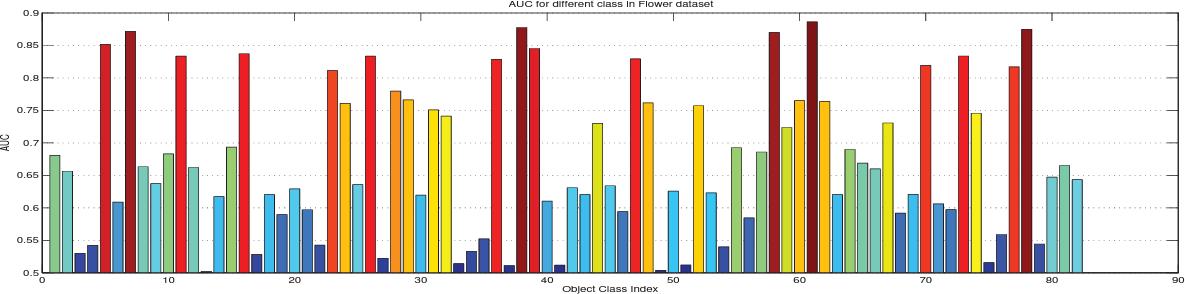
3. Specifically, we used: 1) A Gaussian Process Regressor (GPR) [24], 2) Twin Gaussian Process [3] as a structured regression method, and 3) Nonlinear Asymmetric Domain Adaptation [15]. Due to the fact that our formulation utilizes the TGP and DA baselines, it is essential to determine whether or not the formulation outperforms them. Notably, we also evaluate TGP and DA as alternativeformulationsfortheproblem,neitherofwhich has been used in the same context previously. Results: Table 1 displays the average AUCs for the proposed method versus the three baselines for both datasets. As expected, GPR performed poorly in all classes of both data sets, as it is not a structure prediction method. The DA formulation performed slightly better than TGP on the Flower dataset, but slightly worse on the Bird dataset. Onbothdatasets,theproposedmethodoutperformedall baselines, with a significant difference on the flower dataset. Itis also evident thatthe TGPperformed better on the Bird dataset due to the larger number of classes (more points used for prediction). Fig. 3 displays the ROC curves for our method based on the best predicted unseenclassesfromtheBirdsdatasetontheleftandthe Flower dataset in the center. Figure 4 depicts the AUC for eachclassintheFlower dataset. Additional findings are included in the supplementary materials. On the
right side of Figure 3 is the improvement over the three baselines for each class, calculated as (our AUC- baseline AUC)/baselineAUC Table2: Percentage of classes that the proposed method outperforms the baselines in predicting (relativetothetotalnumberofclassesineachdataset).The dataset where our method produced the greatest average improvement. Thepurpose of this table is to demonstrate that both TGP and DA performed poorly in these instances, whereas our formulation based on both performed significantly better. This demonstrates that our formulation is not merely a combination of the two best approaches, but can significantly improve prediction performance.Toevaluatetheeffectoftheconstraintsinthe objective function, we eliminated the constraints (cTxi) i, whichattemptstoensurethatallobservedexamplesareonthe negative side of the predicted classifier hyperplane, and evaluated the approach. With the constraints, the average AUC for the flower dataset (using a single fold) decreased to 0.59 from 0.61. Likewise, we assessed the impact of the constrainttT Wc l. The average AUC was reduced to 0.58 from 0.65 as a result of the constraint. This demonstrates thesignificanceofthisformulationconstraint.
12. Conclusion and Future Activities
We investigated the problem of predicting visual classifiers from a textual description of classes in the absence of training images. We investigated and tested various formulations of the problem within the context of finegrainedcategorization.Weproposedanovelformulationthat captures information between the visual and textual domainsbytransferringknowledgefromtextualfeaturesto visualfeatures,whichleadsindirectlytothepredictionofthe visual classifier described in the text. Rather than using linearclassifiersinthefuture,weintendtoproposeakernelbasedsolutiontotheproblem.Inaddition,wewillinvestigate the prediction of classifiers based on complex- structured textualfeatures.
Refernces
[1] K.Barnard,P.Duygulu,andD.Forsyth. Clusteringart. InCVPR,2001. 2
[2] E. Bart and S. Ullman. Cross-generalization: Learning novel classes from a single example by feature replacement. InCVPR,2005. 1,2
[3] L. Bo and C. Sminchisescu. Twin gaussian processesforstructuredprediction. IJCV,2010. 5,6
[4] J.Deng,A.C.Berg,K.Li,andL.Fei-Fei. Whatdoes classifying more than 10,000 image categories tell us? In ECCV.2010. 1,2
[5] J. Deng, W. Dong, R. Socher, L.-J. Li, K. Li, and L. Fei- Fei. Imagenet: A large-scale hierarchical image database. InCVPR,2009. 2
[6] L. Duan, D. Xu, I. W.-H. Tsang, and J. Luo. Visual event recognition in videos by learning from web data. TPAMI,2012. 3
[7] A. Farhadi, I. Endres, D. Hoiem, and D. A. Forsyth. Describingobjectsbytheirattributes. InCVPR,2009.1,2
[8] A. Farhadi, M. Hejrati, M. A. Sadeghi, P. Young,C. Rashtchian, J. Hockenmaier, and D. Forsyth. Everypicture tells a story: Generating sentences from images.In ECCV. 2010.3
[9] L. Fe-Fei, R. Fergus, and P. Perona. A bayesian approach to unsupervised one-shot learning of object categories. InCVPR,2003. 1,2
[10] R. Fergus, H. Bernal, Y. Weiss, and A. Torralba. Semanticlabelsharingforlearningwithmanycategories.In ECCV.2010.2
[11] M. Fink. Object classification from a single exampleutilizingclassrelevancemetrics.InNIPS,2004.2
[12] G. Griffin and P. Perona. Learning and using taxonomies for fast visual categorization. In CVPR, 2008. 2
[13] A. E. Hoerl and R. W. Kennard. Ridge Regression: Biased Estimation for Nonorthogonal Problems. Technometrics,1970.3
[14] N.Krishnamoorthy,G.Malkarnenkar,R.Mooney,K. Saenko,U.Lowell,andS.Guadarrama. Generatingnaturallanguage video descriptions using text-mined knowledge.NAACLHLT,2013.3
[15] B. Kulis, K. Saenko, and T. Darrell. What you saw isnotwhatyouget: Domainadaptationusingasymmetric kerneltransforms.InCVPR,2011.3,4,5,6
[16] G. Kulkarni, V. Premraj, S. Dhar, S. Li, Y. Choi, A. C. Berg, and T. L. Berg. Baby talk: Understanding and generatingsimpleimagedescriptions. InCVPR,2011. 3
[17] C. H. Lampert, H. Nickisch, and S. Harmeling. Learning to detect unseen object classes by betweenclass attributetransfer. InCVPR,2009. 1,2
[18] E. G. Miller, N. E. Matsakis, and P. A. Viola. Learning fromoneexamplethroughshareddensitiesontransforms. In CVPR,2000. 2
[19] G.A.Miller. Wordnet:Alexicaldatabaseforenglish. COMMUNICATIONSOFTHEACM,1995. 2
[20] M.-E. Nilsback and A. Zisserman. Automated flower classificationoverlargenumberofclasses. InICVGIP,2008. 2,6
[21] V. Ordonez, G. Kulkarni, and T. L. Berg. Im2text: Describing images using 1 million captioned photographs.In NIPS,2011.3
[22] M. Palatucci, D. Pomerleau, G. E. Hinton, andT. M. Mitchell. Zero-shotlearning withsemanticoutput codes. In NIPS,2009. 2
[23] D. Parikh and K. Grauman. Interactively building a discriminative vocabulary of nameable attributes. In CVPR, 2011. 2
[24] C. E. Rasmussen and C. K. I. Williams. Gaussian ProcessesforMachineLearning.TheMITPress,2005.3,6
[25] M. Rohrbach, M. Stark, G. Szarvas, and B. Schiele. Combininglanguagesourcesandrobustseman-ticrelatedness for attribute-based knowledge transfer. In Parts and AttributesWorkshopatECCV,2010. 2
[26] K.Saenko,B.Kulis,M.Fritz,andT.Darrell.Adapting visualcategorymodelstonewdomains. InECCV.2010. 3
[27] R.Salakhutdinov,A.Torralba,andJ.B.Tenen-baum. Learning to share visual appearance for multiclass object detection. InCVPR,2011. 1,2
[28] B.Saleh,A.Farhadi,andA.Elgammal. Object-centric anomaly detection by attribute-based reasoning. In CVPR, 2013.1
[29] G. Salton and C. Buckley. Term-weighting approachesinautomatictextretrieval. IPM,1988. 6
[30] A. Torralba, R. Fergus, and W. T. Freeman. 80 million tiny images: A large data set for nonparametric objectandscenerecognition. PAMI,2008. 2
[31] L. Torresani, M. Szummer, and A. Fitzgibbon. Efficientobjectcategoryrecognitionusingclassemes.InECCV, 2010.
[32] [32] P. Welinder, S. Branson, T. Mita, C. Wah, F. Schroff, S. Belongie, and P. Perona. Caltech-UCSD Birds 200. Technical report, California Institute of Technology, 2010. 2,6
[33] J. Yang, R. Yan, and A. G. Hauptmann. Crossdomain video concept detection using adaptive svms. In MULTIMEDIA,2007. 3
[34] Y. Yang, C. L. Teo, H. Daum´e III, and Y. Aloimonos. Corpus-guided sentence generation of natural images. InEMNLP,2011. 3
[35] D. Zeimpekis and E. Gallopoulos. Clsi: A flexible approximation scheme from clustered term-document matrices. InInSDM,2005. 6
[36] Research progress of zero-shot learning: Xiaohong Sun, Jinan Gu, Hongying Sun - Applied Intelligence 51, 3600-3614,2021.
[37] Chao,WL.,Changpinyo,S.,Gong,B.,Sha,F.(2016). AnEmpirical StudyandAnalysis of Generalized Zero-Shot Learning forObjectRecognitionintheWild. In: Leibe, B., Matas, J., Sebe, N., Welling, M. (eds) Computer Vision
ECCV 2016. ECCV 2016. Lecture Notes in Computer Science(), vol 9906. Springer, Cham. https://doi.org/10.1007/978-3-319-46475-64
[38] F. Pourpanah et al., "A Review of Generalized Zero-Shot Learning Methods," in IEEE Transac-tionson Pattern Analysis and MachineIntelligence, vol. 45, no. 4, pp. 4051-4070, 1 April 2023, doi: 10.1109/TPAMI.2022.3191696.
[39] A review of generalized zero-shot learning methods: Farhad Pourpanah, Moloud Abdar, Yuxuan Luo, Xinlei Zhou, Ran Wang, Chee Peng Lim, Xi - Zhao Wang, QM Jonathan Wu - IEEE transactions on pattern analysis andmachineintelligence,2022.
[40] Distinguishing unseen from seen for generalized zero-shot learning: Hongzu Su, Jingjing Li, Zhi Chen, Lei Zhu,KeLu-ProceedingsoftheIEEE/CVFCon-ferenceon Computer Vision and Pattern Recognition, 7885-7894, 2022.
[41] A survey of zero-shot learning: Settings, methods, and applications: Wei Wang, Vincent W Zheng, Han Yu, Chunyan Miao - ACM Transactions on Intelligent Systems andTechnology(TIST)10(2),1-37,2019.
[42] Contrastive embedding for generalized zero-shot learning:ZongyanHan,ZhenyongFu,ShuoChen,JianYang - Proceedings of the IEEE/CVF Conference on Computer VisionandPatternRecognition,2371-2381,2021.
[43] Open world compositional zero-shot learning: Massimiliano Mancini, Muhammad Ferjad Naeem,
Yongqin Xian, Zeynep Akata - Proceedings of the IEEE/CVF conference on computer vision and pattern recognition, 5222-5230,2021.
[44] An embarrassingly simple approach to zero-shot learning: Bernardino Romera-Paredes, Philip Torr - International conference on machine learning, 2152-2161, 2015.
[45] Zero-shot learning-the good, the bad and the ugly: YongqinXian,BerntSchiele,ZeynepAkata-Proceedingsofthe IEEE conference on computer vision and pattern recognition,4582-4591,2017.
[46] Zero-shot learning a comprehensive evaluation of the good, the bad and the ugly: Yongqin Xian, Christoph H Lampert, Bernt Schiele, Zeynep Akata- IEEE transactions on pattern analysis and machine intelligence 41 (9), 22512265,2018.
[47] Synthesized classifiers for zero-shot learning: Soravit Changpinyo, Wei-Lun Chao, Boqing Gong, Fei ShaProceedingsoftheIEEEconferenceoncomputer vision and patternrecognition,5327-5336,2016.
[48] Unsupervised domain adaptation for zero-shot learning: ElyorKodirov,TaoXiang,Zhenyong Fu, Shaogang Gong - Proceedings of the IEEE international conference on computervision,2452-2460,2015.
[49] Multi-modal cycle-consistent generalized zero- shot learning: Rafael Felix, Ian Reid, Gustavo CarneiroProceedingsoftheEuropeanConferenceonComputerVision (ECCV),21-37,2018.
[50] Zero-shotlearningviavisualabstraction:Stanis-law Antol, C Lawrence Zitnick, Devi Parikh - Computer Vision–ECCV 2014: 13th European Conference, Zurich, Switzerland, September 6-12, 2014, Proceedings, Part IV 13, 401-416, 2014.
[51] Knowledge-aware zero-shot learning: Survey and perspective: Jiaoyan Chen, Yuxia Geng, Zhuo Chen, Ian Horrocks, Jeff Z Pan, Huajun Chen - arXiv preprintarXiv:2103.00070,2021.
[52]Semantic-guided multi-attention localization for zero-shotlearning: YizheZhu,JianwenXie,ZhiqiangTang, XiPeng,AhmedElgammal-AdvancesinNeuralInformation ProcessingSystems32,2019.