
Production of single cell protein from different food waste
Rajalaxmi S1 , Namrata Patil2 , Nargees Kousar3, S Narendra Kumar*1,2,3MTech Student, Department of Biotechnology, R.V. College of Engineering, Bengaluru, Karnataka, India
*Prof, Department of Biotechnology, R.V. College of Engineering, Bengaluru, Karnataka, India

Abstract - Proteins are one of the most important nutrients required for both human as well as animal health. There is a need to find new solutions to suffice the world population's demand for protein consumption which cannot be obtained just by consuming plant-based protein or animal-based protein. Hence, the best alternative would be to switch to Single Cell Protein (SCP) which would also serve to improve the world's food security and scarcity. The food wastes have the potential to be used by microorganisms as substrate during fermentation processes to produce single cell protein. This review focuses on the utilization of several food wastes as a substrate through the process of batch fermentation to produce single cell protein using Saccharomyces cerevisiae as the source of microorganism. Comparative analysis of application of orange peel, banana peel, apple peel, pineapple peel and fish waste as substrate to produce single cell protein has shown that they all can be used together without the need for segregation. The product obtained yielded a good protein content and hence, could be used as a potential protein substitute for animal feed. More sustainable and economical methods of producing single cell protein are being discovered by researchers all over the world. Hence, the application of single cell protein for both human as well as animal feedcould be a great alternative solution to protein sources through simultaneous bio-valorization of food waste.
Key Words: Proteins, Single Cell Protein, Animal feed, Fermentation, Food wastes, Bio-valorization
1. INTRODUCTION
One of the basic macronutrients that are extremely importantforthestructuralandfunctionalcomponentoflife is protein. The United Nations Food and Agricultural Organization (FAO) refers to proteins as macromolecules. Theyareessentialforthefunctionofcells,tissue,muscles, andorgans.Aprotein'saminoacidcompositiondetermines how nutrient-dense it is. Only by consuming a range of protein sources can one obtain the bulk of the essential aminoacids.Theconsumptionofseveralnutrientsfoundin food is necessary for adequate human nutrition. The necessary amino acids are found in proteins, which are important macronutrients. The nutritional quality of a protein supply might vary depending on its amino acid composition, bioavailability and individual body requirements[1]. Although there are many sources of proteinsavailableforhumanconsumptiontherehasbeena need to investigate the food security and environmental
***
issueswithincreaseintheavailabilityofvariousavailable sources of protein. Legislations related to novel food or genetic modification need to investigate the relevant regulatory framework to ensure the safety of alternative proteins.Lastly,additionalstudiesonthefoodsafetyaspects of alternative proteins are urgently needed for providing relevantfoodgoverningauthoritieswithsufficientdata to oversee that the technological progress in this area is balancedwithrobustsafetystandards[2]
1.1 Single Cell Protein
In order to meet the need for animal-derived protein at presentconsumptionratesandfeedtheworld'spopulation, ithasbeenestimatedthattheglobemustproduceatleast 1,250 million tons of meat and dairy annually by 2050. Consequently,amajorissueinasocietywithacontinuously growingpopulationistheconsumptionofproteinsthatare both affordable and readily available while also satisfying environmental and social concerns[3].Therefore, food securitywillbeamatterofglobalconcernthatistoughto address with existing methods of agriculture and constrained by the depletion of natural resources and climate change. To enhance the effectiveness of the food productionsystemandtodecreasethenegativeexternalities of agriculture, novel technologies are urgently needed. Hence, the production of microbial protein in extremely controlled,intensivesystemsknownasbioreactorsisoneof the most cutting-edge technologies to which, both science andbusinessaredevelopingattention[4].
UnicellularediblemicroorganismsarereferredtoasSingle Cell Proteins (SCP) or microbial proteins which are characterized as biomass or protein extract from pure or mixedculturesofalgae,yeasts,fungus,orbacteria.Itcanbe usedasadditivesorsubstituteforprotein-richmealsandis safeforhumanconsumptionaswellasanimalfeed.Protein has vital roles in maintaining life through its control of biological processes and use in bodybuilding. Humans as wellasanimalsneedanadequatequantityofprotein,which cannot be obtained solely through conventional sources. This is a result of the world population's fast growth. Researchers are investigating the creation of Single Cell Protein(SCP),adifferentproteinsource,usingwastesand low-value materials which, can provide both people and animalswithhigh-qualityproteincontainingbothessential andnon-essentialaminoacids[5],[6]
Theveryfirstproductofthefermentationprocesswasthe productionofSingleCellProtein(SCP),whichhasprovento be a useful protein substitute. As the world's population continues to increase, food competition is getting more intense. SCP might soon be able to make up for a lack of protein.Numerousglobalbusinessesareconcentratingon SCPmanufacturingandastheirexpertiseandtimeadvance, sodoestheextentofitsuse[7].SCPoffersseveraladvantages overanimalandplantproteinssinceitcanbegeneratedall yearroundanddoesnotdependontheseasonsorclimate for growth. It does not require a lot of land, has a high proteincontentwithawiderangeofaminoacids,islowerin fat, and has a greater protein-to-carbohydrate ratio than forages[8]
1.2 Bio-valorization of food wastes
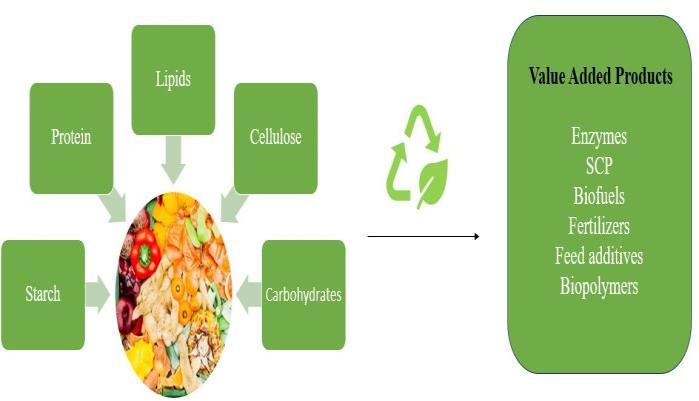
Bio-valorizationreferstotheprocessofreducing, reusing, andrecyclingfoodwasteintousefulproductsalsoreferred to as value added products. Food waste is a significant portionofmunicipalsolidwasteandcomprisesfoodwaste from houses, markets, restaurants, processing companies and additionally, several agro-industrial operations also generatecheapwastesfromallovertheworld.
expansion and it has been predicted that by 2025, the production of food waste worldwide would exceed 2.5 billionwithanannual rate of40%.In fact,themajority of wastescontinuetobedisposedofimproperlyandwithout being utilized, which makes the problem worse[9], [10].A major obstacle to effective waste management are the challenges associated with the right collection methods, storageandbioconversionoffoodwasteintovaluableadded products[11].Finding ways to use waste for the environment'sbenefithasrecentlybecomeatoppriority.To address this issue, the scientific communities have been using wastes and effluents through recycling and clean technologythroughintegratedwasteapplicationelsehave simply been returned to their natural source[12].As an alternative to petroleum-based chemicals, biorefineries create commodity and specialty chemicals as part of a circular bioeconomy. A potential strategy for producing value-added products in a sustainable manner involves usingwastestreamsincludingfoodwasteandagricultural wasteasafeedstockforbiorefineries[13] Thereisalotof wasteproducedbytheseafoodsector.Thesecompriselowvalue underutilized fish that are taken as by-catch in commercialfishingoperations,aswellaslargevolumesof wastewaterreleasedaseffluents.Processingdiscardsalso include fish that have been stripped of their fins and shells[14].Proteins,aminoacids,lipidswithhealthyamounts ofpolyunsaturatedfattyacids,carotenoidsandmineralsare abundant in the discards, effluents, and by-catch. Sustainableseafoodproductionmaybesupportedbyecofriendlyandcost-effectivehandlingofseafoodwasteusing bioconversion alternatives and a bio-refinery strategy[15].Hence,biorefineriesarethemajorcontribution intermsof bio-valorizationoffoodwastetoproducevalue addedproducts[16]
Theamountoffoodwasteisquitelargeeverywheredueto therapideconomicdevelopmentandcontinuouspopulation
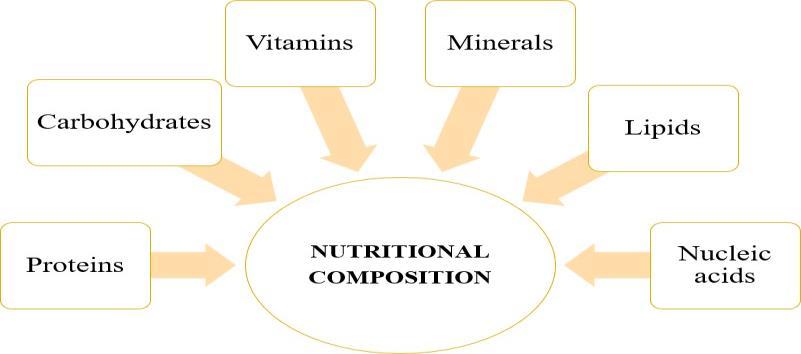
Every component of the food supply system experiences foodlosseswhich,endsupaswaste.Thesewastematerials are disposed in landfills, where toxic substances that are discharged into the air, water, and soil cause adverse environmentaleffects.Hence,theutilizationoffoodwastein a range of value-added products and energy vectors has been the subject of several research projects. The microbiologicalupgradingofthesewastesbyfermentation has been shown to be a promising valorization option, making it one of the most important innovations in science[17],[18].Foodwastesareabundantinnutrientsand substancesthatarebioactiveinnature.Suchwasteshavea variety of components, including proteins, minerals, and carbohydrates, therefore they ought to be seen as raw materials rather than waste products for other industrial operations.Thepresenceofthesenutrientsinthesewastes providesfavorablecircumstancesfortherapiddevelopment ofmicrobes.Hence,thewastehasthepotentialtobeused again by microorganisms as a source of food during fermentation processes to produce value-added products. This approach of wealth from waste contributes to waste recycling,whichhelpssafeguardtheenvironment[19].
2. PRODCUTION OF SINGLE CELL PROTEIN USING DIFFERENT FOOD WASTES AS SUBSTRATE
Therecoveryorproductionofvalue-addedproductsthrough the process of fermentation such as single-cell protein , biofuels,animalfeeds,enzymes,feedadditives, andvarious otherbulkchemicalsandproductshaverecentlybecomethe focus of several initiatives to use waste biomass[20]. Biodegradable waste is treated microbiologically to guaranteethatharmfulcompoundsareneutralizedinorder to reduce environmental contamination. Additionally, the creationofvalue-addedproductsfromthesewastesmakes certain recycling initiatives more profitable. One product that may be produced from diverse waste sources by microbialfermentationissingle-cellprotein[21].Thereare severalmicrobialspeciesthatmightbeusedtoproducethe. Making single-cell protein using cheap materials as a substrateprovidesaneconomicallysensibleproteinsource for animal feeding or for human consumption, as this typically satisfy dietary demands for protein. Numerous microorganismshavebeenusedtoconvertawiderangeof substratesintosingle-cellproteinsthatareusedtoproduce biomassrichinproteincontent[22]
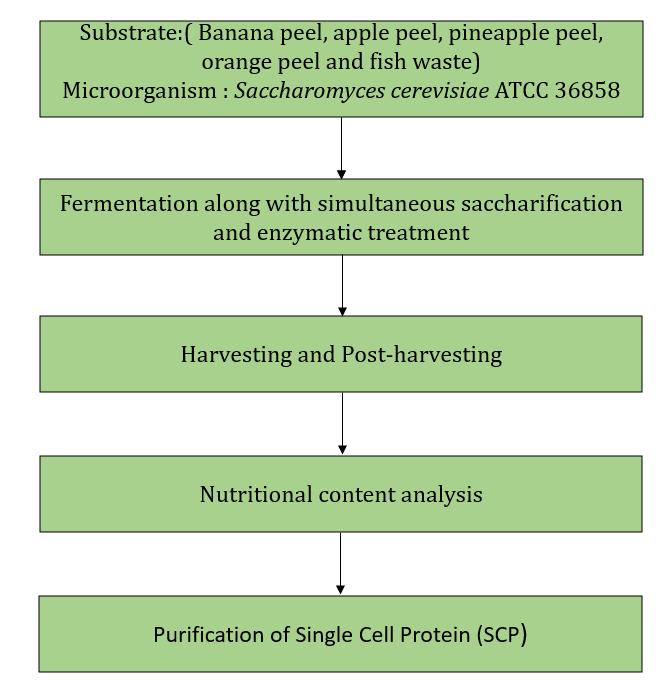
Intheyear2022,astudywasconductedbyA.Tropeaetal., using Saccharomyces cerevisiae ATCC36858asthesourceof microorganism for the process of fermentation using a multicomplex substrate made up of five different food wastes.Thiswouldmakeitpossibletosimultaneouslybiovalorizeavarietyoffoodwasteswithouthavingtoseparate thewastefromthefoodprocesstogetafeed-worthysingle cell protein. In light of the waste's chemical composition, cellulolytic enzymes were added to the medium to simultaneously saccharify and ferment in order to obtain freesugarsfromthecellwallofagriculturalfoodwastethat wouldbesuitableforyeastgrowth[23].Although,inmany studiesthesimilar procedureshave been followedforthe production of SCP using the substrates individually like orangepeelsubstrate[24];bananapeelsubstrate[25];fish waste[26]; pineapple waste[27] by using different microorganismstrainanddifferentoptimizationconditions.
The following procedure (Fig -3) was followed for productionofsinglecellproteinusingdifferentfoodwastes atalabscalelevelaccordingtoA.Tropeaetal.,
Productionofsinglecellproteinfromfoodwaste throughtheprocessoffermentation
2.1 Comparison of crude protein and crude lipid content in different food waste substrate
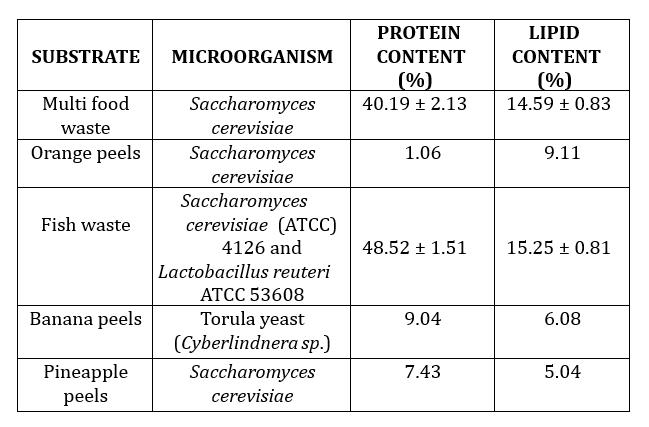
As mentioned in the previous section, many studies have been conducted on application of food wastes such as bananapeels,pineapplepeels,fishwasteandorangepeels whichhavebeendonesuccessfullybut,theyhavebeenused individuallyasasubstratefortheprocessoffermentationto produce single cell protein. Although the highest protein content was obtained by using fish waste as a substrate, from(Table-1)itisevidentthattheproteincontentwashigh even in application of multiple food wastes as substrate throughtheprocessoffermentation
Hence,itcanbeconcludedfrom(Table-1)thatmoreprotein contentcouldbeobtainedwhenmultifoodwasteisusedas asubstratewhich,allowsforsimultaneousbio-valorization
aswellas theproductionofvalue-addedproductwhichis singlecellprotein.
3. CONCLUSIONS
Thisstudyshoweda powerfulwaytodealwithutilizinga multicomplex substrate, made up of various food waste whichledtosetupalab-scalematurationprocesspermitting the execution of a concurrent valorization of various food waste,withouttheneedtoisolatethewasteemergingfrom the food process for getting an additional worthy item. Specifically,thisstudydirectedthechancetowardsutilizing both fish and fruit waste together, by a concurrent saccharificationandfermentationprocessforgettingsingle cellproteinusing S. cerevisiae, whichmaybeappropriateas animalfeed.Thefinalfermentedproductobtainedattheend oftheprocessoffermentationcanbeusedasananimalfeed in the form pellets or powder which, is enriched with the rightamountofnutrientsthatisessentialfortheanimaldiet. Hence, this serves as a great supplement which, could be usedasananimalfeedforthefollowingpurposes:
Fatteningandstuffingofhens,pigs,cows,etc.
Toenhancetheoverallnutritionalvalueoftheanimals throughdiet.
Asanalternativetoaquafeedenrichedwithnutrients. Thecurrentmethodologyfollowedisfeasibleatlabscaleand isyettobeexecutedonalargescaleintheindustrieswhich, will require a lot of optimizations. Although, the final productobtainedhasgood numberofnutritionalvaluesit cannotberecommendedforhumanconsumptionduetothe presence fish waste which, might be one of the major drawbacks. Businesses and researchers from all over the world are interested in single cell protein production becauseofthenumerouspromisingbenefitstheseproducts provide.However,findingasustainable,renewableproteinenriched ingredient is a major obstacle for the sector. As more and more new technologies are coming up, it has becomea top prioritytocomeup withnewsolutionsthat couldbebeneficialtotheenvironmentaswellastheliving organisms. Onesuchproductwouldbeproductionofsingle cell protein that would not only be an alternative protein sourcebut,wouldalsocontributetobio-valorization.
REFERENCES
[1] J. Hadi and G. Brightwell, “Safety of Alternative Proteins: Technological, Environmental and Regulatory Aspects of Cultured Meat, Plant-Based Meat,InsectProteinandSingle-Cell Protein.,” Foods Basel Switz., vol. 10, no. 6, May 2021, doi: 10.3390/foods10061226.
[2] A.G.A.Sá,Y.M.F.Moreno,andB.A.M.Carciofi,“Plant proteinsashigh-qualitynutritionalsourceforhuman
diet,” Trends Food Sci. Technol.,vol.97,pp.170–184, 2020.
[3] A.Ritala,S.T.Häkkinen,M.Toivari,andM.G.Wiebe, “Single Cell Protein-State-of-the-Art, Industrial LandscapeandPatents2001-2016.,” Front. Microbiol., vol.8,p.2009,2017,doi:10.3389/fmicb.2017.02009.
[4] V.Kameshwari,S.Selvaraj, andS.Sangeetha,“Single CellProteinSpirulina-ANutrientTreasure-Review,” Apr.2020.
[5] M.E.Jach,A.Serefko,M.Ziaja,andM.Kieliszek,“Yeast Protein as an Easily Accessible Food Source,” Metabolites,2022.
[6] N.Abdullahi,M.A.Dandago,andA.K.Yunusa,“Review on Production of Single-Cell Protein from Food Wastes,” Turk. J. Agric. - Food Sci. Technol.,2021.
[7] R.S.Vethathirri,E.Santillan,andS.Wuertz,“Microbial community-based protein production from wastewaterforanimalfeedapplications.,” Bioresour. Technol.,vol.341,p.125723,2021.
[8] K. Rasool et al., “Comprehensive insights into sustainableconversionofagriculturalandfoodwaste into microbial protein for animal feed production,” Rev. Environ. Sci. Biotechnol., vol. 22, pp. 527–562, 2023.
[9] G.R.Suman,M.Nupur,S.Anuradha,andB.Pradeep, “SingleCellProteinProduction:AReview,”2015.
[10] M.Sharif,M.H.Zafar,A.I.Aqib,M.Saeed,M.R.Farag, and M. Alagawany, “Single cell protein: Sources, mechanism of production, nutritional value and its usesinaquaculturenutrition,” Aquaculture,vol.531,p. 735885,2021.
[11] T.Dey,T.Bhattacharjee,P.Nag,Ritika,A.Ghati,andA. Kuila, “Valorization of agro-waste into value added products for sustainable development,” Bioresour. Technol. Rep.,2021.
[12] L. Zou, Y. Wan, S. Zhang, J. Luo, Y.-Y. Li, and J. Liu, “Valorization of food waste to multiple bio-energies based on enzymatic pretreatment: A critical review andblueprintforthefuture,” J. Clean. Prod.,vol.277,p. 124091, 2020, doi: https://doi.org/10.1016/j.jclepro.2020.124091.
[13] A. Kover, D. Kraljić, R. Marinaro, and E. R. Rene, “Processesforthevalorizationoffoodandagricultural wastestovalue-addedproducts:recentpracticesand perspectives,” Syst. Microbiol. Biomanufacturing,vol.2, pp.50–66,2021.
[14] V. Venugopal, “Valorization of Seafood Processing Discards: Bioconversion and Bio-Refinery Approaches,” Front. Sustain. Food Syst., vol. 5, 2021, doi:10.3389/fsufs.2021.611835.
[15] R.Sindhu et al.,“Conversionoffoodandkitchenwaste tovalue-addedproducts,” J. Environ. Manage.,vol.241, pp. 619
630, 2019, doi: https://doi.org/10.1016/j.jenvman.2019.02.053.
[16] J.Ibarruri,M.Cebrián,andI.Hernández,“Valorisation offruitand vegetablediscardsbyfungal submerged and solid-state fermentation for alternative feed ingredientsproduction,” J. Environ. Manage.,vol.281, p. 111901, 2021, doi: https://doi.org/10.1016/j.jenvman.2020.111901.
[17] M. Ortiz-Sanchez, P.-J. Inocencio-García, A. F. AlzateRamírez,andC.A.C.Alzate,“PotentialandRestrictions of Food-Waste Valorization through Fermentation Processes,” Fermentation,2023.
[18] P.K.Sadh,S.Duhan,andJ.S.Duhan,“Agro-industrial wastes and their utilization using solid state fermentation:areview,” Bioresour. Bioprocess.,vol.5, no.1,p.1,Jan.2018,doi:10.1186/s40643-017-0187z.
[19] T.Aggelopoulos,K.Katsieris,A.Bekatorou,A.Pandey, I. M. Banat, and A. A. Koutinas, “Solid state fermentation of food waste mixtures for single cell protein, aroma volatiles and fat production,” Food Chem., vol. 145, pp. 710–716, 2014, doi: https://doi.org/10.1016/j.foodchem.2013.07.105.
[20] K.Spalvins,L.J.Zihare,andD.Blumberga,“Singlecell proteinproductionfromwastebiomass:comparison of various industrial by-products,” Energy Procedia, 2018.
[21] S. Ali, J. Mushtaq, F. Nazir, and H. Sarfraz, “PRODUCTION AND PROCESSING OF SINGLE CELL PROTEIN(SCP)-AREVIEW,”2017.
[22] “Single Cell Protein : A Resort to Global Protein ChallengeandWasteManagement,”2016.
[23] A.Tropea,A.Ferracane,A.Albergamo,A.G.Potortí,V. L. Turco, and G. D. Bella, “Single Cell Protein Production through Multi Food-Waste Substrate Fermentation,” Fermentation,2022.
[24] H.H.Laminu,M.Yakubu,H.Bashir,M.A.Milala,andB. Burah, “Production and optimization of single cell protein from orange peels by Saccharomyces cerevisiae,” J. Biosci. Biotechnol. Discov.,2018.
[25] T.M.JiruandB.Melku,“SingleCellProteinProduction fromTorulaYeast(Cyberlindnerasp.)UsingBanana PeelHydrolysate,” J. Adv. Microbiol.,2018.
[26] A.Tropea et al.,“AquafeedProductionfromFermented FishWasteandLemonPeel,” Fermentation,vol.7,p. 272,Nov.2021,doi:10.3390/fermentation7040272.
[27] J.MensahandP.A.Twumasi,“Useofpineapplewaste forsinglecellprotein(SCP)productionandtheeffect ofsubstrateconcentrationontheyield,” J. FoodProcess Eng.,vol.40,2017.