Secure Channel Communication between IOT Devices and Computers
Harsha Kata, Harshith Singathala, Swarag Narayansetty, Sairam Reddy, Jyotsna Malla, Rishita Konda
1Harsha Kata, School of Computer Science and Engineering, Vellore Institute of Technology, Vellore – 632014, Tamil Nadu, India
2Harshith Singathala, School of Computer Science and Engineering, Vellore Institute of Technology, Vellore –632014, Tamil Nadu, India
3Swarag Narayansetty, School of Computer Science and Engineering, Vellore Institute of Technology, Vellore –632014, Tamil Nadu, India
4Sairam Reddy, School of Computer Science and Engineering, Vellore Institute of Technology, Vellore – 632014, Tamil Nadu, India
5Jyotsna Malla, School of Computer Science and Engineering, Vellore Institute of Technology, Vellore – 632014, Tamil Nadu, India
6Rishita Konda, School of Computer Science and Engineering, Vellore Institute of Technology, Vellore – 632014, Tamil Nadu, India ***
Abstract - The proliferation of Internet of Things (IoT) devices and applications is on the rise, resulting in an increase in both the quantity and complexity of malicious attacks. It is imperative to establish robust security measures for IoT networks to counteract malicious attacks, particularly with the aim of preventing unauthorized controloverthesedevices. While numerous security solutions for IoThavebeenproposed in recent years, a significant portion of them lacks standardization and interoperability. As the IoT landscape continues to expand, the diversity and intricacy of IoT applications also grow,renderingsuchnetworkssusceptibleto attacks aimed at data theft, device takeover, and service disruption.
A multitude of protocols and networking frameworks have been developed for IoT, with some achieving standardization and facilitating interoperability among devices and internet connectivity. These protocols have receivedendorsementfrom prominent standardization bodies such as IETF, IEEE, and industry consortia like the Rawan coalition and threadgroup.

This paper's objective is to present a model that establishes secure communication channels among IoT devices as well as between these devices and a server or router, accomplished through the implementation of encryption algorithms. The popularity of smart home IoT systems is increasing due to their efficiency in simplifying various tasks. However, this trend also introduces vulnerabilities in terms of user privacy. Safeguarding the privacy of personal data remains a paramount concern for electronic services. To address this challenge, we employ well-established encryption algorithms such as RSA to create and utilize secure communication channels through Socket Programming for IoT devices.
Key Words: IoT devices, encryption algorithms, RSA, socket programming, communication channels, SHA256, cyber attacks, cybersecurity, communication protocols, cryptography
1.INTRODUCTION
Lately,therehasbeenasignificantsurgeofinterestinthe concept of the Internet of Things (IoT), capturing the attentionofboththeindustrialsectorandacademiccircles alike.WithintherealmofIoT,animmensearrayofobjects equipped with sensors are tasked with amassing data, subsequentlytransmittingthisinformationtoserversforthe purpose of analysis, management, and utilization. The ultimate goal is to construct intelligent systems such as smart grids, sophisticated transportation networks, healthcaresystems,andevenentiresmartcities[1],[2],[3].
DuetotheprevailingtendencyofrelegatingIoTsecurity toasecondaryconcern,maliciousactorscommonlyperceive smart devices as easily accessible targets, akin to "lowhangingfruit,"susceptibletocompromiseandmanipulation. The significance of prioritizing security, along with the inherentneedforprivacy,cannotbeoverstatedinthecontext ofIoT.Themostreliableandeffectiveapproachforensuring theprotectionofcommunicationinsmartdevicesisthrough encryption. Regrettably, striking a balance between convenience and security remains a formidable challenge, particularlywhendealingwithresource-constraineddevices. Asaresult,numerousIoTproductsincorporateencryption featuresthatareeitherineffective,providingafalsesenseof security for communications and stored data, or they lack suchfeaturesentirely[4].
Reported in a 2020 publication by Unit 42, a threat intelligenceteam,anastounding98%ofthe1.2millionIoT devices scrutinized across corporate networks exhibited a
significantdeficiency:theabsenceofencryptioncapabilityfor their network traffic. This critical shortcoming led to a vulnerability where 57% of these IoT devices became susceptible to potential threats, including unauthorized interceptionandmanipulationoftheirdatatraffic.Thesame comprehensive report also shed light on the hazardous consequences of amalgamating IoT and IT assets within a Virtual Local Area Network (VLAN). This practice, as elucidated in the report, could result in compromised IoT devices owned by employees inadvertently disseminating malwarethroughouttheentiretyofthecorporatenetwork [5],[6].
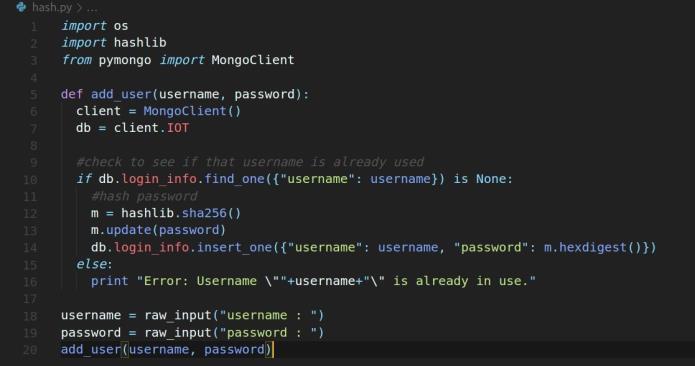
Intheproposedmodel,wehaveincorporatedMongoDB forauthenticationpurposes.Additionally,withinthisproject, theutilizationoftheSHA256algorithmforpasswordhashing has been employed. This approach ensures that even individuals overseeing the database cannot ascertain the actualpassword,asitisstoredinahashedform.Thesecurity ofSHA-256restsuponthreekeyproperties:
1. Resistance to Reverse Engineering: Foremost, it is exceedinglyarduoustoreverseengineertheoriginal datafromitscorrespondinghashvalue.Abruteforce attack,attemptingtodeducetheoriginaldata,would necessitate an astronomical 2^256 attempts. This level ofcomputationalinfeasibilityprovidesrobust protection.
2. CollisionResistance:Thelikelihoodofencountering twodistinctmessagesproducingthesamehashvalue (referredtoasacollision)isincrediblyremote.With a vast 2^256 range of potential hash values, surpassing the count of particles in the observable universe, the probability of encountering two identicalhashvaluesisinfinitesimal.
3. AvalancheEffect:Lastly,evenaminoralterationto theinitialdataprecipitatesasignificantchangeinthe hash value, rendering it virtually impossible to discern that the new hash value is derived from similar data. This phenomenon is termed the "avalancheeffect,"furtherenhancingthesecurityof thehash.
Thesepropertiescollectivelycontributetotherobustness andsecurityoftheSHA-256algorithm,makingitaprudent choiceforprotectingsensitivedatawithinourproject.
Theremainingpartofthepaperisorganizedasfollows. Section2containstheLiteratureSurvey.TheProposedModel isdiscussedinSection3.Section4containstheExperiments andResults.Lastly,theConclusionandFutureDirectionsis presentedinSection5.
2. LITERATURE REVIEW
The Internet of Things (IoT) has the potential to revolutionize numerous aspects of our daily routines and behaviors. With the pervasive nature of data sources, a substantial amount of information encompassing nearly everyfacetofhumanactivity,whetherpublicorprivate,will begenerated,transmitted,collected,stored,andprocessed. As a result, ensuring the integrity and confidentiality of transmitteddata,alongwithverifyingtheauthenticityofthe services providing that data, becomes paramount. This underscoresthecriticalimportanceofsecuritywithintheIoT framework.
Datanetworks,particularlywirelessones,aresusceptibletoa wide array of attacks, including eavesdropping, impersonation, denial of service, and more. Traditional security measures employed in legacy Internet systems mitigate these threats by relying on encryption and authentication at various layers, including the interface, network, transport, and application layers. While some of these security solutions can be adapted for use in the IoT domain, the inherent limitations in processing power and communication capabilities of IoT devices hinder the implementationoffull-fledgedsecuritysuites.[8].
Secure end-to-end communication channels are achievablewithintheunconstrainednetwork(UCN)domain using advanced technologies like IPsec, SSL/TLS, or DTLS. However, these technologies cannot be directly applied to constrainednetwork(CN)nodesduetotheirlimitationsin memory space and processing power. To address these challenges, this paper proposes a practical security architecture for the Internet of Things (IoT) with the followingobjectives:
1.ContinuedUseofUCNSecuritySuites:Existingsecurity suitesemployedwithinUCNswillremainunaltered,ensuring compatibilitywiththeUCNside.
2.DistinctHandlingofInitialSecurityHandshakes:Initial securityhandshakesandprotocolsaremanageddifferently within the CN to accommodate the constraints of limited nodes.Thisenablestheestablishmentofsecureend-to-end channels, allowing constrained devices to manage their complexityeffectively.
3. Unconstrained Nodes Remain Unaffected: Unconstrained nodes continue to operate without any deviationfromtheirstandardprocedures.
The proposed solution revolves around offloading computationallyintensivetaskstoatrustedunconstrained node. This node assumes responsibility for calculating the mastersessionkeyonbehalfofthelimitedIoTdevicesunder its jurisdiction. IoT Gateways, positioned at the interface between UCN and CN, play a crucial role in mediating communicationbetweenthesetwodomains.Thesegateways
often manage protocol layer variations, spanning physical andinterfacelayers,andevenextendingtotheapplication layer[13].
In spite of end to end security, lower layers may keep utilizingheterogeneoussecurityhighlightsacrossnetwork subspacesorforhighlightpointcommunication[14],[18].
Recentadvancementsinsemiconductortechnologyhave paved the way for cost-effective solutions to seamlessly integrate wireless connectivity into embedded processors andsensors.This,inturn,hassparkedsignificantinterestin the Internet of Things (IoT), which involves the interconnectednessofeverydayobjects.TheIoThasemerged as a promising technology for the consumer electronics market, with the realm of smart homes being particularly highlighted. Smart homes hold immense potential for IoT deployment, facilitating home automation and efficient energymanagement. However,therateatwhichIoTgains tractionamonghomeownershingesontheirwillingnessto adopt these devices, and two primary factors influencing theirdecisionareconvenienceandsecurity.Toaddressthis,a Wi-Fi-basedIoTsmarthomesystemhasbeenconceptualized and realized, utilizing a gateway to establish secure communication among IoT devices. This gateway also enables users to configure, access, and control the system through an intuitive interface accessible from ubiquitous mobile devices, such as smartphones [7], [9].Inter-device communication is facilitated using the User Datagram Protocol. Prior to transmission, data messages undergo encryptionusingsymmetriccryptographytechniqueslikethe Advanced Encryption Standard. The encryption employs a shared key generated through the Elliptic Curve DiffieHellman(ECDH)process[16].
The concept of the Internet of Things (IoT) revolves around creating a network of extensively interconnected devices,oftenreferredtoas"things."Inthecurrentcontext, theIoTencompassesawiderangeofdevicetypes,including sensors, actuators, and RFID tags. These devices vary significantlyintermsofsize,capabilities,andfunctionalities. The central challenge lies in orchestrating this diverse networktooperateseamlesslywithintheframeworkofthe conventionalInternet.
Motivatedbythischallenge,ongoingresearchendeavors arefocusedonadapting,applying,andtransformingstandard InternetprotocolsforusewithintheIoT.Theeffortsofthe 6LoWPAN working group have enabled even the smallest, resource-constraineddevicestobecomeintegralpartsofthe InternetbyenablingIPcommunicationoverthesedevices. Thisexceptionalfeatureempowerstheconnectionofbillions ofdevicestotheInternet.Forinstance,ahumiditysensoror anRFIDtagcancommunicatenotonlywitheachotherbut alsowithahumanusingasmartphoneoraremotebackend server.While the concept of the IoT may seem straightforward,significantresearcheffortsarestillrequired. VariousaspectsoftheIoTareunderinvestigation,including
itsapplicationsandarchitectures.Furthermore,anincreasing number of research initiatives are being undertaken to addresschallengesrelatedtosecurity,privacy,andtrustas IoTdevicesbecomemorewidespread[15],[18].
Thisstudydelvedintoarangeofsecure,lightweight,and resilientsolutionsforWirelessSensorNetworks(WSNs)and theInternetofThings(IoT),addressingthedistinctsecurity requirementsandchallengesinherentinthesedomains.We introducedanovelclassificationofexistingprotocolsbased on their key bootstrapping strategies, with the aim of establishing secure communication. Through a comprehensive analysis, we evaluated these protocols against various criteria to identify their respective advantagesandlimitations.Ourfindingssuggestadeparture fromtheconventionalrelianceonsymmetricapproachesfor IoT security. Public key cryptography, particularly asymmetric methods, is emerging as a more viable option withintheIoTlandscape,providedthatthesemethodsare suitably optimized. Additionally, a trusted third party is poised to assume a more active role in enhancing IoT security, considering the heterogeneous nature of IoT deployments.
Furthermore, it is imperative for security protocols to accountfortheresource-constrainednatureofIoTdevices. CumbersomecryptographicoperationslikeRSAandDiffie–Hellman key exchange protocols must be substituted with lightweight alternatives. For instance, the adoption of symmetric cryptography or more streamlined asymmetric algorithms such as ECC (Elliptic Curve Cryptography) and NTRU can significantly improve efficiency. Lightweight securityprotocolsarealsocrucialinreducingthecomplexity ofcommunicationprocesses[19],[20].
The realm of smart-home Internet of Things (IoT) solutionsisstillinitsinfancy,andthefactorofsecuritylooms large, significantly influencing the rate of their adoption. Designing a software security solution for smart-home environments presents a challenge due to the lack of user control over various elements. Additionally, integrating a privacy solution into existing software frameworks while consideringuserexperienceisanotherintricatetask.
Inthispaper,weintroducedanauthorizationschemefor smart-homeIoTdevicesthatareconnectedtoanuntrusted cloud framework. Furthermore, we presented a proof-ofconceptsoftwaresolutionthatleveragestheFIDOprotocol, enabling users to authenticate with their devices. We also proposed several extensions and adaptations of the FIDO protocolsuitableforanIoTenvironment.Theprotocol we introduced prioritizes user anonymity by ensuring that manufacturerscannotestablishalinkbetweendifferentuser accounts. The most relevant user-related information consists of the FIDO public key and a pseudonym. Experimental results indicated that the additional delay introduced by the FIDO authentication protocol has a minimalimpactonsmart-homeapplications.Lookingahead,
our future efforts will focus on various directions. These include testing the FIDO protocol with hardware authenticators,enhancingthesecurityschemewithFIDOU2F features (second-factor authentication), adapting the softwaresecuritystackfordifferenthardwareplatformsand programming languages, and proposing an IoT device authentication scheme for smart homes using the privacy concepts outlined in this paper[10],[11],[12].The user-todevice connections, which form the foundation of our scenario, consider the user-device-driven nature of the securityframeworkwepropose.Theauthorizationmessages presented in this paper are secured through the FIDO protocol, and unlocking the FIDO private key requires biometric(fingerprint)authenticationontheuserdevice.The user-to-deviceauthenticationreliesontheAndroidsecurity framework and hardware security modules found in smartphones,suchasfingerprintreadersorARMTrustZone [17].
3. PROPOSED MODEL
ThevulnerabilitiespresentinIoTsystems,combinedwith the potential interception and manipulation of communicationsbyhackers,posea significantthreat.This canleadtoinaccuratedatareachingIoTdevices,resultingin malfunctionsanderroneousoutcomes.Companiesrelyingon IoT-deriveddataareexposedtorisks,asmanipulateddata traffic can undermine the accuracy and reliability of their operations. To mitigate this, we have proposed the implementation of encrypted communication messages between IoT devices and clients, effectively thwarting the abilityofhackerstotamperwiththetraffic.
Ourencryptionschemeoffersseveraldistinctadvantages:
a.ComprehensiveSecurity:Ourschemeachievesmultiple security objectives in a single logical step, ensuring confidentiality, integrity, authentication, non-repudiation, andanonymitysimultaneously.
b. Heterogeneous Compatibility: The scheme accommodates the heterogeneity of IoT environments, allowingasensornodeutilizingidentity-basedcryptography to transmit messages to a server employing a public key infrastructure. This versatile compatibility renders our schemewell-suitedforsecuredatatransmissionwithinIoT ecosystems.
By incorporating encryption into the communication processbetweenIoTdevicesandclients,weprovidearobust defenseagainstunauthorizedtamperingandmanipulation, enhancing the overall security and trustworthiness of IoT systems.
A. SOCKETPROGRAMMING
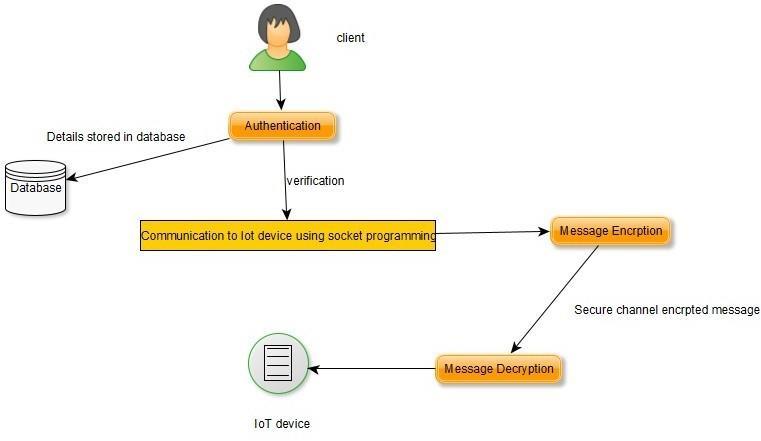
CommunicationbetweentheIoTdeviceandthe client is established through socket programming, enablingatwo-wayexchangeofmessagesbetween thesetwoentities.Socketsserveastheendpointsofa bidirectionalcommunicationchannel,allowingdata transmissionandreception.Thiscommunicationcan occurwithinasingleprocess,betweenprocesseson the same machine, or even across processes on geographicallydistantlocations[22],[23].
The creation of a socket involves the following step: s = socket.socket(socket_family, socket_type, protocol=0).
Forserver-sideoperations,thefollowingsocket methodsareutilized:
1.s.bind():Thismethodassociatesthesocketwith a specific address and port to listen for incoming clientconnections.
2.s.listen():Itpreparesthesocketforaccepting incomingclientconnections.
3. s.accept(): This method accepts an incoming client connection and returns a new socket object representingtheconnection,alongwiththeaddress oftheclient.
Ontheclientside,theprimarymethodis:
1. s.connect(): This method establishes a connection to the server, facilitating message exchangeandcommunicationbetweentheclientand theserver.
Insummary,socketprogrammingenablesseamless communication between IoT devices and clients through a well-defined set of methods and operations,allowingfortheexchangeofmessagesin abidirectionalmanner.
B. RSAALGORITHM
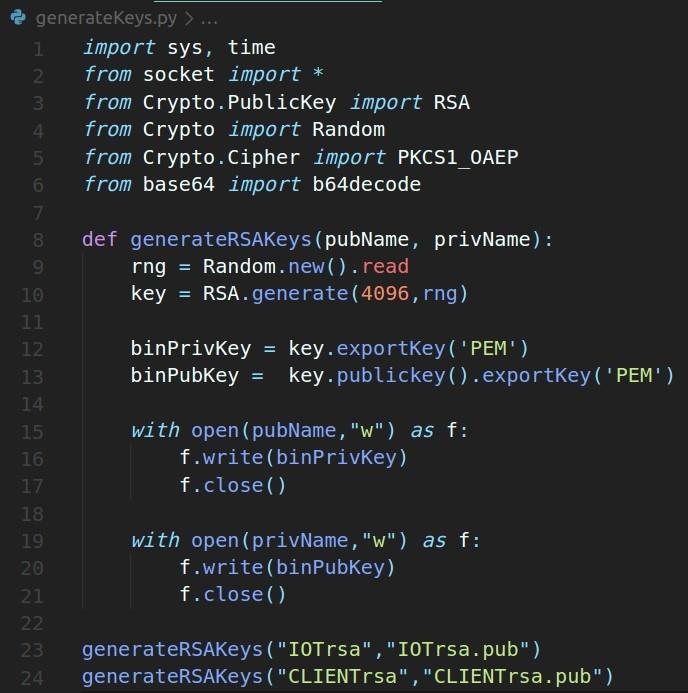
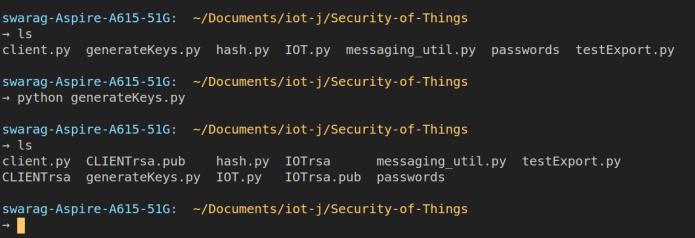
To safeguardagainst potential attacks aimed at intercepting and pilfering messages and data, encryption becomes imperative. Encrypting messages ensures that unauthorized access and decryptionbyhackersbecomeformidablechallenges. Inourproject,weemploytheRSAalgorithmfordata encryption arobustasymmetrickeycryptographic algorithmrootedinpublickeyencryption[21].This algorithmisrenownedforitsformidablesecurityand near-impossibilitytobreak.Inadditiontoencryption, ourproposedmodelencompassesanauthentication featuretovalidateuserswhoseinformationisstored inadatabase.Forthispurpose,weutilizeMongoDB,a user-friendly and highly scalable database system. MongoDB was chosen for its ease of use and scalability.Toenhancesecurity,passwordsentered by clients are hashed before being stored in the database,furtherfortifyingtheprotectivemeasures.
The design of our proposed model takes into accountresilienceagainstvariousattacks:
1.EavesdroppingAttack:Byencryptingthedata, we effectively thwart eavesdropping attempts, making it extremely difficult for attackers to comprehendtheinterceptedinformation.
2. Man-in-the-Middle Attack: The inclusion of encryption and authentication mechanisms helps mitigate the risk of man-in-the-middle attacks, as unauthorized intermediaries would be unable to deciphertheencryptedcommunicationorgainaccess throughauthentication.
3. ARPSpoofingAttack:Ourmodelincorporates measures to counter ARP spoofing attacks, which involvemanipulationofnetworkaddressresolution. These precautions help maintain the integrity and authenticityofcommunicationchannels.
In essence, our proposed model's combination of encryption, authentication, password hashing, and measuresagainstspecificattacksservestoenhance the overall security and integrity of the IoT communicationframework.
4. EXPERIMENTS AND RESULTS
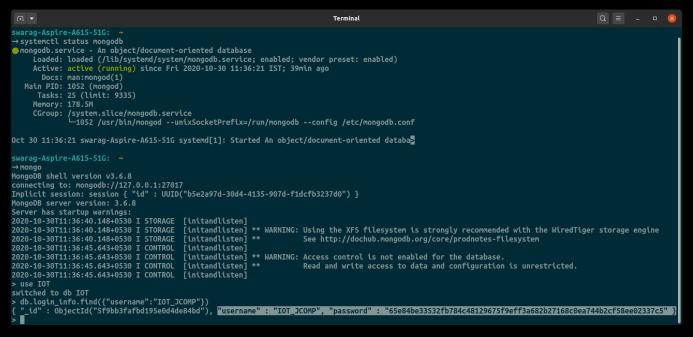
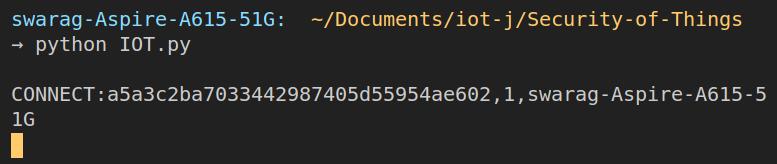
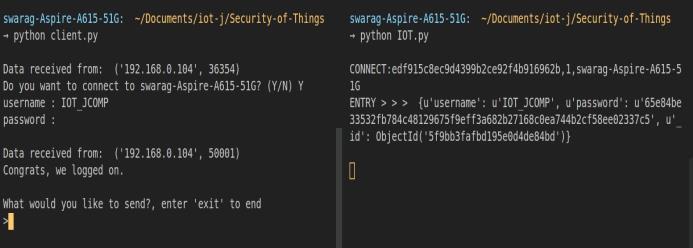
In our experimental setup, we establish the MongoDB servicetoserveasthefoundationforauthenticationwithin the proposed model. The primary objective is to ensure authorized access for making requests from clients to IoT devices.Toachievethis,wefollowthesesteps:
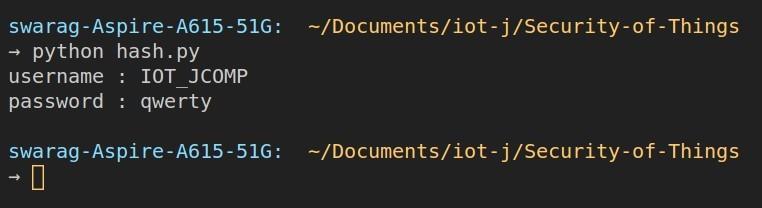
1.AddingUsertoMongoDB:Usersareaddedto the MongoDB database to enable authorized

interactions.Theseusersaregrantedtheprivilegeof sendingauthorizedcommandstoIoTdevicesfrom clients.
2.DataStorageinMongoDB:Relevantuserdata, includinglogincredentials,isstoredsecurelywithin the MongoDB database. Notably, passwords are hashedtobolstersecuritymeasures,safeguarding sensitiveinformation.
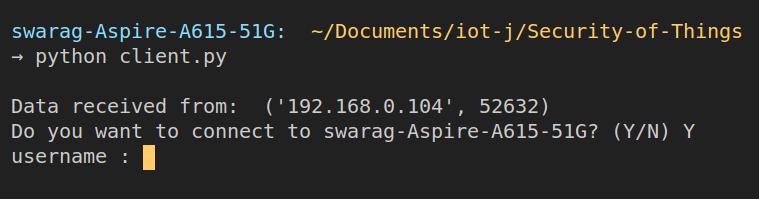
3. Connection and Login: When a connection attemptisinitiated,theclientispromptedtoprovide login credentials. These credentials serve as authenticationforaccesstoIoTdevices.
4.ValidCredentials:Uponenteringcorrectlogin credentials,theusergainsaccesstotheIoTdevice andisauthorizedtoissuecommands.Thisensures thatonlyauthenticateduserscaninteractwiththe IoTdevice.
5. Invalid Credentials: In cases of incorrect or invalid credentials, access to the IoT device is denied, preventing unauthorized users from enteringthesystem.
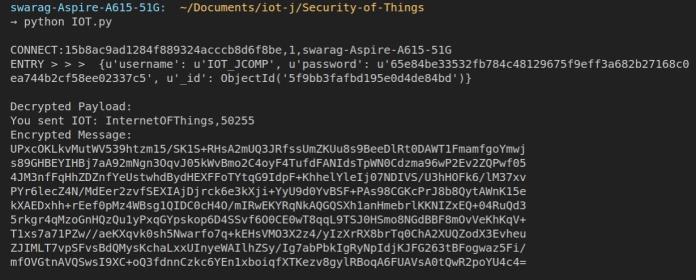
6. Encrypted Command Transmission: Any commandissuedbyanauthorizeduserisencrypted before transmission. This encrypted command is thensecurelysenttotheIoTdevice.
7.DecryptionandExecution:Uponreachingthe IoTdevice,theencryptedcommandisdecryptedand processed.TheIoTdeviceaccuratelyinterpretsand executesthedecryptedcommandasintendedbythe authenticateduser.
Thisexperimentalsetupshowcasestheseamless integration of MongoDB for user authentication, secure storage, and hashed passwords. The interaction between clients and IoT devices is streamlined through encrypted command transmission, ensuring that only authorized users can access and control IoT devices. The process reinforcesthesecurity,privacy,andoverallintegrity oftheproposedmodel.

9. CONCLUSIONS
Indeed, authentication and authorization are pivotal componentsforensuringthesecurityandtrustworthinessof IoTdevices.Inourproject,wehavetakenacomprehensive approachtoaddresstheseaspectsbyimplementingasecure channelcommunicationprotocolbetweenIoTdevicesand clients. To achieve this, we have harnessed the power of several key concepts, including Socket Programming and Cryptography.
The utilization of Socket Programming enables seamless communicationbetweenIoTdevicesandclients,facilitating the exchange of data and commands. On top of this foundation, we have integrated robust cryptographic measurestoensuretheconfidentialityandintegrityofthe transmittedinformation.Particularly,theindustry-standard RSA algorithm has been employed to encrypt commands originatingfromtheclientdevicestotheIoTdevices.
Ourimplementationalsoshowcasesthesignificanceofusing MongoDB as a database for authentication purposes. MongoDB'spopularitywithintheIoTdevelopercommunity makes it a suitable choice for integrating this secure authenticationmechanismintomodernIoTapplications.The database stores user credentials securely, and through proper authentication and authorization procedures, only authorizedusersgainaccesstotheIoTdevices.
Theamalgamationoftheseelements SocketProgramming, Cryptography,andMongoDB resultsinacomprehensive and reliable framework that enhances the security and functionality of IoT devices. By focusing on secure communication,encryption,andproperuserauthentication, ourprojectcontributestotheadvancementofIoTsecurity andpavesthewayforfutureinnovationsinthisfield.
REFERENCES
[1] Y. Lu and L. Da Xu, “Internet of Things (IoT) CybersecurityResearch:AReviewofCurrentResearch Topics,”IEEEInternetThingsJ.,vol.6,no.2,pp.2103–2115,2019,doi:10.1109/JIOT.2018.2869847.
[2] P. D. Babu, C. Pavani, and C. E. Naidu, “Cyber Security with IOT,” in 2019 Fifth International Conference on Science Technology Engineering and Mathematics (ICONSTEM), 2019, vol. 1, pp. 109–113, doi: 10.1109/ICONSTEM.2019.8918782.
[3] M.A.Ferrag,O.Friha,D.Hamouda,L.Maglaras,andH. Janicke,“Edge-IIoTset:ANewComprehensiveRealistic CyberSecurityDatasetofIoTandIIoTApplicationsfor CentralizedandFederatedLearning,”IEEEAccess,vol. 10, pp. 40281
40306, 2022, doi: 10.1109/AC CESS.2022.3165809
[4] Z.-K. Zhang, M. C. Y. Cho, C.-W. Wang, C.-W. Hsu, C.-K. Chen, and S. Shieh, “IoT Security: Ongoing Challenges and Research Opportunities,” in 2014 IEEE 7th International Conference on Service-Oriented Comput ingandApplications,2014,pp.230–234,doi: 10.1109/SOCA.2014.58.
[5] G.Cascavilla,R.Zwart,D.A.Tamburri,andA.Cuzzocrea, “ExplainingIoTAttacks:AnEffectiveandEfficientSemiSupervised Learning Framework,” in 2022 IEEE InternationalConferenceonBigData(BigData),2022, pp. 5662–5671, doi: 10.1109/BigData55660.2022.10020894.
[6] M.Roopak,G.YunTian,andJ.Chambers,“DeepLearning Models for Cyber Security in IoT Networks,” in 2019 IEEE 9th Annual Computing and Communication WorkshopandConference(CCWC),2019,pp.452–457, doi:10.1109/CCWC.2019.8666588.
[7] T. Islam, R. A. Youki, B. R. Chowdhury, and A. S. M. T. Hasan,“AnECCBasedSecureCommunicationProtocol forResourceConstraintsIoTDevicesinSmartHome,”in ProceedingsoftheInternationalConferenceonBigData, IoT,andMachineLearning,2022,pp.431–444.
[8] H.Kim,A.Wasicek,B.Mehne, andE.A.Lee,“ASecure NetworkArchitecturefortheInternetofThingsBased on Local Authorization Entities,” in 2016 IEEE 4th InternationalConferenceonFutureInternetofThings and Cloud (FiCloud), 2016, pp. 114–122, doi: 10.1109/FiCloud.2016.24.
[9] F.K.SantosoandN.C.H.Vun,“SecuringIoTforsmart home system,” in 2015 International Symposium on Consumer Electronics (ISCE), 2015, pp. 1–2, doi: 10.1109/ISCE.2015.7177843
[10] M. Malik, M. Dutta, and J. Granjal, “A Survey of Key Bootstrapping Protocols Based on Public Key Cryptography in the Internet of Things,” IEEE Access, vol. 7, pp. 27443–27464, 2019, doi: 10.1109/ACCESS.2019.2900957.
[11] R. Zahid, M. W. Anwar, F. Azam, A. Amjad, and D. Mukhtar, “Enhancing End-to-End Communication Security in IoT Devices Through Application Layer Protocol,” in Information and Software Technologies, 2022,pp.148–159.
[12] P. Mall, M. Z. A. Bhuiyan, and R. Amin, “A Lightweight SecureCommunicationProtocolforIoTDevicesUsing Physically Unclonable Function,” in Security, Privacy, and Anonymity in Computation, Communication, and Storage,2019,pp.26–35.
[13] R.SharmaandR.Arya,“Securetransmissiontechnique fordatainIoTedgecomputinginfrastructure,”Complex
Intell. Syst., vol. 8, no. 5, pp. 3817–3832, 2022, doi: 10.1007/s40747-021-00576-7.
[14] K. T. Nguyen, M. Laurent, and N. Oualha, “Survey on secure communication protocols for the Internet of Things,”AdHocNetworks,vol.32,pp.17–31,2015,doi: https://doi.org/10.1016/j.adhoc.2015.01.006
[15] R. Bonetto, N. Bui, V. Lakkundi, A. Olivereau, A. Serbanati, and M. Rossi, “Secure communication for smart IoT objects: Protocol stacks, use cases and practical examples,” in 2012 IEEE International Symposium on a World of Wireless, Mobile and MultimediaNetworks(WoWMoM),2012,pp.1–7,doi: 10.1109/WoWMoM.2012.6263790.
[16] K. K. Rout, S. Mallick, and S. Mishra, “Design and Implementation of an Internet of Things based PrototypeforSmartHomeAutomationSystem,”in2018 International Conference on Recent Innovations in Electrical, Electronics Communication Engineering (ICRIEECE), 2018, pp. 67–72, doi: 10.1109/ICRIEECE44171.2018.9008410.
[17] Chifor, I. Bica, V.-V. Patriciu, and F. Pop, “A security authorizationschemeforsmarthomeInternetofThings devices,”Futur.Gener.Comput.Syst.,vol.86,pp.740–749, 2018, doi: https://doi.org/10.1016/j.future.2017.05.048
[18] R. Roman, R. Arjona, and I. Baturone, “Post-quantum SecureCom-´municationwithIoTDevicesUsingKyber and SRAM Behavioral and Physical Unclonable Functions(ExtendedAbstract),”inAttacksandDefenses fortheInternet-of-Things,2022,pp.72–83.
[19] R. V. S. Boolakee, S. Armoogum, R. Foogooa, and G. Suddul,“EnsuringSecureCommunicationfromanIoT Edge Device to a Server Through IoT Communication Protocols,” in Progress in Advanced Computing and IntelligentEngineering,2021,pp.337–349.
[20] S. Encheva and S. Tumin, “Simple E2EE Secure Communication Protocol for Tiny IoT Devices,” in Cooperative Design, Visualization, and Engineering, 2022,pp.286–292.
[21] S. Encheva and S. Tumin, “Simple E2EE Secure Communication Protocol for Tiny IoT Devices,” in Cooperative Design, Visualization, and Engineering, 2022,pp.286–292.
[22] C.Mateo,F.Almagro,W.-J.Yi,andJ.Saniie,“DesignFlow andImplementationofanIoTSmartPowerSocket,”in 2021 IEEE Inter national Conference on Electro InformationTechnology(EIT),2021,pp.151–156,doi: 10.1109/EIT51626.2021.9491841.
[23] A. Rehman, A. R. Syed, I. U. Khan, A. A. Mustafa, M. B. Anwer,andU.A.Ali,“IoT-EnabledSmartSocket,”Wirel. Pers. Commun., vol. 116, no. 2, pp. 1151–1169, 2021, doi:10.1007/s11277-020-07043-5.