Design and Analysis of Wheel Rim Using Finite Element Method
Uma Soliwal 1, Purushottam Sahu2, Ghanshyam Dhanera 31Research Scholar BM College of Technology, Indore

2Professor and HOD BM College of Technology, Indore
3Professor BM College of Technology, Indore
Abstract - we propose that structural steel stands out as the optimal material choice. This selection leads to a notable reduction in mass, specifically 4.64 kg per wheel, resulting in a total weight of the car's spare wheel at 27.84 kg. This reduction not only contributes to the overall weight reduction of the vehicle but also contributes to decreased productionexpenses.
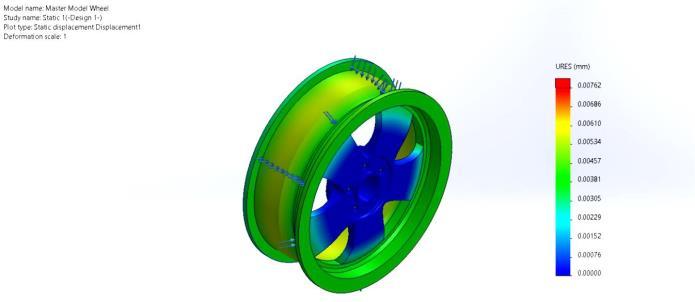
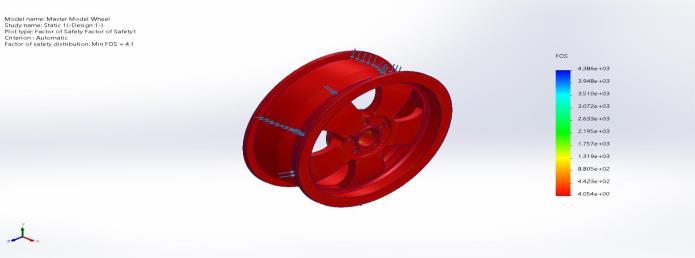
Based on the analysis outcomes, among the six models considered, wheel design6 emerges as the superior choice. It exhibits a lighter weight of 27.192 kg, minimal deformation (0.00703 mm), a safety factor exceeding 15, and the least equivalent stress (6.13956 MPa). Subsequently, this model undergoes a comprehensive analysis employing specialized tools, which reveals von-Mises stress and total deformation factors across six distinct structural steel wheel designs. Following a meticulous comparison of the results, we will confidentlyrecommendthe optimal wheel design.
Key Words: SOLIDWORKS, ANSYS, FEA, Static Analysis, FatigueAnalysis,WheelRim
1. INTRODUCTION
The history of the wheel and rim is a fascinating journey that spans thousands of years, shaping the way humans travel, transport goods, and evolve technologically. Here's abriefoverviewofthehistoryofthewheelandrim:
1. Early Wheel Concepts (Around 3500 BC): The earliest evidence of wheeled vehicles dates back to around 3500 BC in Mesopotamia (modern-day Iraq). These early wheels were solid wooden disks, often attached to carts or chariots. They were initially used for pottery production and laterfortransportationofgoods.
2. SpokedWheels(2000-1500BC):Around2000BC, spoked wheels were invented, likely in the Caucasus region. Spokes allowed for lighter and more flexible wheels, which improved overall efficiency and reduced the stress on the axle. Spoked wheels spread across civilizations, includingancientChinaandEurope.
3. Roman Chariots (4th Century BC - 4th Century AD): The Romans made significant advancements inwheeltechnology,usingspokedwheelsintheir
chariots and military vehicles. This innovation improved their transportation and military capabilities.
4. Medieval and Renaissance Innovations (5th-15th Centuries): During the Middle Ages, wheel technology evolved slowly. Improvements were madeintermsofaxleconstructionandmaterials. In the Renaissance period, Leonardo da Vinci's sketches and designs included concepts for geardrivenvehicleswithspokedwheels.
5. Industrial Revolution (18th-19th Centuries): The Industrial Revolution brought significant advancements in wheel and rim manufacturing. Ironandsteelbecamecommonmaterialsforrims and spokes, making wheels more durable and capable of handling heavier loads. The development of railways and steam-powered locomotivesalsoledtothecreationofspecialized trainwheels.
6. Pneumatic Tires (Late 19th Century): In the late 19thcentury,ScottishinventorJohnBoydDunlop developed the pneumatic tire, which used airfilled rubber to provide a smoother ride and better traction. This innovation marked a significant leap in comfort and performance for wheeledvehicles.
7. Modern Wheel and Rim Technology (20th Century - Present): The 20th century brought further refinements to wheel and rim design, including alloy wheels made from lightweight metals like aluminum and magnesium. These materials enhanced both aesthetics and performance. Tubeless tires, radial tire construction,andadvancedtiretreaddesignsalso improvedsafetyandhandling.
8. Continued Advancements: Today, wheels and rims continue to evolve with advancements in materials, aerodynamics, and manufacturing techniques. The automotive and transportation industriesareexploringtechnologieslikecarbonfiber composite wheels for improved efficiency andreducedweight.
The history of the wheel and rim reflects humanity's continuous pursuit of innovation and improved mobility, leadingtothediverseandsophisticatedwheeldesignswe seeinvariousvehiclestoday.
2. METHODOLOGY FiniteElementAnalysis(FEA)is a computational methodusedtoanalyzecomplex structures and systems by dividing them into smaller, more manageable segments called finite elements. These elements are connected at specific points, known as nodes, to represent the overall behavior of the entire system. FEA is The FiniteElementMethod(FEM)hasawiderangeof applications across various fields of science and engineering. It is a versatile numerical technique that can be used to solve complex problems involving partial differential equations, and it has proven to be invaluable in simulating and analyzingadiversesetofsystems.Herearesome notable applications of the Finite Element Method:
3. Structural Analysis: FEM is widely used for analyzingthebehaviorandresponseofstructures under different loads and conditions. It is used in civil engineering for designing buildings, bridges, and other structures, as well as in mechanical engineeringfordesigningcomponentslikebeams, columns,andframes.
4. Heat Transfer and Thermal Analysis: FEM is employed to study temperature distributions, heat transfer rates, and thermal stresses in systems. This is crucial for designing efficient cooling systems, thermal management of electronic devices, and analyzing heat flow in variousindustrialprocesses.
5. Fluid Dynamics: FEM is used in computational fluid dynamics (CFD) to simulate fluid flow, analyze pressure distributions, and study the behavior of liquids and gases in pipes, channels, andotherflowdomains.
6. Electromagnetic: In electromagnetic analysis, FEMisusedtomodel and predictthe behaviorof electromagnetic fields, such as in antennas, motors,transformers,andelectronicdevices.
7. Acoustics and Vibrations: FEM is employed to analyze the propagation of sound waves and vibrations in structures, vehicles, and other systems. This is crucial for noise reduction and improvingthedurabilityandcomfortofproducts.
8. Geomechanics and Geotechnical Engineering: FEM is used to study the behavior of soils and rocks under different loading conditions. It's
importantforanalyzingfoundationstability,slope stability,andexcavationprocesses.
9. Aerospace and Automotive Engineering: FEM is extensively used in the design and analysis of aircraft,spacecraft,andvehicles.Ithelpsoptimize structures for weight, strength, and aerodynamics.
10. Biomechanics: FEM is applied in biomedical engineeringtoanalyzethemechanicalbehaviorof biological tissues, bones, joints, and implants. It aids in designing prosthetics, orthotics, and medicaldevices.
11. Material Science: FEM is used to study the mechanical properties of materials and predict their behavior under different conditions. This is crucial for designing new materials and understandingmaterialfailuremechanisms.
12. Manufacturing Processes: FEM is employed to simulatevariousmanufacturingprocessessuchas welding, machining, and forming to optimize processparametersandpredictpotentialdefects.
13. Nuclear Engineering: FEM is used to model and analyze the behavior of nuclear reactors, including heat transfer, structural integrity, and safetyassessments.
14. Environmental Engineering: FEMcanbeusedto simulate and analyze environmental processes such as groundwater flow, pollution dispersion, and the behavior of contaminants in the environment.
15. These are just a few examples of the many applications of the Finite Element Method. Its abilitytohandlecomplexandnonlinearproblems makes it an essential tool in engineering and scientificresearch.
Widely employed in engineering, physics, and other fields to simulate and understand how structures or systems respond to various conditions,forces,andloads.
Here'sasimplifiedoverviewoftheFEAprocess:
1. Model Creation: The first step involves creating a digital representation of the physical object or system you want to analyze. This digital model is often created using specialized software and is composedofgeometricshapesanddimensions.
2. Mesh Generation: The model is divided into a mesh of finite elements. These elements are usually triangles or quadrilaterals in two
dimensions and tetrahedra or hexahedra in three dimensions. The more elements you have, the more accurate the analysis, but it also increases computationalcomplexity.
3. Boundary Conditions: Boundary conditions are definedtosimulatethereal-worldenvironmentin which the structure operates. These conditions include fixed points (constraints) and applied loadsorforces.
4. Material Properties: Material properties, such as elasticity, density, and thermal conductivity, are assigned to the finite elements to mimic the behavioroftherealmaterial.
5. Solving the Equations: FEA involves solving a set of mathematical equations derived from the physical principles governing the behavior of the system. These equations relate the forces, displacements, and material properties of the finiteelements.
6. Analysis: The software calculates the displacements, stresses, strains, and other relevant variables within each finite element. These results provide insights into how the structure responds to the applied loads and boundaryconditions.
7. Interpretation of Results: Engineers and analysts interpret the results to assess the performance, safety, and reliability of the system. This may involve identifying areas of high stress, deformation,orpotentialfailurepoints.
8. Optimization and Iteration: Based on the results, design modifications can be made to improve the system's performance. The FEA process can be iterated to refine the design until the desired outcomesareachieved.
FEA is a powerful tool that allows engineers and researchers to gain insights into the behavior of complex systems without having to rely solely on physical testing. It is used in a wide range of applications, including structural analysis, thermal analysis, fluid dynamics, electromagnetic,andmore.
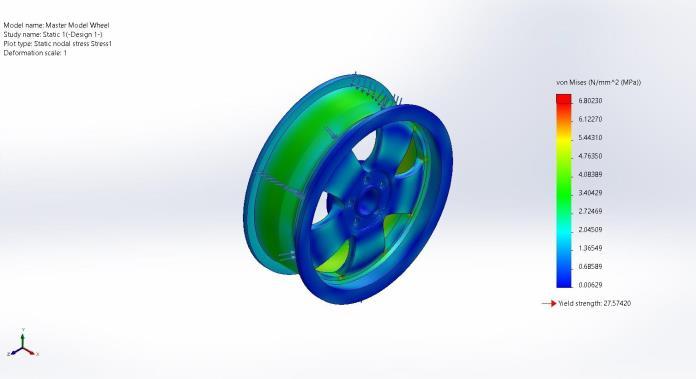
Master Model Wheel-Static 1-Stress-Stress1 Name
Master Model Wheel-Static 1-Factor of Safety-Factor of Safety1 Structural Steel
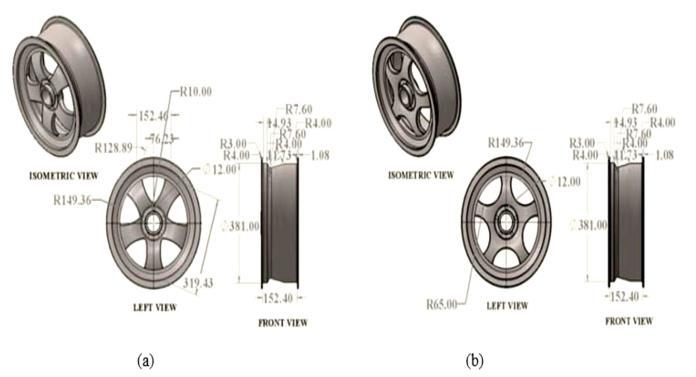
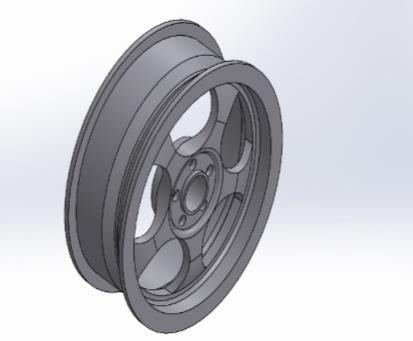
Wheel Design 2 Aluminium alloy


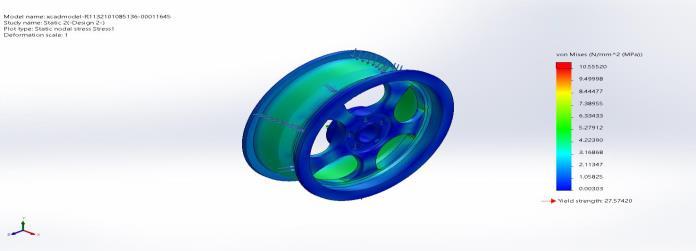
VON: von Mises Stress
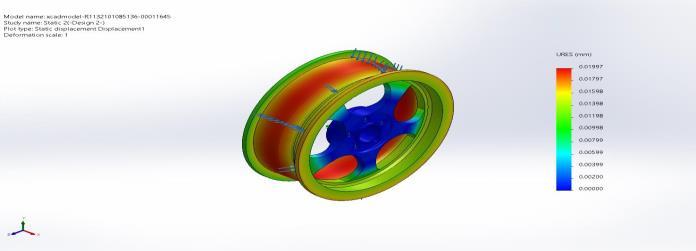
Resultant Displacement
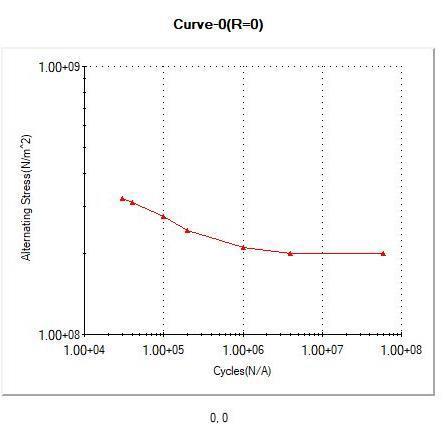
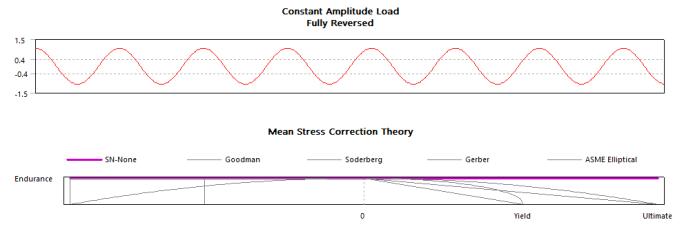
In a fatigue study, it's essential to maintain consistent material properties as those used in static analysis. Nonetheless,it'simperativetodefinethefatiguestrengths of materials, which are represented by S-N curves. These curves encapsulate how a material performs under repetitive loading, illustrated in Figure 5 as a fully reversed alternating stress plotted against the number of cycles on a logarithmic graph. When plotting structural results on this graph, stress ranges are positioned on the verticalaxiswhilethecyclecountisonthehorizontalaxis, oftenleadingtoconsiderabledispersion.
Should the alternating stress surpass the material's endurancelimit,thecomponent'slongevityisrestrictedto a finitenumber ofcycles.This finitelifeencompassestwo distinct regions termed low cycle fatigue and high cycle fatigue. Low cycle fatigue transpires at high stress levels and relatively few cycles, where the material behavior is predominantly plastic. Conversely, the high cycle fatigue region features lower stress levels and elastic material behavior. Structures exposed to stress levels beneath a material's endurance limit undergo a substantial number ofloadcycleswithoutincurringdamage.
5. RESULT
6. CONCLUSION:
Throughourinvestigation,we'vediscernedthatthedesign of the wheel rim wields substantial influence over the overall performance of the wheel. This, in turn, leads to enhanced handling and a more enjoyable ride due to reduced weight and an elevated safety factor. The reduction in weight contributes to improved braking performance and fuel efficiency, amplifying the benefits forthevehicle.
Amethodologycenteredaroundthewheelswasemployed to forecast nominal stress and fatigue life. Within the nominal stress approach, predictions about the wheels' fatigue life relied upon the S-N curve and the equivalent stressamplitudeofthewheelmaterial.
1. The wheel's mass has been effectively trimmed from 29.76 kilograms to 25.12 kilograms, all the while maintaining its physical attributes and functionality.
2. This weight reduction corresponds to a decrease of4.64kilogramsperwheel,culminatinginatotal car spare wheel weight of 27.84 kilograms. This weight reduction carries advantages such as an overall reduction in vehicle weight and a consequentialreductioninproductionexpenses.
3. The lighter weight contributes to heightened performance and improved fuel economy. These findings extend to a range of indirect benefits, including decreased air pollution due to reduced fuel consumption, the conservation of natural resources through diminished crude oil usage, andmore.
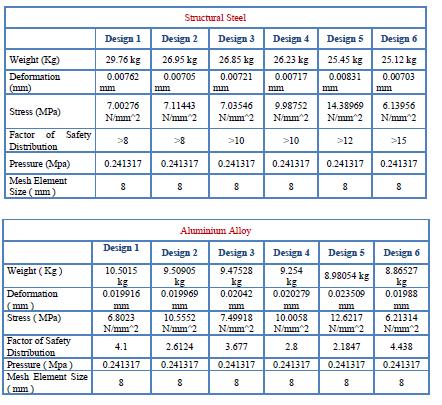
4. While the data collection adhered to the same material and boundary conditions, the diverse wheel designs significantly influence their lifespanandsafetyfactor.
Based on analytical statistics, it is evident that among the sixmodels,wheeldesign6emergesastheoptimalchoice. It boasts a lighter weight of 27.192 kilograms, minimal deformation (0.00703 mm), the highest safety factor (>15),andadiminishedequivalentstress(6.13956MPa).
REFERENCES
1) Abijit Dani, P., Ghosh, A., Ajithkumar, G., Dua, A., Kannan,C.,&Vijayakumar,T.(2019).InfluenceofMaterial and Spoke Pattern on the Performance of Automotive Wheels. Materials Today: Proceedings, 22, 1452–1459. https://doi.org/10.1016/j.matpr.2020.01.503
2) Arunkumar, S., Girimurugan, R., Vairavel, M., Deenadhayalan, M., Dhineshkumar, C., Sivaramakrishnan, N., & Santhoshsivam, S. (2020). Design and Material Optimization of an Automobile Wheel Rim by Finite Element Analysis 1* XII(Iv),1286–1300.
3) Bao, Y., & Zhao, X. (2017). Research of Lightweight Composite Automobile Wheel. World Journal of Engineering and Technology, 05(04), 675–683. https://doi.org/10.4236/wjet.2017.54056
4) Choudhary, V. S., Akram J, W., Yaseen S, M., & Saifudheen, M. (2016). Design and Analysis of Wheel Rim
WithMagnesiumAlloys(Zk60a)ByUsingSolidworksand Finite Element Method. International Research Journal of Automotive Technology, 1(3),16–29.
5) Dharani, V., Mahalingam, S., Santhosh Kumar, A., Scholar, P. G., & Professor, A. (2014). Review on Fatigue Analysis of Aluminum Alloy Wheel under Radial Load for Passenger Car. International Journal of Engineering Development and Research, 3(1), 2321–9939. www.ijedr.org
6) Finite Element Analysis of Alloy Wheel 1, 2,3. (2015). 2, 544–550.
7) Hafeezasif, A., Jayakumar, V., Kumar, D. S., Reddy, M., Sciences, T., & Nadu, T. (2018). A Review on Selection , Manufacturing and Testing of COMPOSITE MATERIALS FOR ALLOY WHEELS. International Journal of Pure and AppliedMathematics, 118(9),331–343.
8) Kancheti, N., Reddy Vemula, A., Reddy Gudibandla, G., Krishna, H., & Bala Subramanyam, P. N. V. (2019). Modeling and analysis of wheel rim using ansys. International Journal of Innovative Technology and ExploringEngineering, 8(8),415–418.
9) Kumar, K. A. (2017). Analysis and Optimization of Material For KTM Motorcycle (Duke 390) Front Alloy Wheel. International Journal of Innovations in Engineering and Technology, 8(2), 113– 130. https://doi.org/10.21172/ijiet.82.017
10) Kumar, R. A., Amarnath, G., & Raj, K. P. | S. K. | I. J. A. (2019). Experimental Studies of Optimization of Automotive wheel RimusingANSYS. International Journal of Trend in Scientific Research and Development, Volume3(Issue-3), 311–316. https://doi.org/10.31142/ijtsrd22778