HEAT TRANSFER ANALYSIS ON LAPTOP COOLING SYSTEM BEFORE AND AFTER INTRODUCING A COOLER AT EXHAUST
Kulkarni1,2,3,4 Students, Department of Mechanical Engineering, Kolhapur Institute of Technology’s College of Engineering, Kolhapur, Maharashtra, India. ***
Abstract - This project uses CATIA and SolidWorks tools to do a thermal analysis and cooling system optimisation of a laptop microprocessor. The aim of the study is to evaluate the ability of the heat pipe, heat sink, and VGA fan to dissipate heat under various operating conditions. The laptop's complex solid model was created using the CATIA software, whereas the SolidWorks software was put to use for the thermal analysis. The results show that the cooling system can effectively dissipate heat produced by the microprocessor, and that the thermal performance is affected by elements like airflow rate and thermal conductivity of the materials used in the heat sink. After the result of these studies, a new cooler is developed and fitted to the previous system in order to further improve thermal efficiency, or the capacity to dissipate heat. This minute change has a significant impact on the laptop's ability to dissipate heat. This research will be helpful in the design and development of new cooling systems for electronic devices which are similar to laptops.
Key Words: Cooling, Cooling System, Thermal Analysis, Simulation,HeatDissipation.

1. INTRODUCTION
Overheating is a major problem with laptop operation becauseitcannegativelyimpactstabilityandperformance, possiblyresultinginhardwarefailureandsystemcrashes. The aim of this research was to examine the thermal behaviourofalaptopcomputerandevaluatehowwellthe suggested cooling technique succeeded in preventing overheatingissues.Inthisproject,wethermallyanalysedthe HPPavilioni511Generationlaptop.whereweconcentrated on researching the cooling system's capacity to dissipate heatunderdiverseoperatingconditions.Toaccomplishthis, wecreatedasolidmodelofthelaptopusingCATIAsoftware, andthen conducted the thermal analysisusing SolidWork software.Althoughthei511GenerationIntelCoreprocessor isextremelyefficient,itproducesa lotofheat.Inorder to avoidthermalthrottling,whichmaydecreaseefficiencyand affecttheprocessor,thisheatmustbeadequatelydrained. Therefore, an effective cooling system should be built in placetomaximisethermalefficiency.Toreducetheheatthat the CPU produces Heat pipe, heat sink, and VGA fan were alreadyincludedinthemodel,butweaddedanewcoolerto thedesigntomaximiseheatdissipation.
1.1 Relevance
Since it addresses the crucial problem of thermal management in laptops, the thermal analysis of a laptop coolingsystemisaveryrelevantandimportanttask.Laptops frequentlystruggletoadequatelydissipateheatbecauseof the growing need for high-performing computingand thin designs.Throughresearchandperformanceoptimisation,the cooling system's efficiency will be improved, resulting in betterthermalcontrolandoveralllaptopreliability.
Thisprojectwillhelptoourunderstandingoflaptopthermal behaviour by doing a thermal analysis under various operatingconditionsandworkloadsituations.Itwillinvolve analysingheatdissipationsystemsincludingVGAfans,heat sinks, and heat pipes and exploring potential design modificationsorimprovements.Theproject'sfindingscanbe usedtodesignlaptopcoolingsystemsthataremoreeffective andreliable,improvinguserexperience,extendinghardware lifespan,andminimisingthepossibilityofthermalfailures.
The primary objectives of this project is to improve user experience,reliability,energyefficiency,andenvironmental impactwhilealsoenhancinglaptopperformance.Theproject aims to resolve these problems and contribute to the developmentofmoreeffective,reliable,andenvironmentally friendly laptop cooling systems by addressing thermal managementconcerns.
2. LITERATURE SURVEY
In paper titled “CFD Thermal Analysis on Laptop Cooling System Using Loop Heat Pipe Technology”, Mr. Ravikiran ChinthalapudishowsthatScienceandtechnologyhavebegun anewerainthehistoryofhumanity.Asaresultoftechnology progress,electronicdeviceshavebecomesmaller,lighterand faster, especially laptops. Laptops are subjected to a lot of heat for high process units,which cause high spots on the processingunit.Becausethecurrentcoolingsystemisweak forheatdissipationinwarmlocations,thetrendyMLHPheat pipe technology is upgraded for better cooling. Compared withcurrentactivecoolingtechnologies,thisnovelpassive coolingsolutionalsoprovides various benefits such noisefreeoperation,lowerenergyusageandincreasedreliability. Thisarticleoffersavisualdepictionofanewlaptopcooling solutionandevaluatesFluent'sapproachforthevictimization offluiddynamics.Thistesthasvaryingthermalreductions,
30W,32W,43Wundervariousoperatingsituations,suchas regularlaptopusage,normalusage,whilebatterychargeand 100%mainframeloadareheavilycharged.Heatdissipation and dispersion under different operating situations were explored.Claves:Laptop,LOOP,CFD
Mr.Syamsuri, etal.explainedinthepaper“Laptopcooling numericalsimulationusingComputationalFluidDynamics” that laptop’s cooling solution is very important. In some cases,duetopoorcoolinganoverheatonthemotherboard, mainchip,andothercomponentsoccurs,sothatthelaptop is quickly broken. Therefore, it is necessary to know the temperaturedistributionsothatoverheatcanbeovercome. One of the methods to determine the temperature distributioninthisfinalprojectisaflowsimulation,using CFD(ComputationalFluidDynamics),3Dmethodwiththe variationifdifferentairflowvelocity,i.e.,5m/s,10m/s,and 15m/s.Thehighertheairflowrate,thehigherthecooling occurs.Fromthetemperaturecontoursitisshownthatthe hottemperatureisbuiltuponthebackoftheheatsink.The resultsofthevalidationofthisstudyandpreviousstudies obtainedanerrorthatoccurredwasaround4%.
Mr.N.H.Ranchagodastudiedinthepaper“Implementation ofanExternalIntelligentCoolingSystemforLaptopsusing TECS” Laptop coolers are external devices, which are ancillariestotheexistingcoolingmechanismoflaptops,in ordertoreducetheirinternaltemperature.Availablecoolers do not provide efficient cooling in high ambient temperatures.Thispaperpresentstheimplementationofan intelligent laptop cooler, which can vary its performance according to the laptop temperature and ambient temperature, and actively cool the air flow by using thermoelectriccoolers(TECs).Inthiswork,a dynamic air flowisintelligentlycooledbythedeviceandtheprocesswill be controlled, based on the feedback provided by a temperature sensor placed at exhaust vent of laptop. Further,thedeviceisdesignedtoreducedustcontentinthe air flow which passes through the laptop, ultimately an effective cooling is provided to the laptop through this devicewhileincreasingthelifetimeofthelaptop.
Mr. Channamallikarjun explained in the paper entitled “ThermalanalysisofCPUwithvariablebaseplateheatsink using CFD” that the computational fluid dynamics is concentrated on the forced air cooling of the CPU using a heat sink. This paper utilizes CFD to identify a cooling solutionforadesktopcomputer,whichusesan80WCPU maximum whereas this number will be increased in the range of 70-120W in the forthcoming desktop computer systems.Thispaperconsiderstheoptimalplatefinheatsink design and cylindrical fin heat sink design with variable copperbaseplateandthecontrolofCPUheatsinkprocesses. To have a better heat dispersion performance, a computational fluid dynamic is utilized to search for an optimalsetofplate-fin.Baseplatethickness,finthickness, fin profile and fin material parameters are to be handled together due to the frequently encountered space
limitations.Thedifferentheatsinkdesignsareanalysedby using commercial CFD software packages ANSYS design modelerformodellingandANSYSmeshingforCFDmeshing and finally ANSYS fluent is used for CFD solver. The well converged;resultsarecomparedwiththeexperimentaldata. Especially,replacingaluminiumwithcopperasbaseplate materialimprovedtheperformance.Thisstudywillbenefit thedesignengineersinvolvedinelectroniccoolingandalso helptoreducethesignificantincreasesinthesoundpower emittedbytheCPU.
3. Problem Definition
Thermalthrottling,afeaturethatslowsdowntheprocessor's speedtopreventoverheating,isusuallytriggeredinlaptops when there is an excessive buildup of heat. This has a negativeimpactonperformanceandcompromisestheuser experience, especially when performing complex activities like gaming, editing videos, or using resource-intensive software.Thereliabilityanddurabilityoflaptopcomponents canbesignificantlyimpactedbycontinuousexposuretohigh temperatures. The ageing process can be accelerated by overheating,whichalsoraisesthedangerofthermalfailures andnecessitatescostlyrepairsorearlyreplacementofcrucial hardwarepartsliketheCPUorGPU.
Insufficientcoolingcanmakelaptopsfeelwarmtothetouch andradiateheatintotheuser'slaporthroughthekeyboard, making them uncomfortable to use for a longer period of time. In addition, when cooling systems have trouble adequatelydissipatingheat,fansmayneedtorunathigher speeds,whichresultsinexcessivenoisethatcanbeannoying andintrusive.
4. Preprocessing
4.1. 3D Model Creation
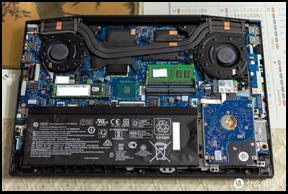
UsingtheCATIAV5software,athorough3DmodeloftheHP laptopwascreated.Thismodelwasdetailedandincludedall necessaryparts,includingthechassis,heatsinks,fans,and vents. This 3D model is exported from CATIA V5 to Solidworkssoftwareforthermalanalysis.
Thermodynamic parameters
Velocityparameters
Solidparameters
Turbulenceparameters
Table
StaticPressure:1.01bar
Temperature:20.05°C
Velocityvector
VelocityinXdirection:0m/s
VelocityinYdirection:0m/s
VelocityinZdirection:0m/s
Defaultmaterial:Aluminum6061
Initialsolidtemperature:20.05°C
Turbulenceintensityandlength
Intensity:2.00%
Length:2.300e-04m
BoundaryCondition
4.2 Mesh Generation
Using the SolidWorks Simulation meshing tools, the mesh generationsettingsaredefined.Themodelwasthenanalysed bysoftware,whichthengeneratedthemeshdependingon thegivenparameters.
Studiedthecreatedmeshforaccuracyandquality.Themesh visualisationtoolsinSolidWorksareusedtostudyelement distortion,evaluateelementquality,andevaluatethemesh's overallappropriatenessforthermalanalysis.Somerequired modifications are then made to the mesh controls or geometrytoenhancethemeshquality.
4.4 Cooler Design
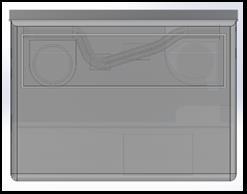
Based on the analysis results, identified areas of improvementinthelaptopcoolingsystem.Developedanew cooler design, considering factors such as size, shape, fin arrangement, fan specifications, and material selection. UtilizedCATIAV5softwaretocreateadetailed3Dmodelof thenewcoolerdesign.
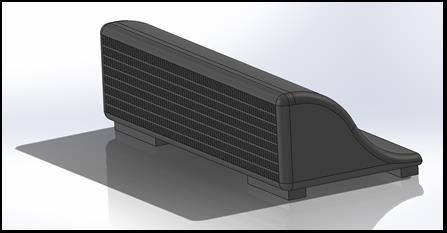
•Threefansinstalledinsidethecasingofspecifications.
•9232-12M
•Path:FansPre-Defined\Axial\JMCProducts
•FanType:Axial
•Rotorspeed:314.159rad/s
•Outerdiameter:0.092m
•Hubdiameter:0.051m
•Directionofrotation:Counter–clockwise
4.3 Boundary Conditions
In thermal analysis, boundary conditions are significant because they define the thermal interactions between the system being studied and its surroundings. To precisely simulateheattransferandtemperaturedistribution,youcan create a variety of boundary conditions in SolidWorks for thermalanalysis.
TheappropriateboundaryconditionsfortheCFDsimulation aredefinedhere.Thisinvolvesdescribinganyotherrelevant boundaryconditions,suchasheatsourcesinsidethelaptop, as well as the intake and output conditions, including temperature,velocity,andpressure.
4.5 Simulation, Analysis and Visualization
Basedonthespecifiedparametersandboundaryconditions, SolidWorkssolvesthegoverningequationsofheattransport
during the analysis run using numerical methods. The temperature distribution and other thermal parameters insidethemodelarecalculatedandupdatediterativelybythe softwareuntilconvergenceisattained.Convergenceindicates thattheproblemhasstabilisedandthatadditionaliterations havelittletonoimpactontheoutcome.
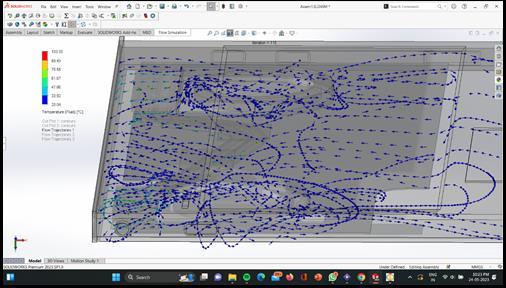
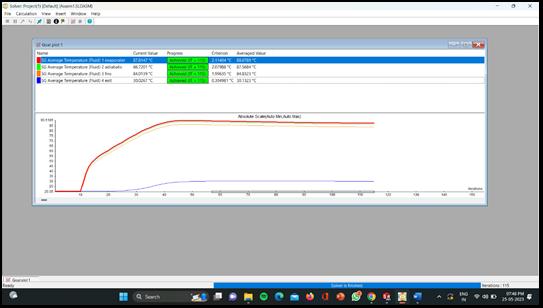
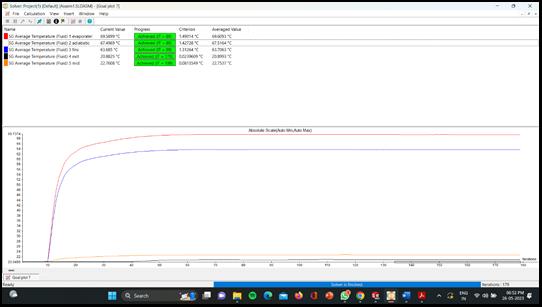
SolidWorksgivesusersaccesstotheresultsaftertheanalysis runisfinishedsotheymayfurtheranalyseandvisualisethem to learn more about the thermal behaviour of the design. Then,inordertoassesstheperformanceandcometowise designjudgements,welookedattemperaturedistributions, heat fluxes, thermal gradients, and other relevant characteristics.
5. Results
5.1 Before Applying Cooler
Theabovefig.showsthetemperaturesofdifferentsectionsof the laptop. We can observe that after a certain time, the temperature of the processor chip remains constant at 87 degreesCelsius.Thetemperatureoftheairisincreasedfrom 20 degrees Celsius to 30 degrees Celsius which means 10 degreesofheatisgettingdissipatedduetoair.
5.2 After Applying Cooler
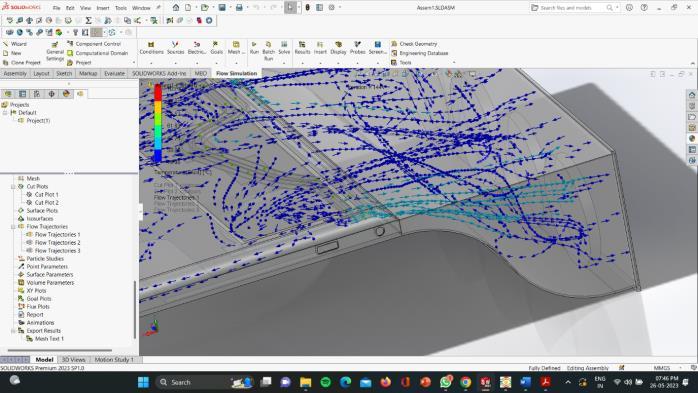
Thefigureshowsthetemperatureoffluidflowafterapplying thecooler.Wecanobservethatheatisgettingdissipateddue totheextraflowrateprovidedbythecooler.
Fig -4:Fluidflowbeforeapplyingcooler
The above fig. shows the temperature of fluid flow in the laptop.Wecanobservethatthetemperatureoftheairbefore passingthroughthefinsisnear20degreesbutafterpassing through the finsit becomesaround40-60 degrees Celsius. This means that around 10-15 degrees Celsius of heat is gettingdissipatedthroughthefinduetotheairflow.
Fig
:Resultsafterapplyingcooler
Theabovefigureshowsdifferenttemperaturesatdifferent sectionsaftertheapplicationofthecooler.Wecanobserve thatthetemperatureoftheprocessorchipgotreducedfrom 89 degrees Celsius to 69 degree Celsius, Reducing the temperatureofabout20degrees.
6. Conclusion
Improvementsintemperaturecontrolandheatdissipation haveresultedfromananalysisofthecoolingsystemandthe creation of a new cooler for the HP laptop. The laptop's temperature was lowered by 10 degrees by the existing coolingsystem'soptimisationpriortotheapplicationofthe
new cooler. However, a further temperature drop of 20 degreeswasachievedoncethenewcoolerwasinstalled.
The results clearly show how the new cooler design improvedthelaptop'scoolingcapabilities.Innovativedesign elements of the cooler, such as its size, shape, fin configuration,fanspecs,andmaterialchoice,haveimproved airflow and boosted heat dissipation. The cooler has significantlyreducedtheriskofoverheatingbyeffectively spreadingheat,whichhasimprovedtheoverallperformance ofthelaptopandincreasedthelifespanofitscomponents.
REFERENCES
[1] “CFDThermalAnalysisonLaptopCoolingSystemUsing LoopHeatPipeTechnology”,RavikiranChinthalapudi1, a),ChandraMohanaReddyGangireddygari1,b)Bathini SiddaReddy2,c),BridjeshPappuula1,d)andChintala Murali Krishna1, e) 1Department of Mechanical Engineering,MLRInstituteofTechnology,Hyderabad, India 2Department of Mechanical Engineering, RGM College ofEngineering and Technology,Nandyala,AP, India.
[2] “Laptop cooling numerical simulation using Computational Fluid Dynamics” Syamsuri1, *, Z.A. Fairuz2, K.D.T. Alfonsus3 Department of Mechanical Engineering,InstituteTechnologyAdhiTamaSurabaya.
[3] “Implementation of an External Intelligent Cooling systemforLaptopsusingTECs”,N.H.Ranchagoda1,M.N. Akram2, c.P. K. Vithange3, N.D. Jayasundere4, DepartmentofElectricalandInformationEngineering, UniversityofRuhuna,Hapugala,Galle,ShriLanka.
[4] “ThermalanalysisofCPUwithvariablebaseplateheat sink using CFD”, Channamallikarjun, Department of MechanicalEngineering,BKIT-Bhalki-585328
BIOGRAPHIES
Mr.PrathameshR.Kulkarni


Bachelor of Technology in Mechanical Engineering from KolhapurInstituteofTechnology’s CollegeofEngineering.
Mr.FaizanF.Sutar
Bachelor of Technology in Mechanical Engineering from KolhapurInstituteofTechnology’s CollegeofEngineering.
Mr.PranavKhade


Bachelor of Technology in Mechanical Engineering from KolhapurInstituteofTechnology’s CollegeofEngineering.
Mr.PratikrajKakade
Bachelor of Technology in Mechanical Engineering from KolhapurInstituteofTechnology’s CollegeofEngineering.