A STUDY ON SELF CURING CONCRETE USING SODIUM LIGNOSULPHONATE BY PARTIALLY REPLACING CEMENT WITH GGBS
Abstract – Self curing concrete is designed to maintain adequate moisture within the concrete mix and to cure itself without the need for external water curing. And also aid to ensure proper hydration and strength development. Sodium lignosulphonate can be used as water reducing agent, helping to maintain a consistent moisture level within the concrete. sodium lignosulphonate act as plasticizer and improves the workability of concrete mix. This leading to a more homogeneous mixture, which can contribute to better moisture distribution throughout the concrete mix. Thus it doesn’t require additional water for curing. This self curing agent has water retaining property and allow the concrete to self cure over time. In this experimental study cement has been partially replaced with GGBS. By using GGBS ensures resource conservation, reduces carbon emission, enhances workability and reduces heat of hydration. Incorporation of GGBS makes the concrete more sustainable and contributing to a greener construction industry. The aim of this investigation is to study the strength of concrete using Sodium Lignosulphonate (NaLS) as self-curing agent. In this study, compressive strength, split tensile strength and flexural strength of concrete containing self-curing agent is investigated and compared with those of conventionally cured concrete. Self-curing agent NaLS (0.5%, 1%, and 1.5%) were added and also cement has been partially replaced with 10% of GGBS. Their strength properties were studied and compared with control mix.
Key Words: Self curing, Compressive strength, Split tensile strength, Flexural strength, GGBS, Sodium Lignosulphonate
1.INTRODUCTION
Curing of concrete is the process of maintaining adequate moisturecontentandtemperatureinconcrete.Thisisdone to ensure proper hydration and strength development. If curing is not provided at the right time, this may lead to shrinkage of concrete and results in cracking, reduces durability and may not achieve desired properties for the concretestructure Differentmethodsofcuringinvolvewater curing, curing using chemical compounds, steam curing, membranecuringetc.Watercuringiswidelyusedmethodto cure the concrete. Construction requires huge amount of waterfortheirworkandlargeamountofwateriswasted.But availabilityofwatermaynotbeassuredineveryregion.So watercuringcannotbeconductedinwaterdeficitareas.In ordertoreducethisproblem,selfcuringagentsareused.By
using selfcuringagents,reducestheexcessiveevaporationof waterfromtheconcreteandincreasesthewaterretention capacity.Thusitsolvestheproblemofwaterdeficiencyfor curinganditisaneffectivemethodforcuringconcrete.Thus savetheamountofwaterusedinconstructionindustry
2. MECHANISM OF SODIUM LIGNOSULPHONATE AS SELF CURING AGENT
NaLS is used as water-reducing and self curing agent in concrete,butitdoesnotundergoachemicalreactionwhen addedtotheconcretemixture.TheNaLSmoleculeshavea negatively charged surface which allows them to adsorb onto the surface of cement particles, forming a protective layer around them. This layer prevents the particles from coming into contact with each other and forming large aggregates, which would increase the viscosity of the mixture. The NaLS can disperse in the water, forming electrostatic repulsion with the cement particles and reducingtheattractiveforcesbetweenthem.Thishelpsto keeptheparticlesinamorefluidstate,allowingtheconcrete toflow more easilyinto moldsand forms.Theaddition of NaLSasaselfcuringagentinconcreteworkstomodifythe physical properties of the mixture. On hardened concrete NaLSreactswiththefreelime(CaO)presentintheconcrete to form insoluble calcium lignosulphonate. This creates a barrier within the concrete that helps to retain moisture, whichisessentialforthecontinuedcuringoftheconcrete. NaLScanpenetratethesurfaceoftheconcreteandhelpsto strengthenthebondsbetweenthecementparticles.Thiscan leadtoanincreaseincompressivestrengthandareduction inthepermeabilityoftheconcrete.
3. OBJECTIVE
Tostudythemechanicalpropertiesofself-curingconcrete usingsodiumlignosulphonate.(Compressivestrength,split tensilestrength,flexuralstrength).
To find the optimum percentage of Sodium lignosulphonate.
To develop a sustainable building material by partial replacementofcementwithGGBS.

4. MATERIALS AND PROPERTIES
4.1 Cement
OrdinaryPortlandcement53gradeisused.ConformingtoIS 12269-1987.
Table1:Physicalpropertiesofcement
4.4 Sodium lignosulphonate
Sodium Lignosulphonate is a yellow brown color water solublepolymer.Itisabyproductofsulfitepulpingprocess forpaper.Itisusedasa water reducingagentinconcrete structure.
Table4:PhysicalpropertiesofSodiumLignosulphonate
4.5 Ground Granulated Blast Furnace Slag (GGBS)
4.2 Fine aggregate
Aggregatesthatpassthrough4.75mmsieveisdesignatedas Fineaggregate.HereMsandisadoptedinsteadofriversand.
Table2:Physicalpropertiesoffineaggregate
GGBS is a co-product produced simultaneously with iron, molten blast furnace slag is cooled instantaneously by quenching in large volume of cold water to produce blast furnaceslag.
4.3 Coarse aggregate
Goodqualityaggregateswithangularshapeand20mmsize areused.
Table3:Physicalpropertiesofcoarseaggregate
4.6
Waterusedforexperimentwaspotablewaterconformingas perIS456-2000.
5. TEST RESULTS
Inthisexperimentbothfreshandmechanicalpropertiesof specimenwerecarriedout.
Note* :
M1:Mix1,Controlmix[GGBS-0,NaLS-0]
M2:Mix2[GGBS-10%,NaLS-0.5%]
M3:Mix3[GGBS-10%,NaLS-1%]
M4:Mix4[GGBS-10%,NaLS-1.5%]
5.1
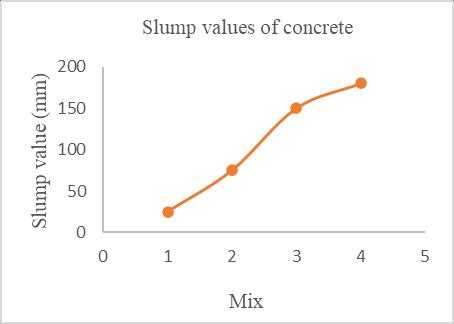
Fresh properties of concrete specimen were tested using slumpconeandresultswereshownbelow.
5.2
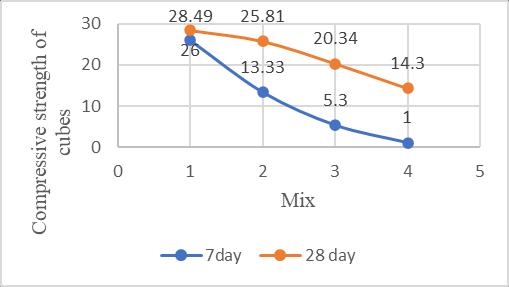
Thecompressiveforceappliedperunitareaonthespecimen is termed as compressive strength. Here both 7th and 28th daystrengthwereconducted.
5.3
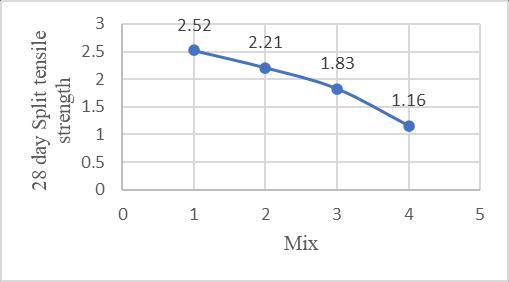
The tensile forceapplied perunitarea onthespecimen is termedassplittensilestrength.Here28th daystrengthwas conducted.
Mix 28th daysplittensilestrength(N/mm2)
5.4
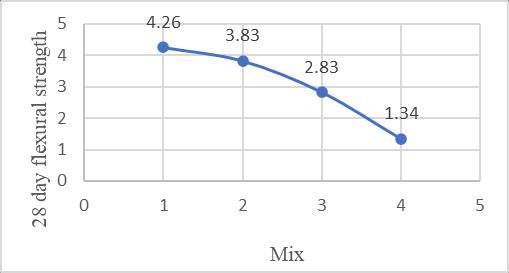
Flexuralstrengthistheabilityofthematerialtowithstand bendingforcesappliedperpendiculartoitslongitudinalaxis. Here28th daystrengthwasconducted.
Mix 28th dayflexuralstrength(N/mm2)
6. CONCLUSION
Inthisprojectwork,theeffectsofSodiumLignosulphonate (NaLS) on the mechanical properties of concrete were studied.M25mixisusedanditisdesignedaccordingtoIS 10262:2009. The concrete specimens such as cubes, cylindersandbeamswerecastedandtestedforfindingthe strengthofconcreteforvariouspercentageofNaLS.Andalso cementhasbeenpartiallyreplacedwith10%ofGGBS.Based ontheinvestigationfollowingconclusionsaredrawn.
•Fromtheexperimentalwork,itcanbeconcludedthatthe slumpvalueofselfcuringconcreteincreasedwithincrease inpercentageadditionofNaLS.For1.5%additionofNaLS, slumpvalueisincreasedupto86%comparedtocontrolmix. Hence it can be concluded that NaLS improves the workabilityofconcrete.
• Compressive, split tensile and flexural strength were testedandthehighestvaluewereobservedforthecontrol mix.ForthetestspecimenwithNaLS,thestrengthwasfound to decrease with increase in percentage addition of NaLS. Thismaybeduetothepresenceoflignin.Lignincanreduce theoverallstrengthofthecuredconcrete,especiallyifitis usedinhigherconcentrations.ButmixM2whichishaving 0.5%NaLShasachievedtherequiredstrengthonselfcuring. Thereforeitcanbeappliedinlowgradeconcreteandcanbe usedinpavementpurpose.
•Wateravailabilitymaybedeficitinsomeareaswhichmake curing almost impossible. So self curing can come as alternativemethodtoovercomethisproblem.
•AddingGGBSensuressustainabilityandreducespollution
REFERENCES
[1] Arivalagan S, (2014), ‘Sustainable studies on concrete with GGBS as a replacement material in cement. Jordan journalofcivilEngineering’,8(3),263-270.
[2] Atmajayanti A. T, Hung, C.C.Yuen, & Shih R.C,(2021), ‘Influencesofsodiumlignosulfonateandhigh-volumeflyash onsettingtimeandhardenedstatepropertiesofengineered cementitiouscompositesMaterials’,14(17),4779.
[3] Ankith MK, (2014), ‘Self-Curing Concrete with Light Weight Aggregate’, International Journal of Scientific EngineeringandResearch(IJSER).
[4] D.R.Bhatt, Prof.Nanak J Pamini and Dr. A.K. Verma,(2013), ‘Comparison of compressive strength of medium strength self-compacted concrete by different curing techniques’, International Journal of Engineering TrendsandTechnology,ISSN:22315381,volume4,2013.
[5] Gopal C, & Suresh A, (2017), ‘Partial Replacement of CementwithGGBSinConcrete.IJARIIT,ISSN.’
[6] M.V.Jagannadha Kumar, M. Srikanth, K. Jagannadha Rao,(2017),‘Strengthcharacteristicsofself-curingconcrete’, International Journal of Research in Engineering and Technology.
[7]ManojKumar,D.Maruthachalam,(2013),‘Experimental investigationonself-curingconcrete’.Internationaljournal ofAdvancedScientificandTechnicalResearch.
[8]MohammadShafique,SanofarP.B.,GopiKrishna,(2016), ‘Strength comparison of self-curing concrete and Normal curing concrete’, SSRG International Journal of Civil Engineering(SSRG-IJCE)volume3.
[9]PandaR,&SahooT.K,(2021),‘Effectofreplacementof GGBS and fly ash with cement in concrete. In Recent DevelopmentsinSustainableInfrastructure’:Proceedingsof ICRDSI2019.SpringerSingapore
[10]RamakrishnaU,ReddyG,N.KSaisri,KTeja,D.S.Akhila, &NikhilK,(2023),‘Experimentalinvestigationonself-curing concretewithsodiumlignosulphatebypartialreplacement ofcementwithflyash’,MaterialsToday:Proceedings.
[11]ReddyB.N,&KumarM.V,(2020),‘Comparativereview onmechanicalpropertiesofconcretewithreplacingcuring waterbyself-curingcompounds.InIOPConferenceSeries: Materials Science and Engineering (Vol. 925, No. 1, p. 012008).IOPPublishing.
[12]S.Azhagarsamy,Dr.S.Sundararaman,(2016),‘AStudyon Strength and Durability of Self Curing Concrete Using PolyethyleneGlycol-400’,InternationalJournalofEmerging TechnologyandAdvancedEngineering,Volume6,Issue1.
[13] Sachan, K., & Srivastava S, (2022), ‘A comprehensive studyofself-curingconcrete’.InAIPConferenceProceedings (Vol.2413,No.1,p.030015).AIPPublishingLLC.
[14]SaranyaV,(2018),‘Experimentalstudyonself-curing concretebyusingbiomaterialsasadmixtures.
[15] Suhail M, (2017), ‘An Experimental Investigation on Self-Cured Concrete: A Review’. International Journal of ResearchinTechnologyandManagement(IJRTM),3(1)
[16] Shumuye E. D, & Jun Z, (2018), ‘A review on ground granulatedblastslag(GGBS)inconcrete’.InProceedingsof theEighthInternationalConferenceonAdvancesinCiviland StructuralEngineering,CSE.
[17]StellaEvangeline,(2014),‘Self-CuringConcreteandIts Inherentproperties’,StellaEvangelineInternationalJournal ofEngineeringResearchandApplications,ISSN:2248-9622, Vol.4,Issue8(Version7).
[18] Thrinath G and Sundara Kumar, (2017), Eco-friendly self-curingconcreteincorporatedwithpolyethyleneglycol asself-curingagent,Internationaljournalofengineering30 473-78.