International Research Journal of Engineering and Technology (IRJET) e-ISSN:2395-0056

Volume: 10 Issue: 08 | Aug 2023 www.irjet.net p-ISSN:2395-0072

International Research Journal of Engineering and Technology (IRJET) e-ISSN:2395-0056
Volume: 10 Issue: 08 | Aug 2023 www.irjet.net p-ISSN:2395-0072
***
Abstract
India'spopulationdynamics havewitnessedsignificantchanges,leadingtocriticaltrends,challenges,andimplicationsforits society and economy. The country's demographic transition, marked by declining birth and death rates due to improved healthcare and family planning efforts, has resulted in a massive population. Despite a decreasing birth rate, India's size continues to strain resource management, infrastructure, education, employment, healthcare, urbanization, and gender balance.
Thearticlehighlightstheneedforcomprehensivepoliciesandinterventions,suchasfamilyplanningprogramsandwomen's empowerment initiatives, to address population-related challenges effectively. The government must focus on sustainable resourcemanagement,investmentineducationandhealthcareinfrastructure,andpromotinggenderequality.
Managing India's population dynamics is crucial to harnessing its demographic dividend for inclusive and sustainable development. However, neglecting this aspect could hinder the country's progress and stability amid its vast and diverse population.
Key words:Birthrate,Deathrate,populationgrowth,Resourcemanagement,Healthcare,Urbanization
Introduction:
India, a vast and diverse country in South Asia, has been experiencing significant population dynamics over the past few decades. With a population of over 1.3 billion, India is the second-most populous country in the world, and its population growthanddistributionhaveimportantimplicationsforvariousaspectsofsocietyandtheeconomy.Thisarticleexploresthe keytrends,challenges,andimplicationsofpopulationdynamicsinIndia.
India'spopulationhasundergoneremarkablechangesovertheyears.Inthemid-20thcentury,thecountryexperienced high birth rates and death rates, resulting in rapid population growth. However, since the 1970s, India has been going through a process of demographic transition, characterized by declining birth and death rates. This transition has been influenced by variousfactors,suchasimprovementsinhealthcare,education,andfamilyplanningefforts.
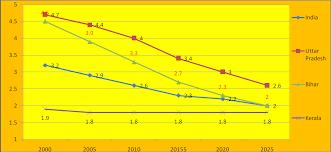
Indiaisoneofthemostpopulouscountriesintheworld.Between2011and2021,itspopulationcontinuedtogrow,although ataslightlyslowerpacecomparedtopreviousdecades.The2011censusestimatedIndia'spopulationataround1.21billion, anditwasprojectedtoincreaseoverthefollowingdecade
Demographic Transition:Duringthisperiod,Indiaexperiencedongoingdemographictransition,characterizedbydeclining birthanddeathrates,leadingtoagradualincreaseintheproportionoftheworking-agepopulation.Thistransitioncanhave significanteconomicimplications,termedthe"demographicdividend"ifharnessedeffectively,butitalsopresentschallenges forprovidingadequatehealthcare,education,andemploymentopportunitiesforthegrowingpopulation.
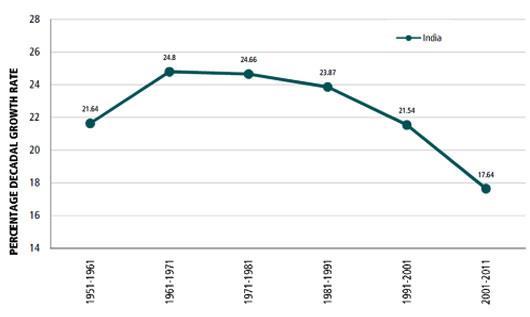
Despite a declining birth rate, India's population continues to grow at a significant rate due to its large base population. The challenges posed by such growth are evident in various sectors, including healthcare, education, employment, and urbanization.Managing the needsand aspirationsofsuch a massiveanddiversepopulationisa daunting task fortheIndian government.
Challenges and Implications:
Resource Management: Theever-increasingpopulationputsimmensepressureonthecountry'snaturalresources,including water, food, and energy. Ensuring sustainable resource management becomes crucial to meet the demands of a growing populationwhilepreservingtheenvironment.
Infrastructure and Urbanization: Rapid population growth has led to an explosion in urbanization. This puts immense strain on urban infrastructure, leading to issues such as inadequate housing, traffic congestion, and waste management. Proper urbanplanninganddevelopmentarevitaltoaddressthesechallenges.
Resource Strain: Theincreasingpopulationputsastrainonessentialresourceslikewater,food,energy,andland.Itbecomes essentialtomanagetheseresourcessustainablytomeetthegrowingdemands.
Infrastructure Pressure: With more people moving to urban areas, there is increased pressure on infrastructure like transportation,housing,healthcarefacilities,andsanitation.
Education and Employment: The young and expanding workforce presents both opportunities and challenges. Ensuring quality education and skill development are essential to equip the youth for gainful employment, while creating enough job
opportunitiesbecomescrucialtopreventunemploymentandsocialunrest.Providingqualityeducationandhealthcaretosuch a large and diverse population becomes crucial to ensure a productive and healthy society. Generating enough employment opportunities for the expanding working-age population is a significant challenge. Insufficient job creation may lead to underemploymentandpoverty.
Healthcare: A large population poses significant challenges in providing accessible and quality healthcare services to all. Ensuringequitablehealthcareandfamilyplanningservicesarenecessarytoimprovetheoverallhealthandwell-beingofthe population.
Aging Population: While the focus has been on the challenges of a young population, India is also experiencing an aging population.Thispresentsitsownsetofchallengesrelatedtohealthcare,socialsecurity,andsupportsystemsfortheelderly.
Gender Imbalance: India facesa skewedsex ratio, withmore malesthan females, particularlyinsomeregions.Thisgender imbalance is a result of cultural preferences for male children and has implications for issues such as human trafficking and violenceagainstwomen.
Government Policies and Interventions:
The Indian government has implemented several policies and interventions to address the challenges posed by population dynamics. These include family planning programs, incentives for smaller families, promotion of education and women's empowerment, and initiatives to improve healthcare infrastructure. However, effective implementation and reaching all sectionsofthepopulationremaincrucialfortheirsuccess.
Implications: The population dynamics in India have several implications:
Economic Growth:Ifmanagedeffectively,thedemographicdividendresultingfromalargeworking-agepopulationcanboost economicgrowth.Askilledandproductiveworkforcecandriveinnovationandinvestment.
Healthcare and Education: Focusingonhealthcareandeducationisessentialforhumancapitaldevelopment.Ahealthyand educatedpopulationcontributestohigherproductivityandoveralldevelopment.
Family Planning and Gender Equality: Addressing family planning and gender equality issues can help control population growthandempowerwomen,leadingtobettersocio-economicoutcomes.
Environmental Impact: Population growth and urbanization can have significant environmental implications. Sustainable practicesandconservationeffortsarevitaltopreservenaturalresourcesandcombatclimatechange.
The passage highlights the need to assess the spatio-temporal variations in population growth in India during the period 2001-2011.Itpointsoutthattheaveragepopulationgrowthrateof17.64%duringthisdecadedoesnotpresentatruepicture, astherearesignificantdifferencesingrowthratesacrossdifferentregionsandtimeframes.
The phenomenon of low population growth has extended beyond the southern states to states in other regions, including Himachal Pradesh and Punjab in the north, West Bengal and Odisha in the east, and Maharashtra in the west. These states recordedgrowthratesbetween11%and16%during2001-2011.
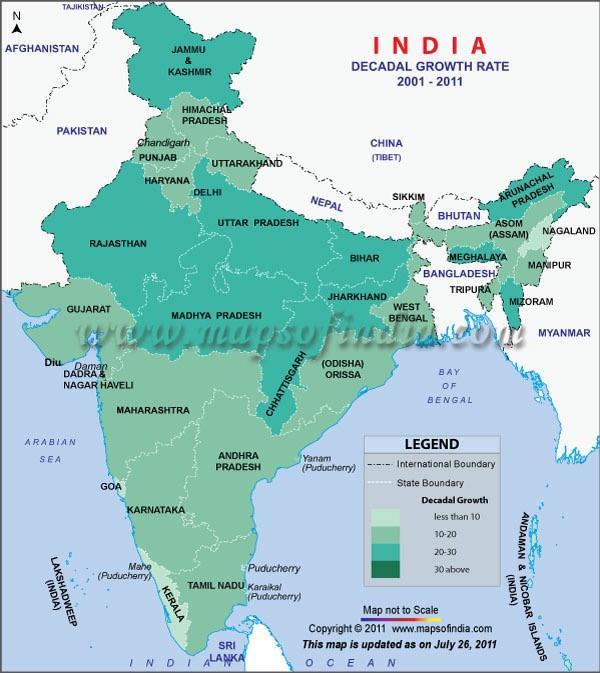
In contrast, some smaller states and Union territories, such as Dadar and Nagar Haveli and Daman & Diu, experienced exceptionallyhighgrowthratesof55.5%and53.54%,respectively,duringthesameperiod.
The passage also highlights significant changes in growth rates in specific states. For instance, Nagaland witnessed a steep declineingrowthratefrom64.53%in1991-2001toanegativegrowthrateof-0.47%inthe2011census.
Kerala,ontheother hand, recorded thesecondminimumgrowth rate of4.86%,indicatingthat ithasreached a highlevel of demographictransition,comparabletoadvancedcountriesinEuropeandAmerica.
Thepassagefurthermentionsstateswithveryhighgrowthrates,suchasBihar(25%),Jammu&Kashmir(23%),Chhattisgarh (22%), and Jharkhand (22%). Additionally, smaller states like Meghalaya (27%) and Arunachal Pradesh (25%) also experiencedrelativelyhighgrowthrates.
Finally from the map, the passage emphasizes the need to analyze and understand the spatio-temporal variations in populationgrowthacrossdifferentstatesandterritoriesinIndia,asauniformgrowthratedoesnotaccuratelyrepresentthe country'sdiversedemographicdynamics.
Conclusion:
Between 2011 and 2021, India experienced notable population dynamics characterized by steady growth, an ongoing demographictransition,and rapidurbanization.Althoughtheoverall growthrate moderatedcomparedto previous decades, Indiaremainsoneoftheworld'smostpopulousnations.
The population dynamics in India are intricate and multifaceted, presenting both opportunities and challenges. Addressing these challenges necessitates a comprehensive approach encompassing sustainable resource management, investments in education and skill development, equitable healthcare access, and policies promoting gender empowerment. By carefully planningand implementing effectiveinterventions, India canharnessthepotential ofits demographicdividend andadvance towardsinclusiveandsustainabledevelopment.However,failuretoadequatelymanageitspopulationdynamicscouldimpede thecountry'sprogressandstability.
Ultimately,tacklingthechallengesandseizingtheopportunitiesarisingfromIndia'spopulationdynamicsdemandscohesive andwell-coordinatedpoliciesacrossdiversesectors.Familyplanning,education,healthcare,infrastructuredevelopment,and sustainable resource management are crucial focal points that require attention to ensure India's future development and well-being. Additionally, continuous monitoring and data analysis play a vital role in informing evidence-based policies and strategiestoadapttotheevolvingpopulationtrendsinIndia.
References:
1. Dyson,T.,&Visaria,L.(Eds.).(2005).Twenty-first-centuryIndia:Population,economy, humandevelopment,andthe environment.OxfordUniversityPress.
2. Jejeebhoy,S.J.(2000).Women'sautonomyinrural India:Itsdimensions,determinants,andtheinfluenceofcontext. PopulationCouncil.
3. Jha, P., Kumar, R., Vasa, P., Dhingra, N., Thiruchelvam, D., & Moineddin, R. (2007). Low male-to-female sex ratio of childrenborninIndia:Nationalsurveyof1.1millionhouseholds.TheLancet,367(9506),211-218.
4. Kugelman,M.,&Maloney,S.(Eds.).(2015).India'scontemporarysecuritychallenges.Routledge.
5. Kurian,N.J.(Ed.).(2014).India'sdemographictransition:Boonorbane?.Springer.
6. Mahapatro,S.(2013).India'spopulation:Concerns,trends,andpolicies.SpringerScience&BusinessMedia.
7. Rajan,S.I.,&Mishra,U.S.(2008).PopulationdynamicsinIndia.SagePublications.
8. Registrar General & Census Commissioner, India. (2011). Census of India 2011: Provisional population totals. GovernmentofIndia.