Experimental investigation of strength of self curing concrete incorporated with light weight aggregate as mineral admixture
Mr. Naufil. W. Sayyad1 , Prof. V.A. Patil2, Asst.Prof. S.R.Takkalki31P.G. Student, Dept. Of Civil Engineering, B.R. Harne College of Engineering and Technology, Maharashtra, India
2Guide, Principal, B.R. Harne College of Engineering and Technology, Maharashtra, India
3Assistant Professor, Dept. of Civil Engineering, B.R. Harne College Engineering and Technology, Maharashtra, India

Abstract - In present study the internal curing or self curing is achieved by adding Light weight aggregate namely Light weight expanded clay aggregate (LECA) in replacement of coarse aggregate. Seven mixes of M40 grade were casted and tested with varying percentage of LECA in replacement of coarse aggregate i.e. 0%, 5%, 10%, 15%, 20% and 25%. Among these, first and second mix (M1 & M2) were nominal mixes with 0% LECA. M1 was cured in a curing tank whereas M2 by wet gunny bags. These specimens were then tested for Compressive strength, Split tensile strength,Flexuralstrength, ultrasonic pulse velocity and continuous immersion in salt water. Results shown that replacing coarse aggregate with LECA up to 10% will produce improvement in strengths in compression, tension and flexure also this mixhasshowngood resistance to chloride attack when tested in continuous immersion test with improvement of 10.74% in compressive strength. Whereas mix with 15% LECA has shown excellent quality of concrete in ultrasonic pulse velocity test and attained adequate strengths in compression and flexure. This leads to conclude that the optimum content of LECA in replacement of course aggregate in concrete should be 10% and it should not exceed 15% for attaining the required strength.
Key Words: Selfcuring,Lightweightaggregate,Lightweight expandedclayaggregate,Polyethyleneglycol,Compressive strength,splittensilestrength,flexuralstrength,Ultrasonic pulsevelocity,Chlorideattack.
1. INTRODUCTION
Atthepointwhenthemineraladmixturesrespondtotallyin a mixed concrete framework, their interest for relieving water(outsideorinward)canbealotmoreprominentthan thatinacustomarycommonPortlandconcretecement.At the point when this water isn't promptly free, because of depercolation of the hairlike porosity, for instance, huge autogenousdistortionand(early-age)breaking.
Because of the substance shrinkage happening during concretehydration,voidporesaremadeinsidetheconcrete glue, prompting a decrease in its inner relative stickiness andfurthermoretoshrinkagewhichmightcauseearly-age breaking. This present circumstance is heightened in HPC (contrastedwithtraditionalcement)becauseofitsbyand
largehigherconcretesubstance,decreasedwater/concrete (w/c)proportionandthepozzolanicmineraladmixtures(fly debris,silicasmolder).Thevacantporesmadeduringselfdryingupinitiateshrinkagestressesandfurthermoreimpact theenergyofconcretehydrationprocess,restrictingthelast levelofhydration.FrequentlyuncommonlyinHPC,itisn't effectivelyimaginabletogiverestoringwaterfromthetop surfaceattherateexpectedtofulfillthecontinuoussynthetic shrinkage, because of the very low porousness frequently accomplished.Todefeatsuchcircumstancesthereisaneed of water in concrete inside for complete hydration to accomplish the normal strength. This is accomplished by Insiderelievingutilizingvariousspecialistswhichgivethe water to hydration through narrow activity even after dissipation outside restoring water. In present review the inwardrestoringisaccomplishedwiththeassistanceofLight weightexpandedclayaggregate(LECA).
1.1 Definition of Internal Curing (I.C.)
TheACI-308Codeexpressesthat"inwardcuringalludesto theinteractionbywhichthehydrationofconcretehappens in view of the accessibility of extra inner water that isn't importantfortheblendingWater."Traditionally,relieving substantialmeansmakingconditionstosuchanextentthat water isn't lost from the surface i.e., relieving is taken to happen'fromanexternalperspectivetoinside'.Conversely, 'innerrelieving'istakingintoconsiderationrestoring'from withintooutside'throughtheinteriorsuppliesmade.'Inside relieving'isfrequentlylikewisealludedas'Self-curing.'
1.2 Light Weight Aggregate
Lightweight aggregates are those minerals, regular stone materials,items,andresultsofassemblingprocessesthatare utilizedas massfillersinlightweightunderlyingconcrete, substantial workmanship units, precast cement primary items, street surfacing materials, mortar totals, and protecting fill. Light weight extended mud total is kind of light weight total fabricated by pyro handling in turning oven.
2. LITRATURE REVEIW
A.Mueller,S.N.Sokolovab,V.I.Vereshagin[1]"Attributes of lightweight totals from essential and reused unrefined components"inElsevierdiary,(2008),pp703-712,Carried out examinations in the research facility and in the pilot plant have exhibited that the range of constituents reasonable for lightweight total creation can be widened. Reasonable are zeolite rocks, of which there are stores in numerouslocalesofRussia.InGermany,stoneworkrubble could be utilized as elective natural substance. The innovative cycle for the production of the granules is comparableforthetwomaterials.
DayalanJ,Buellah.M[2]"Inwardrestoringofsubstantial utilizing prewetted Lightweight Total" in Global Diary of imaginative Exploration in Science , Designing and innovation, Walk 2014 pp 10554-10560, closed after trial examination that the inside relieved concrete is ended up beingsuperiortotraditionallyrestoredconcretedefinitely. The utilization of lightweight total for inner restoring of cementisespeciallyadvantageousasitdiminishesdifferent shrinkagebreaks.Thecompressivestrengthfortheinside restoredconcretebroughtaboutvalues20%higherwhen contrastedwiththeplainconcrete.Empowersahighrelative stickiness inside the pore design of the substantial which diminishes inward drying and expands hydration process which subsequently builds strength and toughness of the substantial.
Patel Manishkumar Dahyabhai, Prof. Jayeshkumar R. Pitroda[3], "Presenting Oneself Relieving Concrete in Development Industry"in Global Diary of Designing ExplorationandInnovation,Walk2014,pp1286-1289find anendthatCompressivestrengthofself-restoringconcrete isexpandedbyapplyingoneselfrelievingadmixtures.The compressivestrengthofsubstantialblendexpandedby37% by adding 1.0% of PEG600 and 33.9% by adding 1.0% of PEG1500 when contrasted with the regular cement. The ideal measurements of PEG600 for greatest compressive qualitieswasviewedas1%ofweightofconcreteforM25 grades of cement. The ideal dose of PEG1500 for most extremecompressivequalitieswasviewedas1%ofweight ofconcreteforM25gradesofcement.Self-relievingconcrete isthebestanswerfortheissueslookedinthedesertarea andlookedbecauseofabsenceofappropriaterestoring.
AlaaA.Bashandy[4],"ExecutionofSelfrelievingconcrete at raised temperatures" in Indian Diary of Designing and Materialsciences,February2105,pp93-104,finishedupthe discoveries after series of examinations to research remaining strength of OC and SCC exposed to raised temperaturegoingfrom200oCto600oCforwarmingspan between 2hours to 4 hours that leftover SCC is chiefly impacted by to target temperature, warming time and cooling technique. The Deficiency of solidarity of SCC incrementswithraisedtemperatureanduncoveredperiod. Air cooling is more powerful than water cooling at high
temperatures.UtilizingwatercoolingisappropriateforSCC upto400oCwithwarmingtimeaslongas2hoursasitwere. At last reasoned that one can enact utilization of SCC at raisedtemperature.
Ahmad Mustafa Sabaoon, Navinderdeep singh [5], "A Survey Paper on Self Restoring Concrete", Worldwide Exploration Diary of Designing and Innovation (IRJET), January 2018, pp 745-747, saw that As a self-relieving specialist the polyethylene glycol - 400 or polyethylene glycol -600isadecentadmixtureandbyaddingof1%of thisadmixtureforM25andM20gradeofsubstantialithad great outcome however adding 2% of polyethylene glycol diminishedstrengthofcement.Fromconsideringofmany papers it found that strength of self-restoring concrete is morethantraditionalcement.Wecanutilizewoodpowder asself-restoringspecialist.Self-restoringconcreteistheway for tackling the trouble confronted with relieving. Selfrelieving concrete is the most appropriate response for desert region where the accessibility of water is exceptionallylessornotaccessible.
Amal Viswam1, Arjun Murali2[6], "Survey on the investigationofselfrelievingconcrete",inIJARIIE,January 2018,pp271-274,shownareviewthatWatermaintenance for the substantial blends consolidating self-restoring specialist is higher contrasted with traditional substantial blends, as found by the weight reduction with time, Selfrelievingconcretebroughtaboutbetterhydrationwithtime under drying condition contrasted with regular cement, Watertransportthroughselfrelievingconcreteislowerthan air-restoredcustomarycementandRutesteemincrements with expansion in the amount of Stake 5 Self relieving concreteisthesolutiontonumerousissueslookedbecause ofabsenceoflegitimaterelieving.
Tuptewar Shriprasad Madhavrao, Unde Rajeshwar Houshiram, Rukare Suraj Sangappa, Salunkhe Shubhamkumar Suresh [7], "Review and plan of self relievingconcreteform30grade",WorldwideExploration DiaryofDesigningandInnovation,May2017,pp1076-1078, Researched Water maintenance of cement containing self restoring specialists, Substantial weight reduction and inward relative dampness estimations with time were completed,toassessthewatermaintenanceofselfrestoring concrete. Non-evaporable water at various ages was estimatedtoassessthehydration.Watertransportthrough concrete is assessed by estimating absorption%, porous voids%, water absorptivity, and water penetrability. The watertransportthroughself-relievingconcreteisassessed withage.Theimpactofthesubstantialblendextentsonthe presentationofself-restoringconcreteandclosedfromthe testsled,itisseenthatself-relievingconcretedoesn'thave shrinkage as contrasted and ordinary concrete and selfrestoringconcreteismoreconservativeinviewofitwipe outtherelievingcharges.
2.1 Gap in literature
Theliteraturestudyhasshownthatthereareattemptsmade to find the strength of self curing concrete using different agents. Particularly lightweight aggregate is added in a concrete mix in percentile replacement of fine aggregate with which the required strength is not attained unless a shrinkagereducingadmixturei.e.Polyethyleneglycol(PEG) isaddedinproportionofweightofcement.Whenwetreat LWA as building material for sustainable development it shouldproducegoodresultasfarasstrengthofconcretemix isconcerned without additionof PEG asmanufacturing of PEG has its own Environmental Impact. Hence self curing concrete should be prepared using lightweight Expanded ClayAggregateasamineraladmixtureincertainpercentiles ofweightofcoarseaggregateandstrengthofthismixshould be tested. Even if it attains expected strength of concrete without usage of PEG this will be also great initiative towardswaterconservationandsustainabledevelopment.
3. METHODOLOGY
3.1 Material properties
Cement-The Ordinary Portland Cement of 43 grade conforming to IS: 12269-1987 is used. Various tests were performed to find the properties of cement. The specific gravity of cement was found to be 3.16. The standard consistencyofcementwasobtainedtobe40%.Theinitial and final setting times for cements are found to be 145 minutesand265minutes.
CoarseAggregate-Thefractionsfrom20mmto4.75mmare usedascoarseaggregate,conformingtoIS:383isused.The propertiesofcoarseaggregatessuchasspecificgravitywere found to be 2.69 and water absorption was 3.08%. The finenessmodulusobtainedwas2.672.
FineAggregate- The fine aggregate typeusedin thestudy wasmanufacturedsand.Themanufacturedsandisscreened toeliminateoversizeparticles.AccordingtoIS:383thefine aggregateconformingtozoneIwasused.Thepropertiesof sand such as specific gravity was found to be 1.567 and waterabsorptionwas16.29%.Finenessmodulusobtainedis
3.12
LightWeightAggregate-Forthepresentworklightweight aggregate used was light weight expanded clay aggregate (LECA).Thelightweightaggregateofthefractionbetween7 and15mmhasaspecificgravityof0.253.ThisLECAwillbe surface coated with lime powder in order to reduce the porosity of LECA. The specific gravity of this lime coated LECA is found to be 0.557 with water absorption of 31.25%.Thefinenessmodulusobtainedas2.67.
Water-Potablewater.
Lime powder -To provide surface coating on LECA lime powderofspecificgravity2.26wasused.
Superplasticizer-ConmixSP1030wassuperplasticizerused for making M40 grade of concrete. Marsh cone test was conducted for determining the saturation point and optimumdosageofthissuperplasticizerresultsofwhichare mentionedinbelowtable.Thesaturationpointisobserved on 1.1% dosage of superplasticizer i.e. 22ml for 2Kg of cement.
3.2 Casting program
Castingprogrammeconsistsof
- Preparation of moulds as per IS 10086:1982, preparation of materials, weighing of materials and castingofcubes,beamsandcylinders.
-Mixing,compactingandcuringofconcretetobedone accordingtoIS516:1959.
- Concrete mix are to be prepared as per design mix and for each mix following specimens of both conventionalandselfcuringconcretesaretobecasted.
Cubesofsize150mmX150mmX150mm
Cylinderofsize150mmdiameterand300mmheight
Beamofsize150mmX150mmX700mm
Table -1: Mixproportionofmaterialperm3
Self-curedspecimensshouldbedevelopedusingself-curing agentslikelightweightexpandedclayaggregate.
Initial mix (M1) is prepared without using light weight expanded clay aggregate and cured in curing tank. Then anotherconventionalmix(M2)ispreparedandcuredunder wet gunny bags like generally columns and other vertical members are cured in field. Then the specimens made by addingdifferentpercentagesoflightweightexpandedclay aggregate. The cubes which are intended for self-curing should be kept in indoor/shade at room temperature and curedbywetgunnybags.
Themixdesignandmaterialrequiredformixareshownin Table1.
Split tensile strength Test-The cylindrical samples of size 150 mm breadth and 300 mm level were tried on compression testing machineand theload isapplieduntil the disappointment of cylinder along the upward width. Whentheloadisappliedalongthegeneratrixanelementon theverticaldiameterofthecylindersubjectedtoahorizontal stressandfoundthesplittensilestrengthusingsubsequent formulae. Split tensile strength is calculated using the formulae
������=2��/������
Where,P=maximumloadinNewtonappliedtothe specimen
l=lengthofthespecimen(inmm),
d=crosssectionaldimensionofthespecimen(in mm)
Flexural Strength Test-Flexural strength is the capacity of pillarorchunktoopposedisappointmentinbowing.Thebar examplesofsize150mmX150mmX700mmweretriedon pressure testing machine. The flexural strength is communicated as modulus of crack in N/mm². The heap appliedwasexpandedpersistentlyataconsistentrateuntil theobstructionoftheexampletotherisingloadseparates and never again can be maintained. The maximum load applied on example was recorded. Flexural strength is determinedutilizingtheformulae
����=����/��d²
Wherep=maximumload
3.3 Testing program
To find the properties of self-relieving concrete the accompanying test were directed on both self-restored concreteandcustomarycement.
Compressive Strength Test-The shape examples of size 150mm X 150 mm X 150 mm were tried on compression testingmachine.Thebearingsurfaceofmachinewascleared off clean and sand or other material eliminated from the outerlayeroftheexample.Theexamplewasputinmachine insuchawaythattheheapwasappliedtoinversesidesof the3Dshapesascastedthatison topandbase.Theheap appliedwasexpandedceaselesslyataconsistentrateuntil the obstruction of the example to the rising burden separatesandneveragaincanbesupported.Themaximum loadappliedonsamplewasrecorded.Compressivestrength isdeterminedutilizingtheformulae
fc=p/A,
Where,pisthemaximumload
Anisthecross-sectionalarea
l=lengthofthespecimen
b=breadth
Ultrasonic pulse velocity test-In this test technique, the ultrasonicpulseisdeliveredbythetransducerwhichisheld intouchwithonesurfaceofthesubstantialpartundertest. In the wake of crossing a known way length L in the substantial,thepulseofvibrationsischangedoverintoan electrical sign continuously transducer held in touch with the other surface of the substantial part and an electronic timingcircuitenablesthetransittime(T)ofthepulsetobe measured.Thepulsevelocity(V)isgivenby:
V=L/T
Continuousimmersiontest-Theshape exampleof150mm sidearereadyandrelievedfor28daysincuring tankand afterwardtheseexamplearecuredin5%saltwatersolution for 28 days. The compressive strength of these cubes is testedinCompressiontestingMachine(CTM).Thisstrength iscontrastedandtraditionallyrestoredsubstantialshapes.It givestheimpactofchlorideonconcrete.
4. RESULTS
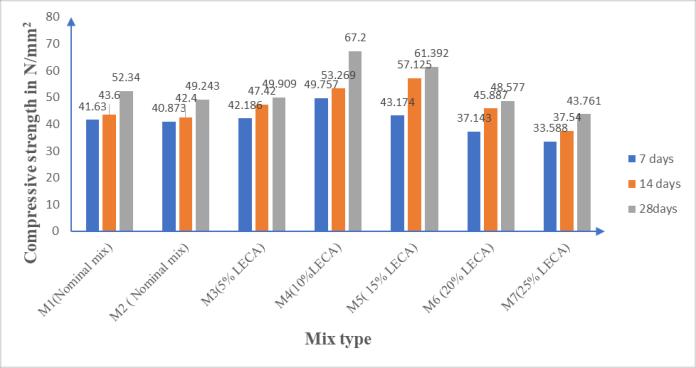
Followingtestresultswereobtainedafterconductingabove saidtests.
Chart


Table
Fromthestudyofresultsobtainedfollowingconclusions aremade
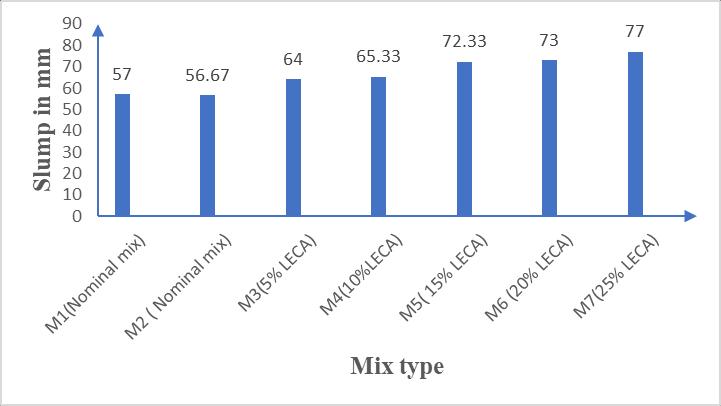
1. FromresultsofSlumpconetestitcanbeconcluded thatgreaterpercentageofLECAmakesconcrete moreworkable.
2. From Compressive strength test results it can be concludedthatforgoodresults10%LECAcanadded inreplacementofcoarseaggregateasithasshown improvementincompressivestrengthofmixupto 28.39%ascomparedtonominalmixM1.
3. M5 mix (i.e. concrete with 15% LECA replaced against coarse aggregate) has attained maximum compressivestrengthafterM4(10%LECA)andthat tomorethannominalmixM1withimprovementof 17.29%.
4. Thecompressivestrengthattainedbyconcretewith 10% LECA and 15% LECA after 14 days curing is morethanthatofnominalmixafter28days,itcanbe concludedfromthisthatthesemixareattainingthe required strength in half of the time required for nominalconcretemix.Thismaketheuseselfcuring concrete beneficialinrigidpavementswherecuring periodmakestroubletopassengerafterconstruction orrepairworkofpavement.
5. The split tensile strength test results shows that increasingpercentageofLECAbeyond10%maylead toreductioninsplittensilestrengthofconcrete.
6. Flexural strength ofnominal concrete mixislesser than that of mixes incorporated with LECA in replacement of coarse aggregate at different percentages. Also M4 (mix with 10% LECA) has shownimprovementinflexuralstrengthby51.48% andthatinM5(mixwith15%LECA)isfoundupto 29.59%ascomparedtonominalmixM1.
7. QualitygradingofnominalmixM1andM5(mixwith 15%LECA)wasobservedas‘Excellent’while thatof allothermixeswasseentobe‘Good’onthebasisof Ultrasonic pulse velocity test. Which shows that concrete with 15% LECA is as durable as nominal concretemix.
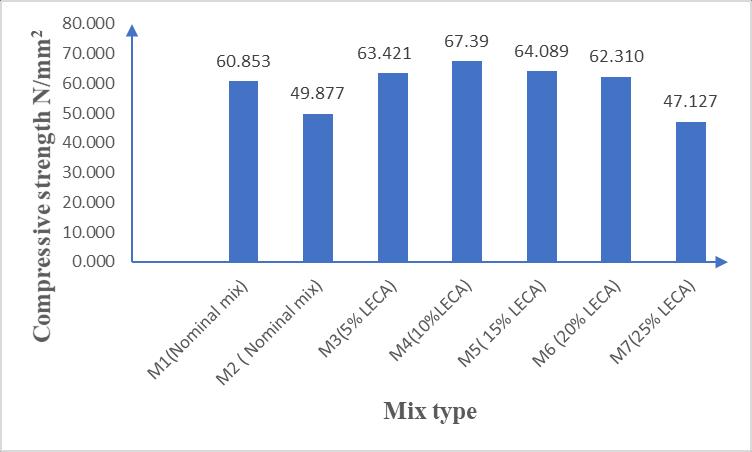
8. Continuous immersion test results shows that insufficient curing to the nominal mix may lead to threatofchlorideattackwhileconcretewithLECAis observedtoberesistivetothechlorideattackeven though it iscuredunder wet gunnybags.However compressive strength of M4andM5(i.e.with10% and 15% LECA) was observed to get improved by 10.74%and5.31%respectively.
9. From above findings it can be concluded that Optimum percentage of LECA in concrete for good performance in all aspects can be taken as 10% to 15%inreplacementofcoarseaggregate.
ACKNOWLEDGEMENT
WeextendourdeepgratitudetoDirectorAnjumanIIslam’s KalsekarTechnicalCampusDr.AbdulRazakHonnutagiand PrincipalofAnjumanIIslam’sA.R.KalsekarpolytechnicProf. RamjanA.KhatikandalsotheirstaffforprovidingtheirwellequippedConcretetechnologylaboratoriesforconductionof testsincludedwithallsafetyandprecautionarymeasuresin thisstudyinbadtimesofCovid-19pandemicduringunlock5 declaredbyGovernmentofMaharashtra.
REFERENCES
[1] I.S. 10262 (2009) Concrete Mix ProportioningGuidelines
[2] I.S.516(1959),Methodoftestsforstrengthofconcrete
[3] I.S. 5816(1999), Split tensile Strength of ConcreteMethodoftest
[4] I.S.13311(1992),Non-destructivetestingofconcretemethodsoftest
[5] ‘Characteristicsoflightweightaggregatesfromprimary andrecycledrawmaterials‘A.Mueller,S.N.Sokolovab, V.I.Vereshagin,inElseveirjournal,(2008),pp703-712
[6] ‘InternalcuringofconcreteusingprewettedLightweight Aggregate’by Dayalan J, Buellah. M in International JournalofinnovativeResearchinSceince,Engineering andtechnology,pp10554-10560
[7] ‘Introducingthe Self Curing ConcreteinConstruction Industry’ by Patel Manishkumar Dahyabhai, Prof. Jayeshkumar R. Pitroda in International Journal of EngineeringResearchandTechnology,March2014,pp 1286-1289.
[8] ‘Performance of Self curing concrete at elevated tempratures’byAlaaA.BashandyinIndianJournalof EngineeringandMaterialsceinces,February2105,pp 93-104.
[9] ‘A Review Paper on Self Curing Concrete’, by Ahmad Mustafa Sabaoon, Navinderdeep singh , International Research Journal of Engineering and Technology (IRJET),Jannuary2018,pp745-747.
[10] ‘Reviewonthestudyof self curing\concrete’,byAmal Viswam1, Arjun Murali in IJARIIE,Jannuary 2018, pp 271-274
[11] ‘Studyanddesignofselfcuringconcreteform30grade’, by Tuptewar Shriprasad Madhavrao, Unde Rajeshwar Houshiram, Rukare Suraj Sangappa, Salunkhe ShubhamkumarSureshInternationalResearchJournal of Engineering and Technology,May 2017, pp 10761078
[12] ‘Selfcompactingselfcuringconcretewithlightweight aggregates’,byGopiRajamanickam,RevathiVaiyapuri, radevinar,May2016,pp279-285
[13] ‘Self Curing Concrete and Its Inherentproperties’ by StellaEvangelineinInternationalJournalofEngineering ResearchandApplications,august2014,pp66-71
[14] ‘AnExperimentalInvestigationofSelf-CuringConcrete Incorporated with Light Weight Fine Aggregate and Polyethylene Glycol’,by Vishnu T, Beena B R in InternationalJournalforInnovativeResearchinScience &Technology,September2016,pp116-122
[15] ‘Studies On Properties Of Self-Curing Concrete Using PolyEthyleneGlycol’, byBasilMJosephinIOSRJournal of Mechanical and Civil Engineering (IOSRJMCE),2016,pp12-17
[16] ‘SelfCuringConcretewithLightWeightAggregate’by Ankith M.K. in International Journal of Scientific EngineeringandResearch(IJSER),July2015,pp107-111
[17] ‘Selfcuringconcrete’,byRahulDev,R.Navneethanin International Journal of Advance Research, Ideas and InnovationsinTechnology,March2018,pp534-541
[18] ‘Self-Curing Concrete with Shrinkage Reducing Admixture’,bySiddiquiMohd.Junaid,SheikhSaddam, KhanYusuf,ShaikhAbuHuzaifaandMansuriJunaidin Journal of Civil Engineering and Environmental Technology,April-June,2015pp.506-509
[19] ‘Strength characteristics of self-curing concrete’, by M.V.JagannadhaKumar,M.Srikanth,K.JagannadhaRao inInternationalJournalofResearchinEngineeringand Technology,September2012, pp.51-57
[20] ‘Strength Comparison of Self-Curing Concrete and Normal Curing Concrete’ by Mohammed Shafeeque, Sanofar.P.B, Praveen.K.P, Jithin Raj, Nikhil.V.P, Gopikrishna.P.M in SSRGInternational Journal ofCivil Engineering(SSRG–IJCE),March2016,pp.47-52
[21] ‘AnExperimentalInvestigationonCompressiveStrength ofSelf-CuringConcreteIncorporatedWithPolyethylene Glycol-400’,byHardikDhullinInternationalJournalfor ResearchinAppliedScience&EngineeringTechnology (IJRASET),September2017,pp.73-78