AN INTEGRATED SECURED ROUTING APPROACH FOR MANETS
Dr. D. CHITRA, DIVYA.KDr.D. Chitra, Professor, Department of Electronics and Communication engineering Mahendra Engineering College Divya K, PG student, Department of Electronics and Communication Engineering,
Mahendra Engineering CollegeAbstract
This paper aims to integrate different machine learning algorithms to get an optimized and secured routing technique for Mobile Ad-hoc NETworks(MANETs). Routing of packets are highly challenging in MANETs, as they are infrastructure-lessnetworksformedwithmobilenodes,connectedbyflexiblewirelesslinks.Themainroutingchallenges inMANETsarethefrequenttopologicalchanges,limitedavailabilityofpowerresourcesandvulnerabilitiestoattacks.This method suggests a technique that is trustworthy that provides fast convergence for topological changes with minimum energyutilizationperpacket.Inthismethod,atrust-basedandenergy-efficientfuzzyclusteringroutingalgorithmisused. The Cluster Heads(CHs) are selected depending on the various trust values that provide multi-paths to the destination. Then Bacteria for Aging Optimization Algorithm (BFOA) selects the best path by finding ideal hops to the destination avoidingthemisbehavingnodes.Theproposedmethodoffersbettersecurity,reduceddelayandbetterenergyutilization.
Keywords:Clusterheads,Trustmodel,BFOA,Intruderdetection,Misbehavingnodes.
1. Introduction
The MANETs are flexible wireless networks with dynamic topology. The MANETs are formed through the collectionofmobilenodeswhichareconnectedwithwirelesslinks.ThetopologyofMANETchangesasthemobilenodes enter and leave the network. When a node along a path leaves the network, the packets along that route must be routed throughanotheralternatepath.Thesefrequenttopologychangesandrelatedroutingproblemsarethemajorissuesinthe developmentofroutingprotocolsforMANETs.Theseconddesignissueisrelatedtothepowerresourcesavailability.The mobiledevicesdependononeoranotherformoftheexhaustiblepowersource.Whenthepowersupplyisexhaustedata node,itbecomesadeadnodeandcannottakepartinthetransmissionofthepackets.Theotherproblemisthepresenceof attackersinsideandoutsidethenetwork.InMANETs,thereisnocentralizedmonitoringmechanismtodetectandprevent intruders.
Here, we propose an integrated approach to solve the routing issues in MANETs. This method uses a fuzzy clustering algorithm that determines the CHs through an effective adaptive trust model. As it selects the nodes with maximumtrustvaluesandsetsthethresholdfortrustvalues,theintrudernodescanbeeasilyandeffectively identified.It provides multiple paths between the source and destination. In the second stage, an optimal route is selected employing BFOAthatusesidealhopstodeterminetheroute.
2. Related works
Inpaper[1],M.JabirullaandA.Kumardiscusshowtoplanandanalyzeobstacles,mobility,andpowerforoptimal MANET routing. It uses a routing protocol framework to uncover viable investigations of obstacles, power, and mobility. Thepaperaimstosolveissuescausedbymobility,interfacequality,andbatteryimperativeofmobilehubsbetweenoverlay associations.Theproposedmethodselectsroutingchoicesbydecidingtheoptimalcoursewithenergy-productivehubsto keepupnetworkdependabilityandlifetime.Thepowermindfulutilizationsobstaclerecognitionalgorithmforthechoiceof optimal middle-of-the-road hubs dependent on the available energy level, mobility, and connection quality boundaries. In Mobile Ad Hoc Networks (MANETs), the absence of centralized infrastructure, changes in the network topology, device mobilityanddatatransmissionoverwirelesschannelsmakemulti-hoproutingaverychallengingtask.TheMANETscanbe deployedinmanycriticalapplicationsanddevelopingaroutingprotocolthatdealswiththesechallengesthroughthedesign of a Quality of Service (QoS)-assured protocol is a major problem. As the movement of mobile nodes in MANETs occurs frequently,a properapproachwithrobustnessandQoSassuranceisrequired.S.Mostafavi et. al. [2]proposedQMAR-AODV, whichisanoptimizedversionoftheAODVprotocolcalledtheQoS-assuredMobility-AwareRoutingprotocol.Itoutperforms E2E-LREEMR and reduces route instability, end-to-end delay, data retransmissions and packet loss while increasing data reception and network throughput, compared to E2E-LREEMR routing protocol. There is a need for a secure protocol for MWSNwithmechanismsthattakeintoaccountthelimitedresourcesofthenodesand thedynamismofitsnodes’locations which are included in the research of O. Oladayo and A. Ashraf [3]. Background and Objective Mobile Wireless Sensor Network (MWSN) is a specialized wireless network made up of a large number of mobile sensors, where each sensor is

capableofchangingitslocationandrelayingdatatoeitherthebasestationorneighbouringnodes.Thereforeitisnotsuitable for WSN that is energy-constraint with mobile sensors. This protocol is capable of selecting the optimal multi-hop route amongavailableroutesforthesourcenodeandsecurelyhopsthedatatothedestinationnodesthroughintermediarynodes. Tomakesureaboutthesecurityleveloftheprotocol,formalandinformalsecurityanalysisoftheroutingprotocolisdone.
ThedevelopmentofRemotelyPilotedAircrafts(RPAS)forcivilapplicationshasbeenrapidlygrowingoverthepast years. Toachievethistask a two-layeredapproachisproposed[4]. TheAnt Colony Optimization(ACO)which isbased on SwarmIntelligence(SI)arewellsuitedforMANETs. Aninexpensiveandfeasiblesolutionforreal-worldimplementationis providedbythePotentialFieldmethod.Itisshownthatthealgorithmsperformreasonablywellinseveralscenarios. Even though the network assumes that all its mobile nodes are trusted, it is impossible in the real world as few nodes may be malicious. Therefore,itis essential toputforwarda mechanismthatcanprovidesecuritybyselectinganoptimal routefor dataforwardingassuggestedbyA.M.ChintalapalliandV.R.Ananthula[5].Afitnessfunctionisdevelopedfortheselectionof the best routes using the multi-objective parameters. The performance of this algorithm is evaluated using three metrics, suchas packetdelivery ratio (PDR), throughput,and energyand is compared with thatof existingtrust-based QoSrouting model, LA, and WOA. Energy harvesting is crucial for IoT devices as it eliminates the need for frequent energy source replacement.WithadvancementsinEHtechniques,thedesignproceduresofroutingprotocolshaveundergoneadramatic change for energy-harvesting wireless sensor network-based IoT applications. T. D. Nguyen et. al. [6] proposed a new routing algorithm called EHARA that improves energy efficiency and satisfies QoS requirements of distributed IoT networks. In [7],a noble route selection technique basedon themobility of the nodesin ad-hoc networksarepresented. The mobility factor is used to select nodes to establish a path between source and destination nodes. Simulations of dynamicsourceroutingandadhocon-demanddistancevectorroutingprotocolswithandwithouttheproposedtechnique showthattheproposedprotocolsoutperformexistingprotocols.
Theremainingpartofthispaperisorganizedas:SectionIIIdescribesthemethodologySectionIVtheOutputand SectionVgivestheConclusion.
3. The Methodology
AnefficientMANETroutingtechniqueprovidesthetransmissionofdatapacketswithoutmuchdelayandwithoutany loss.Intheproposedmethod,theuseofBFOAreducesthetransmissionenergylossesandenhancesthesystem'slifetime.
Thevariousstepsusedinthismethodare:
1. ApplicationoffuzzyclusteringalgorithmandselectionofCHsbasedondirect,indirectandrecenttrustvalues.
2. ApplicationofBFOAalgorithmfortheoptimumrouteselectionavoidingtheintrudernodes.
3.1 CH selection
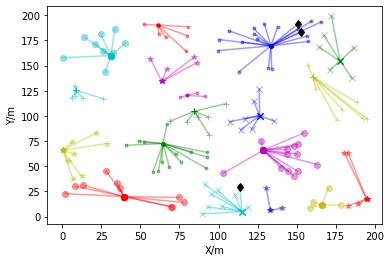
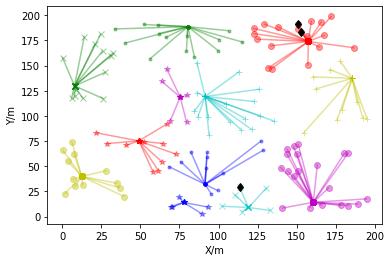
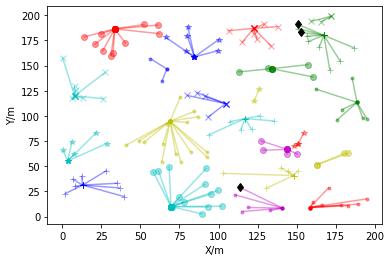
Using the fuzzy clustering algorithm CHs are selected based on the direct, indirect and recent trust values. The trustmanagementmechanismisveryeffectivetodeal withsecurityissuesinMANETs. Thetraditionaltrustmanagement systems are not effective, as frequent communication may lead to congestion, high energy consumption and large transmission delay between the source and destination. In this method, the use of adaptive factors with space and time constraintsimprovestheaccuracyofthetrustvalueevaluationandalsospeedsupthedetectionofmaliciousnodes.Using theCHformationsecuremultipathscanbeobtainedandthebestsecurepathavoidingthemisbehavingnodesisselected usingBFOA.
Trust valuesindicate the degreeof trust depending on the behaviour ofthe nodes. Atrust model iscomposed of thefollowing5components.
TrustComposition–Thisinvolvesthecomputationofthetrustvalues.
Trustformation–Itdeterminesthetrustattributesforthecomputationofthetrustvalues.
Trustpropagation–Itrepresentsthewaysinwhichtrustinformationispropagatedtoothernodes.
Trustaggregation–Itaggregatestrustinformationfromthevarioustrustvaluessuchasdirect,indirectandrecent trustvalues.
Trustupdate–Itdetermineswhenthetrustvaluesaretobeupdatedusingtrustaggregation.
DirectTrust(DT):Itisthedifferencebetweentheactualtimeandpredictedtimefortheith nodetoauthenticatethepublic keythatwasgeneratedbythekth destinationnode.
InDirectTrust(IDT):DTdependsontheinformationexchangedbetweentheneighbouringnodes.Ifthecommunicationis noteffectiveorthechannelortheneighbouringnodesaremalicious,thenDTvalues cannotmeasurethecredibilityofthe nodes.
wherenisthenumberofneighbouringnodesofith node. RecentTrust(RT):Recenttrustvaluesareusedforlocaltrustsynthesis.RTisdesignedtobe
where�� =03
Thebio-inspiredBFOAisusedtoidentifytheidealhopsfortheidealrouteselectionforMANETs.BFOAcanbeusedto solveseveral difficult numerical problems quicklyand effectively. Forsearchingthe nutrients,a bacteriumuses a process called Chemo taxis to follow a path. To stimulate the chemo-toxic movement, the bacteria communicate with each other throughsignals.Theunderlyingoptimizationmethodcanbeusedtosolvenumerousoptimizationproblems. Bacteriacan tumbleorswimtotravelwiththehelpofFlagella.Whenplacedinasemi-solidmatrixwithasinglechemo-effector,agroup ofE. coli cellsarrange themselves in a traveling ring by moving up the nutrient gradient. The cellsaggregate into groups whentheyarestimulatedbyahighlevelofsuccinateandmoveasconcentricswarmpatterns.Thisiscalledswarming.This process continues for the entire life span. The cell-to-cell signalling can be represented by an objective function. In the reproductionstage,thelesshealthybacteriawilldieandhealthierbacteriagotothenextgenerationbybreakingintotwo, whichareplacedinthesamelocation.Thismechanismkeepstheswarmsizestable.EliminationandDispersalisthestage where a bacteriumpopulationundergoesa gradual orsudden change.Due tovarious reasons, there may be a gradual or suddenchangesinthebacteriumpopulationlives.Insomecases,allthebacteriainaregionarekilledoragroupismoved intoanewlocation.
TheBFOAAlgorithm
Step 1: All variables are initialized, and counters are set for the elimination-dispersal loop(l), reproduction loop(k), chemotactic loop(j) and swim counter(w) is set to zero Step 2: Bacterium index (i) is set to zero Step 3: Eliminationdispersal loop is started by setting l = l + 1 Step 4: Start the reproduction loop by setting k = k + l Step 5: Start the chemotaxisloopbysettingj=j+1
Step1:Initializeallvariablesandsetcountersforelimination-dispersalloop(l),reproductionloop(k),chemotacticloop(j) andswimcounter(w)
Step2:Starttheelimination-dispersalloop
Step3:Startthereproductionloop
Step4:Startthechemotaxisloop,computethefitnessfunctionandgotonextbacteriumtoprocess next.
Step5: Continuechemotaxisifthelifespanofthebacteriaisnotover.
Step6:Startthereproductionprocess
Step7:Startthenext-generationprocess.
Step8:Eliminateanddisperseeachbacteriumtokeepthenumberofbacteriainthegroupconstant.
Step9:Endifthedispersalloopiscompleted;otherwisegotostep2.
4. Results and Discussions
Thissectionpresentstheperformanceanalysisofthesuggestedmethodbasedondifferentmetrics.
Time delay
It represents the end-to-end delay time elapsed from the generation of the packet at the source node to the successfuldeliveryofthatpackettothedestination.Thetable1showsacomparisonofthedelaysexperiencedbydifferent methods and we see can see that the proposed method experiences less delay. With an adaptive trust value model, the delayofthepacketsatthemaliciousnodescanbeavoided.
Table 1 Delay time of existing and proposed methods
Packet Delivery Ratio (PDR)
PDRrepresentstheratioofthepacketsthataresuccessfullydeliveredtothedestinationnodeoutofthenumberof packetsthataresentbythesource.Table2showsacomparativeanalysisofthePDR.
2 Packet delivery ratio of existing and proposed method
Astheproposedsystemusesaneffectivetrustmanagementmodel,misbehavingnodescanbeaccuratelydetermined.The use BFOA for the best path selection effectively avoids the paths through malicious nodes. This mechanism ensures no packetlossinthetransmissionwhichyieldsahighpacketdeliveryratio.
Routing Overhead (RO)
The optimal route discovery and successful transmission of the packets demand for more control packets. The comprehensivetrustvaluesofthetrustedneighbouringnodescalculatedbythesinknodesreducethenetworkoverheads andthusreducescongestion.Theroutingoverheadofexistingandproposedmethodshavebeensummarizedintable3.
3 Routing Overhead of existing and proposed methods
TheeffectofmajorconstraintsinthedesignofaroutingprotocolforMANETscanbereducedtoasignificantlevel in this proposed method. From the results, we can see that the BFOA is well-suited for efficient route determination in MANETs. In the first stage of this method, fuzzy clustering is used to determine the cluster heads based on an adaptive trustmodelthatusesdirect,indirectandrecenttrustvalues.Thepacketsareroutedthroughtheclusterheadsavoidingthe paths involving misbehaving nodes. With the proper settings of the threshold valuesof the trust, malicious nodescan be effectivelyidentifiedandthosenodescanbedroppedwhileselectingthebestpathusingtheBFOAalgorithm.Thisresults in reduced loss of packets. The suggested method shows faster convergence toward topological changes in the network. The use of ideal hops by BFOA reduces the delay in the transmission and also reduces energy consumption. Thus, the methodproposedwithBFOAwithanenhancedtrustmodelimprovestheoverallefficiencyofthenetwork.
References
1. M. Jabirulla and A. Kumar, ‘‘Design and analysis of obstacle, mobility and power aware optimal MANET routing Areview,’’SolidStateTechnol.,vol.63,no.3,pp.46–55,2020.
2. S.Mostafavi, V.Hakami,and F.Paydar,‘‘AQoS-assuredandmobilityaware routingprotocol forMANETs,’’Int.J. Informat.Visualizat.,vol.4,no.1,pp.1–9,Feb.2020.
3. O. Oladayo and A. Ashraf, ‘‘A secure and energy-aware routing protocol for optimal routing in mobile wireless sensornetworks(MWSNs),’’Int.J.Sensors,WirelessCommun.Control,vol.9,no.4,pp.507–520,Sep.2019.
4. J.M.M.Alves,‘‘PathplanningandcollisionavoidancealgorithmsforsmallRPAS,’’M.S.thesis,Dept.Aerosp.Eng., TecnicoLISBOA,Lisbon,Portugal,2017.
5. R.M.ChintalapalliandV.R.Ananthula,‘‘M-LionWhale:Multi-objectiveoptimisationmodelforsecureroutingin mobilead-hocnetwork,’’IETCommun.,vol.12,pp.1406–1415,2018.
6. T. D. Nguyen, J. Y. Khan, and D. T. Ngo, ‘‘A distributed energy-harvestingaware routing algorithm for heterogeneousIoTnetworks,’’IEEETrans.GreenCommun.Netw.,vol.2,no.4,pp.1115–1127,Dec.2018.
7. S. Sarkar and R. Datta, ‘‘Mobility-aware route selection technique for mobile ad hoc networks,’’ IET Wireless SensorSyst.,vol.7,no.3,pp.55–64,Jun.2017.
8. MallikarjunaandV.C.Patil,‘‘PUSR:PositionupdatesecureroutingprotocolforMANET,’’Int.J.Intell.Eng.Syst., vol.14,no.1,pp.93–102,Feb.2021.
9. S. R. Halhalli, S. R. Sugave, and B. N. Jagdale, ‘‘Optimisation driven-based secure routing in MANET using atom whaleoptimizationalgorithm,’’Int.J.Commun.Netw.Distrib.Syst.,vol.27,no.1,p.77,2021.
10. V. Alappatt and J. P. P. M., ‘‘Trust-based energy efficient secure multipath routing in MANET using LF-SSO and SH2E,’’Int.J.Comput.Netw.Appl.,vol.8,no.4,p.400,Aug.2021.
11. Vahid Heydari 2012, “A new acknowledgment-based scheme against malicious nodes and collusion attack in MANETs”,IEEE14thInternationalConferenceonCommunicationTechnology,pp.784–788.
12. Abdulsalam Basabaa, Tarek Sheltami and Elhadi Shakshuki 2014, “Implementation of A3ACKs Intrusion DetectionSystemunderVariousMobilitySpeeds”,ProcediaComputerScience,vol.32,pp.571-578.
13. DaehoKang, Hyung-SinKim, ChangheeJoo and SaewoongBahk 2018, “ORGMA: Reliable opportunistic routing withgradientforwardingforMANETs”,ElsevierJournals-ComputerNetworks,vol.131,pp.52-64.
14. ParthPatel, RajeshBansode and BhushanNemade 2016, “Performance Evaluation of MANET Network Parameters Using AODV Protocol for HEAACK Enhancement”, Elsevier Journals- Procedia Computer Science, vol.79,pp.932-939.
15. Kamini Maheshwar, S. Veenadhari, "Secure Cluster based Routing Protocol for WSN",2022 IEEE International ConferenceonCurrentDevelopmentinEngineeringandTechnology(CCET),pp.1-6,2022.
16. Hanbing Xie, Gui Zou, Lin Ma, "A Hierarchical Routing Protocol Based on AODV for Unmanned Aerial Vehicle SwarmNetwork",2022IEEEInternationalConferenceonUnmannedSystems(ICUS),pp.1113-1117,2022.
17. Moaath Alshaikh, Akram Morie, "Development of Multipath Dynamic Address Routing Protocol in MANET to Improve Data Transfer in Poor Infrastructure Environment",2022 International Conference on Computer ScienceandSoftwareEngineering(CSASE),pp.368-373,2022.
18. Uppalapati Srilakshmi, Neenavath Veeraiah, Youseef Alotaibi, Saleh Ahmed Alghamdi, Osamah Ibrahim Khalaf, Bhimineni Venkata Subbayamma, "An Improved Hybrid Secure Multipath Routing Protocol for MANET",IEEE Access,vol.9,pp.163043-163053,2021.
19. UppalapatiSrilakshmi,SalehAhmedAlghamdi,VeeraAnkaluVuyyuru,NeenavathVeeraiah,YouseefAlotaibi,"A Secure Optimization Routing Algorithm for Mobile Ad Hoc Networks",IEEE Access, vol.10, pp.14260-14269, 2022.
20. Samreen Banu Kazi and Mohammed Azharuddin Adhoni “Secure IDS to detect malevolent node in MANETs” International Conference on Electrical, Electronics, and Optimization Techniques (ICEEOT), India, pp. 1363 –1368,March-2016
21. RasikaR.MaliandSudhirT.Bagade“DetectionofMisbehavingnodeusingSecureAcknowledgementinMANET” InternationalConferenceonComputing,AnalyticsandSecurityTrends(CAST),India,pp.611 -616,December2016.