International Research Journal of Engineering and Technology (IRJET) e-ISSN: 2395-0056

Volume: 10 Issue: 08 | Aug 2023
International Research Journal of Engineering and Technology (IRJET) e-ISSN: 2395-0056
Volume: 10 Issue: 08 | Aug 2023
1Research Scholar, Department of Electronics & Communication Engineering,Kalinga Institute of Industrial Technology (KIIT) University, Bhubaneswar, India
2Assistant Professor, Department of Electronics & Communication Engineering, Avanthi St.Theressa College of Engineering, JNTU Vizianagaram, Garividi, India
3Professor, Department of Electronics & Communication Engineering, MVGR College of Engineering Autonomous, Vizianagaram, India ***
Abstract Due to two primary considerations, UltraWideband (UWB) Antennas are becoming more and more popular and desirable in current and next wireless communications systems. First off, the demand for wirelesstransmissionratesisrising,andUWBfeatureslike fast data rates, low power consumption, and low cost are givingUWBantennasatremendouspush.Second,asmore and more wireless transmission functionalities and operatingbandsarerequiredbyportablewirelessdevices, designing antennas may become more difficult due to issues such antenna size constraints and multi-antenna interference, among other things. Multi-narrow-band antennas can be replaced by UWB antennas, potentially reducing the overall number of antennas. A Compact Dual Microstrip-Fed UWB Monopole Antenna with a Parasitic Patch is designed and simulated over HFSS in this proposed work, and the simulation results are presented and discussed in comparison with the results that were actuallyobtainedinordertoverifyandsupporttheresults generated by simulation. In order to attain a passband frequency of 2.45 GHz for Bluetooth application without sacrificingtheUWBantennaefficiency,afractalbinarytree is introduced. Over the specified frequency band, the suggested antenna exhibits a consistent radiation pattern with group delay fluctuation of less than 1 ns. The gain varies for the Bluetooth band from 1-1.5 dB and for the UWB application from 2.5
6 dB. According to the results, the antenna performed well in terms of gain, bandwidth, VSWR, return loss, radiation patterns, and other criteria. The antenna's operating frequency of 9.21 GHz makes it a strong contender for systems that combine Bluetooth and UWB. In order for the antenna to be used in real-time applications,theVSWR mustbelessthan2andthereturn lossmustbelessthan-10dBatthisfrequency.
Index Terms UWB Technology, Monopole Antenna, WirelessCommunication,Bluetooth,fractal
Wireless communication devices are getting more and more common these days. To meet the greater resolution and data rate needs, wireless communication technologies must be further developed.
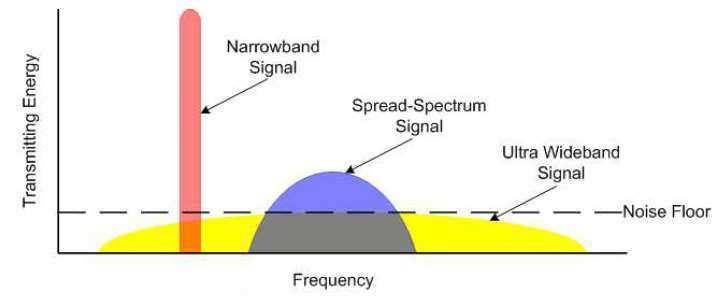
Due of this, systems for ultra-wideband (UWB) communications,whichoperatebetween3.1and10.6GHz and were approved by the FCC in 2002, are now being developed. Different wideband antennas have been investigated for communications and radar systems for a long time. Wideband antenna design is a challenging undertaking, particularly for hand-held terminals where a balance between simplicity, cost, and size must be struck. One of the main challenges in UWB communication systemsisdesigningasmallantennathatcannevertheless provide wideband characteristics across the whole working spectrum. Wideband monopole configurations in the shapes of circles, squares, ellipses, pentagons, and hexagons have all been suggested for use in ultra wideband (UWB) applications due to their appealing characteristics of wide bandwidth, simplicity of structure, unidirectional radiation pattern, and ease of construction. However,becausetheylackplanarstructures,theycannot be integrated with printed circuit boards. The low profile, cheap cost, and light weight of a microstrip-fed monopole antenna make it an appealing candidate for integration withahand-heldterminal.
Numerous alternatives have been put up as the demand for high-data-rate wireless communication grows morecritical.Thebenefitsofultra-wideband(UWB)radio over other candidate technologies include greater data rates, good immunity to multi-path cancellation, a potential boost in operational security for
Volume: 10 Issue: 08 | Aug 2023 www.irjet.net
communications, and less interference with existing systems. Antennas are a particularly difficult feature of UWB technology since they need to be compact and have relative bandwidths. The IEEE 802.11 a frequency range (5.15–5.825GHz),whichisalsoalow-powertechnology,is included in the Federal Communications Commission's (FCC)versionofUWBradio'sspectrum(3.1–10.6GHz).As aresult,boththeIEEE802.11aandhigh-performanceradio local area network (HIPERLAN) technologies may be considered to be interfered with by FCC UWB. Different UWB antennas with multi-notch band stop characteristics have been studied as a solution to this issue. Ultrawideband (UWB) systems' impending widespread commercial deploymenthas reignited interest in the topic of ultra-wideband antennas. Every dB counts in a UWB system as much as if not more than in a typical narrowband system due to the power levels permitted by the FCC. As a result, the design of a UWB system as a whole must include an effective UWB antenna. In this study,thedesiredstop-bandpropertiesareobtainedusing a fractal binary tree. Because the fractal can be replicated andcompletelycompressedwithintheexistingfootprintof atypicalUWBantenna,itcanbeusedmoreeffectivelywith lessarea
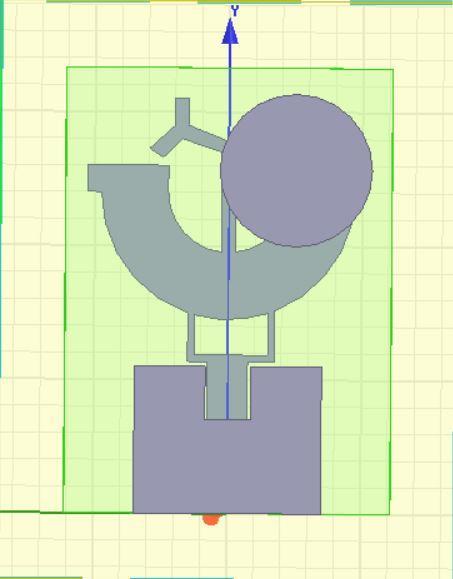
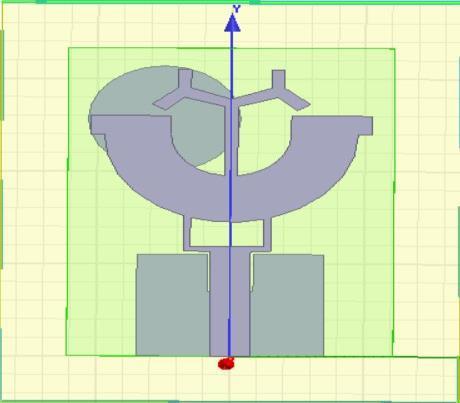
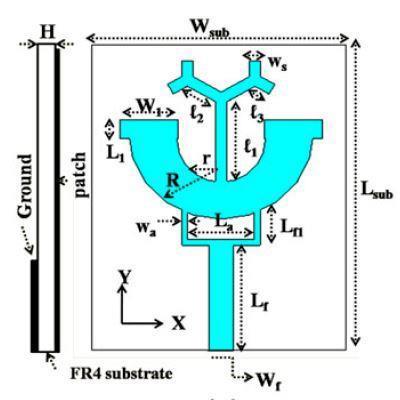
Figure 2 depicts the geometry of the suggested antenna, which is implemented on a FR4 substrate with a 1.6mmthickness.Thesubstrate'sdimensionsare33.3mm x24.4mm(LsubxWsub).Here,alargecircleradiusof9.5 mm is chosen because it results in a lower resonance frequency of 4 GHz with the successful coupling in the higherfrequencyrange.Sincealargeportionoftheelectric currentsarecenteredattherestrictedareaoftheradiator, anannularshapecanreducetheoverallsizeoftheprinted UWB antenna. In addition, the primary patch is electromagneticallyconnectedtoacircular parasiticpatch that in the substrate backed and employed as an auxiliary resonator.
Theproposedantennahasadouble-fedconfiguration and is fed via a 50 microstrip line. The innovative feeding method enhances the polarization properties and impedance bandwidth by ensuring only vertical currents andpreventinghorizontalcurrents.Anidealvalueof4mm is selected for appropriate matching purposes because when the length of the rectangular strip changes, the matchinglikewisechanges.Theantennagainisinfluenced bythematchingqualitiesovertheband,whichisindicated by the width of the ground plane (Wg). The matching concerningoverthebandgetsbetterasthegroundplane's breadth widens, indicating increased antenna gain. If a ground plane width of 14 mm is taken into account, a compromise between antenna size and gain can be reached.
a) Simulation Using HFSS:
Theaboveantennadesignissimulatedandstudied using HFSS (High-Frequency Simulation Software) version 13.0softwareasshownbelowinFig.3
a) FrontView
b) TopView
b)VSWR
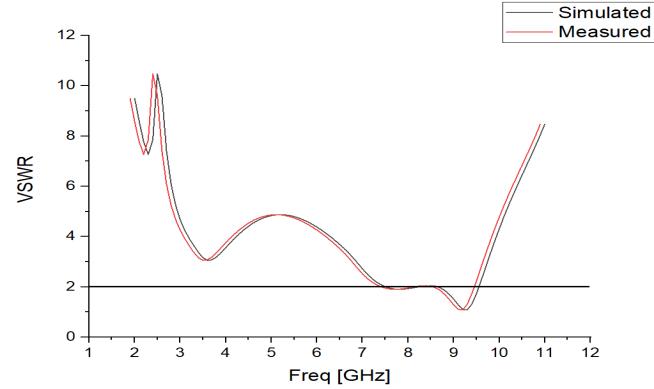
A perfect match requires a VSWR of no less than unity. Figure 6 displays the VSWR of the UWB monopole antennawithafractalbinarystructurecreatedinHFSSand similar to Figure 3. The ideal range for practical applications is between 1 and 2. The VSWR at 9.2 GHz is observed to be 1.1126, and the associated bandwidth is below-10dB.
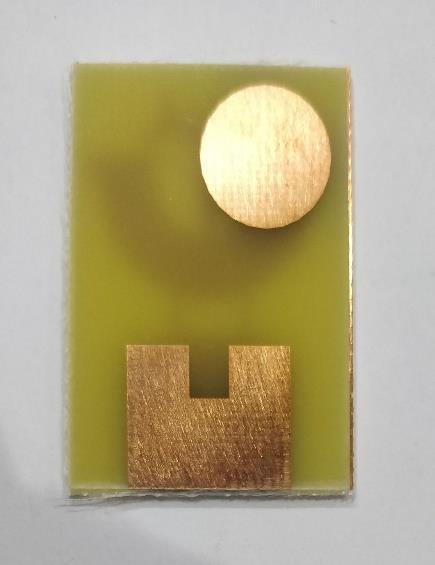
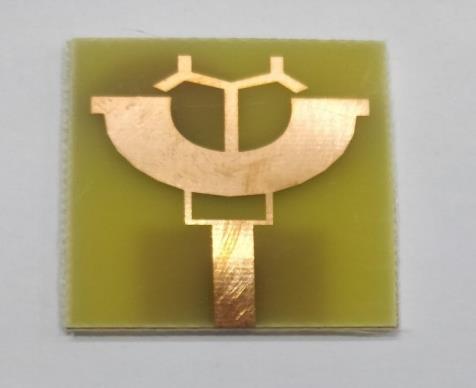
a) FrontView b) BackView
IV. Simulated & Measured Results
a) S11 (Reflection Coefficient)
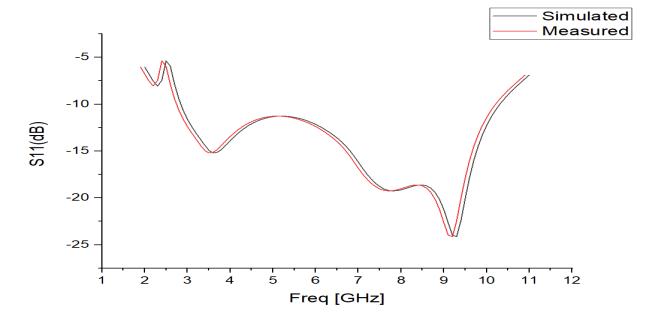
Figure 5 displays the return loss for the UWB monopole antenna with the fractal binary structure that was created in HFSS and corresponds to Figure 3. The Reflection Coefficient is seen to be -23.96 at the operating frequencyof9.2GHzandlessthan-10dBwithabandwidth of7.5GHzfromthismeasurement
c) Gain
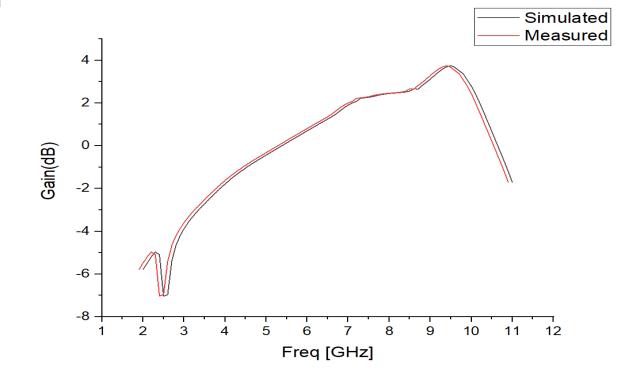
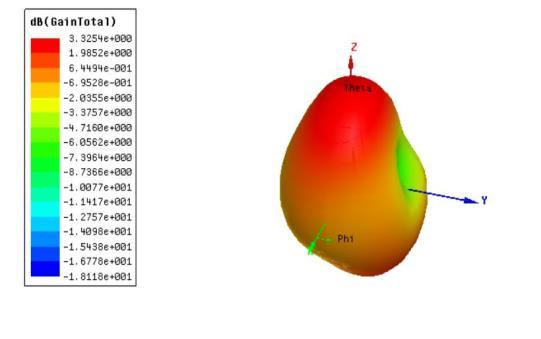
Gain is nothing more than the amount of power thatissentpersolidangle.Figure7displaysthegainofthe UWB monopole antenna created in HFSS and similar to figure 3. 3.46 dB of gain has been measured for this antenna.
b) polar
International Research Journal of Engineering and Technology (IRJET) e-ISSN: 2395-0056
Volume: 10 Issue: 08 | Aug 2023 www.irjet.net p-ISSN: 2395-0072
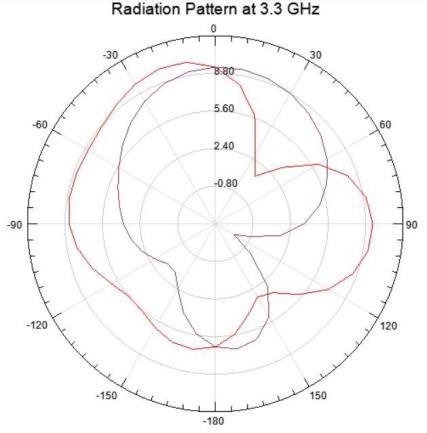
Afluctuationinanantenna'spowerasafunction ofthedirectionitisfacingawayfromtheantennaisknown as a radiation pattern. In the far-field of the antenna, this power variation as a function of the arrival angle is seen. Figure 8 depicts the radiation pattern of a dual-bandCPW fedantennadevelopedinHFSSthatcorrespondstoFigure 3.
and simulated over HFSS. The simulation results are presented and discussed in comparison with the results that were actually obtained in order to verify and justify the results produced by simulation. According to the results, the antenna performed well in terms of gain, bandwidth, VSWR, return loss, radiation patterns, and other criteria. The antenna has two working resonance frequencies of 2.5 GHz and 3.3 GHz, encompassing the Bluetooth/Wi-Fibandaswellasthemajorityofthe3G,4G, and an anticipated 5G spectrum in the future. When operating in real-time applications, the antenna's VSWR and return loss are obtained to be less than 2 and -10 dB, respectively,atthesefrequencies.
1. Shubhanshi Rathore, Rajeev Paulus, A.K. Jaiswal, Aditi Agrawal “ Ultra-wideband Antenn for WLAN, WiMAX and LTE Applications,” International Journal of Computer Applications(0975–8887),Volume121–No.7,July2015.
2.M.Satyanarayana,SunilPrakash,SudhirKumarSharma, A. Sudhakar “Single Band-Notched UWB Square Monopole Antenna with Double U- Slot and Key Shaped Slot,” 2015 FifthInternationalConferenceon CommunicationSystems andNetworkTechnologies,
ThereferencepapersarerelatedtoUWBAntennafor Wireless Communications and above result analysis, compared the size of an antenna, return loss, VSWR and Antenna Gain. Antenna gain is more in proposed work when compared to UWB Antennas which taken the reference.
A promising technology for offering wireless communications ease and mobility to high-speed interconnectivity in devices throughout the digital home and office is ultra-wideband technology. In this project, a novel semi-arc monopole with fractal binary tree shape, overlapped circular slots, and rounded edges is designed
3. Asma Ejaz, Muhammad Zahid, Yasar Amin “Dual Band Notch Planar Patch Antenna for UWB Applications,” 2020 3rd International Conference on Computing , Mathematics and Engineering Technologies (iCoMET), 978-1-7281-4970-7/20/$31.00©2020 IEEE
4. Reshma Lakshmanan,Shinoj K. Sukumaran “Flexible Ultra Wide Band Antenna for WBAN Applications,” International Conference on Emerging Trends in Engineering, Science and Technology (ICETEST- 2015) ProcediaTechnology24(2016)880–887.4
5. Sesha Vidhya S , Rukmani Devi S, Shanthi KG, Nowshith Parveen N “Design of UWB Slot Antenna for WBAN Application” International Journal of Current Research andReview, Int JCur ResRev| Vol13• Issue 06•March 2021
6. Chen, H. D., 2003, “Broadband CPW-fed square slot antennas with a widened tuning stub,” IEEE Trans. AntennasPropag.,vol.51,no.8,pp.1982–1986.
7. Solis, M. A. P., Galvan-Tejada, G. M. and Jardon-Aguilar, H.,2005, "StateoftheArtinUltra-WidebandAntennas,"in 2nd International IEEE Conference on Electrical & Electronics and XI Conference on Electrical Engineering, pp.101-105.
8. Sobli, N. M. and Abd-El-Raouf, H. E., 2008, “Design of a Compact Band-Notched Antenna for Ultrawideband Communication,” IEEE Antennas and propagation symposiumAPS2008.
9.Y.S.,Yang,X.D.,Liu,C.Y.,andJiang,T.,“CompactCPW-fed Ultrawidebandantennawithband-notchedcharacteristic,” ElectronicLett.,2010,46,(23),pp.1533–1534.
10. Abed, D., Kampuchea, H., and Atrouz, B., 2008, “Smallsize printed CPW- Fed antenna for ultra-wideband communications,”Electron. Lett.2008,44,(17), pp. 1003–1005
11. G. Roberto Aiello and Gerald D. Rogerson “Ultra wideband wireless systems,” IEEE microwave magazine pp36-47,June2003.
12. K.S. Lim, M. Nagalingam, and C.P. Tan, “Design and constructionofmicrostripUWBantennawithtimedomain analysis”,PIERM,Vol.3,pp.153–164,2008.
13. Saou-Wen Su, Kin-Lu Wong and Chia-Lun Tang “Ultrawideband square planar monopole antenna for IEEE 802.16a operation in the 2–11 GHz band,” Microwave OpticalTechnologyLetters,vol.42,pp.463-466,2004.
14. Tilanthe, P., P. C. Sharma, and T. K. Bandopadhyay, “A compactUWBantennawithdualbandrejection,"Progress in ElectromagneticsResearchB,Vol.35,389-405,2011.
15.Zhu,Y.,F.S.Zhang,C.Lin,Q.Zhang,andJ.X.Huang,“A novel dual band-notched monopole antenna for ultrawideband application," Progress In Electromagnetics ResearchLetters,Vol.16,109-117,2010.