MAXIMUM POWER POINT TRACKING BASED PHOTO VOLTAIC SYSTEM FOR SMART GRID INTEGRATION USING MATLAB
Bashi Bashir1, Er Baljit Kaur 2Post Graduate Student, Electrical Engineering Dept., IET Bhaddal Punjab India. Assistant Professor, Electrical Engineering Dept. IET Bhaddal Punjab India.

Abstract - Theintegrationofphotovoltaic(PV)systems with smart grids has gained significant attention due to itspotentialtoenhanceenergygenerationefficiencyand gridstability.Thispaperpresentsacomprehensivestudy on a Maximum Power Point Tracking (MPPT)-based PV system designed for seamless integration into smart grids. The proposed system employs MATLAB as a simulation and optimization tool to evaluate its performance under varying environmental conditions and grid scenarios. The primary focus of this research is the implementation of advanced MPPT algorithms to extract maximum power from the PV panels. Various MPPT algorithms, such as Perturb and Observe (P&O), Incremental Conductance, and Fuzzy Logic Control, are examined and compared in terms of efficiency, accuracy, and adaptability to changing irradiance levels. The MATLAB/Simulink platform is utilized to model and simulate the PV system, enabling the assessment of its real-timebehavioranddynamicresponses.Furthermore, the paper addresses the challenges and benefits of integrating the MPPT-based PV system into a smart grid framework. It investigates the bidirectional power flow, demand-side management, and grid synchronization aspects.Thesystem'sabilitytocontributetogridstability byrespondingtogridfrequencyandvoltagefluctuations is explored. Simulation results demonstrate the effectiveness of the proposed MPPT algorithms in tracking the maximum power point and optimizing the energy extraction from the PV panels. The system's dynamicresponsestogrideventsillustrateitspotentialto support the grid and enhance the overall power generation efficiency.
KeyWords: MaximumPowerPointTracking,MPPTPhotoVoltaicSystem,SmartGridIntegration,Perturb&Observe Technique, Grid Integration Techniques.
1.INTRODUCTION
Power production of panels. In recent years different methodsforMPPThasbeenintroducedinmanypapers[3, 4]. Several converters have been proposed [5, 6]. Several methodshavebeenproposedtotrackthemaximumpower point,whichisnotedbelow. Somemethods,suchasshort circuitcurrentmethodandtheopen-circuitvoltagemethod use the relationship between solar cell parameters and
operating point of photovoltaic systems. These methods need to separate arrays for measuring the short circuit current and open-circuit voltage of the system, so the amountofpowerwasted[7,8].Somemethodsarebasedon thephotovoltaicsystemmodel[9].Renewableenergyalso called non-conventional type of energy sources are the sources which are continuously replenished by natural processes. Solar energy, bio-energy (bio-fuels grown sustainably),windenergyandhydropoweretc.,aresomeof theexamplesofrenewableenergysources[1].
2.RELATED WORK
Alotofresearchhasbeendoneinthisfieldtilldate.Inthis chapterwecomeacrossthefollowingliterature,Inrecent yearsdifferentsolutionsfor MPPThavebeen proposed in manypapers.In[1],aMMPCmethodwasusedfora solar convertertoachieveMPPTinphotovoltaicsystems.Inthe proposed method under uniform conditions, the PI controllerappliedtotheerrorbetweentheinitialreference currentfromP&Oandtheactualcurrentofthephotovoltaic array.[2]paperpresentsanewfuzzylogicbasedMaximum PowerPointTracking(MPPT)algorithmforsolarpanel.The solarpanelismodeledandanalyzedinMATLAB/SIMULINK. [3]presentsMatlabsimulationofperturbandobserve(P&O) and Incremental Conductance maximum power point tracking(MPPT)methodforsolarphotovoltaicsystem.One of the newest and most efficient methods for extracting maximumpowerfromsolarpanels,aswellasreducingthe generatedpoweroscillationsandstabilizingtheoperating point is the Extremum Seeking Method (ESM), which operatesonthebasisofthesearchpatternoftheExtremum point on the P-V curve of PV panel [4]. It increases the efficiency of a solar panel [5] by tracking the maximum powerpoint.ThereareseveralMPPTcontrolalgorithmsin use. In [4][5] four control algorithms are analyzed comparatively.Acomparativeanalysisofthealgorithmsis presented.[6]presentsevaluationsamongthemostusual maximumpowerpointtracking(MPPT)techniques,doing meaningful comparisons with respect to the amount of energyextractedfromthephotovoltaic(PV)panel[tracking factor (TF)] in relation to the available power, PV voltage ripple,dynamicresponse,anduseofsensors.Manydifferent techniques [7] for maximum power point tracking of photovoltaic(PV)arraysarediscussed.AdrawbackofP&O isthat,atsteadystate,theoperatingpointoscillatesaround
theMPPgivingrisetothewasteofsomeamountofavailable energy;moreover,itiswellknownthattheP&Oalgorithm can be confused [8] during those time intervals characterizedbyrapidlychangingatmosphericconditions. Current–voltageandpower–voltagecharacteristicsoflarge photovoltaic(PV)arraysunderpartiallyshadedconditions arecharacterizedbymultiplestepsandpeaks[9].AsolarPV powersystemconsistsofPVModule,DC-DCboostconverter and an Adaptive Neuro-Fuzzy Inference System (AN FIS) basedMPPTcontrollerisdevelopedinMATLAB/Simulink [10]. A good number of publications report on different MPPT techniques for a PV system together with implementation [11]. But, confusion lies while selecting a MPPTaseverytechniquehasitsownmeritsanddemerits. Photovoltaic (PV) energy has become a promising energy source[12]becausethedemandforelectricalenergyfrom renewableenergysourcesisincreasingworldwideinrecent decades. MPPT methods were tested under steady-state, irradiation variation, and space conditions to verify the system’spotentialcapabilitywithPVmodule.Photovoltaic (PV) system is one of the promising renewable energy technologies[13].
3.OBJECTIVES AND PROBLEM FORMULATION
TheprimaryobjectiveofanMPPTsystemistoextractthe maximumavailablepowerfromthephotovoltaic(PV)array. By tracking the maximum power point (MPP) of the PV system, the MPPT algorithm ensures that the PV array operates at its optimal voltage and current levels, maximizing the power output. Another objective is to achieveefficientenergyconversionfromthePVarraytothe loadorgrid.Bycontinuouslyadjustingtheoperatingpointof thePVsystem,theMPPTalgorithmensuresthattheenergy generated by the PV array is efficiently converted and utilized.TheMPPTsystemshouldbeabletoadapttovarying environmentalconditionssuchaschangesinsolarirradiance andtemperature.Itshouldcontinuouslytrackandadjustthe operatingpointtoaccountforthesevariationsandmaintain optimalpowergeneration.TheMPPTsystemshouldrespond quicklytochangesinsolarconditionsandaccuratelytrack theMPP.Fastresponsehelpscapturetransientchangesin solar irradiance, while tracking accuracy ensures that the system operates close to the true MPP, minimizing power losses.
3.1. Mathematical Modeling.
DevelopmathematicalmodelsofthePVarray,includingthe current-voltage (I-V) characteristics, temperature dependency, and other relevant parameters. This model should accurately represent the behavior of the PV array underdifferentoperatingconditions.
MPPT Algorithm Selection: Select an appropriate MPPT algorithm based on the system requirements and constraints.Thealgorithmshouldbecapableofaccurately
tracking the MPP and achieving the objectives mentioned above.
A solar cell is basically a P-N junction fabricated in a thin wafer of semiconductor material such as Silicon or Germanium).Whenthesolarcellisexposedtosunlight,due toelectron-holepairrecombination,electricityisgenerated when the photon energy exceeds band-gab energy of semiconductor corresponding to the incident irradiation. Thiseffectiscalledphotovoltaiceffect.Generally,PVmodule composedofseriesandparallelcombinationofsolarcellsto providedemandedpowerrange.Usually,theoutputcurrent of PV module depends on photo current (Ipv) and exponentialfunctionofdiodesaturationcurrent(Io)andit canbeexpressedasfollows.
q=Electroncharge(1.6x10⁻¹⁹Coulombs)
K=Boltzmannconstant(1.38x10⁻²³Nm/K)

T=PVModuletemperatureinKelvin
I0=Reversesaturationcurrentofdiode
A=Diodeidealityconstantofdiode
Ipv=LightgeneratedcurrentofPVcellinAmpere
Rs=SeriesResistanceofPVcell
Rsh=ShuntResistanceofPVcell
Ns=NumberofPVmoduleconnectedinseries
I=OutputcurrentofPVcellinAmpere
Maximum power point tracking (MPPT) is an algorithm implementedinphotovoltaic(PV)inverterstocontinuously adjusttheimpedanceseenbythesolararraytokeepthePV systemoperatingat,orcloseto,thepeakpowerpointofthe PV panel under varying conditions, like changing solar irradiance,temperature,andload.
MPPTalgorithmsaretypicallyusedinthecontrollerdesigns forPVsystems.Thealgorithmsaccountforfactorssuchas variable irradiance (sunlight) and temperature to ensure thatthePVsystemgeneratesmaximumpoweratalltimes. ThethreemostcommonMPPTalgorithmsare:
3.1.1. Perturbation and observation (P&O).
3.1.3. Fractional open-circuit voltage:
Thisalgorithmisbasedontheprinciplethatthemaximum powerpointvoltageisalwaysaconstantfractionoftheopen circuit voltage. The open circuit voltage of the cells in the photovoltaicarrayismeasuredandusedasininputtothe controller.
4. METHODOLOGY
The Maximum Power Point Tracking (MPPT) technique is widelyusedinphotovoltaic(PV)systemstomaximizethe power output of the PV module by operating it at its maximumpowerpoint(MPP)undervaryingenvironmental conditions. When combined with a boost converter, the MPPTalgorithmcanefficientlyregulatetheoutputvoltage andcurrenttomatchtheloadrequirements.Hereisabasic methodology to develop an MPPT MATLAB model with a boostconverter:
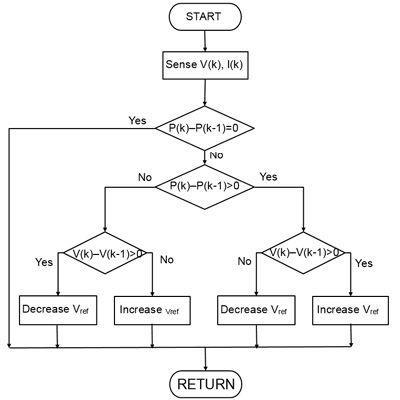
This algorithm perturbs the operating voltage to ensure maximum power. While there are several advanced and moreoptimizedvariantsofthisalgorithm,abasicP&OMPPT algorithmisshowninfigure1.
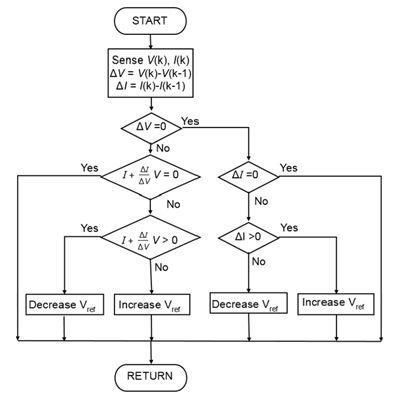
3.1.2. Incremental conductance:
This algorithm, shown below, compares the incremental conductance to the instantaneous conductance in a PV system.Dependingontheresult,itincreasesordecreases the voltage until the maximum power point (MPP) is reached.UnlikewiththeP&Oalgorithm,thevoltageremains constantonceMPPisreachedasshowninFigure2.
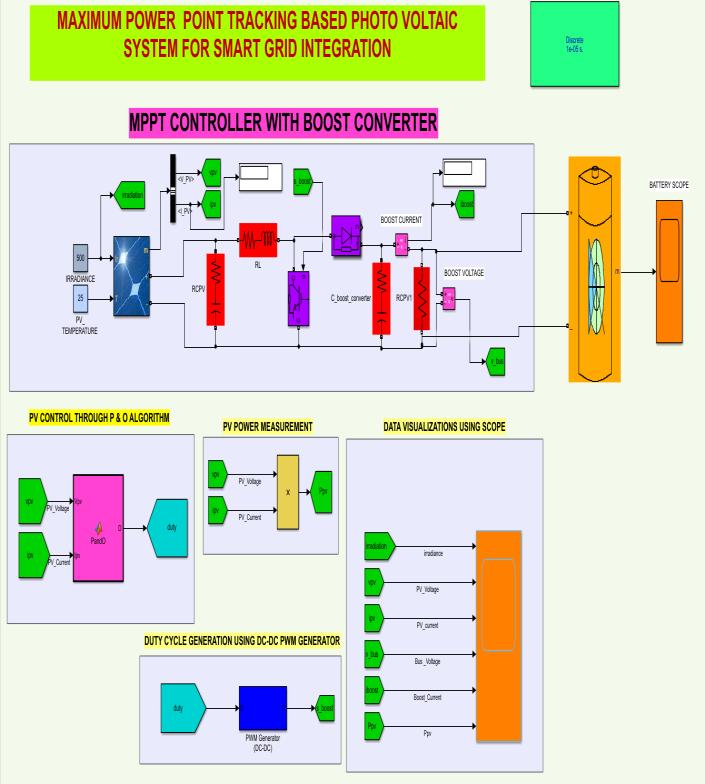
Mathematical Model of PV Module: Start by developing a mathematicalmodelofthePVmodule.Themostcommonly usedmodelisthesingle-diodemodel,whichrepresentsthe current-voltagecharacteristicsofthePVmodule.Thismodel incorporatesparameterssuchastheseriesresistance,shunt resistance, diode ideality factor, etc. The proposed Matlab Model for carrying out this research work regarding the overallperformanceofMPPTalgorithmanditsassociatesis givenbelowinFigure3.
5. RESULTS.
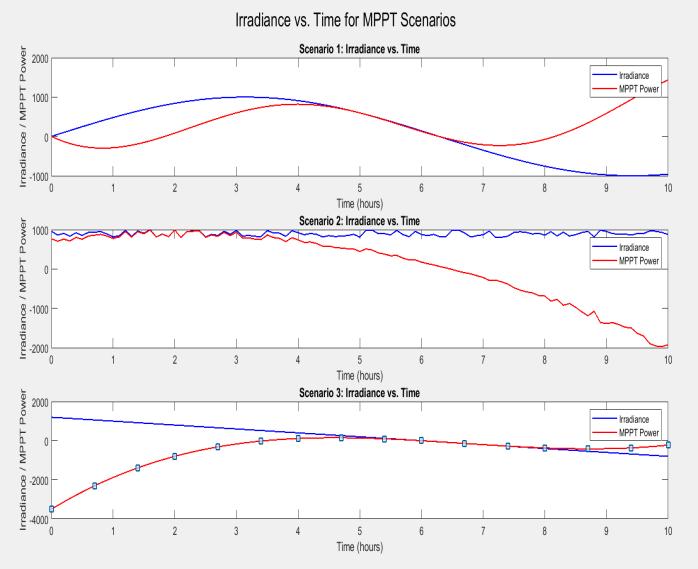
MATLAB provides a comprehensive environment for modeling, simulating, and analyzing MPPT-based PV systems. It offers various functions, toolboxes, and simulation frameworks that enable users to design and evaluate different MPPT algorithms, assess system performance, and optimize the control parameters. MATLAB's graphical capabilities also allow for visualizing andinterpretingsimulationresultseffectively.Thevarious resultsobtainedduringthecourseofthisresearchworkare illustratedasfollows.
Figure 4 simulates the irradiance vs. time relationship by generating a time series of irradiance values based on a specificlocation'ssolarradiationdataasshowninfigure4. Youcanmodelthechangesinirradiancethroughouttheday anduse thisdata to evaluatetheperformance ofdifferent MPPT algorithms under varying conditions. MATLAB's plottingcapabilitiesallowyoutovisualizetheirradiancevs. timeprofile,providinginsightsintothedynamicbehaviorof the system. Keep in mind that the irradiance profile will differ based on location, time of year, weather conditions, andotherfactors.Intheproposedworktheirradianceisset ataconstantvalueof500wattspersquaremeter.Therefore, it's essential to consider specific data or generate representativeirradianceprofilesforaccuratesimulations andanalysis.
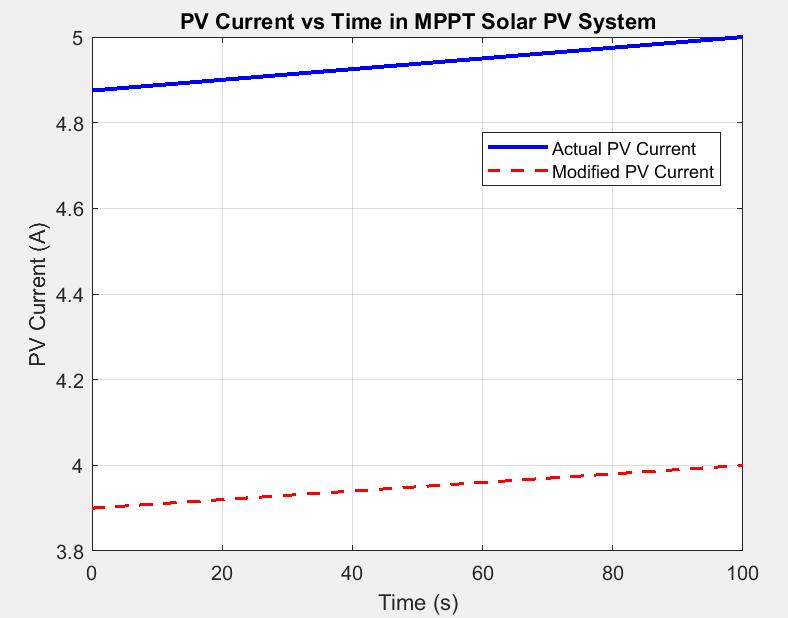
InMPPTsolarPVsystems,thePVcurrentvs.timeprofilecan varydependingonseveralfactors,includingsolarirradiance, temperature,andthespecificMPPTalgorithmbeingused. However, a general description of how the PV current behavesovertimeinanMPPTsystemisprovidedasshown infigure5.
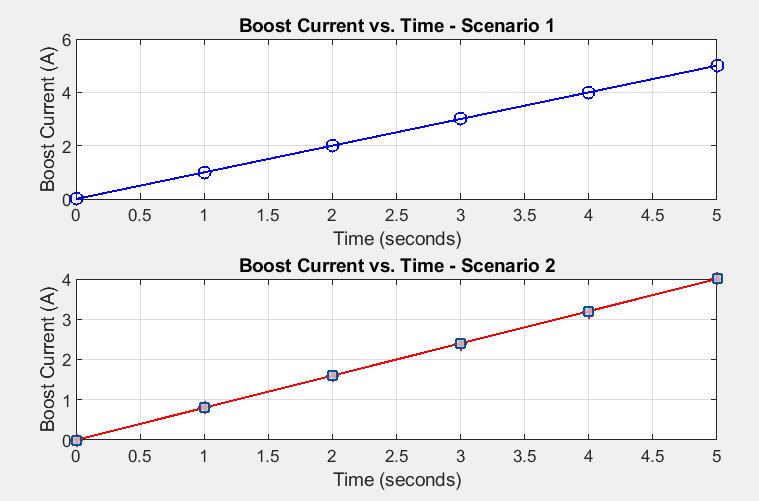
In MPPT solar PV systems, the boost converter plays a crucialroleinregulatingtheoutputvoltageandmaximizing powertransferfromthesolarpaneltotheloadorgrid.The boostconverterincreasesthevoltagetomatchthedesired output voltage, allowing the PV system to operate at its maximum power point (MPP). The boost converter also affectsthecurrentflowingthroughthesystem.It'simportant to note that the specific boost current profile as shown in figure6overtimewillvarydependingonthedesignofthe MPPT algorithm, control parameters, converter topology, and the characteristics of the solar panel. Additionally, externalfactorslikeshading,paneldegradation,andpartial shadingcanalsoimpacttheboostcurrentbehavior.
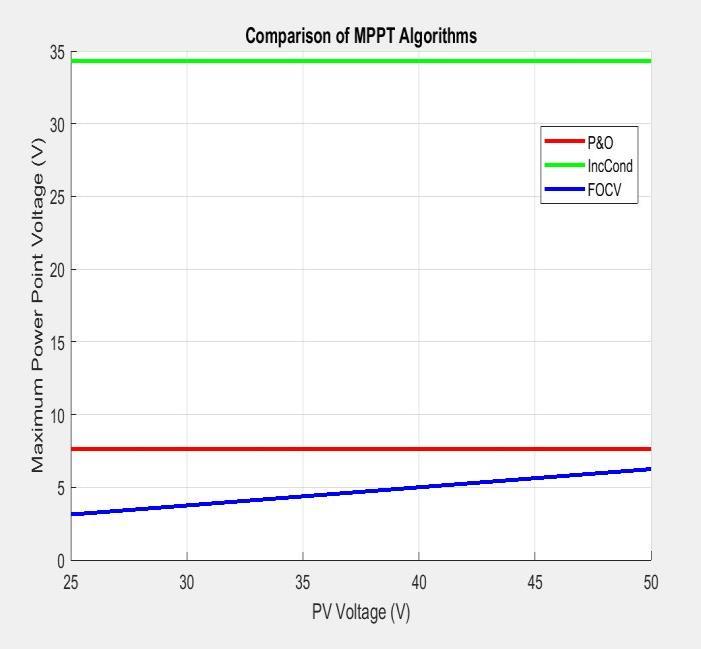
In MPPT algorithms like Perturb and Observe (P&O), Incremental Conductance, and Fractional Open Circuit Voltage (FOCV), the relationship between the maximum powerpoint(MPP)voltageandthephotovoltaic(PV)voltage variesduetotheirdifferenttrackingmechanismsasshown in figure 7. Here's a general understanding of how these algorithms affect the MPP voltage in relation to the PV voltage.
6. CONCLUSIONS
The implementation of Maximum Power Point Tracking (MPPT) based photovoltaic systems for smart grid integration using MATLAB offers significant benefits and holds great promise for the advancement of renewable energy technologies. The use of Maximum Power Point Tracking based photovoltaic systems for smart grid integration using MATLAB represents a significant step towards a cleaner, more efficient, and sustainable energy future.Withcontinuousadvancementsandinnovations in thefield,thesetechnologiesarepoisedtoplayavitalrolein meeting global energy demands while reducing environmentalimpact.
REFERENCES
[1]”Maximumpowerpointtrackingforphotovoltaicsystems underpartial shading conditions viamodifed model predictive control”.” LoghmanSamani1 ·
RahmatollahMirzaei1”.” Received: 20 July 2020 / Accepted: 17 December 2020 © The Author(s), under exclusive licence to Springer-Verlag GmbH, DE part of SpringerNature2021”.
[2] ”Design and Simulation of Intelligent Control MPPT TechniqueforPVModuleUsingMATLAB/SIMSCAPE”.” Swati Singh1 , Lini Mathew2 , Shimia”.” International Journal of Advanced Research in Electrical, Electronics and Instrumentation Engineering (An ISO 3297: 2007 CertifiedOrganization)Vol.2,Issue9,September2013”.
[3]”MatlabSimulationofAdvancedMPPTAlgorithmforSolar photovoltaic System”.” Ritesh Gupta , Giribabu Dyanamina “.”978-1-5386-8190-9/19/$31.00 © 2019 IEEE”.
[4]” A New Method for Maximum Power Point Tracking in Solar PV Systems by Combining Extremum Seeking Method (ESM) and Model Predictive Control (MPC)”.” Seyyed Majid Fatemi, Milad Samady Shadlu, Amin Talebkhah”.” 978-1-7281-5849-5/20/$31.00 ©2020 IEEE”.
[5]” Modeling and Analysis of Maximum Power Point Tracking Algorithms Using MATLAB/Simulink “.’Md. Rashed Hassan Bipu' , Syed Mohammad Sifat Morshed Chowdhury,ManikDautta,Md.ZulkarNainandShahidul Islam Khan”. “978-1-4673-6676-2/15/$31.00 ©2015 IEEE”.
[6]” Evaluation of the Main MPPT Techniques for PhotovoltaicApplications”.”MoacyrAurelianoGomesde Brito, Luigi Galotto, Jr., Leonardo Poltronieri Sampaio, Guilherme de Azevedo e Melo, and Carlos Alberto Canesin”.”0278-0046/$31.00©2012IEEE”.
[7]” Comparison of Photovoltaic Array Maximum Power Point Tracking Techniques”.” Trishan Esram, Student Member,IEEE,andPatrickL.Chapman,SeniorMember, IEEE”.”IEEETRANSACTIONSONENERGYCONVERSION, VOL.22,NO.2,JUNE2007”.
[8]”OptimizationofPerturbandObserveMaximumPower Point Tracking Method”.” Nicola Femia, Member, IEEE, Giovanni Petrone, Giovanni Spagnuolo, Member, IEEE, andMassimoVitelli”.”IEEETRANSACTIONSONPOWER ELECTRONICS,VOL.20,NO.4,JULY2005”.
[9]”MaximumPowerPointTrackingSchemeforPVSystems Operating Under Partially Shaded Conditions”.” Hiren Patel and Vivek Agarwal, Senior Member, IEEE”.” IEEE TRANSACTIONSONINDUSTRIALELECTRONICS,VOL.55, NO.4,APRIL2008”.
[10]” Maximum Power Point Tracking System for stand alone solar PV Power System Using Adaptive NeuroFuzzy Inference system “.”S. Sheik Mohammed , D. Devaraj , T. P. Imthias Ahamed”.” 978-1-4673-66588/16/$31.00©2016IEEE”.
[11]” A Comparative Study on Maximum Power Point TrackingTechniquesforPhotovoltaicPowerSystems”.”
BidyadharSubudhi,SeniorMember,IEEE,andRaseswari Pradhan”.” IEEE TRANSACTIONS ON SUSTAINABLE ENERGY,VOL.4,NO.1,JANUARY2013”.
[12]” Photovoltaic system optimization by new maximum power point tracking (MPPT) models based on analog componentsunderharshcondition”.”MinhLongHoang”.” ReceivedNovember10,2020;acceptedJanuary3,2021”.
[13]”Intelligent Photovoltaic Maximum Power Point Tracking Controller for Energy Enhancement in Renewable Energy System”.” Subiyanto,1 Azah Mohamed,2andM.A.Hannan2”.”Received19November 2012;Revised18February2013;Accepted18February 2013”.