Mapping the Crashworthiness Domains: Investigations Based on Scientometric Analysis
R Teddy Samuel1 , M Jaikumar 2 , S.K. Vignesh31Research Scholar, Hindustan Institute of Technology and Science, Chennai, India

2Professor, Dept of Automobile Engineering, Hindustan Institute of Technology and Science, Chennai, India
3 Research Scholar, Hindustan Institute of Technology and Science, Chennai, India ***
Abstract - This paper provides a scientometric analysis of research advances in the crashworthiness of vehicle analysis. Using the software of VosViewer andMATLAB, a scientometric analysis is carried out by reviewing 1047 papers with various perspectives from 1969 to 2023, providing an integrated knowledge mind map of crashworthiness. Thefindings suggest that the United States, Germany, China, India, the United Kingdom, Japan, and Italy have made the most significant contributions to the field of crashworthiness. Important institutions, publications, citations, and article keywords are also covered. The main goals ofcrashworthiness aretoprevent energy transmission entry into the car's compartment during collision, to stop crushing and collapsing, and to use new geometrical designs, materials, and parameter choices to absorb impact energy through controlled mechanisms. Analysis found that the number of publications increasedfrom one (0.10%) in 1969 to 52 (4.97%) in 2016 and observedgood progress in scholarly literature, in particular, the study of crashworthiness analysis, which is rapidly growing. This analysis generates a thoroughandintegratedknowledge mind map that adds to the crashworthiness information network and enables researchers and softwaredevelopers inthefieldof crashworthiness to gain useful insights about next research paths and advances.
Key Words: Crashworthiness,Collision,EnergyAbsorption, Scientometric analysis
1.INTRODUCTION
Every year, 1.3 million people lose their lives in traffic accidents. The severity of a collision's effects and the likelihoodthatonewillhappenarestronglycorrelatedwith anincreaseinaveragespeed.Theriskoffatalaccidentsrises by 4%, and the risk of serious accidents rises by 3%, for everyonepercentincreaseinmeanspeed.Automobilesplay a crucial role in reducing serious injuries and avoiding collisions.AnumberofUNregulationsonvehiclesafetyhave thepotentialtosavealotoflivesiftheyareimplementedin themanufacturingandproductionstandards.(RoadTraffic Injuries,WHO)Crashworthinessemphasisesoccupantsafety toreducethenumberoffatalitiesandseriousinjuries.The researchoncrashworthinesscanachievetheWorldHealth Organisation's(WHO)ambitiousgoalofpreventingatleast 50%ofdeathsandinjuriesfromtrafficaccidentsby2030.
2. DATA AND METHODS
2.1 Source of Data
Scopusistheworld’slargestabstractandcitationdatabaseof peer-reviewedliterature,includingscientificjournals,books, andconferenceproceedings,coveringresearchtopicsacross allscientificandtechnicaldisciplines,rangingfrommedicine and social sciences to the arts and humanities. This study used the Scopus source database to find the data, and it containsadatabaseof1047documentsfrom1969to2023. After screening, we obtained 1047 documents from 56 different countries, 1010 research institutions, 663 conferences,349journals,and1036authors.
Methods
The Scientometric study covered all research publications indexed in the Scopus database on crashworthiness. It accessed the contributions on "Crashworthiness", "Automotive",andotherrelatedareastocrashes.Usingthe followingsearchquery,thesubject-relatedbibliographicdata were retrieved from Scopus on March 30, 2023, without restriction on time span. TS=("automotive*" AND "crash*" AND"design*"OR"simulation*"OR"crashworthiness*"OR "materials*" OR "deformation*" OR "energy*" OR "absorption*")-Timespan:Allyears.Theretrieveddatawere carefullyexamined,and1,047recordswereincludedinthe analysis. The information downloaded was dissected for variousparameters,liketypeofdocument,references,and usage;publicationandcitationgrowthyear-wise;topsource journalsandkeywordsusedmostfrequently;countriesthat work together;patternofauthorshipandthemostprolific authors;andthehighestcontributionoforganisations.MSExcel was used to analyse the data, and VOS viewer and MATLABwereusedtocreateavisualrepresentationofthe keywords that were used together. This study included crashworthiness-relatedScopus-indexedpublicationsasof March 30, 2023. As a result, scholars ought to take the findingsofthisstudyintoaccountinlightoftheselimitations.
3.DATA ANALYSIS
Figure1showstheyear-wisedistributionofpublicationson crashworthinessfrom1969to2023usingMATLAB.Thetotal number of records in the dataset is 1,047. The number of
publications related to crashworthiness shows an upward trendfrom1969to2016,withthehighestnumberofrecords publishedin2016(52records).After2016,thenumberof records fluctuates, with a relatively small number of publications in some years. The most recent years, 2020, 2021, 2022, and 2023, show a moderate number of publications(ranging from5 to 37 records).Basedon this information,crashworthinessappearstobeathrivingfieldof studywithvaryingpublicationratesinrecentyears.
Table -1: TopCountrieswithACI
Fig. 1. Yearwisedistributionofpublicationsfrom1969to 2023
3.1 Top 11 Countries with most significant contributions to the field of crashworthiness
According to Figure 2 and Table 1, the four active countrieswiththegreatestnumberofpublicationsarethe United States of America, Germany, China, and India. AlthoughtheACIisonly9.6fortheUnitedStates,whichisthe lowestamongthetop11countrieswiththehighestnumber ofpublications,thenumberofpublicationsbyUnitedStates scholars ranks first globally. It is evident that the United Statesresearchrecognitionstillhasalongwaytogo.China hasthehighestACIindexamongthetop4countrieswiththe highest publications. However, despite having the lowest numberofpublications,Australia,Turkey,Italy,andIranhave ahighACI,indicatingthattheirresearchrecognitionlevels arerelativelyhigh.
3.2 Distribution of publication types and Number of Records


The number of records related to crashworthiness for nine different types of publications is shown in Figure 3. Conferencepapersarethemostcommontypeofdocument, with663recordsaccountingfor63.32%,followedbyarticles with 349 records (33.33%). Compared to an article, conference papers are 50% more expensive. The other 6 recordsareforreviews(16),bookchapters(8),conference reviews (5), notes (3), books (2), and one short survey. Researchers,students,andprofessionalswhoareinterested in crashworthiness and want to know what kinds of publications are available on the subject might find this informationhelpful.

3.3 Top Contribution
Retrieved publications were also analyzed by means of citation.Therefore,thefeature"TopCitedArticles,"shownin Table 2, was used to calculate the total citations of both authors and total citations per year. The first rank of the article belongs to Jacob, George C. TC 319, and the TC per yearis14.50.Theaveragenumberofcitedreferencesper articlevaried in thegeneral search overthelast20years, betweenamaximumof319in2002andaminimumof110 in2017.ThemaximumTCperyearshows16.13in2008,for thearticlepublishedbyLiaoandXingtao,and15.71byLea K.in2017.
Top11citedarticlesarepresentedintheTable2
Table- 2: Topcitedarticles
3.4 Co-occurrence of Keywords
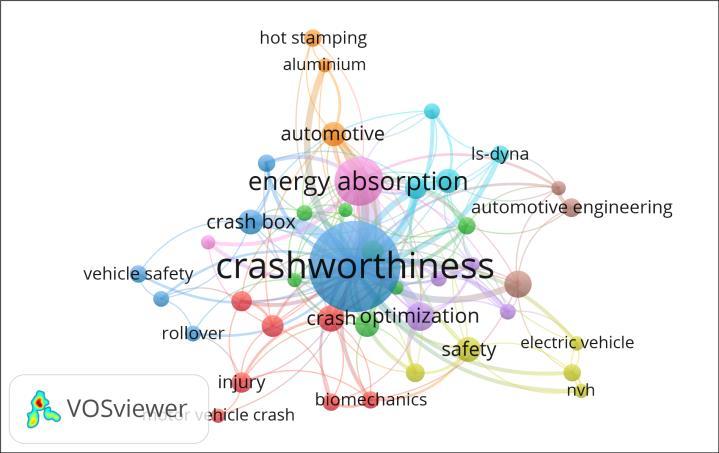
The keywords convey the major ideas of the article. As a result, a keyword analysis can be used to pinpoint the knowledge'sexpandingresearchhorizons.Figure2depicts the top 41 keywords from the crashworthiness studies. "Crashworthiness" has the highest total link strength and number of occurrences, followed by "energy absorption," whichisthetypeofcrashworthinessthatisdevelopedand usedthemost."Optimisation"and"FiniteElementMethods", "Crash","CrashBox,"and"Safety"implythatdesign,research, and development processes must in large part fulfil safety and performance as the fundamental requirements of crashworthiness. In recent years, grooves,", "beads," and "holes"as"triggers"havegraduallyemergedastheprevalent energy absorption solution for crashworthiness; however, therearestillnumeroustechnicalissuestoberesolved.As shownin Fig.2, VOSviewerwasutilised to implementand collect a keyword co-occurrence analysis of the crashworthiness investigations. The hubs address the keywords, and the sizes of the nodes represent how frequentlytheassociatedkeywordsoccurandhowstrongly twonodesareconnectedtooneanother.Whenitisthicker, thereisastrongerrelationshipbetweentheterms.InFig.2, therearefourclustersintheco-occurrencenetwork;theblue clusterhasthebiggestvolume,followedbythepinkandred clusters,andtheyellowclusterhasthesmallestvolume.The keyword with the highest notable recurrence in the blue group is "Crashworthiness" (127); other keywords with greater frequencies include "Energy Absorption" (42), "Optimisation," "Finite Element Techniques," "Crash," and "CrashBox."Theterm"crashworthiness"appearsthroughout
theentirecollection.Thegeneralresearchfocusareasinclude enhancing the crash box and vehicle mechanisms safety performancebyfusingrelevantliteratureandothercluster keywords.
3.5 Most relevant sources
The number of papers on crashworthiness that were published by various sources is shown in Table 3. SAE TechnicalPaperrankedfirstinthelistofpublications,with 413majorjournalspublished.FollowedbyAccidentAnalysis and Prevention, which published 35 (3.34%) papers, the American Society of Mechanical Engineers, Applied MechanicsDivision(AMD),andtheInternationalJournalof Crashworthiness,whichpublished27(2.57%)papers.The numberofpublicationspublishedbythefirst-andsecondrankedjournalswasvastlydifferent.Itdemonstratedhow prominent and high-quality the research is in the SAE TechnicalPaper.

3.6 Funding sponsor for crashworthiness publication
The funders of crashworthiness publications are listed in this table. The ability of a vehicle or its components to safeguardoccupantsintheeventofacrashisreferredtoas crashworthiness. The sponsors are listed in the table in orderofhowmanydocumentstheyhavefundedinthisarea. Thedatacoverawiderangeofnationsandregions,with15 relatedpublicationsfundedbytheNationalNaturalScience FoundationofChina,thelargestsponsor.TheUSDepartment ofEnergyisthesecond-biggestsupporter,subsidisingnine distributions. A wide range of sponsors, including governments,researchcouncils,universities,andbusinesses fromallovertheworld,aredepictedinthetable.
3.7 Author’s impact
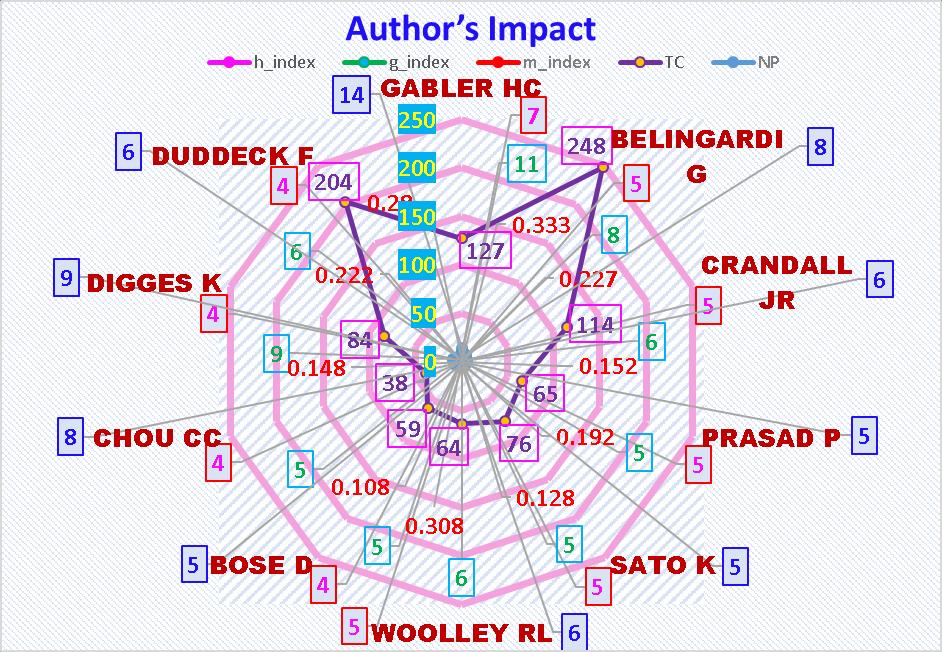
Table 7 displays the author's crashworthiness h-index, gindex, m-index, TC,NP, and PYvalues from1985 to 2011. Gabler HC topped the list with the highest h-index (7), gindex (11), and NP (14) values, despite having the fewest citations(127).ThenextfiveauthorstoachievethesamehindexvaluewereBelingardiG.,GradallJR,PrasadP.,SatoK., andWooleyRL.ItisessentialtonotethatDuddeckF.hasa TC204withanNPof6,whereasBelingardiG.hasaTC248 withanNPof8;thisdemonstratesthehighqualityoftheir research article. With fewer publications, the authors BelingardiG.(0.333)andBoseD.(0.308)hadthehighestmindex.In1997,DuggesJ.obtainedNP9withalowerTC(84) butag-indexof9.
problem that includes all of the essential components necessarytoconveythestudy'sfindings.Authorsofresearch articlesshouldpromotetheirworkwithintheirnetworks, informtheircolleaguesandstudents,andencouragethemto read the journal and cite it. This will improve the level of recognitionforcitations.
C3: Journals ought to be expanded in the field of crashworthiness.
C4:Researchersneedtoknowhowpopularandinfluential theirpublicationsareinthescholarlycommunitythrough citations.
C5:Choosingrelevantkeywordswillimprovesearchengine rankings.
C6: It sheds light on the most prevalent means by which researchersinthecrashworthinessfieldsharetheirfindings.
C7. Tangible opportunities for researchers: Researchers should speak up to learn about new ideas, policies, and fundingopportunities.Fundingorganisationsshould pave thewayforachangeinpractisesandpoliciesthatwillmake it easier for everyone, particularly young researchers and students, to access funding opportunities across internationalborders.
C8 Hot Streak Phenomena: A challenging task at the beginningofaresearcher'ssuccesscouldnotonlyprovidea betterunderstanding ofhowinfluencegrows,butitcould alsoguideandpreparehigh-impactresearchers.
4. CONCLUSIONS
Challenges
Due to the large population and shifting distribution of transportation use, crashworthiness faces numerous researchgaps,includinginvehiclefuelefficiency,safety,and consumer demands. Challenges with crashworthiness are discussedinthissection.
C1: Vehicle that is safer in a crash: There has not been a consistentriseinthenumberofresearcharticlesthathave been published. The vehicle design, materials, and parametersofnewandimprovedvehiclesoughttobethe focusofadditionalresearch.
C2:Improvethelevelofresearchrecognition:Anarticlethat is simple to read will greatly benefit from having a wellorganised,high-qualitypaperonahottopicornewresearch
Crashworthinessiscurrentlyundergoingrapidgrowthina variety of vehicle safety disciplines, including engineering and transportation. The world's top research topic is the United States, with substantial positions being held by Germany,China,andIndia.Globalisationmaycontributeto theongoingchallengeofcrashworthinessprogressamong manufacturersandresearchers.Theprimaryresearchareas inthefieldofvehiclesafety duringthepast30yearshave been collision avoidance systems, pre-crash systems, and active safety. With the use of simulation technologies, the study of crashworthiness recognition under various circumstances is growing and will continue in the future. Accordingtothepredictionsmadeinthispaper,thestudyof crashworthiness will gradually increase through crash simulationproceduresusingmultiplesoftwarepackages,a technique that will continue to grow in interdisciplinary fields. It is crucial to establish as a conclusion that crashworthiness is a multidisciplinary field of study with importantimplicationsforvehiclesafety.Eachyear,research in this area increases; however, it fluctuates more than in other fields. The current information might provide accommodatingdatatotheresearcherswhoareentrusted withfurtherdevelopingexplorationandexecutioninVehicle Safety.
REFERENCES
[1] https://www.who.int/news-room/factsheets/detail/road-traffic-injuries
[2] Han Wang, Hui Liu, Jieyu Yao, Dong Ye, Zhihui Lang, AdamGlowacz,Mappingtheknowledgedomainsofnew energy vehicle safety: Informetrics analysis-based studies,JournalofEnergyStorage35(2021)102275.
[3]BeatrixGroneberg-Kloft,DorisKlingelhoefer,SimonaE Zitnik and Cristian Scutaru, Traffic medicine–related research: a scientometric analysis, BMC Public Health 2013,13:541
[4]YongxinLiao,Past,presentandfutureofIndustry4.0-a systematic literature review and research agenda proposal,InternationalJournalofProductionResearch· March2017
[5] Jingqi Gao,Xiang Wu,* Xiaowei Luo,andShukai Guan,, Scientometric Analysis of Safety Sign Research: 1990–2019,Int J Environ Res Public Health.2021 Jan; 18(1): 273.
[6] Subasish Data, Ja,sa Zubaidi, Last Forty Years of ITE JournalArticles:AScientometricOverview,ITEJournal· February2021.
[7]BeatrixGroneberg-Kloft,DorisKlingelhoefer,SimonaE Zitnik & Cristian Scutaru Traffic medicine–related research: a scientometric analysis, BMC Public Health volume13,Articlenumber:541(2013)
[8] Sivankalai, S Virumandi, Sivasekaran, Bala Sankar, Balamurugan,Sharmila,Kaladevi,ScientometricAnalysis and Visualization of Astrovirus based on R-packages, ResearchGate,January2021.
[9] Fuli Zhang, Xiaomei Bai, Ivan Lee, Author Impact: Evaluations, Predictions, and Challenges, IEEE Access, Volume4,2016
[10]GeGuo, XinranLi,AScientometricReviewofMobilityon-Demand Car-Sharing Systems, 19391390/22©2022IEEE,Jan./Feb.2023