Performance Analysis of Aerodynamic Design for Wind Turbine Blade
Tukur Sani Gadanya 1 , Abdulyakin Usman 2 , Lawal Salisu 31 Department of Mechanical Engineering, Faculty of Engineering, Federal University Dutsin-Ma, Katsina State, Nigeria
2 Department of Mechanical Engineering, Faculty of Engineering, Federal University Dutsin-Ma, Katsina State, Nigeria
3 Directorate of Physical Planning and Development, Umaru Musa Yar’adua University, Katsina, Nigeria ***
Abstract - In spite of the endowed abundant wind energy resource which can be harnessed for various applications especially in core Northern region of the country, Nigeria is still faced with challenges of the requiredtechnicalknow-how for appropriate integration. Thus, in this paper, a numerical study has been carried out to investigate the aerodynamic performance of designed blade of a wind machine which is to be installed at Faculty of Engineering, Federal University Dutsin-Ma (FUDMA). The system was designed by modelling differential equations of the aerodynamic block and then simulated in MATLAB SIMULINK environment. A computer program was also written in Matlab to carry out parametric study on the effect of varying parameters such as wind speed (ν) and tip speed ration (λ) on the performance of the wind turbine. The whole analysis was done usingthe meteorological data of Dutsin-Ma in Katsina State, Nigeria. Increase in generated power was noticed with increase in wind speed at cut-in speed of 3m/s and maximum power coefficient of 0.48. The results obtained which corroborates with those found in literatures. It also shows that at a wind speed of 9m/s, the energy needed to efficiently power the whole Faculty(150kW) could be achieved. As such, the wind turbine blades can efficiently convert the energy in the wind to electricity by varying the wind speed of the location. Furthermore, this work is an important reference material for wind turbine design in Dutsin-Ma and its environs.
Key Words: Wind Energy, Wind Turbine, Power Generation,Simulation,Modelling,Dutsin-Ma

1. INTRODUCTION
The need and importance of clean, abundant alternative source of energy cannot be over emphasized due to the negative effects posed by the use fossil fuels on life and environment. In Nigeria, especially in the dry season, the availabilityofsufficientwaterforthehydro-electricpower plantsaffects the generationof electricity. Climate change coupled with low rainfall and drought leads to evapotranspirationwhichreducedwatervolumeaswellashydroelectricpowergenerationandtransmissioncapacities [1] Thus,theneedtoexplorealternativesourcesofthesefossil fuels such as wind and solar is essential. Wind energy is currentlyoneofthemosteconomicandgrowingsourceof renewableenergygloballyduetoitsavailability [2].Wind
turbinebladeisoneofthemostimportantcomponentsofa windpowersystem.Manymethodshavebeenproposedto improvetheaerodynamicefficiencyoftheblade.Inaddition, tocapturemorewindenergyandensureefficientuseofthis energy,thesizeofwindturbinebladeshastoincrease.The world's largest installed wind turbine blade length has reached more than 100 meters [3] [4] Conducted a parametricstudytodeterminethevariousfactorsaffecting theperformanceofawindturbinethatcanbeimproved,in order to eliminate lossesandachieve betterperformance. Thefactorsrecommendedinclude:typeofwindturbineand material, number of blades, wind flow directions, blade surfaceconditions,shapeandgeometryofblades,lengthof blades, altitude, suitable site, wake effects, aerodynamic loadsandotherdesignparameters.Theeconomicanalysisof smallwindturbinewasinvestigatedby [5].Findingsfrom theirstudysuggested€3000.00astherealisticcostofsmall windturbine.Moreover,theyaddedthattherotorshouldbe optimizedforlowwindspeedbyreducingtheblademass andensuringrotationwithacceptabletipspeedratio(TSR) tominimizenoise.Toenhancewindharnessingcapabilityof areaswithlowwindspeed,[6]workedontheaerodynamic designofahorizontalaxismicrowindturbinebladeusing NACA4412 profile. Betz-Joukowsky limits theory for wind turbine optimization, and multiple iterations for aerodynamic parameters calculations were applied. The coefficientofpowerobtainedincreasedby30%,whenthe optimized blade and thickness were reduced by 24% and 44%respectively.[7]Addedthat,poorperformancedueto the laminar separation bubbles on the blade is one of the major challenge faced by small wind turbine operating at lowwindspeed.[8]Investigatedtheaerodynamicdesignof turbine blade. The maximum coefficient of wind energy utilization obtained was found to be 0.42 which is 2.4% higherthanaresultobtainedfromsimilarstudy.[9]Carried out a study to control wake effect activity in order to optimize the efficiency of wind farm. It was found that optimizingthepitchvariationoftheturbineleadtoincrease inpowergenerationby4.5%.Thecharacteristicsofturbine spacinginawindfarmusinganoptimaldesignprocesswas studiedby [10].Thespacingbetweenthefirstandsecond turbine was found to be responsible for the optimal increment on the wind farm efficiency. [11] Developed a numericalcodebasedonbladeElementMomentum(BEM) theory. This novel development enables the wind turbine
power coefficient in the designed wind speed to be maximized,aswellastheperformanceofthewindturbine. [12]alsodeveloped optimal designperformance software for a wind turbine. The result obtained for CP and λ were comparedwithresultobtainedusingcommercialsoftware (GH-bladed), and were found to be in agreement in all values.Similarly, [13] evaluatedtheannual energy output andcapacityfactorofsmall-mediumsizedwindturbinein some selected location of Oyo State, Nigeria. The wind turbinewithacut-inspeedofabout2.5m/sandmoderate ratedwindspeedwasfoundtobesuitableforthelocations. [14]Conductedwalk-throughenergyaudittoascertainthe overall power consumption of a faculty building. They recommendedfromtheirstudythat,anyalternativesource of energy that is worth 150kW can be used to power the wholebuilding.Thethrustofthisresearchworktherefore,is todesignandanalyzetheperformancethebladeofawind turbinethatwillserveasalternativesourceofenergytothe faculty.
2. Methodology
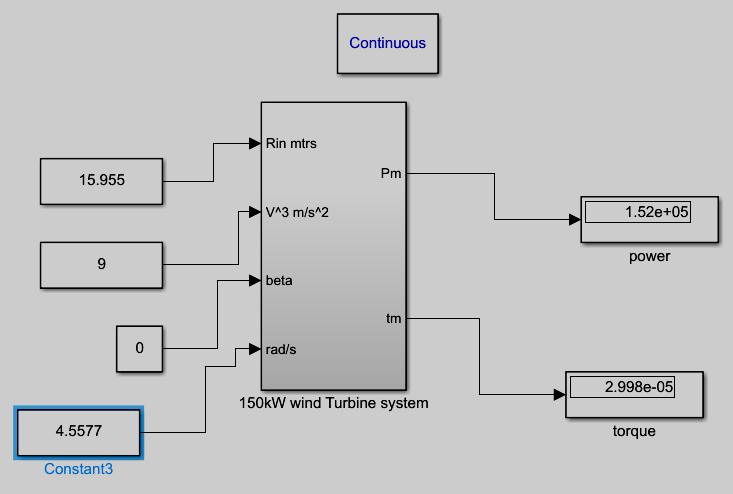
Aerodynamicblockisresponsiblefortheextractionofpower fromthewindinformofkineticenergyneededtodrivethe blades.Themodelledaerodynamicwindturbinebladewas designedandsimulatedinMATLABSIMULINKenvironment asshowninFig1.
The aerodynamic design was described by the tip speed ration(TSR),powercoefficient(CP)andTorque. Thekinetic energythatitextractedfromthewindwasusedtopropelthe wind turbine blades. Betz’s law stated that 59.3% is the maximumpowerthatcanbeextractedfromawindturbine [15].ThepoweraccessiblefromtheWTisproportionaltothe cube of the wind speed (ν). Thus, the power output was calculatedfromtheequationsgivenas:
ThevalueofCPvariesdependingonthetypeofblades,TSR and other design factors of the turbine. The TSR (λ) is the ratio of the blade tip speed to the free wind speed and is expressedasfollows:
Whereρairisthedensityofairinkg/m3,Aissweptareain m2,νiswindspeedinm/sandCPisthepowercoefficient. The CP is usually expressed as function TSR (λ) and pitch angle(β)andisgivenbelowasfollows[16]:
Whereωistherotorangularvelocityinrad/sandRisthe radiusoftherotor.Therotortorquedevelopedbytheturbine isdefinedas:
WhereC1 =0.5176,C2=116,C3 =0.4,C4 =5,C5 =21,C6 = 0.0068andγisdefinedas:
3.
Results
and Discussion
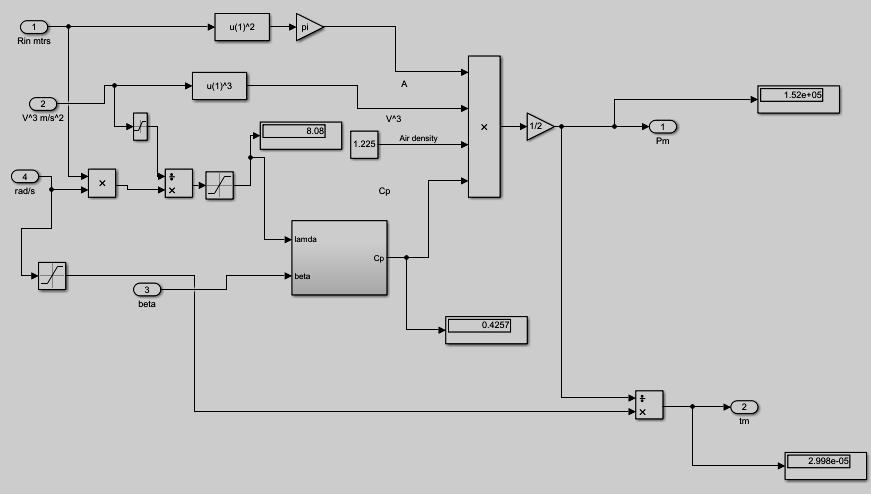
TheaerodynamicblockSimulationschematicwasperformed asdepictedinFig2.Byvaryingνandλfrom1-12m/sand113respectively,thepowercurverevealedthatthemaximum poweroutputcouldbegeneratedatawindspeedof12m/sas depictedinChart-1.Furthermore,theresultalsoshowedan increaseinpowerwithincreaseinthewindspeed.Itwasalso noticedthatthewindturbinestartedtoproduceusefulwork from a cut-in speed of 3m/s. However, the output energy neededtopowerthewholefacultybuildingasproposedin currentresearchcouldbeattainedatwindspeedof9m/s. Chart-2depictedthetipspeedratio-CPcurvewhichshows thatthetheoreticalmaximumpowercoefficientreaches0.48. Thissignifiesthatthedesignedbladehasaveryhighwind energyutilizationcoefficient.Theresultsobtainedfollowed thetrendsofthoseobtainedby[6]and[9]


4. CONCLUSIONS
Inthisstudy,acomputationalanalysisoftheaerodynamic designofawindturbinebladewascarriedouttoinvestigate theeffectofνandλontheperformanceoftheturbineblade. Theanalysisdisclosedthatthegeneratedpowerincreasesas thewindspeedincreases,andtheturbinebladestartedto produce useful work from a cut-in speed of 3m/s. It also shownthatthegeneratedenergyneededtopowerthewhole faculty is attained at 9m/s, and the blade has a very high windenergyutilizationcoefficient.Thus,thedesignedwind turbinebladescanefficientlyconverttheenergyinthewind toelectricity.Furthermore,thestudywillfacilitateandaid thedesignofacompleteandfunctionalwindturbineinany locationof Dutsin-Ma inKatsina Stateof Nigeria.It isalso recommended that the Mechanical and Electrical blocks should be modelled in order to have a complete designed windelectricitygenerationsystem.
ACKNOWLEDGEMENT
Theworkreportedinthisresearchpaperisfundedbythe NigerianTertiaryEducationTrustFund(TETFUND)under theInstitutionbasedResearch(IBR)GrantScheme2023on theprojecttitled:“ModellingandSimulationofaStand-alone Wind-drivenElectricityGenerationSystem”.
REFERENCES
[1] Scott, L., VanDam, C. P., and Daniel, S. (2014). Design studiesofsweptwindturbine blades.Renewable Energy, 7(1): 563-571. http://dx.doi.org/10.1016/j.renene.2014.05.050.
[2] Usman,A.,Gadanya,T.S.,andIlyasu,A.L.(2022).Wind PowerGenerationinSudano-Sahelian Regionof Nigeria. Path of Science Journal, 8(11): 87-89. http://dx.doi.org/10.22178/pos.87-9
[3] Jonathan, O., Okoronkwo, O., and Innocent, D. (2016). DesignConsiderationsoftheKatsinaWind Farm in Nigeria. IEEEPES PowerAfricanConference,pp.251243.
[4] Joselin,H.G.M.,Selvan,N.S.,andDevarenjan,J.(2020). AParametricStudyandFieldData Analysisofa Wind Farm. Solid State Technology,6(3):8817-8833.
[5] Maciej, K., Piotr, W., Piotr., B., and Krysztof, S. (2017). EconomicAnalysisofSmallWindTurbine. Journalof Machine Engineering,1(7):20-27.
[6] Sandip. A., Kale, and Ravindra, N. V. (2014). Aerodynamic Design of a Horizontal Axis Micro Wind TurbineBladeUsingNACA4412Profile. International Journal of Renewable Energy Research, 4(2): 21-34.
[7] Ronit, K., Singh, M., and Rafiuddin, A. (2013). Blade designandperformancetestingofasmallwindturbine rotor for low wind speed applications. Renewable Energy, 50(3): 812-819.
http://dx.doi.org/10.1016/j.renene.2012.08.021
[8] Jaejoon, L., Eunkuk, S., Byungho, H., and Soogab, L. (2013). Blade pitch angle control foraerodynamic performance optimization of a wind farm.Renewable Energy,5(4):124- 130.
http://dx.doi.org/10.1016/j.renene.2012.08.048
[9] Jianhua, X., Shiqiang, Z., Wenping, S., Zhonghua, H., Shaojun,Z.,andXinlong,L.(2022).Aerodynamicdesign of wind turbine blade with second derivative of thicknessdistributionasconstraint. Journal of Physics: The13thAsiaConferenceon MechanicalandAerospace Engineering (ACMAE 2022), vol. 2476. http://dx.doi:10.1088/1742-6596/2472/1/012059
[10] Eunkuk,S.,Seungmin,L.,Byeongho,H.,andSoogab,L. (2014).Characteristicsofturbinespacingin a wind farm using an optimal design process. Renewable Energy, 6(5): 245-249.
http://dx.doi.org/10.1016/j.renene.2013.09.022.
[11] Lanzafame, R., and Messina, M. (2009). Design and performanceofadouble-pitchwind turbinewithnontwisted blades. Renewable Energy, 3(4): 1413-1420. http://dx.doi:10.1016/j.renene.2008.09.004
[12] Bumsuk,K.,Woojune,K.,Sanglae,L.,Sungyoul,B.,and Youngho,L.(2013). Developementandverificationofa performance based optimal design software for wind turbine blades. Renewable Energy, 5(4): 166-172. http://dx.doi.org/10.1016/j.renene.2012.08.029
[13] Adaramola,M.S.,andOyewola,O.M.(2011).Evaluating theperformanceofwindturbinesselectedlocationsin Oyostate,Nigeria. Renewable Energy,3(6):3397-3304. http://dx.doi:10.1016/j.renene.2011.04.029
[14] Usman,A.,Gadanya,T.S.,andIlyasu,A.L.(2023).Study on Walk-Through Energy Audit of a Faculty Building. Fudma Journal of Sciences,7(3):282-287.
[15] Betz, A. (1996). Wind-Energie undihrea usnut zungdurchWindmühlen.Göttingen:Vandenhoeck.
[16] Gagnon, R. (2016). Wind Farm (IG) MATLAB & Simulink Example. Mathworks.com. Available at: http://www.mathworks.com/help/physmod/sps/exam ples/wind-farm- ig.html
BIOGRAPHIES
Author
“Tukur Sani Gadanya obtained hisMaster’sDegreeinMechanical Engineering from Aydin Adnan Menderes University Turkey (2018) and Bachelor Degree in Mechanical Engineering from BayeroUniversityKano(2014).He is currently an Assistant Lecturer in Mechanical Engineering Department at Faculty of EngineeringinFederalUniversity Dutsin-ma Katsina Nigeria. His research interest is in Heat Transfer in Nano-fluids and has publishedmorethan3papers“

Author
“Abdulyakin Usman hasMaster’s DegreeinEnergyEngineeringfrom Bayero University Kano (2020) andBachelorDegreeinMechanical Engineering from Bayero University Kano (2017). He is currentlyaLecturerIIandHeadof Mechanical Engineering Department at Faculty of EngineeringinFederalUniversity Dutsin-ma Katsina Nigeria. His research interest is in Green Fuel Technology and has published morethan10papers“
“Lawal Salisu obtainedhisPhDin Mechanical Engineering from Bayero University Kano (2021), Master’s Degree in Energy Engineering from Bayero University Kano (2014) and Bachelor Degree in Mechanical Engineering from Bayero University Kano (2006). He is a Director of the Directorate of Physical Planning and Development in Umaru Musa Yar’adua University Katsina Nigeria. He is the author of more than12Papersandhasinterestin SolarEnergyTechnology“