Heart Failure Prediction using Different Machine Learning Techniques
Prof. Pritesh Patil1, Rohit Bharmal2, Shravani Ghadge3, Dhanashri Gundal4, Ankita Kawade51Prof. Information Technology, AISSMS Institution of Information Technology, Pune, Maharashtra, India
2Student, Information Technology, AISSMS Institution of Information Technology, Pune, Maharashtra, India
3Student, Information Technology, AISSMS Institution of Information Technology, Pune, Maharashtra, India
4Student, Information Technology, AISSMS Institution of Information Technology, Pune, Maharashtra, India

5Student, Information Technology, AISSMS Institution of Information Technology, Pune, Maharashtra, India ***
Abstract - A This study compares the effectiveness of four well-known machine learning methods for predicting heart failure using a publically accessible dataset from kaggle.com: Random Forest (RF), K-nearest neighbors (KNN), NaiveBayes (NB), and Logistic Regression (LR). LR, or regression. They were chosen as a result of their successful applications in the field of medicine. The care of heart failure situations has to be improved in order to raise the survival rate because it is a widespread public health issue. The availability of sophisticated computational systems and the abundance of medical data on heart failure allow researchers to carry out more tests. Accuracy, precision, recall,f1-score,sensitivity,and specificity were used to evaluate the effectiveness of the machine learning algorithms in predicting heart failure using 14 symptoms or characteristics. In comparison to KNN, NB, and LR, experimental investigation revealed that RF delivers the greatest performance score (90.16). The findings of additional RF trials to identify the key indicators of heart failure prediction showed that each of the 14 symptoms or traits is crucial.
Key Words: Machine Learning, Heart Failure Prediction, Logistic Regression, Naive Bayes, Random Forest, Knearest neighbors
1. INTRODUCTION
The human body's most vital organ is the heart. The effectivefunctioningoftheheartisabsolutelyessentialto humanlife.Theheartdeliversbloodthroughbloodvessels tothevariousbodilyareas,withenoughoxygenandother necessarynutritionalelementsfortheorganism'sefficient operation.Ahealthyheartleadstoahealthylife.Butinthe modernworld,heartdiseasehasemergedasamajorfactor in both male and female fatalities. cardiac failure results from corona virus induced cardiac muscle inflammation. Regardless of respiratory symptoms, experimental data indicatesthat1in5patientshadcardiacdamagecausedby theCoronavirus.Themostprevalentkindofcardiacillness iscoronaryarterydisease.Heartfailureisamajorissuethat significantly affects people's lives. Most individuals consistentlydisregardtheirhealthduetothefasterpaceof life, larger portion sizes, and inactivity. Additionally, because of the deterioration of the environment, those factorsmaycontributetotheproblemofheartfailure,which
Futuretimesmayseeanincreaseintheirfrequency.Heart failuremighteventuallyresultindeathifpeopledidnotpay attentiontoit.Thepatient'smedicalandfamilyhistories,a physical examination, and test findings are often the foundationofthediagnosticprocessforheartfailure. Due to several risk factors, including diabetes, high blood pressure,highcholesterol,anirregularpulserate,andmany other conditions, it can be challenging to diagnose heart disease. cardiac failure is a severe symptom or advanced stageofseveralcardiacdisorders.Typically,cardiacejection wouldbeinsufficientinpatientswithheartfailure.
Heartfailurehasahighmortalityrateandisexpensiveto treat.Sinceheartdiseaseisthemostprevalent,itisurgent todevelopveryaccurateandearlymethodsofdiagnosing heartdisease,whichcanhelpmanypatientssurvive.There are several scanners available to identify heart illness, however detecting a cardiac ailment before it manifests itselfcansavemanylives.Byutilizingatoolthatenablesthe administratortovisuallyassessthepatient'sdata,weare giving further information to the administrator. Early detection and analysis of the existence of arrhythmia is crucial to preventing patients from developing heart problems.Inmanycircumstances,theexistenceofastroke orheartfailuremaybecausedbythesmalllevelsofcardiac rhythm.Thehealthcaresectorhasalotofpromisewithdata miningsinceitcanhelphealthsystemsassessanddiagnose diseasesbyusingthedata.Thecostandtimesavingsresult fromourabilitytoevaluatedataandforecastillness.
TheWorldHealthOrganizationpredictsthatheartfragility willcausethedeathsofalmost23.6millionpeoplebetween now and 2030. Therefore, anticipating a coronary illness shouldbeavoidedinordertolowertherisk. Therearetwo primarycategoriesforheartdiseaseriskfactors.Wecannot modify the risk variables in the first category, which includes things like age, gender, and family history. Risk factorsinthesecondcategoryincludethingslikesmoking, poor eating habits, and high cholesterol; we improve this secondgroup.Therefore,byusingthemedicaldatamining classification algorithms, which is a crucial part for identifying the possibility of heart attack, the risk factors belonging to the second class can be eliminated or controlled by changing lifestyle and through medication. Medicalprofessionalsmostfrequentlyemployangiography
todiagnoseCAD,howeverthisprocedurehassomeserious drawbacks,chiefamongthemitscost.
2. LITERATURE SURVEY
The authors proposed the predicting systems by using variousClassificationandpredictionalgorithms,andthere wereseveralpredictionsystemsthatwerealreadyinuse. AmongthecurrentsystemsareInordertodemonstratethe approach's suitability for disease prediction, Kaur K. suggestedamethodforthepredictionofheartdiseasethat isbasedontheprincipalsofcomponentanalysisandSVM classification.Ahybridneuralnetworkthatcombinesselfencodingandtwo-waylong-termmemorywasproposedby Ren Y. The model was applied to predict renal disease in hypertensionpatients,andthefinalpredictionaccuracywas 89.7%usingthedataof35,332hypertensivepatients.
Anintelligentsystem-basedsupportvectormachineanda radialbasisfunctionnetworkwereproposedbyShashikant GhumbreandChetanPatiltoreflectthepatient'sdiagnosis. Clinical symptoms will be used to determine the type of heart disease that may manifest in a patient, including whetherornotaheartattackisimminent.Thepatientdata set is subjected to the support vector machine with sequentialminimumoptimizationtechnique.Thesamedata setisthenusedtomakepredictionsusingtheRadialBasis Function(RBF)networkstructuretrainedbytheOrthogonal LeastSquare(OLS)technique.
CART is able to handle and analyse high dimensional categoricaldataandemploystheGiniindexasameasureof thecontaminationofapartitionoracollectionoftraining tuples.Althoughcategoricaldatamustfirstbeconvertedto continuousdata,decisiontreescanhandlecontinuousdata (like in regression). According to B. Jin, C. Che, Z. Liu, S. Zhang, X. Yin, and X. Wei, heart disease may be predicted usingsomepatient-providedfeatures.Theyalsogathered patienthealthdataandpriorpatienthistorytodoso.They madeadvantageofthepicturesfromtheelectronichealth records (EHR). EHR is made up of hospital records, physician records, and patient diagnostic records. By detectingandevaluatingtheconnectionsbetweenevents, theycanfinallyforecastwhenapatientwillbediagnosed based on the output they received from the EHR records, which is some unstructured data in picture format. As a result, using the current data directly will be challenging duetotheirsparseness.
ThedataminingapproachwasproposedbyRajKumarand Sophia, and they achieved an accuracy of 52.33% in their heart disease detection. To diagnose cardiac illness, they combined characteristics. This system employs the Naive Bayes method, the Decision list algorithm, and the KNN algorithm. This method is inaccurate and produces inaccurateresults.
Anbarasietal.alsoapplyageneticalgorithminadifferent strategy. By identifying the characteristics involved in the predictionofheartdisease,thepatient'srequirednumberof tests can be decreased. This method uses three classifiers and requires more time to build models because the classifiersweresuppliedwithfewercharacteristics.
Supportvectormachineand multilayerperceptronneural networkarchitectureweresuggestedbyGudadheetal.asa method for diagnosing cardiac illness. To illustrate the presenceorabsenceofheartdisease,theyusedtheSupport Vector Machine to split the information into two groups. They were 80.41% accurate, whereas the artificial neural networkclassifiedtheheartdiseasedatainto5categories withanaccuracyof97.5%.
ThehybridstrategywasusedtoofferasolutionbyKanika PahwaandRavinderKumarforchoosingthecharacteristics on the heart disease dataset for prediction. The SVM-RFE and gain ratio were used by the author in their feature selectionstrategytogetridofextraneousandunnecessary characteristics. Prediction requires identifying the characteristics.Onthesubsetoffeaturesforcategorizingthe datasetintothepresenceorabsenceofheartdisease,they applied Nave Bayes and Random Forest. When certain characteristicswereused,theymoreaccuratelyattainedthe results. The accuracy obtained using the Naive Bayes algorithmis84.15percent,whereastheaccuracyobtained usingtheRandomForestalgorithmis84.16%.Inorderto anticipateshort-termtimeseriesdatamoreaccuratelyand makeitacceptablefornumerical sequences,theARIMA is utilized.Aneuralnetworkmaybebuilttohandletheissue for non-numerical time series, however this system is inefficientanddoesnotproducereliableresults.Datamining Methods for Heart Disease Years of practice and rigorous medical examinations may be required to determine whetherapersonhasheartdisease.Ittakesmoretimeand moneytocompletethisprocessbecausetherearenumerous tests that must be performed. A system that can more accuratelypredictthepossibilityiswhatweneed.
3. PROPOSED WORK (METHODOLOGY)
Construction of computer systems that can automatically improve based on experience is the focus of the field of machine learning. It has become more well-liked in the medical field because to its capacity to handle enormous, complicated, and uneven data, one of which is prediction. Different machine learning techniques have been used to foresee heart failure issues. To predict cardiac disease, a comparisonofthefourmachinelearningmethodsLogistic Regression(LR),K-NearestNeighbor(KNN),RandomForest (RF),andNaiveBayes(NB)hasbeendone.ButwhenRF,NB, KNN,andLRwerecomparedforheartdiseaseprediction,RF outperformedtheotherMLtechniqueswithanaccuracyrate of90.16%.RFoutperformedothercategorizationmethodsin termsofheartdiseaseprediction.
3.1 Dataset and Features
TheheartdiseasedatasetfromKaggle,whichincludes303 cases, is where the dataset is found (https://www.kaggle.com/ronitf/heart-disease-uci). Age, sex,cp(chestpain),trestbps(restingbloodpressure),chol (cholesterol), fbs (fasting blood sugar), restecg (resting electrocardiographic),thalach(maximumheartrate),exang (exercise-induced angina), oldpeak, slope, ca (number of major vessels), and thal (thalassemia) are among the 14 variables in this dataset. They act as features or input variables, and the output variable indicates whether the patientexhibitingthelistedsymptomsisexperiencingheart failure.Anoutputvariable,target,inthisexperimentwith values of 0 and 1, respectively, denotes the absence and existenceofheartfailure.Figure1providessomeinstances oftheheart diseasepredictiondata utilized in this study, andTable1providesasummaryforeachvariable.
Table1.DescriptionofFeatures

Age Ageofthepersoninyears
Sex Sexoftheperson
Cp Chestpainexperience
fbs Fastingbloodsugaroftheperson
restecg Restingelectrocardiographicmeasurement
thalach Maximumheartrateachievedbytheperson
exang exercise-inducedangina
oldpeak STdepressioninducedbyexerciserelativeto rest
slope TheslopeofthepeakexerciseSTsegment
ca Numberofmajorvessels
thal Thalassemia
trestbps Restingbloodpressureoftheperson
chol Cholesterolmeasurementoftheperson target Heartfailureproblem
3.2 Machine Learning Techniques
a) Random Forest
A supervised machine learning technique known as random forest is utilized for both classification and regression applications. It is an ensemble learning techniquethatcreatesanumberofdecisiontreesandthen combinestheiroutputstopredictsomething. Asubsetof characteristicsanddatapointsfromthetrainingsetare randomlychosentogenerateanumberofdecisiontreesin a random forest. They are independent of one another sinceeachdecisiontreeisbuiltusingaseparatesubsetof thecharacteristicsanddatapoints.Eachtreeintheforest separatelypredictssomethingduringprediction,andthe combinedforecastsofallthetreesintheforestleadtothe final prediction. This method enhances the model's accuracywhilereducingoverfitting.
b) Logistic Regression
Binaryclassificationchallengesarehandledbysupervised machinelearningtechniquessuchaslogisticregression.The likelihood of a binary result as a function of one or more input factors is modeled by logistic regression.The linear combination of the input variables and their weights is transformedintoaprobabilityvaluebetween0and1using thelogisticfunction,sometimesreferredtoasthesigmoid function.
The formula for logistic regression can be expressed as follows:
p=1/(1+e^(-z))
The logistic regression model may take into account interactionsbetweenvariablesandcanhandlecategorical andcontinuousinputvariables.Todiscovertheweightsor coefficientsthatminimizetheerrorbetweenthepredicted probabilitiesandtheactualbinaryoutcomesinthetraining data, the logistic regression model is trained using maximum likelihood estimation or gradient descent optimization.
c) K-Nearest Neighbor
The supervised machine learning method K-nearest neighbors (KNN) is utilized for both classification and regressionapplications.Findingthekclosestneighborsto a data point in the training set and using their labels to predictthelabelofthedatapointisthefoundationofthe method.
KNN'smathematicalformulaisasfollows:
Calculatethedistancebetweeneachdatapointinthetest setandeachdatapointinthetrainingsetusingadistance metric,suchastheManhattandistanceortheEuclidean distance.
Basedontheirdistancefromthetestdatapoint,choose thekneighborsthatareclosesttoit.Theuserselectsthe valueofthehyperparameterk.
Inclassificationtasks,choosetheclasslabelforthetest datapointthatreceivesthemostvotesfromitskclosest neighbors.Taketheaverageoftheoutputvaluesofthe test data point's k closest neighbors to determine the outputvalueforregressiontasks.
d) Naive Bayes
Insupervisedmachinelearning,theNaiveBayesmethod isa sortofclassificationalgorithm.BasedontheBayes theoremandthesuppositionthattheinputvariablesare conditionallyindependentgiventheclasslabel,themodel is constructed. The formula for Naive Bayes can be expressedasfollows:
P(y|x1,x2,...,xn)=P(y)*P(x1|y)*P(x2|y)*...* P(xn|y)/P(x1,x2,...,xn)
NaiveBayesmakesthe"naive"assumptionthattheinput variablesareconditionallyindependentgiven theclass label,allowingfortheestimationofeachinputvariable's probability given the class label without taking into account the other input variables. This presumption makestheprocedurecomputationallyefficientandmakes thecalculationoftheconditionalprobabilitieseasier.
4.
Figure2showsusArchitecturalModelofProposedsystem
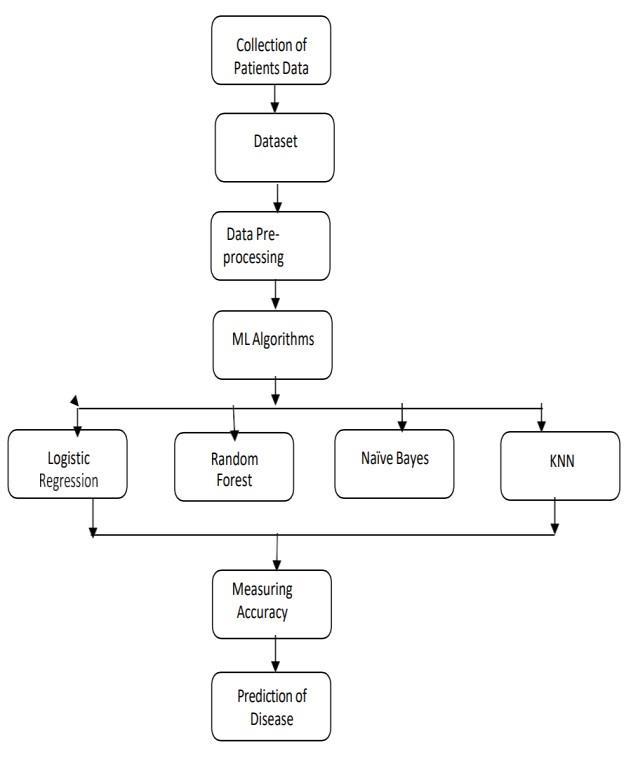
1. Data collecting is the first step in this project's process.Wehavegatheredthereadilyavailable, opensourcedatacollectionfromkaggle.
2. Data preprocessing comes after data collecting. Thedataiscleanedupinthisstagebygettingrid of pointless values. Additionally, it eliminates corrupted,missing,ornullvalues.
3. Oncethedatahasbeencleaned,thenextstepisto separateitintotwosets:trainingdataandtesting data. Values must be dealt with before we can buildthetrainingmodel.Usingtrainingdata,we createapredictionmodel.
4. WechoosetheSVMalgorithmsinceitiseffective and has higher accuracy. We now need to determine the model's accuracy. Predicting the illnessisthelaststage.Inthefinal result, 1will indicate"yes"and0willindicate"no."

5. IMPLEMENTATION/ EXPERIMENTAL SETUP
I. Importingessentiallibrariesimportnumpyasnp importpandasaspd importmatplotlib.pyplotas plt importseabornassns
II. Importingandunderstandingourdatasetdataset =pd.read_csv("heart.csv")
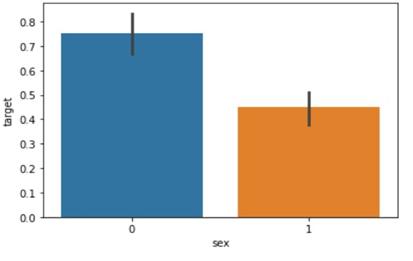
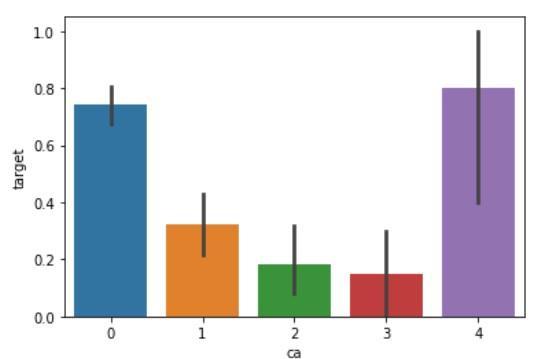
III.ExploratoryDataAnalysis(EDA)
To comprehend the underlying structure, trends, and relationships in the data, EDA entails the analysisofthedatathatyouhavegathered.Before usingthedatatotrainyourMLmodels,EDAletsyou findanyproblemsorabnormalitiesinthedatathat canbefixed.
IV.TrainTestsplit
from sklearn.model_selection import train_test_split predictors=dataset.drop("target",axis=1) target=dataset["target"]




X_train,X_test,Y_train,Y_test= train_test_split(predictors,target,test_size=0.20,ra
V. ModelFitting
In order to train a model to generate predictions on freshdata,afundamentalstageinmachinelearningis modelfitting.UsingPython'sscikit-learnmodule. fromsklearn.metricsimportaccuracy_score
VI.Outputfinalscore
The below Figure 12 shows us the comparison all modelsofmachinelearning.Thehighestaccuracyscore achievedusingRandomForestis:90.16%.

Table 2 lists the performance score of all the four techniquesbycomputingtheaverageforalltheevaluation criteria,anditshowsthatRFachievesthehighestaverage score,followedbyLR,NB,andKNN.
7. CONCLUSION
Thehumanheartisthemostimportantorganinthebody, andheartfailureisresponsibleforanexponentialriseinthe loss of human life every day. Experimental research has shown that the Global Pandemic Corona Virus hurts the heartsofmanysufferers.Thus,itisurgentlynecessaryfor researchtoconcentrateonthecausesofheartfailureandto developareliableearlydetectionsysteminordertoprevent lossoflife.Medicalofficers'timeandeffortspentonearly forecastsforhealthcaremanagementobjectivesarereduced thankstomachinelearningtechnology.
Amachinelearningapproachthatcanassistinreliablyand effectivelypredictingheartfailureasthefrequencyoffatal heartfailuresrises.Thisstudydemonstratesthepotential formachinelearningtoenhancethehealthcaremanagement systembyusingearlyheartfailurepredictions.RFappears to provide the highest performance score among the approachestestedinthistrial.Itcouldresultinaneffective method of controlling the condition that could slow its progression.Theaccuracywillbeincreasedinfuturestudies by combining machine learning approaches with optimisationalgorithmsandmoredata.
Figure12.Comparisonofallalgorithms.
6. RESULT ANALYSIS
As indicated in Table 1, the data set used for this study includes a variety of clinical variables for the patients, includingage,sex,chestdiscomfort,Fbs,andmore.Thedata setisthensplitintotwogroups,withthetrainingsetbeing 70% and the testing set being 30%.Testing is done to determinewhetherthemodelisaccurateoncethetraining sethasbeenconstructed.Thedata setisrunthroughfive differentalgorithmsaspartofthisresearchproject,andthe outcomes are compared. This study effort was able to predictwith90.16%accuracyifapatienthadheartdisease or not using this strategy. When compared to other techniques,thismodel'saccuracyofpredictionutilizingthe RandomForestwasthegreatestatroughly90.16%.
Thefollowingaretheoutcomesafterusingthealgorithms:
8. FUTURE WORK
Futurescopeforheartdiseaseprognosisreportsmightbein anumberofareas,including:
ExpandingtheSizeandDiversityoftheDataset:Increasing thesizeanddiversityofthedatasetcanaidinincreasingthe precision of the machine learning models. To make the dataset more typical of the community, it might contain peoplewitharangeofages,regions,andhealthissues.
Integration with Electronic Health Records (EHR): When machine learning models are integrated with electronic healthrecords(EHR),itispossibletoforecastheartfailure accurately and in real time, which improves patient outcomes. Informed choices concerning the patient's treatment may be made by doctors and other healthcare professionalsbecausetothis.
UsingMulti-ModalData:Machinelearningmodelsforheart failure prediction can be improved upon by using multimodaldata,suchasphotos,audio,andvideo.Medicalscans, forinstance, might offer moredetailson theanatomyand operation of the heart, which can increase the models' accuracy.Thecreationofmobileapplicationscangivepeople a simple and handy method to keep track of their heart health.Mobileapplicationsforheartfailurepredictionare one such example. To anticipate the possibility of heart
failureandpromptpatientstoseekmedicalassistancewhen necessary, these applications can use machine learning models.
ACKNOWLEDGMENT
WeappreciatethesupportoftheInformationTechnology Department of our institution, the AISSMS Institute of InformationTechnology,andourmentor,Mr.PriteshPatil, anassociateprofessorthere.Wewouldespeciallywantto expressourthankstoDr.MeenakshiThalor,Headofthe Information Technology and Engineering Department of theAISSMSIOITCollegeofEngineering,forherunwavering directionandsupportofourprojecteffort.

REFERENCES
[1] JiangW,LuoJ.GraphNeural NetworkforTraffic Forecasting: A Survey[J]. arXiv preprint arXiv:2101.11174,2021.
[2] Kim, Young-Tak, et al. "A Comparison of Oversampling Methods for Constructing a Prognostic Model in the Patient with Heart Failure." 2020 International Conference on Information and Communication Technology Convergence(ICTC).IEEE,2021.
[3] C. for Disease Control and Prevention, “Atrialfibrillation| cdc.gov, ” Centers for Disease ControlandPrevention,May2020,Accessed:Mar, 23, 2021. [Online]. Available: https://www.cdc.gov/heartdisease/atrial_ fibrillation.htm
[4] Olsen,CameronR.,etal."Clinical applicationsof machinelearning in the diagnosis, classification, and prediction of heart failure." American Heart Journal(2020).
[5] Fang, Hao, Cheng Shi, and Chi-Hua Chen. "BioExpDNN: Bioinformatic Explainable Deep Neural Network." 2020 IEEE International Conference on Bioinformatics and Biomedicine (BIBM).IEEE,2020.
[6] A. Javeed, S. Zhou, L. Yongjian, I. Qasim, A. Noor and R. Nour, "An Intelligent Learning System Based on Random Search Algorithm and Optimized Random Forest Model for Improved HeartDiseaseDetection,"inIEEEAccess,vol.7,pp. 180235-180243,2019.
[7] Guo, Aixia, et al. "Heart Failure Diagnosis, Readmission, and Mortality Prediction Using Machine Learning and Artificial Intelligence Models."CurrentEpidemiologyReports(2020).
[8] B. Wang et al., "A Multi-Task Neural Network ArchitectureforRenalDysfunctionPredictionin Heart Failure Patients With Electronic Health Records," in IEEE Access, vol. 7, pp. 178392178400,2019.
[9] S.Adithya Varun, G.Mounika, Dr. P.K. Sahoo, K. Eswaran, “Efficient system for Heart disease predictionbyapplyingLogisticregression.ijcstvol 10,issue1,march2019


[10] Rajalakshmi, S., & Madhav, K. V., A Collaborative Prediction of Presence of Arrhythmia in Human Heart with Electrocardiogram Data using MachineLearning Algorithms with Analytics. 278 287. doi:10.3844/jcssp.2019.278.287,2019.
[11] B.Jin, C.Che, Z.Liu,S.Zhang, X.YinandX. Wei, "Predicting the Risk of Heart Failure withEHR Sequential Data Modeling," in IEEE Access,vol. 6,pp.92569261,2018.
BIOGRAPHIES AISSMSInstituteofInformation Technology
Prof.PriteshPatil InformationTechnology Professor

RohitBharmal BEITStudent

AISSMSInstituteofInformation Technology
DhanashriGundal BEITStudent
AISSMSInstituteofInformation Technology
ShravaniGhadge BEITStudent
AISSMSInstituteofInformation Technology
AnkitaKawade BEITStudent
AISSMSInstituteofInformation Technology