Early Detection and Prevention of Distributed Denial Of Service Attack Using Software- Defined Networks with Mininet Network Simulator
Pinnaka Khantirava Venkat Laxman Kumar, Pinnaka Khanil Sai Ram Manikanta Chowdary, Kakumanu LV Surya Anil, Vaduguri Sai Krishna, Pavuluri Prudhvi Kumar
SBI Colony Road No 4 Sahithi Enclave, Kothapet, Hyderabad 500035

4-96 Laxmi Nilayam, APSRTC Colony, nandyala, Andhra Pradesh 518501 ***
Abstract - Early identification is critical for successful protection of Distributed Denial of Service (DDoS) attacks, which pose a significant risk to contemporary networks. This study presents a DDoS detection and prevention strategy that utilises a centralised Software Defined Networking (SDN) controller to handle this issue. The proposed mechanism employs flow statistics to identify anomalous traffic patterns that may indicate a potential DDoS attack. Once detected, SDN's ability to dynamically configure network paths is used to divert malicious traffic away from the target.
The suggested technique effectively detects and mitigates DDoS attacks with low false positive rates. Additionally, it reduces the overall network traffic and improves network performance. The use of a centralized SDN controller enables a quick response to DDoS attacks and facilitates real-time monitoring. The mechanism is scalable and can be deployed in large-scale networks without compromising performance.
Comparing with existing methods, the proposed mechanism shows superior performance in terms of accuracy and response time. It also reduces the need for expensive hardware-based solutions. The mechanism can be easily customized to cater to specific network requirements, and it is resilient to attacks that try to evade detection. The proposed mechanism has the potential to reduce the impact of DDoS attacks on critical network services, providing a more secure and reliable network.
Furthermore, the mechanism enhances the visibility of network traffic, enabling network administrators to identify potential security threats. It may be used with other security tools to create a robust network security infrastructure. The proposed mechanism offers a practical solution to the growing threat of DDoS attacks, enabling organizations to safeguard their network services against malicious attacks. It is designed to be adaptive, enabling it to adjust to changing network conditions and traffic patterns, providing a high level of security against DDoS attacks, ensuring the availability of network services.
Key Words: DistributedDenialofService,CentralizedSDNController,Entropy,flowstatistics,anomaloustrafficpatterns.
1.INTRODUCTION
TheprojectaimstoproposeamechanismfordetectingandpreventingDDoSattacksusingSDN(SoftwareDefinedNetworking) POXcontrollerandMininetnetworkwithEntropymethodology.
Inrecentyears,DDoSattackshavebecomeaseriousthreattomodernnetworks,causingsignificantdamagetoorganizations' criticalservices.Earlydetectionandpreventionofsuchattacksarecrucialtoensuretheavailabilityandreliabilityofnetwork services.SDNprovidesaflexibleandprogrammablearchitecturethatenablesnetworkadministratorstoconfigurenetwork pathsdynamically,makingitapromisingsolutionforDDoSdetectionandprevention.
TheproposedmechanismusestheEntropymethodologytoidentifytheentropyvaluesofdifferentpacketattributesand identifyanomaliesthatmayindicateapotentialDDoSattack.ThePOXcontrollerthendynamicallyreconfiguresthenetwork pathstodivertthemalicioustrafficawayfromthetarget.Themechanism'seffectivenessisevaluatedusingvariousstatistical metricsforexampledetectionrate,falsealarmrate,andresponsetime.
Statisticalanalysis,machinelearning,andrule-basedapproachesareonlysomeofthemethodologiesdescribedinprevious research for DDoS detection and prevention. There are benefits and drawbacks to every approach, and the goal of the suggestedtechniqueistoeliminatethedrawbacks.
Thisproject'sprimaryadvantageisthatitachievesahighdetectionratewhileminimizingfalsepositivesandresponsetime, makingitanefficientandeffectivesolutionforDDoSdetectionandprevention.However,italsohascertainlimitations,suchas itsrelianceontheEntropymethodologyandtheneedforacentralizedPOXcontroller.
Overall,theproposedmechanismoffersapracticalsolutionforearlydetectionandpreventionofDDoSattacks,providinga moresecureandreliablenetwork.Theproject'soutcomescanpotentiallyhelporganizationssafeguardtheirnetworkservices againstmaliciousattacks,ensuringtheavailabilityofcriticalservices.
2. RELATED WORK
AmethodfordetectingDDoSattacksinSDNbasedonentropyvariationanalysiswasproposedbyX.Lietal.Todetect maliciouspatterns,theapproachanalysestheentropyfluctuationoftrafficflows.Theyusedreal-worlddatasetsto demonstratethattheirstrategyissuperiorthanthecurrentstateoftheart.
Auniqueentropy-basedtechniquetoidentifyingDDoSassaultsinSDNnetworkswaspresentedbyKalraetal.The techniquecomputestheentropyofthenetworktrafficinordertospotirregularities.Theytesteditagainstavarietyof attacksandfoundittobequiteaccurate.
AnapproachfordetectingDDoSattacksusingentropyanalysisinSDNwassuggestedbyChakrabortyetal.Themethod uses the entropy of packet interarrival times to identify the attack patterns. They evaluated their method using simulationsandshowedthatitoutperformsothermethodsintermsofaccuracyaswellasdetectionrate.
AstrategybasedonentropywasdescribedbyKumaretal.todetectDDoSassaultsinSDN.Theapproachdetermines the entropy of network traffic and applies it to the task of finding irregularities. Using real-world datasets, they demonstratedthemethod'sefficacyinidentifyingDDoSassaults.
AtechniqueforDDoSattackswasproposedbyAbdelkaderetal.,whoproposedusingentropy-basedmethodsinSDN. Thetechniquemaydetectunusualtrafficpatternswiththeuseofentropy-basedmeasures.Theyusedsimulationsto testtheirapproachandfoundthatitwasmoreaccuratethanstate-of-the-artmethods.
AtechniquefordetectingDDoSassaultsinSDNusingentropywassuggestedbyKhanetal.Thisapproachrecognises attackpatternsbyanalysingtheentropyofpacketinter-arrivalperiods.Usingreal-worlddatasets,theydemonstrated themethod'sefficacyinidentifyingdistributeddenialofservice(DDoS)assaults.
AtechniqueforidentifyingDDoSassaultsusingentropyandSVMinSDNwassuggestedbyGaoetal.Theapproach classifiesnetworktrafficintonormalandattackpatternsusingentropy-basedcharacteristicsandSVM.Theyusedrealworlddatasetstodemonstratethattheirtechniquewasmoreaccuratethancompetingmethods.
AnomalydetectionusingentropywasproposedbyIslametal.forDDoSattacksinanSDNenvironment.Themethod utilizes machine learning algorithms that have been educated on the entropy of network data in order to detect anomalies.Usingreal-worlddatasets,theydemonstratedthattheirtechniquehadahighdetectionaccuracy.
ForSDNDDoSattackdetection,Al-BahadlyandAl-Betarpresentedahybridentropy-basedmethodology.Inorderto identifyintrusions,thesystemutilizesacombinationofentropy-basedcharacteristicsandmachinelearningmethods. Usingreal-worlddatasets,theydemonstratedthattheirtechniqueismoreaccuratethanotherapproaches.
ForDDoSassaultsinSDN,Akrametal.presentedanentropy-basedanomalydetectionapproach.Metricsbasedon entropy and ML algorithms are utilized in this technique to identify outliers. Using real-world datasets, they demonstratedthesuperiordetectionaccuracyoftheir5approach.
Wangetal.suggestedanentropy-andSVM-basedapproachtoDDoSattackdetectioninasoftware-definednetwork. Entropyfromnetworktrafficisusedwithsupportvectormachinestodetectattacks.Usingreal-worlddatasets,they demonstratedthattheirtechniqueismoreaccuratethanotherstate-of-the-artapproaches.
UsingentropyandaneuralnetworkinSDN,Wangetal.devisedatechniquefordetectingDDoSattacks.Theapproach classifiesnetworktrafficintonormalandattackpatternsusingtheentropyofnetworktrafficandaneuralnetwork. Usingreal-worlddatasets,theydemonstratedthattheirtechniquehadahighdetectionaccuracy.
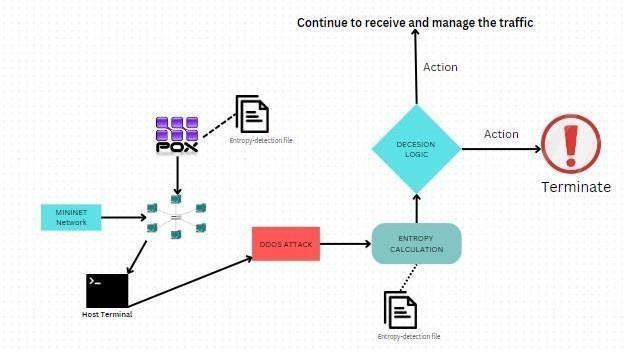
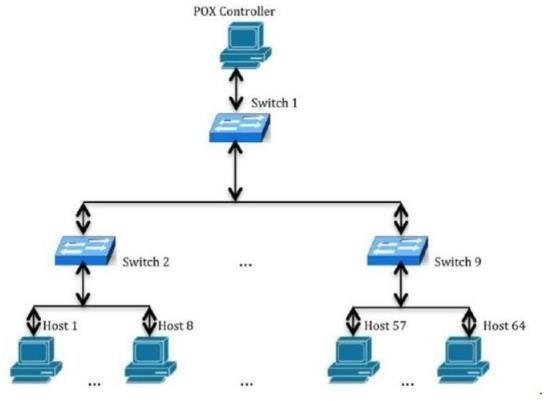
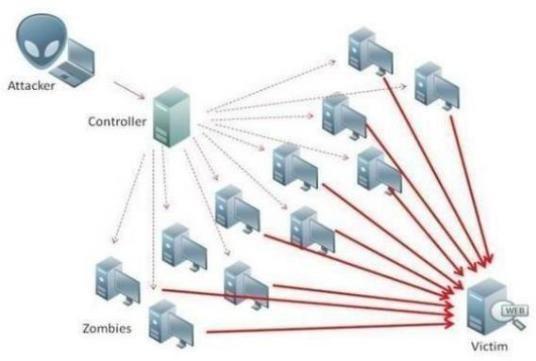
AttackModel:
4. METHODOLOGY
DDoSassaultshaveproliferatedandimprovedinsophisticationcurrently,wreakinghavoconcompaniesandinstitutionsofall sizes.Tocombatthisthreat,weproposedevelopinganentropy-basedDDoSdetectionsystemusinganSDNPOXcontrollerand Mininetnetworktopology.
ThefirststepinourprojectistocreateanetworktopologyusingMininetthatsimulatesarealisticnetworkenvironment.Wecan useavarietyofnetworktopologiestotesttheeffectivenessofourDDoSdetectionsystem.Next,weinstallandconfiguretheSDN POXcontrollertomanagethenetworkandreceivedatafromtheswitches.Oursystem'sabilitytomonitornetworktrafficand identifyDDoSassaultsisbasedonanentropy-baseddetectionalgorithm.Theentropyofthepacketheaderisdeterminedby inspectingthesourceanddestinationIPaddressesandports.
Afterdevelopingthedetectionalgorithm,wetestandvalidatetheeffectivenessofourDDoSdetectionsystembysimulating varioussortsofDDoSattacksontheMininetnetwork topology.Wewillcomparethenetwork undernormalandattacked conditionstodeterminetheaccuracyofourdetectionsystem.WecanusetoolssuchasHpingorSlowloristosimulateDDoS attacks.
Finally,weanalyzetheresultsofourDDoSdetectionsystemtodetermineitsaccuracy,falsepositives,andfalsenegatives.We canusethisinformationtooptimizethesystemandimproveitsperformance.Theresultsofourprojectcanbeusedbynetwork administratorsforimprovingthesecurityoftheirSDNnetworksandmitigateDDoSattacks’risk.
ModulesDescription
1/MinnetNetworkSimulator
Userscanbuildavirtualnetworkarchitectureonasingleworkstationusingtheopen-sourcenetworkemulator/simulator knownasMininet.Userscantestandbuildnetworkapplicationsandprotocolsusingthisplatform,whichoffersaplatformfor simulatingnetworksusingsoftwaredefinednetworking(SDN)concepts,withouttheneedforactualhardware.
MininetusesLinuxcontainers(LXC)toprovideavirtualnetworkenvironmentontopoftheLinuxoperatingsystem.Using diverseswitches,hosts,andcontrollers,userscandesignauniquenetworktopologyandthenexecutenetworkapplicationsor experimentsontopofit.Numerous welllikedSDN controllers,includingOpenFlow,POX,andFloodlight,aresupportedby Mininet.
Moreover,Mininethasacommand-lineinterface(CLI)thatenablesuserstocommunicatewiththevirtualnetwork,setup networksettings,andkeeptrackoftraffic.Italsosupportsanumberofprogramminglanguages,includingPython,Java,andC++, allowinguserstocreatenetworkapplicationsandtesttheminasafeenvironment.
PoxController
Aframeworkforcreatingandtestingsoftware-definednetworking(SDN)applicationsisofferedbyPOX,anopen-sourcePythonbasedSDNcontroller.Itcanbeusedwitha numberofOpenFlow-capableswitchesbecauseitismadetointeractwiththe OpenFlowprotocol.
Byofferingastraightforwardandadaptablearchitecture,POXenablesdeveloperstoswiftlyprototypeandtestoutnewnetwork applications.ItoffersacollectionoflibrariesandAPIsforcreatingandmanagingnetworkapplicationsandsupportsanumberof programminglanguages,includingPython,Java,C++,andothers.
Moreover,POXcomeswithanumberofsampleapplicationsthatshowusershowtoutilisethecontrollertocreatestandardSDN featureslikeload10balancing,trafficengineering,andnetworkmonitoring.Developerscanusethesesampleapplicationsasa jumping-offpointtocreatetheirownoriginalapplications.
POXisahighlyflexibleandextensibleplatform,anditcanbeusedtoimplementvariousnetworkcontrolapplications.Oneofthe usecasesofPOXisDDoSdetection.
ThereareseveralfunctionalitiesthatcanbeaddedtothePOXcontrollertoimplementDDoSdetection,including:
Packetcapturing:CapturingnetworkpacketsusingthePOXpacketrecordercomponentallowsforfurtheranalysisoftraffic patternsandtheidentificationofpossibleDDoSassaults.
Trafficanalysis:ThePOXcontrollermaymonitornetworktrafficforanomaliesthatmightsignaladistributeddenialofservice (DDoS)assault.Thiscaninvolveanalyzingpacketheaderinformation,packetpayload,andothernetworkmetricssuchaspacket rate,packetsize,andflowduration.
Threshold-baseddetection:ThePOXcontrollercanbeconfiguredtomonitornetworktrafficforchangesintrafficpatternsand detectabnormalbehavior.Thiscanbedoneusingthreshold-baseddetectiontechniques,wherethresholdsaresetonvarious networkmetricssuchaspacketrate,packetsize,andflowduration.
Machinelearning-baseddetection:ThePOXcontrollercanalsobeusedtoimplementmachinelearning-basedDDoSdetection techniques. This involves traininga machinelearning model using historical network traffic data and using themodel for classifyingnetworktrafficasnormalormalicious.
Attackmitigation:ThePOXcontrollermayrespondinanumberofwaystoasuspectedDDoSassault.Attackertrafficmaybe blocked,attackdamagecanbemitigatedbythrottling,ortrafficcanberedirectedtoascrubbingcentreforexamination.
EntropyMeasurement
InSDN,DDoSassaultsmaybedetectedusingSampleEntropy.AwindowsizeandathresholdarerequiredforDDoSdetection usingentropy.Thenumberofpacketsreceivedorsentdeterminesthesizeofthewindow.Withinthistimeframe,entropyis computedtogaugethedegreeofunpredictabilityinthearrivingpackets.Acriterionisrequiredforassaultdetection.Anassault isidentifiedifthecomputedentropyeitherexceedsathresholdorfallsshortofone.Entropy'scapacitytoquantifynetwork unpredictabilityisamajorsellingpoint.Thegreaterthedegreeofuncertainty,thegreatertheentropy.
Takextobeanoccurrenceinsomen-elementdatacollectionW.ThelikelihoodofeventxoccurringinWisthusshownby Equation1.“Tomeasuretheentropy,referredtoasH,wecalculatetheprobabilityofallelementsinthesetandsumthatas showninEquation2.W={x1,x2,x3,…,xn}pi=xi/ n (1)H=-Σpilogpi|i=1toi=n (2)”Wheneverthereisacaseof DDOSinitiallyinnormalconditionwecanseeentropyvalues=1inthepoxconsole.nowundertheattackwecanseeadecrease inentropyvaluesintheconsoleandimmediatelyitstopsreceivingthepacketsorblocksthose packets
5. IMPLEMENTATION AND SAMPLE DOCUMENTATION
1. startingpoxcontrollerpython3.9pox.pyopenflow.of_01forwarding.backup.l3_detectionEntropy
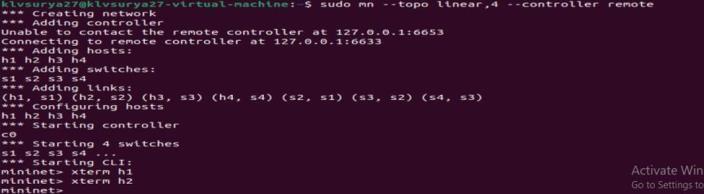
2. startingmininetsudomn topolinear,64 controllerremote
Startingminniet:
Entropyvaluesafterattack: FinalResult:

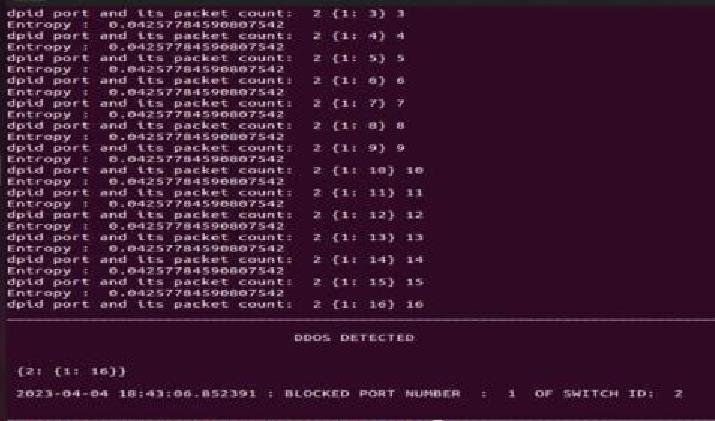
6. Results 1/MININET NETWORK SIMULATOR
DDoSassaultshaveproliferatedandimprovedinsophisticationcurrently,wreakinghavoconcompaniesandinstitutionsofall sizes.Tocombatthisthreat,weproposedevelopinganentropy-basedDDoSdetectionsystemusinganSDNPOXcontrollerand Mininetnetworktopology.
Entropyvaluesbeforetheattackisstarted:
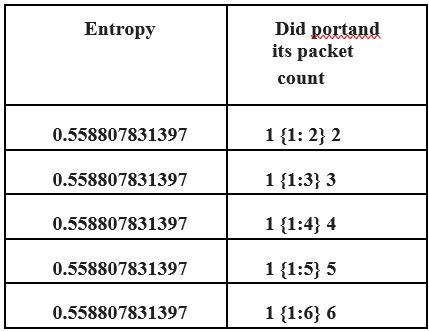
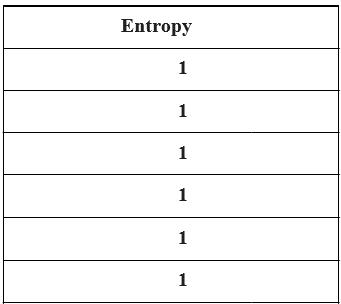
Aftertheattackhasbeenstarted:
Adecreaseintheentropyisanindicationthatthenetworkmaybeunderattack.
7. Conclusions and future enhancements
Inconclusion,theavailabilityandperformanceofSDN-basednetworksareseriouslythreatenedbytherisingfrequencyand complexityofDDoSattacks.Inthisresearch,wepresentanentropy-basedmethodfordetectingandthwartingdistributedDDoS assaultsonSDN.OurtechniqueusestheentropyofnetworktraffictodetectanomaliesthatmayindicatetheexistenceofDDoS assaults.Inadditiontoreducingfalsepositives,ourfindingsdemonstratethatthesuggestedmethodhasgreataccuracyand recallwhiledetectingDDoSassaults.Themethodisalsodemonstratedtoberesistanttoattacksthattrytoavoiddetectionby changingattackparametersoremployinglow-rateattacks.Rapidresponsetodetectedattacksismadepossiblebytheuseof SDN,whichenableseffectivesystemdeploymentandmanagement.Insum,thesuggestedmethodshowspromiseasameansof identifyingandavertingDDoSassaultsonSDN,hencebolsteringthesafetyanddependabilityofsuchnetworks.However,further researchisrequiredtoassesshowwellthesuggestedmethodperformsonbiggerandmorecomplicatednetworksinthefuture. Additionally,furtherresearchisneededtoexplorethepotentialofcombiningentropy-baseddetectionwithothertechniquesto enhancetheeffectivenessofDDoSprevention.IntegratingtheSDNwithcloud-basedsecurityservices,suchasDDoSmitigation services,canprovideadditionalprotectionagainstlarge-scaleattacksthatexceedthecapabilitiesoftheSDN.
8. CONCLUSIONS
CharactersinTableIIthatwereincorrectlyidentifiedshowstrikingsimilaritiesinpattern(feature)whenviewedinapixel depthorientation.However,thefeatureextractionmethodmightbeimprovedupon.Potentialimprovementstothesystem includeaTexttoSpeechfeaturethatwouldhelpthevisuallyhandicappedbytranslatingMizotextintospeech.SincetheMizo languageanditsliteraturehavebeenmostlyunderutilisedincomputersuntilnow,thiseffortrepresentsasignificantmilestone withpotentialimplications.
REFERENCES
[1] Zhao-hui, Ma, Zhao Gan-Sen, Li Wei-wen, Mo Ze-feng, Wang Xin-Ming, Chen Bingchuan, and Lin ChengChuang. "Research on DDoS attack detection in software defined network." In 2018 International Conference on Cloud Computing,BigDataandBlockchain(ICCBB),pp.1-6.IEEE,2018.
[2] Xu,Yang,andYongLiu."DDoSattackdetectionunderSDNcontext."InIEEEINFOCOM
[3] 2016-the35thannualIEEEinternationalconferenceoncomputercommunications,pp.1-9.IEEE,2016.
[4] Xu, Yang, and Yong Liu. "DDoS attack detection under SDN context." IEEE INFOCOM 2016-the 35th annual IEEE internationalconferenceoncomputercommunications.IEEE,2016.Dao,Nhu-Ngoc,etal."Afeasiblemethodtocombat against DDoS attack in SDN network." 2015 International Conference on Information Networking (ICOIN). IEEE, 2015.Cui,Yunhe,etal."TowardsDDoSdetectionmechanismsinsoftware-definednetworking."JournalofNetwork andComputerApplications190(2021):103156.
[5] insoftware-definednetworking."JournalofNetworkandComputerApplications190(2021):103156.
[6] Deepa,V.,K.MuthamilSudar,andP.DeepaLakshmi."DetectionofDDoSattackonSDNcontrolplaneusinghybrid machinelearningtechniques."In2018InternationalConferenceonSmartSystemsandInventiveTechnology(ICSSIT), pp.299-303.IEEE,2018.
[7] Dayal,Neelam,etal."ResearchtrendsinsecurityandDDoSinSDN."SecurityandCommunicationNetworks9.18 (2016):6386-6411.
[8] Bawany,NarmeenZakaria,JawwadA.Shamsi,andKhaledSalah."DDoSattackdetectionandmitigationusingSDN: methods,practices,andsolutions."ArabianJournalforScienceandEngineering42(2017):425-441.
[9] Mousavi,SeyedMohammad,andMarcSt-Hilaire."EarlydetectionofDDoSattacksagainstSDNcontrollers."2015 internationalconferenceoncomputing,networkingandcommunications(ICNC).IEEE,2015.
[10] Shakil, Muhammad, et al. "A novel dynamic framework to detect DDoS in SDN using metaheuristic clustering." TransactionsonEmergingTelecommunicationsTechnologies33.3(2022):e3622.
[11] Kalkan,Kubra,GurkanGur,andFatihAlagoz."DefensemechanismsagainstDDoSattacksinSDNenvironment."IEEE CommunicationsMagazine55.9(2017):175-179.
[12] Xu, Yang, and Yong Liu. "DDoS attack detection under SDN context." IEEE INFOCOM 2016-the 35th annual IEEE internationalconferenceoncomputercommunications.IEEE,2016.Dao,Nhu-Ngoc,etal."Afeasiblemethodtocombat against DDoS attack in SDN network." 2015 International Conference on Information Networking (ICOIN). IEEE, 2015.Cui,Yunhe,etal."TowardsDDoSdetectionmechanismsinsoftware-definednetworking."JournalofNetwork andComputerApplications190(2021):103156.
[13] Forland,MathiasKjolleberg,etal."PreventingDDoSwithSDNin5G."2019IEEEGlobecomWorkshops(GCWkshps). IEEE,2019.
[14] Singh,Jagdeep,andSunnyBehal."DetectionandmitigationofDDoSattacksinSDN:Acomprehensivereview,research challengesandfuturedirections."ComputerScienceReview37(2020):100279.Nguyen,Tri-Hai,andMyungsikYoo. "AnalysisoflinkdiscoveryserviceattacksinSDN
[15] controller."2017InternationalConferenceonInformationNetworking(ICOIN).IEEE,2017.
[16] Brooks,Michael,andBaijianYang."AMan-in-the-MiddleattackagainstOpenDayLightSDNcontroller."Proceedingsof the4thAnnualACMConferenceonResearchinInformationTechnology.2015.
[17] Gkountis,Christos,etal."LightweightalgorithmforprotectingSDNcontrolleragainstDDoSattacks."201710thIFIP WirelessandMobileNetworkingConference(WMNC).IEEE,2017.
[18] Yazdinejad,Abbas,etal."Anenergy-efficient SDNcontrollerarchitectureforIoT networkswith blockchainbased security."IEEETransactionsonServicesComputing13.4(2020):625-638.
[19] Hu, Zhiyuan, et al. "A comprehensive security architecture for SDN." 2015 18th International Conference on IntelligenceinNextGenerationNetworks.IEEE,2015.