Text Summarization Using the T5 Transformer Model
Abstract - In our information-filled world, it is crucial to focus on the essential content amidst the overwhelming volume of information available. Unfortunately, people often spend a significant amount of time sifting through irrelevant details, inadvertently overlooking crucial information. To address this issue, we present a project that utilizes the T5 transformer model in natural language processing to develop an abstractive text summarization system. By leveraging advanced language modeling techniques, our project aims to enhance efficiency, comprehension, and decision-making processes across various domains.
Key Words: Abstractive summarization, T5 transformer model, Natural language processing.
1.INTRODUCTION
In our information-filled world, focusing on what truly mattersisessentialforsuccess.Onaverage,apersonspends a significant amount of their lifetime reading useless information, often missing out on significant bits by subconsciouslydismissingthem.Tosolvethisproblem,we built a text summarizer that condenses lengthy text into shorterconcisesummaries,providinga quick overview of themaininformation.
Text summarization is a vital tool in today's informationdriven world, allowing us to distil the essence of lengthy texts into concise summaries. By employing advanced naturallanguageprocessingtechniques,textsummarizers extractkeyinformation,enablingreaderstograspthemain ideasquickly.Inthisreport,weexploretheeffectivenessand applications of text summarizers, shedding light on their potential to enhance efficiency, comprehension, and decision-makingprocessesacrossvariousdomains.
1.1 The T5 Transformer Model
Toachievethis,weusetheT5transformermodelwhichis apowerfullanguagemodelthatcanunderstandandgenerate human-liketext.ConstructingatextsummarizerbasedonT5 is beneficial because it allows for concise and accurate summarizationoflengthydocuments.T5'sabilitytocapture contextualrelationshipsandgeneratecoherentsummaries makes it an ideal choice for text summarization tasks, enabling efficient information extraction and facilitating quickcomprehensionofcomplextexts.
Finally, complete content and organizational editing before formatting. Please take note of the following items whenproofreadingspellingandgrammar:
2. Literature Review

AdhikaPramitaWidyassarietal.[1]providesanoverviewof various techniques and methods used in automatic text summarization, with a particular focus on the Natural Language Toolkit (NLTK). The author explores different approaches, including extractive and abstractive summarization,anddiscusseshowNLTKcanbeutilizedin thesetechniques.
Preprocessing: NLTK performs essential text preprocessingtasksliketokenization,stemming,and stop-wordremoval,aidingininformationextraction by breaking text into words or sentences and reducingwordstotheirrootform.
Sentence Scoring: NLTK facilitates extractive summarization by offering tools to calculate sentence similarity (e.g., cosine similarity) and assign scores, enabling the selection of relevant sentencesbasedontheirimportance.
Feature Extraction: NLTK'spart-of-speech tagging and named entity recognition assist in identifying entities and key terms, enhancing summary accuracyandrelevance.
LanguageModeling:Inabstractivesummarization, NLTK helps build language models (e.g., n-gram models) for generating concise and coherent summaries by predicting probable next words or phrases.
Evaluation:NLTKincludesevaluationmetrics(e.g., ROUGE, BLEU) to assess summary quality by comparing them with reference summaries and measuringsimilarityoreffectiveness.
Khiljietal.[2]examinesAbstractiveTextAnalysis,described asanaturallanguageprocessing(NLP)techniquethataimsto generateaconciseandcoherentsummaryofagiventextby understanding its content and generating new sentences. Abstractivesummarizationinvolvescreatingnovelsentences thatcapturethekeyinformationandmainideasofthesource textinamorehuman-likemanner.
3. PROPOSED ARCHITECTURE
summaries,whilesummariesinthefeaturecolumnprovide acondensedoverview.
4.2 Model Creation
For model creation, we use a T5 transformer architecture tailored for sequence-to-sequence language tasks. The DataCollatorForSeq2Seq ensures proper tokenization and datacollation.TheAutoModelForSeq2SeqLMclassloadspretrainedT5weights,togeneratecoherentsequences,suchas textsummarization.
4.1 Model Training
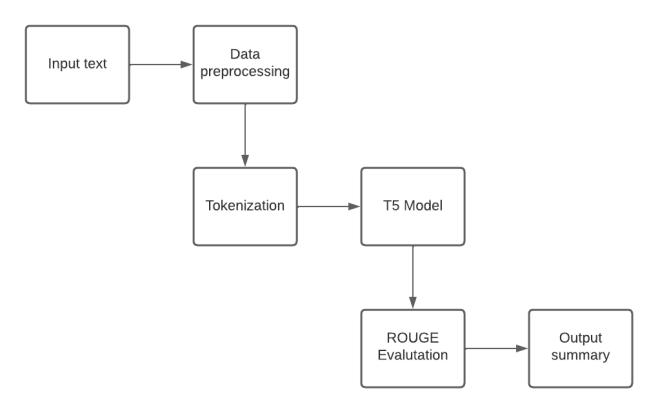
-1: System Architecture
Oursystememploysthecutting-edgeT5transformermodel for effective text summarization. The process starts with data preprocessing, including cleaning and organizing. Tokenizationdividesdataintosmallerunitsforprocessing. The T5 model is then trained to understand input and generateinformativesummaries.
Once trained, it condenses key information in new input documents. Evaluation is done using the ROUGE metric, measuringsimilaritytohuman-writtensummaries.Higher scores indicate better summarization. This architecture leverages T5's power to process input, generate concise summaries, and assess quality, streamlining information extractionforquickercomprehensionanddecision-making.
3.1 Architecture Workflow
This code implements a sequence-to-sequence (Seq2Seq) neural network, leveraging the T5 model, to achieve text summarization.Theprocessencompassesdatapreparation, wherelibrariesareimported,andthe"multi_news"dataset is loaded, split, and organized. Tokenization and preprocessingareemployedtoadaptthedata,utilizingthe "t5-small"tokenizeranddefiningasummarizationprefix.
Thecoreoftheworkflowinvolvesmodeltraining,wherethe pre-trainedT5modelisfine-tunedforsummarization.The Seq2SeqTrainer facilitates this training, optimizing the model's capacity to generate accurate and concise summaries. After training, the model predicts summaries, andRougescoresarecalculatedusingtheRougelibraryto assessthequalityofthesesummaries.
4. EXPERIMENTATION
4.1 Dataset
Thisdataset,multi_newsfoundonHuggingFace,consistsof two columns: a feature column containing news text separatedby"|||||,"andatargetcolumnwithhuman-written summaries. The target column serves as the reference for
The trainer is configured with the necessary components, includingtrainingarguments,tokenizer,datacollator,and datasets for training and evaluation. By calling the train function, the training process begins, during which the modellearnstogenerateconcisesummariesfromthegiven inputdata.Oncethetrainingiscomplete,thetrainedmodel issavedtoaspecifiedpathforlater.Additionally,thetrained modelandadatafilearedownloadedandcopied,enabling further analysis or storage of the results. The model is trained for 10 epochs and 25 epochs and the results are accordinglyevaluated.
5. RESULTS AND ANALYSIS
ROUGE,which stands for "Recall-Oriented Understudy for GistingEvaluation,"isasetofmetricsusedtoevaluatethe qualityofsummariesorgeneratedtextinnaturallanguage processing tasks. It is commonly used in automatic summarizationandmachinetranslationevaluation.Theyare assessedusing ROUGE-1,ROUGE-2,andROUGE-L.ROUGE metricsprovideawaytoquantitativelyassessthequalityof summaries or generated text by comparing them to a reference summary. These metrics are widely used in research and evaluation of text generation models to measuretheireffectivenessincapturingthekeyinformation ormeaningfromthesourcetext.
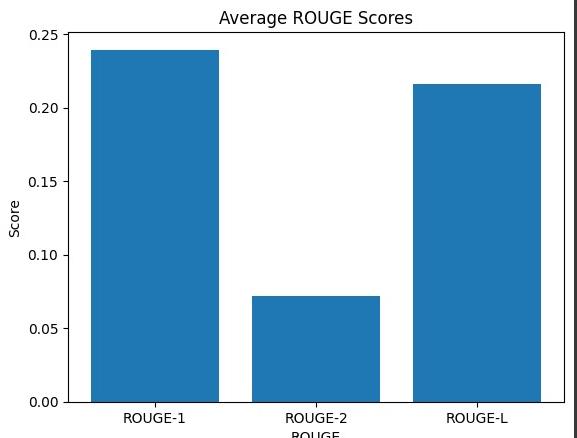
Fig1showstheROUGEscores,itshowsthatoverthespanof 10epochs,themodel'sscoresgetbetter.Notably,thehighest scores are achieved in the order of ROUGE-L, followed by ROUGE-2,ROUGE-1,andROUGE.Thispatternindicatesthe model'sabilitytocreatecoherentandfluentsummarieswhile preservingessentialinformation.Despitethisprogress,the ROUGEscoresremainrelativelylow,whichmeansthereis roomtoimprove.
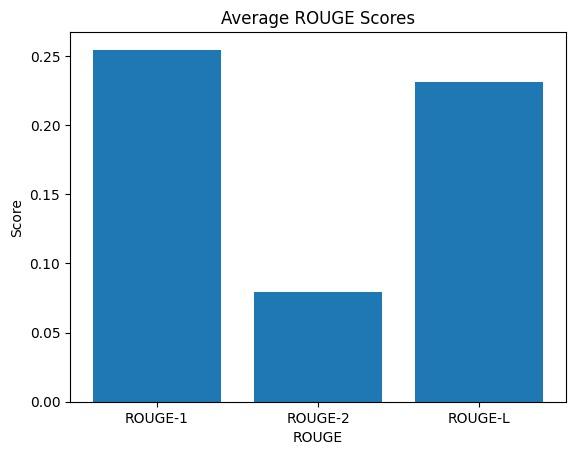
Fig2showsthemodel’sprogresswhenitistrainedwith25 epochs. Throughout 25 epochs, the model's ROUGE scores demonstrateprogressiveenhancement.Thehighestscores areconsistentlyobservedintheorderofROUGE-L,followed byROUGE-2,ROUGE-1,andROUGE.Thispatternhighlights the model's capability to generate summaries that are not onlycoherentbutalsomorefluentcomparedtotheoriginal text,whilepreservingcrucialinformation.
Themodel'simprovementinROUGEscorescanbeattributed to a few key factors. Firstly, longer training exposes the model to a wider range of information, leading to better performance. Additionally, extended training duration enhancesthemodel'sgraspofhumanlanguage,resultingin improved summaries. Furthermore, as the model learns more,itsaccuracyinproducingsummariesthatalignwith human-generated content also increases, ensuring factual correctness.
3. CONCLUSIONS AND FUTURE WORK
Our successful project focused on abstractive text summarization introduces a system powered by the T5 transformer language model. The project highlights the utility of abstractive summarization in automating data extractionandelevatingdecision-makingprocesses.Notably, a comparative analysis reveals that the abstractive model outperforms the extractive counterpart, capturing more comprehensivedetails.
Looking forward, this technology bears the potential to revolutionizehowhumanscomprehendandutilizetextual content, enhancing its accessibility and efficacy across variousdomains.Futureenhancementscouldincludefine-
tuninganddomainadaptationtotailormodelsforspecific industries,enablingmorepreciseandcontextuallyrelevant summaries.Furthermore,addressingthechallengeofmultidocument summarization is crucial for accommodating scenariosinvolvingrelateddocuments,requiringmethodsto generatecoherentsummariesfrommultiplesources.
ACKNOWLEDGEMENTS
Wearedeeplygratefultoourguide,Prof.SasikalaNagarajan fortheirsupportandmentorshipthroughoutthecourseof thisproject.
REFERENCES
[1]AdhikaPramitaWidyassari,SupriadiRustad,GuruhFajar Shidik,EdiNoersasongko,AbdulSyukur,AffandyAffandy,De Rosal Ignatius Moses Setiadi, “Review of automatic text summarizationtechniques&methods",JournalofKingSaud University2022
[2] Khilji, Abdullah & Sinha, Utkarsh & Singh, Pintu & Ali, Adnan&Pakray,Dr.Partha"AbstractiveTextSummarization Approaches with Analysis of Evaluation Techniques", ComputationalIntelligenceinCommunicationsandBusiness Analytics2021
[3] Ilya Sutskever, Oriol Vinyals, Quoc V. Le, “Sequence to Sequence Learning with Neural Networks”, arXiv Cornell University2014.
[4]JakobUszkoreit,“Transformer:ANovelNeuralNetwork ArchitectureforLanguageUnderstanding”,GoogleResearch 2017
[5]AbigailRai,StudyofVariousMethodsforTokenization, ApplicationsofInternetthingspp193-2002020.