“DYNAMIC ANALYSIS OF GRAVITY RETAINING WALL WITH SOIL STRUCTURE INTERACTION”
Dr. Pradeep P. Tapkire1 , Somnath M. Patil2, Atul S. Chandanshive31H.O.D. Civil Dept., N.B. Navale Sinhgad College of Engineering, Solapur, Maharashtra, India-413255
2Research Scholar at N.B. Navale Sinhgad College of Engineering, Solapur, Maharashtra, India-413255
3Lecturer at Solapur Education Society’s Polytechnic, Solapur, Maharashtra, India -413002 ***
Abstract - Gravity retaining walls play a crucial role in civil engineering by providing essential support to control soil erosion and maintain the stability of slopes and embankments. The interaction between these retaining walls and the surrounding soil is a complex phenomenon that becomes even more intricate when subjected to dynamic loads, such as seismic events or sudden impact loads. This study presents a comprehensive investigation into the dynamic behavior of gravity retaining walls, considering the intricate interplay between the wall and the surrounding soil.
The analysis involves a detailed examination of soilstructure interaction (SSI) effects on the dynamic response of gravity retaining walls. A numerical framework based on finite element methods is developed to simulate the coupled behavior of the retaining wall and the underlying soil. The soil is modeled using appropriate constitutive models in software ANSYS 18.0 that capture its nonlinear and dynamic characteristics, while the retaining wall is represented as a rigid or flexible structure, depending on the specific scenario.
Key Words: Gravity Retaining Wall1 , Soil Structure Interaction2,DynamicLoading3
1. INTRODUCTION
Awalldesignedtomaintainthedifferenceinelevationsof the ground surfaces on each side of the wall is called a retainingwall.Thematerialthatisretainedononesideof wall is commonly called as back-fill and the wall is constructed to retain this backfill. Retaining walls are extensively used in connection with railways, highways, bridges, canals and many other engineering works whenever material is to be retained on one side of the wall.
Gravity retaining wall, semi gravity retaining wall, cantilever retaining wall or T – wall and counterfort retaining wall etc. are common types of retaining walls. Besides these, few more types of retaining walls are also used like buttress retaining wall, braced wall, etc. Due to ease of the construction gravity retaining wall (GRW) is commonlyused.
In most of the conditions GRWs are constructed by using plaincementconcrete.Sometimesstoneorbrickmasonry isalsousedforconstructionofGRW.TheGRWislikelyto failinanyoneofthefollowingways:
1. Failureduetosliding
2. Failureduetooverturning
3. Failureduetoexcessivesettlement
4. Failure due to excessive scour of the earth under the base
First three types of failure are most common and hence while designing a GRW, the trail geometry of the crosssection is checked against first three stability criteria viz. sliding, overturning and bearing capacity given in the list.Thecross-section ofGRWisalsocheckedforstrength ofmaterialprovided.
Amongstthethreecriteria,stabilitycriteriaagainstsliding is critical, as the area required to satisfy the criteria is more. This governing factor generally leads to a crosssectionwhichisunderstressed.
A number of retaining wall failures have been reported duringthepost-earthquakereconnaissance.Thestructural response of retaining wall is a complex topic due to the soil structure interaction and uncertainties in the determination of actual earthquake data and soil properties. The frequent earthquake events, followed by the failure have increased the demand on the seismic designofretainingwalls.Theclassicearthpressuretheory of Coulomb (1776) and Rankine (1857) is widely used to determinethelateralearthpressureontheretainingwall.
1.1 Aim of Study
Tofindoutthefeasibleandeconomicalcrosssectionarea of Gravity retaining wall for Dynamic loading considering soilstructureinteraction.
2. Literature Review
Retainingwallsarenotanewconcept.Wallsusedtoretain massesofsoilhavebeenaroundforthousandsofyearsand

were used in virtually every civilization in history. Geotechnical engineering is a branch of civil engineering that deals with soils as engineering materials; a retaining wallisanygeotechnicalstructurewhichisusedtoretaina massofsoilthatwouldotherwisetendtomovedownslope duetogravityandstressesactingwithinthesoil(Terzaghi etal,1996).
The contribution has been done by the researchers to optimize the design of earth retaining structures and also inthedirectiontodevelopanearthretainingsystemusing different innovative concepts. The researchers applied different optimization techniques and adopted a nonconventional system for different types of retaining walls like reinforced concrete structure obtained according to Richard and Elms (1979) analytical model, Some of these research contributions of researchers are presented as follows,
S. Al-Homoud Jordan And lrbid, Jordan [1] studied The behavior of earth retaining structures during earthquakes is considered an important design problem in seismic regions, One such structure is the gravity retaining wall, which uses its mass for stability against failure. Field observations indicate that, where there has been significant movements of gravity retaining walls during earthquakes, rotational displacement (or tilting) of these wallshasbeenimportant.
Vijay K. Puri[2]observed that design of retaining walls in seismic areas poses acomplex problem,Forsafe designof retaining walls in seismic areas, the calculation of static and dynamic earth pressure behind the retaining walls is the firstrequirement.Realisticcalculationof displacement of the retaining wall is an equally important aspect. The paper presents a simple method for calculation of static and dynamic active force on the rigid retaining wall. The methodfollowsthepseudo-staticapproachofanalysisand includes the effects of cohesion of the backfill and the frictionbetweenthebackfillandthewallface.
Aram M. Raheem and Mohammed Y. Fattah[3 ] used a numerical method through finite element(FEM) with two models:Elastic&EquivalentLinearwasusedtoinvestigate the seismic behavior of retaining wall supporting saturated, liquefiable, cohesionless backfill soil. It was shown that the Equivalent model gives more reasonable results and the liquefaction zones concentrated in the passive side more than the active side. Max. horizontal displacement at the top of the wall reaches 0.67m while vertical displacement increased in the range (66-116)% with the wall increasing in dimensions. Both pore water pressure/horizontal total stress increased with time/dimensionsintherange(37%),(200%)respectively.
Md. Abu Taiyab ; Md. Jahangir Alam ; and Md. Zoynul Abedin[4]observed that the lateral spreading of backfill soilcausedbydisplacementofgravity-typequaywallsisa
major concern for geotechnical engineers. This paper evaluates the efficiency of a technique for mitigation of damagetoquaywalls,whichinvolvesdensificationofloose sandaroundthetoe.Thebeneficialandunfavorableeffects ofdensificationofsandofdifferentlocationsofthegravitytype quay walls are also answered. For these purposes, numerical simulations (using a finite-element code) and shake table tests were conducted. From numerical simulations and model tests, it was observed that the displacement of a gravity-type quay wall occurred mainly becauseofshearstraininthefoundation.
KAVEH AND M. KHAYATAZAD[5] Inthepreviousstudies, the optimization of the retaining walls has been accomplished by quasi-static methods; however, in this paper a pseudo dynamic approach is utilized. Here, by optimizing a cantilever retaining wall via a recently developed method, so-called Ray Optimization, the design controllingparametersareinvestigated.Ray Optimization method is a multi-agent optimization method which is inspiredfromtheconceptoflightrefraction.Inthismethod by moving the agents to new positions, the optimal solutionisfound.
Abhay Tripathi And Tarik Salman[6] This paper presents a comparison of the various methods of analysis of retaining wallsunder seismicloads, which is considered tobeverycomplex.Asthesoil-structureinteractionduring the earthquake is very complex, the most commonly used methods for the seismic design of retaining walls are the Pseudo static method, Seed and Whitman method and MononobeandOkabemethod.
Kamal Mohamed Hafez Ismail Ibrahim[7] Inthisstudy plain strain numerical analysis is performed using Plaxis dynamic program where prescribed displacement is applied at the bottom boundary of the soil to simulate the applied seismic load. It is also found that seismic wall displacement is directly proportional with the positive angle of inclination of the back surface of the wall, soil flexibility and with the earthquake maximum ground acceleration. Seismic wall sliding is dominantandrotation isnegligibleforrigidwallswhentheratiobetweenthewall height and the foundation width isless than 1.4, while for greaterratiosthewall becomesmoreflexibleandrotation (rocking) increases till the ratio reaches 1.8 where overturningissusceptibletotakeplace.
Ms. Patil Swapnal[8] In theproposedstudy,the effecton gravity dam has been examined using finite element analysissoftwareANSYS14.Thegravitydamiscompletely resting on soil media and surrounded by soil media. The relevant amount of soil around and bottom of the gravity dam has been modeled to simulate the in-situ conditions. Thegravitydamhasbeenanalyzedusingdynamicloading in transient analysis using Imperial Valley (1940) earthquake record are included. Analysis of the gravity dam has been carried out and the influence of soil
properties has been studied at the region of transverse sections, which exhibited the response in terms of stress anddeformationwithsignificantdifference.
The researchers have been analyzing various structures usingsoilstructureinteractionthevariousresearcherhave focused on soil structure interaction along with retaining wall. But the soil structure interaction along with Gravity Retaining Wall is untouched/ rarely touched. Considering thisasgapinresearchertheproblemisformulatetostudy GravityRetainingWallusingSoilStructureInteraction.
Inthisresearch,agravityretainingwallwithaverticalface retaining horizontal backfill is taken into account. For analysis,backfillsoilwithadensityof18 KN/m3andM25 grade concrete are both taken into account. Fig. No. 1 depictsthecross-sectionoftheGRWunderstudy.Analysis is done on the variation in dimensions relative to their heights. In this study, the system is discretized into two substructures, the GRW section without and with SSI, in ordertoestablishtheresponseformodelingGRWsoil.The gravity retaining wall portion in this instance is analyzed usingANSYS18.0.
3.1 Profile and Material considerations for the
In the properties of Gravity retaining wall, two consideredprofileofretainingwallandmaterialproperties are mentioned. The both profiles of retaining wall are shown in Fig No.1&2 Material properties of retaining wall [12],soilismentionedinTable2.
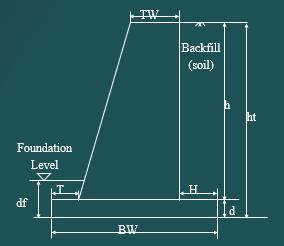

Table1:Geometry parameters of GRW
Table2:Thematerial properties of GRWand Soil
4.Research Methodology
As per researcher methodology various parameters are considered for analysis of GRW with & without SSI. As mentioned in fig. no. 4.4. Two different profiles with 8 differentheightsareconsideredforDynamicAnalysiswith &withoutSSI.
Deformation & Stresses are obtained from the analysis fromeachcaseconsidered
The obtained results are tabulated as per given in Appendix B. Variation of parameters are plotted and discussedinnextchapter.
4.1 Validation of problem solution by software
In this problem, Dynamic Analysis of GRW with and withoutsoilstructureinteractionsystemisanalyzedusing simplified analysis of fundamental response is validated withANSYSSoftwareresults.
Deformation is obtained by SOM approach calculation at differentloadofGRWarecomparedwithresultsobtained byAnasys18.0Software.
After comparing the results, it is observed that SOM approachandAnsys18.0resultsarepracticallysimilar.
Hence, the formulation which is adopted for the farther study to solve GRW-soil interaction and effect for calculatingdeformation.
5. Results
ThecurrentprojectworkistostudytheeffectofDynamic analysis on Gravity retaining wall with SSI as per flow of project mentioned in the previous chapter. Profiles of gravity retaining wall and parameters considered for the Dynamic analysis of gravity retaining wall with SSI as discussedinpreviouschapter.
Gravityretainingwallwithdifferentgeometryandheights are designed governed by stability criteria dimensions of gravity retaining wall for various Heights are calculated using worksheet. which are separately developed for design of gravity retaining wall with considering horizontal backfill as a loading case (details given as per appendix A). As per flow of proposed study two earthquake sample cases are considered. The various Heights with different geometry with and without consideration of soil structure interaction along with different earthquakecasesaresolvedusing finite element package of ANSYS. Maximum and minimum of the deformationand stressesobtainedfor eachcase,the nondimensional variations are plotted and discussed in the currentchapter.
5.1 Parameter Considered for Research Work
Fig.5.3 Flow Chart of the research

5.2 Variation of Weight and Height Ratio
Aspreviouslyindicated,stabilitycriteriaareusedtobuild spreadsheetsforgravityretainingwalls.Ithasbeennoted that the stability against sliding criterion (appendix A) directs the stability criteria for the design of gravity retainingwalls.
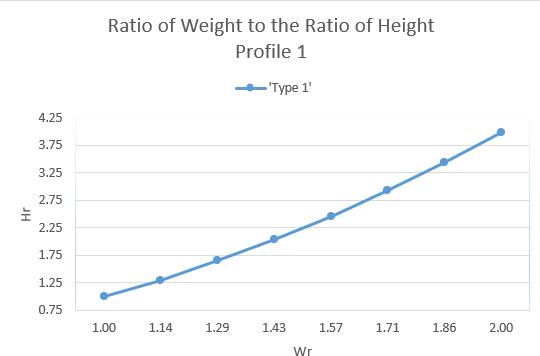
Plot G1 shows how the cross-section area of the GRW varies with varied Heights. Two alternative terms are createdforeachprofiletoallowforgeneralization,andthe resultsareasfollows.Thephraseisdefinedwithreference to the situation analyzed, which is a gravity training wall with a height of 3.5 meters. The height ratio (Hr) is the comparison of the height of the gravity retaining wall to the height of the gravity retaining wall taken as the referencecase.
Ratio of cross-sectional area The definition of Ar is the areaincross-sectionbetweenagravityretainingwalland itscross-sectioninthereferencescenario.
Weight ratio Wr is defined as weight of gravity retaining wall to the weight of gravity retaining wall of reference case
Plot G1 shows that, height ratio and wight ratio increases simultaneously. They are directly proportional to each other.

5.3.1 Variation of deformation percentage of GRW as per dynamic loading (Kobe)considering SSI with height ratio for different types
The variation of the Deformation percentage of gravity retaining walls as per dynamic loading (Kobe) with and withoutsoilstructureinteractionareconsidered&plotted againstHr(Asmentionedabove)referringtoTableno.4
TheDeformationsareobtainedasperconsidereddynamic loading case, only retaining wall and retaining wall with soil mass (considering soil structure interaction). Are analyzedusingFEMpackageaspercasesmentionedinthe fig.5.1. To understand the effect of dynamic loading and SSI deformation percentage is obtained with reference to GRW without SSI and results are tabulated and given in Tableno.4
Table No 4 - Variation to Deformation percentage of GRW with SSI considering against Height ratio (Hr) for various profiles dynamic loading (Kobe)
Graph G2:Variation to Deformation percentage of GRW with SSI considering against Height ratio (Hr) for various profiles dynamic loading (Kobe)
Followingobservationsarenoted,
Fromaboveplotprofile,showingvariationofdeformation percentagewhichissubstantiallyreducedascomparedto withoutSSI.
The deformation percentage including all profile is only 2.56percentageascomparedtowithoutSSI(thatis97.44 percentagereductionisobserved.)
For Profile I shows variation of deformation percentage increases up to maximum value that is 2.56 percentage. There after deformation percentage increases up to Hr 1.57. Afterwards the variation in Deformation percentage isabruptlydecreases.
ForProfileIshowMaximumdeformationpercentageatHr 1.57.
5.3.2 Variation of deformation percentage of GRW with soil mass as per dynamic loading (Kobe) with height ratio for different types
The variation of the Deformation percentage of gravity retaining walls as per dynamic loading (Kobe) with and withoutsoilstructureinteractionareconsidered&plotted againstHr(asmentionedabove)referringtoTableno.5
The Deformation are obtained as per considered dynamic loading case, only retaining wall and retaining wall with soil as a whole mass (soil+ retaining wall as whole structure). Are analyzed using FEM package as per cases mentioned in the fig.5.1. To understand the effect of dynamic loading and SSI deformation percentage is obtained withreferenceto GRWwithoutSSI& results are tabulatedandgiveninTableno.5
Table No.5 Variation of Deformation percentage of GRW with SSI with whole soil mass considering against Height ratio (Hr)for various profiles dynamic loading
The Deformation are obtained as per considered dynamic loading case, only retaining wall and retaining wall with soil mass (considering soil structure interaction). Are analyzedusingFEMpackageaspercasesmentionedinthe fig.5.1.TounderstandtheeffectofdynamicloadingandSSI deformationpercentageisobtainedwithreferencetoGRW withoutSSI&resultsaretabulatedandgiveninTableNo6.
Table No-6 Variation to Deformation percentage of GRW with SSI considering against Height ratio (Hr) for various profiles dynamic loading (IS Code)
GraphG3:Variation of Deformation percentage of GRW with SSI with whole soil mass considering against Height ratio (Hr)for various profiles dynamic loading (Kobe)
Followingobservationsarenoted,
Fromaboveplotprofile,showingvariationofDeformation percentage which is substantially reduced as compared to withoutSSI.
The Deformation percentage including all profile is only 2.55 percentageascompared to without SSI(that is97.45 percentagereductionisobserved.)
1. For Profile I show variation of Deformation percentage increases up to maximum value that is 2.55 percentage. There after Deformation percentage increases up to Hr 1.57. Afterwards the variation in Deformation percentage isabruptlydecreases.
2.ForProfileIshowMaximumDeformationpercentageat Hr1.57.
5.3.3 Variation of deformation percentage of GRW as per dynamic loading (IS Code) considering SSI with height ratio for different types
The variation of the Deformation percentage of gravity retaining wall as per dynamic loading (IS Code) with and withoutsoilstructureinteractionareconsidered&plotted againstHrreferringtotableno.6
Graph G4: Variation to Deformation percentage of GRW with SSI considering against Height ratio (Hr) for various profiles dynamic loading (IS Code)


Followingobservationsarenoted,
Fromaboveplotprofile,showingvariationofDeformation percentagewhicharesubstantiallyreducedascomparedto withoutSSI.
The Deformation percentage including all profile is only 2.06 percentageascompared to without SSI(that is97.94 percentagereductionisobserved.)
1. For Profile I show variation of Deformation percentage increases up to maximum value that is 2.06 percentage. There after Deformation percentage increases up to Hr 1.57. Afterwards the variation in Deformation percentage issuddenlydecreases.
2.ForProfileIshowMaximumDeformationpercentageat Hr1.57.
5.3.4 Variation of deformation percentage of GRW with Soil mass as per dynamic loading (IS Code) considering SSI with height ratio for different types
The variation of the Deformation percentage of gravity retaining wall as per dynamic loading (IS Code) with and withoutsoilstructureinteractionareconsidered&plotted againstHr(Asmentionedabove)referringtotableno.7
The Deformation are obtained as per considered dynamic loading case, only retaining wall and retaining wall with soil as a whole mass (soil+ retaining wall as whole structure). Are analyzed using FEM package as per cases mentioned in the fig.5.1. To understand the effect of dynamic loading and SSI Deformation percentage is obtained with reference to GRW without SSI & results are tabulatedandgiveninTableNo.7.
Table No.7 Variation of Deformation percentage of GRW with SSI with whole soil mass considering against Height ratio (Hr) for various profiles dynamic loading (IS Code)
1. For Profile I show variation of Deformation percentage increases up to maximum value that is 2.05 percentage. There after Deformation percentage increases up to Hr 1.57. Afterwards the variation in Deformation percentage issuddenlydecreases.
2.ForProfileIshowMaximumDeformation percentageat Hr1.57.
6. CONCLUSIONS
6.1 Variation of cross-section area of GRW with Heights
1)Fromthevariationofheightratioagainstarearatioitis concluded that the area of cross-section of GRW increases withincreaseinheightupto4timesforHR=2
2)ProfileIshowshighercross-sectionareaforHR>1.57
6.2 Variation of Deformation Percentage of GRW with Height ratio
1)From the tabulatedresultand plots it is concludedthat due to consideration of SSI the deformation of GRW for horizontalbackfillissignificantlyreduces.
2) the deformation percentage varies withheight ratio for profileIhigherthanotherprofile
3) Profile I show 2 % of deformation as compared to withoutSSIforlowerheightratio,forhigherheightratioit is reaches to undeformed condition as compared to withoutSSI
6) Considering profile I maximum 1.85 %, deformation % ofwithSSIisobserved
7) the aboveconclusion indicates that thesoil massactive along with GRW significantly affect the deformation. All together maximum 1.85% deformation is observed for consideredprofileincludingallheights.
REFERENCES
Graph G5: Variation of Deformation percentage of GRW with SSI with whole soil mass considering against Height ratio (Hr) for various profiles dynamic loading (IS Code)
Followingobservationsarenoted,
Fromaboveplotprofile,showingvariationofDeformation percentage which is substantially reduced as compared to withoutSSI.
The Deformation percentage including all profile is only 2.05 percentageascompared to without SSI(that is97.95 percentagereductionisobserved.)
[1] AZM S. AL-HOMOUD (1994) "INSTABILITY AND STABILIZATION OF AN EMBANKMENT ON THE IRBIDAMMAN HIGHWAY IN JORDAN "Civil Etzgineerit~g Department,JordanUniversityofScienceandTechnology, P.O.Box3030,Irbid,Jordan.
[2] Vijay K. Puri. (2011) " DYNAMIC EARTH PRESSURE AGAINST RETAINING WALLS.", Professor, Civil and Environmental Engineering, SIU Carbondale, IL, USA , puri@engr.siu.edu Proceedings of Indian Geotechnical Conference December 15-17,2011, Kochi (Invited Talk5.).
[3] Aram M. Raheem and Mohammed Y. Fattah (2008) “ANALYSIS OF RETAINING WALL SUBJECTED TO EARTHQUAKE LOADING."Journal of Kirkuk University –ScientificStudies,vol.3,No.1,2008
[4] Md. Abu Taiyab ; Md. Jahangir Alam ; and Md. Zoynul Abedin (2010) “SEISMIC ROTATIONAL STABILITY OF WATERFRONT RETAINING WALL USING PSEUDODYNAMIC METHOD”, International Journal of Geomechanics10(1)DOI:10.1061/(ASCE)15323641(2010)10:1(45)
[5] A. KAVEH AND M. KHAYATAZAD (2014) “OPTIMAL DESIGN OF CANTILEVER RETAINING WALLS USING RAY OPTIMIZATION METHOD."IJST, Transactions of Civil Engineering,Vol.38,No.C1+,pp261-274.
[6] Abhay Tripathi and Tarik Salman (2014) “REVIEW OF ANALYSIS OF RETAINING WALL UNDER STATIC AND SEISMIC LOADING."IJSRD - International Journal for ScientificResearch&Development|Vol.2,Issue07,2014| ISSN(online):2321-0613.
[7] Kamal Mohamed Hafez Ismail Ibrahim (2011) “SEISMIC DISPLACEMENT OF GRAVITY RETAINING WALLS."HBRCJournal.
[8] Ms. Patil Swapnal V. (2015), “EFFECT OF SOIL STRUCTURE INTERACTION ON GRAVITY DAM”, Assistant Professor, Dept. of Civil Engg., JSPM’s Imperial College of Engineering&Research,Pune