Textile Industrial Wastewater Treatability Studies by Soil Aquifer Treatment in Conjunction with Jackfruit Peel as Adsorbent

Yogesh
K N1, Dr. Nagarajappa. D. P2, Mr. Sateesh G Muttagi31PG Student, Department of Civil Engineering, UBDT College of Engineering, Davanagere, Visvesveraya Technological University, Belagavi – 590018, Karnataka, India
2Professor, Department of Civil Engineering, UBDT College of Engineering, Davanagere, Visvesveraya Technological University, Belagavi – 590018, Karnataka, India
3Research scholar, Department of Civil Engineering, UBDT College of engineering, Davanagere, Visvesveraya Technological University, Belagavi – 590018, Karnataka, India ***
Abstract - Water is an important fundamentalbasic needfor the living organisms. Water resources around the world getting pollution due rapid growing of population and industrialization. It is not only the depletion of quantity but also the quality is deteriorating due to improper discharge of untreated industrial waste waters andsewage generated from the community. Better wastewater management requires many treatment methods. This research employs SAT System to recycle wastewater for potable and non-potable usage. SAT system was tested on textile industry effluent under different experimental circumstances. The NaturalAdsorbent like Jack fruit peel powder were tested in clayey andsilty soils. In silty soil, which gives good removal efficiency.
Key Words: SAT,Jackfruitpeel,Copper,Zinc,Chromium.
1. INTRODUCTION
Water has its own importance and humanity’s most vital resource. Population growth Industrialization and urbanization are creating dense human settlements that pollutethewaterIndiagenerates6.2millionm3ofuntreated Industrialwastewatereveryday,yetbarely20%and60% ofhouseholdandIndustrialwastewaterIndustrialeffluent pollutes waterways. Men and their actions polluted the aquatic environment, harming the ecology and human’s Industrialeffluents,urbanrunoff,agriculturalfertilizer,and animalfeacesarethewaterpollutantsTheseactivitiesraise physio-chemicalparametersoverpermissiblelimits,altering water quality. lather, printing, textile, sugar, and other industries.
This industry's waste water contains more colored contaminants and certain haram compounds that impair humanhealth,theenvironmentIndustrialeffluentcontains heavy metals such as copper, zinc, nickel, chromium, and others, which are harmful to aquatic life and the environment. Textiles industries generates a lot of wastewaters it contains the combination of dyes solvents heavymetalsandorganiccompoundsfromdyeing,printing, finishing, and washing. Wastewater flow into waterways may pollute soil, water, and aquatic habitats. Many
wastewaters treatment process like electrocoagulation reverse osmosis and other techniques are used SAT (Soil AquiferTreatment)Istheoneofthewastewatertreatment techniquesisusedfortreatingofthistextileindustrialwaste waterbecausethisprocessgivesmoreefficientresultsinthe treating of wastewater and removing of heavy metals in industrialwastewater.
SATartificiallyrechargesgroundwateraquifers.Controlled soil percolation adds water to groundwater. Soil aquifer treatment either artificially augments groundwater to removefreshwaterlaterorpreventssaltwaterorpollutants fromentering.Percolationallowswatertoentertheaquifer and mix and maybe undergo additional physical and chemicalprocesses.
Adsorbentsremoveheavymetals,contaminants,andtoxic chemicals from environmentally harmful liquid or gas substances. (natural adsorbents) are made of natural materials like natural fibers, volcanic rocks, soils, plant biomass, agricultural and industrialwastes,animal shells, Microalgae,andFungalbiomass, coconutshell,Scraptypes, bark,Fruitwastesandothertannin-richmaterials.Sawdust andotherwoodtypematerials,ricehusk,fertilizer,Flyash, Sugar industry wastes, chitosan, Blast furnace slag, petroleumwastes
2. MATERIALS AND METHODOLOGY
2.1 Collection of Soil Samples
Soilsampleswerecollectedfromthetwodifferentlocation thatisinandaroundBangalore.SiltSoilwerecollectedfroman opengroundinNagavaraandtheClayeySoilwascollected from the lake in Nagavara. These two Soil samples were testedandthenintroducedinthecolumns.
2.2 Preparation of Adsorbent
Collectionofjackfruitpeelsatlocalfruitshopsitiswashed fromthe tap water firstafter to remove extra fleshly parts fromthepeelsandtocleanthepeelsfromthedistilledwater afterthatitcandriedunderthesunlightuntilitisreadyfor
making thepowderafterwordsgrindthepeelsitbecomes thepowder.
2.3 Experimental Setup For SAT
The experimental setup involves a PVC column with 1.5 metersinlengthandadiameterof6inches.Atthebaseofthe column,afinemeshwithaporesizeof60µmisprovided The bottomofthecolumnisdesignedinfunnelshapetofacilitate the collection of treated water. A regulator is to maintain the flowofwastewaterinthecolumn.Tomaintainconsistency,a pondingdepthof35cmismaintained,andanyexcesswateris guidedoutofthe columnthroughanoverflowsystem.The column,includingthemesh,isthoroughlycleanedaftereach trial.
2.4 Collection of Wastewater
ThewastewaterisusedfortheSATsystemiscollectedfrom thetextileindustryislocatedinKareemsablayoutofPeenya industrialareaBangalore.
3 RESULTS AND DISCUSSIONS
TheexperimentiscarriedtodeterminetheefficiencyofSAT withandwithoutusingadsorbentsforthisstudytwotypesof soil isused theyare Clayeysoil and Siltysoil andJackfruit peel powder used as adsorbent. The textile industrial wastewaterusedinthestudywasobtained fromaspecific industrialsource.
The results obtained by experimentation and efficiency of SAT with and without using adsorbents can be discussed below.
As the table 2 shows the removal efficiency by the SAT systembyonlysiltysoil.Theremovalefficiencyofchromium is 51.11%, Copper 50.30% and Zinc of 54.167% by above resultstheperformanceofSATbyonlysiltysoilgivesZincis themaximumremovalefficiency
Table3showstheperformanceof SATby onlyclayeysoil withoutusinganyadsorbents.inthistheremovalefficiency ofChromium.CopperandZincis8.88%,30.61%and6.67% ofremovalefficiency.
- -
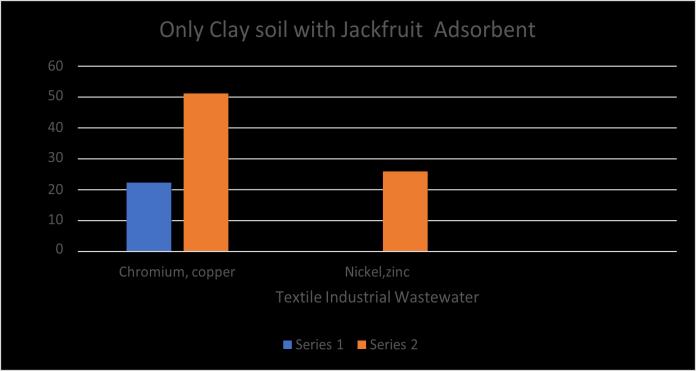
TheEfficiencyofSATbytheclaysoilwithjackfruitadsorbent showed the removalof chromium about 22.22% copper 51.02%andzincof25.8%bythisresultsistabulatedintable 4.9andtherespectedgraphisplotedforthevaluesinfig4.6 by this combination of clay soil and jack adsorbent it removes maximum amount of 51.02% of copper. These resultsareshownbygraphbelow.

Table
efficiencyof SATby silty soil
jackfruit adsorbenttheremovalefficiencyisChromium64%,Copper 81.63% and Zinc is 63.33%. and these results shown in graphbelow.
3 CONSLUSION
Clayey soil with adsorbent shows less removal efficiency in removing heavy metals from wastewater.
Silty soil with jackfruit peel as adsorbent shows maximum removal efficiency in removing heavy metalssuchascopper81.64%,Chromium64%and Zincof63.33%.
Jackfruit peel adsorbent have the capacity to remove the heavy metals present in industrial wastewaterbySAT.
Both silty soil and clayey soil are introduced into SAT System without conjunction with adsorbent. Silty soil gives more efficiency than clayey soil in removal of heavy metals in the wastewater along with-itadditionoftheadsorbentwillincreasethe efficiency.
4 REFERENCES
1. Shivaleela Chavan, Nagarajappa, D P, Shrikanth Chavan“TextileMillWastewaterTreatmentbySAT System in Conjunction with Natural Adsorbents” InternationalJournalSciencesandResearch(2017).
2. Saroj K. Sharama and Maria D. Kennedy “SAT for Wastewater Treatment” International Biodeterioration and Biodegradation Vol 119, (2017)
3. Rekha. K.H. Nagarajappa D P, Lokeshappa B “Deportation of Wastewater Utilization SAT with Adsorbent, International Journal of Management (2018).
4. Sana Khan and Abdul Malik “Environmental and Health Effects of Textile Industry Wastewater”. EnvironmentalDeteriorationandHumanHealthpp 55-71(2013).
5. P.Sharmila.PPSaradhi.“Potentialof theAquatic Macrophytes for Removing the CONTAMINANTS From the “ Environment Science Technology 39 (2009).
6. Fakayode. S.O. “Impact of Industrial Effluents on WaterQualityofAlaroRiverinLabadm”.(2005).
7. Harish Naik and Nagarajappa D. P. “Rural Waste water Treatability Studies by Soil Aquifer Treatment in Conjunction With Mangifera Indica” GRD Journals Research and Development Journal forEngineeringVolume02(2017).