
Design & development of Insect trapper for selected crops in Vidharbha region
Sarang Gedam1, Minhaj Ahemad Rehman2Department of Mechanical Engineering, St. Vincent Pallotti College of Engineering, Nagpur, India ***
Abstract - This paper presents a solar-operated insect trapper as an eco-friendlysolutionforreducingthepopulation of insects, such as mosquitoes and flies, in outdoor areas. The trapper is designed to attract insects with its ultraviolet (UV) light source and capture them, which pulls them into a container where they can be safely disposed of. The trapper is powered by a solar panel, making it self-sufficient and independent of external power sources. The solar panel charges a battery during the day, allowing the trapper to operate continuously throughout the night. The trapper is equipped with a light sensor, which automaticallyturnsonthe UV light at dusk and turns it off at dawn, further increasing its energy efficiency. The design and construction of the trapper are straightforward, and its materials are easily accessible, making it a cost-effective option for households and communities. The performance of the trapper was evaluated through field tests, demonstrating its effectivenessinreducing the population of insects in outdoor areas. This type of insect control is a safe alternative to harmful pesticides Overall, the solar-operated insect trapper presents a sustainable and efficient solution for controlling insect populations while minimizing the environmental impact.
Key Words: Solar light trap, Insects, Crops, Model

1. INTRODUCTION
A solar-operated insect light trap is a device designed to attractandcaptureinsectsusingacombinationoflightand solarpower.Itisanenvironmentallyfriendlyandenergyefficient way to control insect populations, particularly in agricultural or outdoor settings. The device works by emittingaspecificwavelengthoflightthatattractsinsects, which then fly into the trap and are captured. The solar panel powers the light source, making it independent of electrical grid systems and reducing the carbon footprint. This type of insect control is a safe alternative to harmful pesticidesandcanbeusedforavarietyofinsects,including mosquitoes,moths,andotherflyingpests.However,someof these result in monetary losses. The significant pests that infestcrops.
In addition, sucking insects include thrips (Scirtothrips dorsalis), aphids (Aphis craccivora), leafhopper/jassids (Empoascakerri),andmealybugs(Phenacoccussolenopsis) are also damaging crops as pests and vectors of virus diseases. The solar-operated insect light trap is a great solutionforthoselookingtocontrolinsectpopulationswhile
also promoting sustainable practices. In this paper, we presentthedesign,construction,andevaluationofasolaroperated insect trapper, highlighting its efficiency and effectivenessinreducingthepopulationofinsectsinoutdoor areas. The solar-operated insect trapper represents a sustainableandeco-friendlysolutionforinsectcontrolthat addressestheenvironmentalandhealthconcernassociated withtraditionalinsectcontrolmethods.
1.1 Study area
The study was conducted in a farm at Matkazari village, Nagpurdistrict,duringwintertothesummerseason,2023. Wheat,wassownin2acrefield.Thedurationofthecropis around100to160days.Thetrialswereconductedfor 10 days.Inthestudyarea,.Theexperimentalfieldareaforeach trapwas3600m2,andthetotalfieldareawasabout2acre, and no other field crops were grown surrounding the experimentalfield.Thesitewasfreefromexistingartificial lightingatleast100mradiustoensurenoinfluencebyother lights.Themanual weeding wasdoneonetimebeforethe experiment, and no insecticides were applied during the trials.
1.2 Selection of Light
When designing a solar-operated insect trapper, selecting the appropriate light source is crucial to its effectiveness. Herearesomefactorstoconsiderwhenselectingthelight source for a solar-powered insect trapper: wavelength, Intensity,EnergyEfficiency,Durability,andCost.Also,four differentcoloredLedlightssuchasultraviolet,blue,green, andred withdifferent frequenciesweretested.TheLEDs’ colors and wavelengths were selected based on the literaturereview.
2 LITERATURE REVIEW
AccordingtoRietaGolsandJeffrey 2023assumesthatinsect herbivores play a major role in shaping not only the evolutionofplanttraitsbutalsoinhavingsignificantimpacts onplantfitness.Theprimarybioticbarriertotheproduction ofvegetablesinIndiaisinsectinfestations.Manyofthemnot only cause direct harm but also serve as viral vectors. diseases. Vegetable crop losses of between 30 and 40 percent have been reported. Vegetable crops are greatly impactedbyinsectinfestationsandproductionloss. Butit damage the crops and encured heavy loss to the farmers
.Therearenumberofstudiesavailableondifferenttypesand applicationofvariousmethodsforinsecttrappingRecently developed light-emitting diode (LED) technology was appliedtostandardinsect-vectortrapstoproduceamore effectivelightingsystemCohnstaedt,etal(2008).Recently, there has been an epidemic of gall midge (Asphondylia capparis), which is a minor pest that is progressively becomingaregularprobleminchilli,capsicum,andbrinjal. AndhraPradeshandKarnataka,aswellasinbrinjal.Inthe stateofChattisgarh.Variousspeciesofmealybugsincotton, vegetables,andpapayahaveincreasedinseverityinvarious sectionsofthecountryand havebecomeindicatorinsects forcontemporaryecosystemsasaresultofmodestchanges inclimateoverthelastdecade.Termites,whitegrubs,hairy caterpillars,grammepodborers,andSpodopteralituraare amongthenationalandinternationalpolyphaguspeststhat arebecomingmoresevereandwideningtheirhost-horizon (Raietal.2014).
Campbell and. Hanula 2007 suggested Malaise traps and colored pan traps for collecting flower visiting insects HardingJr,etal.(1966)suggesteduseofblacklightlampsfor seasonalabundanceofimportantinsectpestspecies
For Lepidoptera, Hemiptera, Hymenoptera, Odonata, and Diptera, mercury light was more effective, whereas black lightwasmoreeffectiveforColeoptera,Orthoptera,Isoptera, andDictyoptera.Coleopteranswereshowntobeattractedto blacklightandmercuryinacomparableway.Whenallbug traps were taken into account, the average temperature revealed a substantial association with coleopterans, lepidopterans,andhemipterans..(Ramamurthy2010)
Thisimpliesthatfarmingmethodsshouldbereconsidered forreorientation,andvegetablesshouldbeprioritisedwith properinsectpestmanagementstrategies.Inthiscontext, the Integrated Pest Management (IPM) system was developed in response to the need for a long-term crop protectionstrategyinthefaceofrisingpesticideuseandthe negative effects of pesticide residues on the environment (Rai2014)
Fromtheabovediscussionitisclearthatstillthereisaneed todesignalowcostinsecttrappingsystemforagricultural field.Forthiswehavedevelopansolarbasedlighttrapfor insectinagriculturefield,followingarethestepsfollowedin developingthismodel.
3. DESIGN & FABRICATION OF PROPOSED MODEL
ThesolarLEDinsecttrapcomprisesaSolarpanel,storage battery, LED array, insect collecting tray, PVC legs, sticky pads.SolarPanelgenerateselectricityduringthedaytime, storedinabattery,andstoredelectricitycanbeexploitedto capturetrapduringthenighttime.Thesolarpanelwasfixed ontheheadofthebatteryunitwithasteelplate’shead.The product can be accessible to farmers. The trapper utilizes Arduino technology for automation and improved
functionality. Additionally, sticky pads can be used to enhancethetrapper'seffectivenessbycapturingagreater number of insects in day time. The solar panel's direction can be manually adjusted to follow the sun's movement. Moreover, the trapper features a sensor-based UV light operationthatturnsonautomaticallyaftersunsetandturns offduringtheday.Thistrapperoffersdualefficiency,asit utilizes UV light to attract insects at night and sticky pads during the day to capture insects. The product can be adjustable according to the height of crops. The solaroperated insect trapper consists of a tall pole with an adjustable height of 1250-2000mm. The pole supports a solarpanelthatcanbemanuallyrotatedtofacethesunfor maximum efficiency. The solar panel powers an Arduinobasedsystemthatautomatesthetrapper'sfunctionality.At the top of the pole, a UV light is mounted, which attracts insectsduringthenight.BelowtheUVlight,thereisasticky padthattrapsinsectsthatflyintoit.Thestickypadcanbe easily replaced when it becomes full. The trapper also featuresasensor-basedsystemthatautomaticallyturnson the UV light after sunset and turns it off during the day, optimizing its energy use. The trapper is designed to be easily accessible to farmers and gardeners, and its simple design requires minimal maintenance. Additionally, the trapper's efficiency is enhanced by the use of sticky pads, whichcaptureagreaternumberofinsectsthantraditional traps.Overall,thisconceptualsolutionforasolar-operated insect trapper offers a sustainable and effective way to control pestswhile minimizingenvironmental impactand reducingcosts.

4. MATERIALS USED & PURPOSE
Table1givesdetailsofmaterialusedforthemodel
Table -1: Material used
Plasticcontainer
LEDorfluorescentlight source
Solarpanel
Rechargeablebattery
Insectattractant
StickyPads
Fortrappinginsects
Toemitlight
Forpoweringthelight source
Forstoringsolarenergy
Toattractinsects
Topreventtheescapeof trappedinsects.
5. SUITABILITY OF TRAPPER IN FOLLOWING CROPS
5.1 WHEAT
1. UV Light Traps:UVlighttrapsuseultravioletlight to attract insects, which are then captured in a containerornet.Thesetrapsareeffectiveformany types of insects, including aphids, which are a commonpestinwheatfields.
2. Pheromone Traps:Pheromonetrapsusechemical attractantstolureinsectsintothetrap.Thesetraps are effective for certain types of insects, such as armyworms and cutworms,whichcandamagewheat cropsinIndia.
3. Sticky Traps: Sticky traps use glue or adhesive to captureinsectsthatcomeintocontactwiththetrap.
Thesetrapsareeffectiveforawiderangeofinsects, including thrips and leafhoppers,whichcandamage wheatcrops.
4. Combination Traps: Combination traps use a combinationofdifferenttechniques,suchasUVlight and pheromones, to attract and capture insects. Thesetrapsareeffectiveforawiderangeofinsect pestsinwheatfields.
5. Mobile Traps:Mobilesolarinsecttrapsaremounted onawheeledcartortrailer,makingiteasytomove themaroundthewheatfieldasneeded.Thesetraps are particularly useful for monitoring insect populationsandidentifyinghotspotsofpestactivity.

5.2 COTTON
1. UV Light Traps:UVlighttrapsuseultravioletlight to attract insects, which are then captured in a container.Thesetrapsareeffectiveformanytypes of insects, including moths and beetles, which are commonpestsincottonfields.
2. Pheromone Traps:Pheromonetrapsusechemical attractantstolureinsectsintothetrap.Thesetraps are effective for certain types of insects, such as bollworms and pink bollworms, which are major cottonpestsinIndia.
3. Sticky Traps:Stickytrapsuseglueoradhesiveto captureinsectsthatcomeintocontactwiththetrap. Thesetrapsareeffectiveforawiderangeofinsects, including whiteflies and thrips, which can damage cottoncrops.
4. Combination Traps: Combination traps use a combination of different techniques, such as UV light and pheromones, to attract and capture insects.Thesetrapsareeffectiveforawiderangeof insectpestsincottonfields.
5. Mobile Traps: Mobile solar insect traps are mountedonawheeledcartortrailer,makingiteasy to move them around the cotton field as needed. Thesetrapsareparticularlyusefulformonitoring insectpopulationsandidentifyinghotspotsofpest activity.

5.3 BANANA
1. Pheromone traps:Pheromonetrapsusechemical attractantstolureinsectsintothetrap.Thesetraps are effective for certain types of insects, such as banana weevils and fruit flies, which can damage bananacropsinIndia.
2. Sticky traps: Yellow sticky traps use glue or adhesive to capture insects that come into contact with the trap. These traps are effective for a wide rangeofinsects,including thrips and aphids,which candamagebananacrops.
3. UV light traps:UVlighttrapsuseultravioletlightto attract insects, which are then captured in a containerornet.Thesetrapsareeffectiveformany types of insects, including fruit flies and whiteflies, whichcandamagebananacrops.
4. Combination traps: Combination traps use a combination of different techniques, such as pheromonesandyellowstickytraps,toattractand captureinsects.Thesetrapsareeffectiveforawide rangeofinsectpestsinbananafields.
5.4 CAULIFLOWER
1. Pheromone traps: Pheromonetrapsusechemical attractantstolureinsectsintothetrap.Thesetraps are effective for certain types of insects, such as diamondback moths and cabbage loopers,whichcan damagecauliflowercropsinIndia.
2. Sticky traps: Stickytrapsuseglue or adhesive to captureinsectsthatcomeintocontactwiththetrap. Thesetrapsareeffectiveforawiderangeofinsects, including flea beetles and thrips,whichcandamage cauliflowercrops.
3. Light traps: Lighttrapsuseartificiallighttoattract insects,whicharethencapturedinacontaineror net. These traps are effective for many types of insects, including moths and beetles, which can damagecauliflowercrops.
4. Combination traps: Combination traps use a combination of different techniques, such as pheromonesandstickytraps,toattractandinsects. Thesetrapsareeffectiveforawiderangeofinsect pestsincauliflowerfields.
6. RESULTS
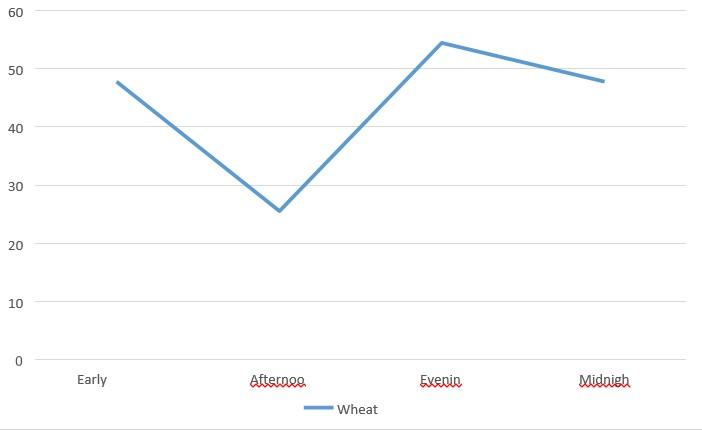
The model is installed in a farm for testing. The testing is done in early morning, afternoon, evening, midnight. Also stickypadsareusedformoreefficiency.Theresultsshows thepercentageofinsecttrap.
FORCOTTONFIELDS-
Percentageofinsectstrapped=No.ofinsectstrapped/Total no.ofinsects*100


FORCOTTONFIELD–
Total no. of insects captured = 90 = Early morning + afternoon+evening+midnight+pad
No.ofinsectstrappedinEarlymorning=36=36/90* 100=40.
No.ofinsectstrappedinafternoon=28=28/90*100 =31.11.
No.ofinsectstrappedinevening=54=54/90*100 =60.
FORWHEATFIELDS–
Total no. of insects captured = 90 = Early morning + afternoon+evening+midnight+pad
No.ofinsectstrappedinEarlymorning=43=43/90* 100=47.77
No.ofinsectstrappedinafternoon=23=23/90*100 =25.55
No.ofinsectstrappedinevening=49=49/90*100= 54.44No.ofinsectstrappedinmidnight=30=30/90* 100 =33.33
AutomaticsolarinsectlighttraptheyuseUVlightsthatare energy-efficientandhavealongerlifespancomparedtothe incandescentorfluorescentbulbsusedintraditionaltraps. This reduces the frequency of replacements and energy consumption,ultimatelyresultinginloweroperatingcosts.
Secondly,automaticsolarinsectlighttrapscomeequipped with sensors that can detect changes in light conditions, allowing them to adjust light intensity and duration according to the current circumstances. This feature conservesenergywhileensuringoptimaloperationduring bothdayandnight.
Thirdly,automaticsolarinsectlighttrapsusesolarpanelsto charge their batteries, eliminating the need for electricity and decreasing operating costs. They can function continuously without increasing energy bills or requiring frequentbatteryreplacements.
Fourthly,automaticsolarinsectlighttrapsareconstructed with durable materials withstand harsh environmental conditions,makingthemweather-resistant.Asaresult,they canbeusedinvariousoutdoorsettings,eveninareaswith extremeweatherconditions.
Lastly, automatic solar insect light traps require minimal maintenance,reducinglaborcostswhileensuringlong-term effectiveness.Thismakesthemacost-effectiveandefficient pest control solution in both residential and commercial settings.
7. CONCLUSION
Solar-operated insect trappers are an effective and ecofriendly method of controlling insects without the use of harmful chemicals or electricity. These devices use solar energy topowerthelightsourcethatattractsinsects,and thentraptheminsideacontainerwheretheycanbesafely disposedof.Oneofthemajoradvantagesofsolar-operated insect trappers is that they are self-sufficient and can operate in remote areas without access to electricity. Additionally, they do not emit any harmful chemicals or pollutants into the environment, making them a safe and sustainablealternativetotraditionalinsectcontrolmethods. However,itisimportanttonotethatsolar-operatedinsect trappersarenotacompletesolutionforinsectcontroland shouldbeusedinconjunctionwithothermethods,suchas proper sanitation and hygiene practices, to effectively control insect populations. Overall, solar-operated insect trappersareapromisingtechnologythatcanhelpreducethe negativeimpactofinsectpopulationsonhumanhealthand theenvironment.
Moreover, its robust and weather-resistant construction necessitateslowmaintenance,makingitareliableandlonglasting solution for pest control in both residential and commercialsettings.Thedevelopmentofanautomatedsolar insect light trap offers several advantages in the field of entomologyandpestmanagement.Herearesomekeypoints toconsider:
EnhancedEfficiency:Theautomatedsolarinsectlighttrap utilizes solar power to operate, eliminating the need for externalpowersourcesandreducingoperationalcosts.This allows for continuous and prolonged monitoring of insect populationswithoutinterruptions.
IncreasedAccuracy:Thetrap'sautomatedfeatures,suchas programmedon/offcyclesandlightintensitycontrol,ensure consistentandstandardizedtrappingconditions.Thisleads to more accurate data collection, enabling researchers to study insect behavior, population dynamics, and pest outbreakswithgreaterprecision.
Time and Labor Savings: The automation of trapping processes reduces the need for manual intervention and constantmonitoring.Researcherscanallocatetheirtimeand resources more efficiently, focusing on data analysis and interpretationratherthanroutinetrapmaintenance.
RemoteMonitoring:Automatedsolarinsectlighttrapscan beequippedwithremotemonitoringanddatatransmission capabilities.Thisallowsresearcherstoaccessreal-timedata

from multiple trap locations, facilitating the tracking of insect populations over larger geographic areas and providingvaluableinsightsintoregionalpestdynamics.
EnvironmentallyFriendly:Theutilizationofsolarpowerin thetrap'soperationalignswithsustainableandeco-friendly practices.
REFERENCES
1. Antignus, Yehezkel. "Manipulation of wavelengthdependent behaviour of insects: an IPM tool to impede insects and restrict epidemics of insectborneviruses." Virus research 71.1-2(2000):213220.
2. Swinton, Scott M., et al. "Estimation of crop yield loss due to interference by multiple weed species." Weed Science 42.1(1994):103-109.
3. Shimoda, Masami, and Ken-ichiro Honda. "Insect reactions to light and its applications to pest management." Applied Entomology and Zoology 48 (2013):413-421.
4. Ramamurthy, Vilayanoor V., et al. "Efficiency of differentlightsourcesinlighttrapsinmonitoring insect diversity." Munis Entomology & Zoology 5.1 (2010):109-114.
5. Qing, Y. A. O., et al. "An insect imaging system to automatericelight-trappestidentification." Journal of Integrative Agriculture 11.6(2012):978-985.
6. Cohnstaedt,L.E.E.,Gillen,J.I.,&Munstermann,L.E. (2008).Light-emittingdiodetechnologyimproves insecttrapping.JournaloftheAmericanMosquito ControlAssociation,24(2),331.
7. Harding Jr, W. C., Hartsock, J. G., & Rohwer, G. G. (1966).Blacklighttrapstandardsforgeneralinsect surveys.BulletinoftheESA,12(1),31-32.
8. RietaGolsandJeffreyA.Harvey2023,Integrating chemical plant trait- and ecological-based approaches to better understand differences in insect herbivory between cultivated and natural systemsAgriculture,Ecosystems&Environment27 June2023
9. Campbell,J.W.,&Hanula,J.L.(2007).Efficiencyof Malaisetrapsandcoloredpantrapsforcollecting flower visiting insects from three forested ecosystems.JournalofInsectConservation,11(4), 399-408.3
10. Ramamurthy, V. V., Akhtar, M. S., Patankar, N. V., Menon, P., Kumar, R., Singh, S. K., ... & Mittal, V. (2010).Efficiencyofdifferentlightsourcesinlight traps in monitoring insect diversity. Munis Entomology&Zoology,5(1),109-114.
11. Rai, A. B., Halder, J., & Kodandaram, M. H. (2014). Emerginginsectpestproblemsinvegetablecrops andtheirmanagementinIndia:Anappraisal.Pest Management in Horticultural Ecosystems, 20(2), 113-122.