International Research Journal of Engineering and Technology (IRJET) e-ISSN: 2395-0056

Volume: 10 Issue: 08 | Aug 2023 www.irjet.net
International Research Journal of Engineering and Technology (IRJET) e-ISSN: 2395-0056
Volume: 10 Issue: 08 | Aug 2023 www.irjet.net
(a) M.Tech. , Department of Mechanical Engineering, HBTU Kanpur, Uttar Pradesh India
(b) Associate Professor, Department of Mechanical Engineering, HBTU Kanpur, Uttar Pradesh India ***
Abstract: Electro-discharge machining is a machining process that is most widely used for machining different types of hard materials, especially electrically conductive materials. Electrical discharge Machining produces a complex profile that is not possible by traditional machining processes. In the electro-discharge machining process, the w/p and electrode both must be electrically good conductive Graphite, copper and brass are mostly used for making the electrode due to high electrical conductivity. In this paper, a Graphite electrode used for machining of Copper Nickel alloy (grade Cu70Ni30) with a stationary and rotary electrode and analysed the MRR, Ra and TWR and compared the MRR, Ra and TWR between the static electrode and rotary electrode. In this research paper, the value of the discharge current changed during the experiment and study the consequence of the discharge current on MRR, Ra and TWR in both conditions (static and rotary electrode).
Key-words :EDM,StaticandRotaryElectrode,GraphiteElectrode,MRR,TWR,Ra
Whenasparkisgeneratedbetweentwoelectricallyconductivematerialsthenasmallamountofmaterialremovedfrom the w/p and if the w/p and tool both submerge into the dielectric then it localised into a small portion which is can be controlled by various methods used This technique for machining the varies hard materials which are not possible to machining by traditional machining process In electrical discharge machining, short-duration spark and high frequency are usedforgoodmachininganditissuitableforobtainingagoodsurfacefinish.IntheEDMdielectricsparkscanbeconcentrated into small areas and due to this meter machining is possible[1]. Electro discharge machining is one of the best machining processes for machining very hard materials because EDM is a non-contact machining process in which the tool and w/p never touch each other during the machining, when high voltage which is in pulse form and low current is applied on small electrodegap(10μmto70μm)whichissubmergedindielectricthenveryhighthermalenergyhavingsparkgenerateswhich meltthematerialandvaporiseandthisprocesscontinuewhenpulseonandpulseoff respectively.Whenthepulseisoff,the removedmaterialisflushedoutbythedielectricfluidwhichflowsonthemachiningsurfacewithhighpressure[2].Inelectrodischargemachiningelectricalenergyistransformedintothermalenergy. Whenthesparkisgeneratedbetweentheelectrode andw/pthenhighenergyisreleasedwhichlocalisedasmallareaduetothehighenergyw/p’ssurfacemeltandvaporiseand machining takes place. High heat energy is released when a spark is generated at approximately 8000 to 12000 degrees Celsius[3-4].IntheEDMwhenmaterialremovesthenasmallportionofthematerialfromtheelectrodeisalsoremovedwhich is called Tool wear sometimes this material is deposited on the w/p and this is called modification of electro-discharge machining surface which increases the w/p material wear and erosion resistance [5-6].Inthe EDM, the electrode is calleda tool, and when machining takes place, a replica of the tool (electrode ) design is obtained on the w/p In the EDM any electricalconductivematerialwithanytypeofmechanicalpropertieslikehardness,strength,modulusofelasticityetchaving materialscanbemachinedveryeasily.Formachininganytypeofmaterialbythe EDMprocess,onlytwoimportantproperties arerequired:firstelectricalconductiveandsecondthermalconductiveandothermechanicalpropertiesarenotimportant.All new advance materialsand alloys whichhave better electrical and thermal propertiescan be machined by the EDM process very easily which is not possible to machine by another machining process [7-8]. Nowadays, many companies, particularly those that make moulds and dies, submarine, ship, automobile and aerospace industries all use the EDM process for machiningadvancedalloymaterials[9].IntheEDMprocesstoolmaterialanditsmechanicalpropertiesplayaveryimportant role. For good and accurate machining, choosing electrodes with excellent electrical and mechanical properties is essential. Theselectionofelectrodedependsonthemechanicalpropertiesofthew/pmaterialandbasedontherequiredsurfacefinish, MRR[10]
Apiwat Muttamara [11] use graphite electrode in EDM machining and conclude that Graphite electrode makes more surface roughnessascomparedtootherelectrodes.ShusongZana[12]usedgraphiteelectrodesandtriedtofindouttheTWRinthe EDMprocess.HefoundthatlowporositygraphiteelectrodeshavelowTWRwhensubmergedinthewater-baseddielectric.he tried to compare the tool wear by taking different types of dielectric which have different percentages of carbon. the researchersabsorbthatifcarbondepositionismorethentoolwearislessduringthemachiningprocess.Hardeep Singhetal. (2021)[13]usedcopper,graphiteandbrasselectrodesintheirexperiment,Duringtheexperimentresearchersabsorbedthat if the peak current and pulse on duration then MRR also increases and we get a higher MRR. C. Pavan (2019)[14] experimented on the machinability of nickel alloy material and used the Taguchi method by using copper, and brass electrodes. TheresearchersabsorbthatintheEDMprocessdischargecurrentisapredominantfactorwhich affectstheMRR duringthemachining.A.Torres (2014)[15]investigatedthesurfacefinishandMRRofInconelmaterialintheEDMprocessby taking different variable parameters like discharge current, and pulse on time The researchers absorb that the discharge currentandpulseontimearethemost dominantprocessparameters thataffectthemachining surfaceandMRR Duringthe machining of Inconel material in the EDM process if the peak current and the pulse are on time then it is absorbed and the MRR andsurface roughness arealso increased.Abhishek Thakur et al.[16] (2020) used different process parameters during theirexperimentintheEDMprocesssuchasdischargecurrent,pulseontimeandpulseofftimeontheTi-6246materialand usedgraphiteelectrodeasatool theresearchersusedtheroundnesssurfacemethodtechniquetoanalysethesurfacefinishof thematerial.theresearchersabsorbthatsurfacefinishdecreaseswhenthedischargecurrentandpulseontimeincrease R.L. Balaji et al. [17](2016) used Monel material as a w/p and copper electrode as a tool in their experiment, the researchers absorbthatdischargecurrent affects thesurfaceroughness(72.6%),pulseontime affectsthesurface roughness(5.2%)and pulse off time affect the surface roughness (3.4%) S. Gowthaman et al. [18](2018) investigated the machining of Monel material bythe GRA andusedcopper electrodes asa tool The researchers absorb thatdischarge currents play a very major role in MRR and Ra ( surface roughness). Discharge current consequence on MRR and Ra ( surface roughness ) is 71% and 81%respectively
This paper, investigate the consequence of static and rotary Graphite electrode in Electro discharge machining on Copper-nickel alloy analyses andstudy theconsequenceofdischargecurrentvariationon MRR, TWR andRa withthestatic electrodeandrotaryelectrodeandcomparesitsresults
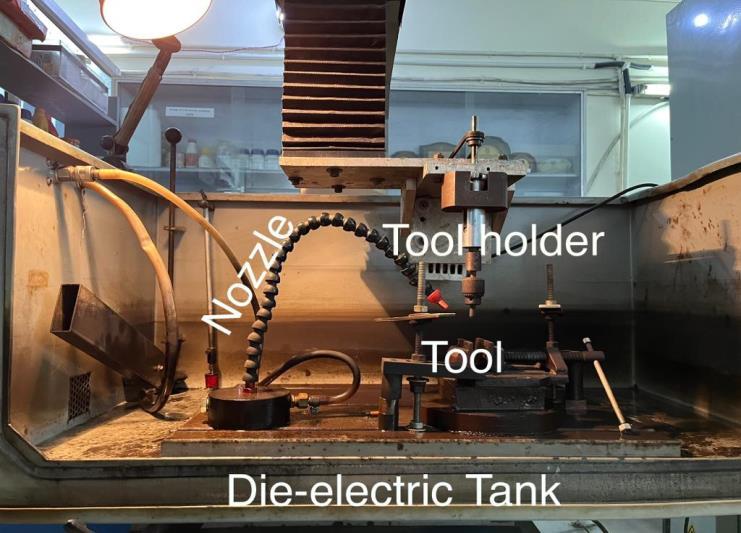
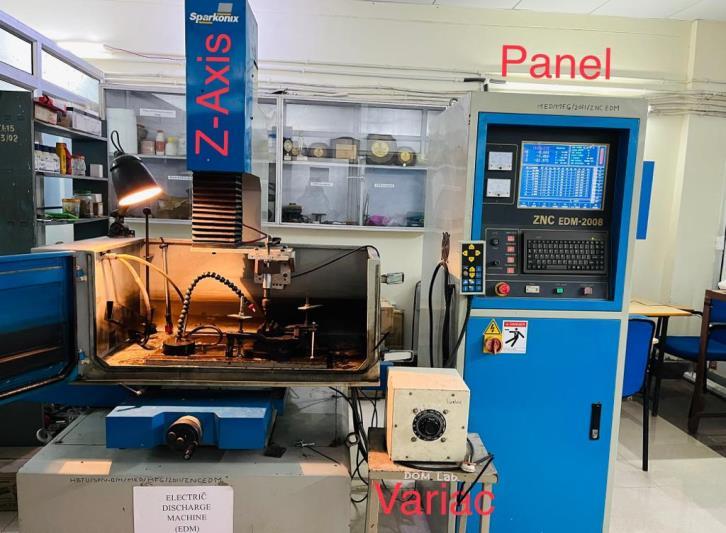
Sparkonix ZNC(ZaxisnumericalControlMachine)2008,modelnumber S50ZNC electricaldischargemachineusedfor experimentation.
Dielectric
CopperNickelalloyGradeCu70Ni30 material wasusedfortheexperimentandagraphiteelectrodewasusedasatool formachining.
Table no.2 gives the chemical composition of copper-nickel alloy, and Table no.3 gives some mechanical properties of copper-nickelalloy,andtableno.3givessomepropertiesofgraphiteelectrodes
Table No 2
Chemical composition of Copper Nickel(Cupronickel) Alloy
Copper
Alloy has some Mechanical properties
Mi –Initialweightingrams(w/p)
Mf –finalweightingrams(w/p).
ρ–Densityingram/cc(w/p)
t-Totalmachiningtime(minute) (Ti Tf)×1,000 mm3
Ti –Initialweightingrams(electrode)
Tf –Finalweightingrams(electrode)
ρ–Densityingram/cc(electrode)
t-Totalmachiningtime(minute)
4.EXPERIMENTAL ANALYSIS WITH STATIONARY ELECTRODE
The consequence of discharge current on MRR TWR and Ra with Stationary Electrodes are analysed during the experiment.Theobtainedoutputisgivenbelow.
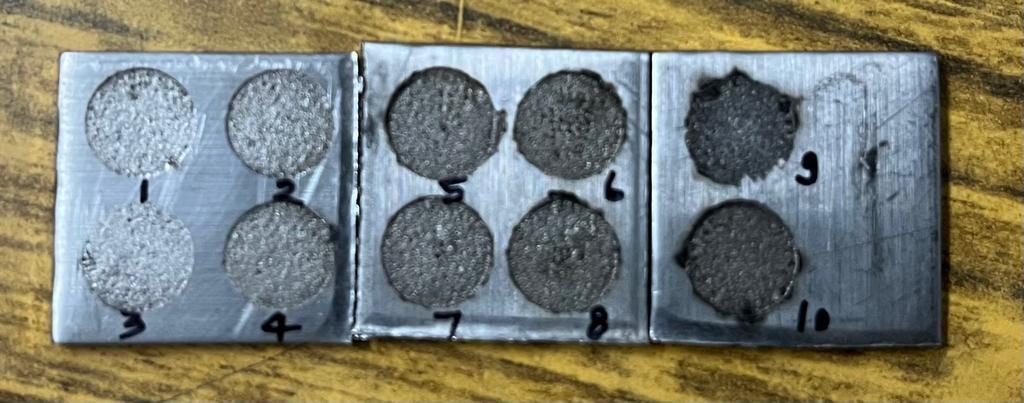
Figure1.ShowstheconsequenceofdischargecurrentonMRR,TWRandRawithStationaryElectrode.Theexperimentshows that MRR and TWR are very low when the discharge current is small because when the discharge current is small then discharge energyis small and whenthedischargecurrent increase then discharge energy also increase due to thisMRR and TWR alsoincrease gradually. The experiment shows thata small variationin discharge current does notaffect the MRR and tool wear is negligible but when the discharge current is greater, MRR and TWR increase rapidly and with high discharge currentitisobservedthatcarbondepositiononthew/pstartsthataffectthemachiningandsurfaceroughnessofthew/p.
TheexperimentshowsthatMRR graduallyincreaseswhenthedischargingcurrentincreases,ItisabsorbingthattheRaof the w/p is good when the discharging current lies between 3 to 15 Ampere and if the discharge current is greater than 15 amperethenthesurfaceroughnessincreasesrapidly.
TheconsequenceofdischargecurrentonMRR,TWRandRawithRotaryElectrodesanalyses duringtheexperiment.The obtainedoutputisgivenbelow.
International Research Journal of Engineering and Technology (IRJET) e-ISSN: 2395-0056
Volume: 10 Issue: 08 | Aug 2023 www.irjet.net p-ISSN: 2395-0072
Figure2.ShowstheconsequenceofdischargecurrentonMRR,TWRandRa(surfaceroughness) withRotaryElectrode The experiment shows that MRR and TWR with Rotary Electrode are moreas compared to Stationary Electrodes. MRR and TWR aremorewithrotaryElectrodebecause whentheelectrode(tool) rotatesthenit exerts morepressureonthew/pand pressurebecomeshighbetweenw/pandelectrodeandthiscreatesagreatervortexascomparedtoastationaryelectrodeand itspreadsmoreheatfluxduetothismoreheatflowonthew/pandmorematerialmeltandvaporised.
TheexperimentshowsthattheSurfaceRoughnessofthew/pwitharotaryelectrodeislessascomparedtotheStationary Electrode.ItisabsorbedthatwhentheElectroderotaryRPMislowthensurfaceroughnessisalsolowandasmoothsurfaceis obtained.
By theanalysisoftheabove experimentalresults,someimportantconclusionsaregivenbelow
1.MRRandTWRbothincreasewhenthedischargecurrentincreases,MRRandTWRdecreasewithdecreasingthedischarge current
2.Surface Roughness (Ra) increases when the discharging current increase and it decrease when the discharging current decrease.
3.RotaryelectrodehavinggreaterMRRandTWRascomparedtothestationaryelectrode
4.Rotaryelectrodesprovidebettersurfacequalityascomparedwithstaticelectrodes
Based on the above analysis Graphite electrode with rotation provide good surface quality and have higher MRR (material removal rate) but graphite electrode with rotation also have high TWR as compared to the stationary electrode so rotary electrodeissuitablewhenhighmaterialremovalisrequired
1. AdvancedMachiningProcessesByV.K.Jain(page126)
2. E.C.Jameson,“Descriptionanddevelopmentofelectricaldischargemachining(EDM),ElectricalDischargeMachining,” SocietyofManufacturingEngineers,Dearborn,Michigan,2001,pp.16.
International Research Journal of Engineering and Technology (IRJET) e-ISSN: 2395-0056
Volume: 10 Issue: 08 | Aug 2023
3. Singh, Shankar, S. Maheshwari, and P. C. Pandey. "Some investigations into the electric discharge machining of hardenedtoolsteelusingdifferentelectrodematerials."MaterialsProcessingTechnology(2004)
4. Dauw,D.F."Charmillestechnologies:facingthefuture."PaperPresentedDuringtheInaugurationofCTJapan.1989.
5. Ho,K.H.,andS.T.Newman."State-of-the-artelectricaldischargemachining(EDM)." International Journal of Machine Tools and Manufacture 43.13(2003):1287-1300.
6. Lee, Hwa-Teng, and Jiahn-PiringYur. "Characteristic analysis of EDMed surfaces using the Taguchi approach." MaterialsandManufacturingProcesses15.6(2000):781-806.
7. Stovicek, D. R. "The state-of-the-art EDM science." Tooling and Production, Nelson Publishing Inc., Ohio, US 59.2 (1993):42.
8. Marafona, Jose, and Catherine Wykes. "A new method of optimising MRR using EDM with copper–tungsten electrodes."InternationalJournalofMachineToolsandManufacture40.2(2000):153164.
9. Tsai, Kuo-Ming, and Pei-Jen Wang. "Semi-empirical model of surface finish on electrical discharge machining." InternationalJournalofMachineToolsandManufacture41.10(2001):1455-1477
10. Tsai,H.C.,B.H.Yan,andF.Y.Huang."EDMperformanceofCr/Cu-basedcompositeelectrodes."InternationalJournal ofMachineToolsandManufacture43.3(2003):245-252.
11. ApiwatMuttamara,“ConsequenceofGraphiteElectrodetoSurface’sCharacteristicof EDM January 2016
12. ShusongZana“StudyofGraphiteToolWearinEDMwithWater-basedDielectricsandEDMOil”20thCIRPConference onElectro-PhysicalandChemicalMachining(ISEM2020)
13. Hardeep Singh, Jujhar Singh,Shubham Sharma, S. P. Dwivedi, and Ahmed J. Obaid: Journal ofGreen Engineering, 11 (2021)922-938
14. C.Pavan,N.Sateesh,andR.Subbiah:MaterialsToday:Proceedings,46(2020)9281-9286.
15. A.Torres,I.Puertas,andC.J.Luis:PrecisionEngineering,(2014)2334-2340.
16. A.Thakur,P.SudhakarRao,andMohd.Y.Khan:MaterialsToday:Proceedings,44(2020)838-847.
17. R.L.Balaji,andJ.P.Kumar:JournalofEngineering,ScientificResearchandApplications,(2016)2455-3964
18. S. Gowthaman, K. Balamurungan, P. M. Kumar, S. K. Ahamad Ali, K. L. Mohan Kumar, and N. V. Ram Gopal: Procedia Manufacturing,20(2018)386-391.