An investigation of an Arduino-based solar tracking system with panel surface cleaning mechanism
Srinivasa Murthy MK1 , Shivanandappa N D2 , Satya Prema31Assistant Professor, Dept. of Mech. Engg. JNN College of Engineering, Shivamogga, Navule, Karnataka, India

2Assistant Professor, Dept. of Mech. Engg. JNN College of Engineering, Shivamogga, Karnataka, India
3Assistant Professor, Dept. of Mech. Engg. JNN College of Engineering, Shivamogga, Karnataka, India ***
Abstract - Solar energy presents a clean, readily accessible, and abundant alternative source of power in nature. Harnessing this energy for electricity generation offers significant benefits. However, fixed Photovoltaic (PV) panels have limitations, as they can only extract maximum energy during a specific time frame, typically from 12 noon to 2 PM in southern parts of India, leading to reduced energy efficiency. Further due to high dust atmosphere the panels are covered with 0.5 to 1 mm thick mud dusts. This will check much of the solar light source reaching the panel. The presence of dust on solar panels can lead to a reduction in their power output. To address this issue, it becomes crucial to enhance the energy efficiency of PV solar panels by implementing a solar tracking system and a cleaning cum wiping system. This study employs an Arduino-based solar tracking system and cleaning model utilizing Light Dependent Resistors (LDRs) to gauge sunlight intensity. The PV solar panel is adjusted accordingly to optimize energy capture as it tracks the sun's movement. The tracking mechanism utilizes a servo motor controlled by a microcontroller, responding to signals from the LDRs. Also motor driven wipers are designed to operate at intervals. The conclusive findings clearly indicate that the solar tracking panel produces a greater amount of energy in comparison to a stationary panel with a pristine surface.
Key Words: Solar Energy, Arduino, Tracking, Microcontroller,PanelCleaning
1.INTRODUCTION
South India has a tropical climate with ample sunshine throughout the year. This region receives high solar irradiationlevels,makingitanideallocationforsolarenergy generation. Installing solar panels in South India allows harnessing this abundant solar resource efficiently. Solar panel installations promote energy independence by reducingrelianceonfossilfuel-basedenergysources.South India,liketherestofthecountry,faceschallengesrelatedto energy security and power shortages. Solar power installationscanhelpmeettheincreasingenergydemand, especiallyduringpeakhours,andreducethestrainonthe conventionalpowergrid.SouthernpartofIndiaisoneofthe tropicalclimatezonewithtemperaturesrangingfrom30to 40degreesandaverageof6.25hoursofsunshineperday. ThoughstateslikeKaranataka,TamilnaduandKerala have significantelectrificationratethepowercutoffratesarehigh
inruralareas.Onthiscount,only40%ofresidencesinIndia currentlyhaveaccesstopublicpower,andthisisnotalways the case. In India, where there is no reliable source of electricity, people have begun to embrace the tradition of producingtheirownpower.Expenseoflivingisquitehigh, especiallyintheruralareasofthenation,duetotherising expenseofusingfossilfuelstogeneratepower.Additionally, theusageoffossilfuelshaspollutedtheenvironment,which isharmfultohumanhealth.Thegreenhouseeffectisbrought onbythecarbondioxidereleased.Deforestationoftheland aswellasairandwaterpollutionresultfromthis.Because solar energy only comes from the sun, it does not release carbondioxide,preventingthegreenhouseeffect.Indiasolar energy development has the potential to provide employment.Particularlyascomparedtocoalminingandoil extraction, employment in the renewable energy sector wouldloweroccupationaldangers.Duetoitsabundanceand environmentalfriendliness,solarenergyisbecomingoneof themostdependablesourcesofelectricity.
Solar tracking systems optimize the positioning of solar panels,maximizingsunlightexposureandincreasingenergy generation, which is crucial for meeting India's growing energy demand. Solar tracking increases the overall efficiency of solar installations, allowing for higher power output per unit area. This efficiency gain translates into improved cost-effectiveness and a higher return on investment for solar projects. Solar tracking helps align energygenerationwithpeakdemandperiods,contributing togridstabilityandfacilitatingtheintegrationofrenewable energy intoIndia'spower grid, reducing relianceonfossil fuelsandsupportingsustainableenergytransition.
Keepingallthementionedaspectsinthemindasystemwith optimal and effect enhancement of solar panels has be developed. A system that tracks the sun will be able to determineitspositioninanon-linearway,claimsreference [2]. This system's operation ought to be managed independently[3].AsolarPVpanelwillproducethemost electricity when it is angled directly towards the sun and withcleansurfacethepotentialcanbefurtherenhanced.
2 Literature Reviews
Asolarcellisadevicethatusesthephotovoltaiceffectto convertlightenergyintoelectricalenergy.Thefoundationof
photovoltaic modules, or solar panels, are solar cells. In a solar tracking system, the surface of the module automaticallytracksthelocationofthesunduringthecourse of the day. As the sun moves across the sky, its location changes.Thesolartrackercanboosttheeffectivenessofsuch equipment in any given position. For solar powered equipmenttofunctionoptimally,itmustbeplacedcloseto thesun,basedonperformance,price,andsophistication.
Several sun tracking techniqueshave been studiedand assessedinordertokeepthePVcellsperpendiculartothe sunlight. An ideal tracker would allow the PV cells to preciselyaimtowardsthesun,correctingforchangesinthe sun'saltitudeangle(duringtheday),latitudinaloffset(during seasonal fluctuations), and azimuth angle. Tracking in relation to latitudinal offset raises the system cost. The altitudeangleistrackedusingasingleaxismethod.Thereare twotypesofsuntrackers:passive(mechanical)trackersand active(electrical)trackers[1][6].
1. Locationandazimuthelevationrange[3].
2. Illuminationdetectedbysensorslikephoto-resistor [4],[5]light-dependentresistor(LDR)
Thefixedsolarpanelisonetypeofpassivesolartracker. Itispositionedhorizontallyonthesolidgroundwithitsface tothesky.However,themajorityofpassivesolartrackers relyonhumanpaneladjustment[1].Majoractivetrackers are built around a microprocessor, a computer-controlled date and time system, an auxiliary bifacial solar cell, or a combinationofthesethreecomponents.Twofrequentlyused approachesareusedtocomputetheangularstepsrequired forthemotor.
The orientation of solar panels plays a crucial role in maximizing their exposure to sunlight [1]. By actively adjustingthepanel'spositionthroughoutthedaytofacethe sun,solartrackingsystemsoptimizetheangleofincidence, ensuring that the panels receive the maximum amount of solar radiation. This leads to increased energy production and higher overall system efficiency. Active solar panel orientationhelpsoptimizeenergygenerationbymaximizing the conversion of sunlight into electricity. By tracking the sun'smovement,panelscancapturesunlightatanoptimal angle, increasing the efficiency of the photovoltaic cells[1][2][4]. This enhanced energy generation translates into higher power output, allowing for better costeffectiveness and a faster return on investment for solar installations.
Keepingthesurfaceofsolarpanelscleanisessentialfor maintaining their efficiency. Dust, dirt, bird droppings, or other debris that accumulate on the panels can create shading and reduce the amount of sunlight reaching the photovoltaiccells.Regularcleaninghelpsensurethatpanels operateattheirmaximumcapacity,preventinganypotential lossofenergyproduction.Cleansolarpanelsalsoenhancethe
longevityofthesystembypreventingdamageorcorrosion thatcouldoccurduetoprolongedexposuretodebris.
3 Methodology
Thesolarpanelismountedonastand,andtwoLDRsare mountedonoppositesidesofthepanel.Avoltagedivideris used to convert the LDR's output, which is in the form of resistance, into voltage. The microprocessor instructs the motor to rotate clockwise or anticlockwise based on the highest voltage from the voltage divider. The power is computedbasedontheoutputofthepanelandthecurrent sensor. The panel tilts to receive more solar energy dependingontheintensityandpowerratings.Asaresult, thesun'slocationistracked.
Thefollowingarethemaincomponentsofthissystem:
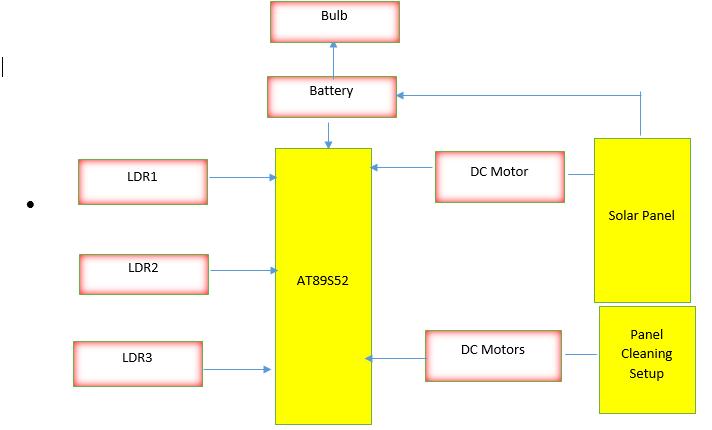
1. Microcontroller8051
2. LDRs
3. MotordriverL293D
4. DCMotors
Softwarespecifications
1. EmbeddedC
2. Keil
A solar panel, an Arduino microprocessor, and sensors makeupthesolartrackingsystem.Lightmustbeemittedby thesunforthissystemtofunction.TheLDRsactassensors, detectingtheamountoflightenteringthesolarpanels.The LDRthentransmitsdatatotheArduinomicrocontroller.The servomotorcircuitisthenbuilt.Theservohasthreepins, the positive side of which is connected to the +5v of the Arduinomicrocontroller.Theservo'snegativeisconnected to ground. The servo's data point is linked to the microcontroller's analogue point. A potentiometer is connectedtocontroltheservomotor'sspeed.Theflowchart and block diagrams of the tracking system are shown in figure1.
4. Description of Parts
A microcontroller-based solar power tracking system withcleaningfunctionalityisasmartandautomatedsolution tooptimizeenergygenerationfromsolarpanels.Thissystem employsamicrocontroller,sensors,andmotorstotrackthe sun's movement throughout the day and ensure the solar panels are appropriately oriented for maximum energy capture.Additionally,itincorporatesacleaningmechanism toremovedustanddebrisfromthepanels,maintainingtheir efficiencyovertime.Here'sanoverviewofhowsuchasystem mightwork:
1.SolarTrackingSystem:
Light sensors (such as LDRs) are placed on the solar panelstodetecttheintensityofsunlight.
Themicrocontrollerreceivesinputfromthelightsensors and calculates the sun's position relative to the solar panels.
Based on the position information, the microcontroller controlsservomotorsthatadjustthetiltandorientation ofthesolarpanelstofacethesunoptimally.
Thesystemcontinuouslymonitorsthesun'spositionand makes real-time adjustments to ensure the panels are alwaysfacingthesunformaximumenergyabsorption.
2.CleaningMechanism:
Thesystemisequippedwithacleaningmechanism,such asbrushesorwipers,installedonaseparatetrackorrail system.
The cleaning mechanism is programmed to activate at scheduledintervalsorwhencertainconditionsaremet (e.g.,apredefinedlevelofdustaccumulation).
Whentriggered,thecleaningmechanismmovesalongthe solar panels' surface, removing dust, debris, and other contaminantsthatmayhinderenergyproduction.
Thecleaningprocesscanbecombinedwithawaterspray or other cleaning agents for more effective cleaning, althoughwaterusageshouldbeoptimizedinaridregions.
3.IntegrationandPowerSupply:
The microcontroller governs the solar tracking and cleaning systems and ensures they work together seamlessly.
The entire system can be powered using a small solar panelandbatterysetuptomakeitself-sustainableand independentofexternalpowersources.
5 Experiment and results
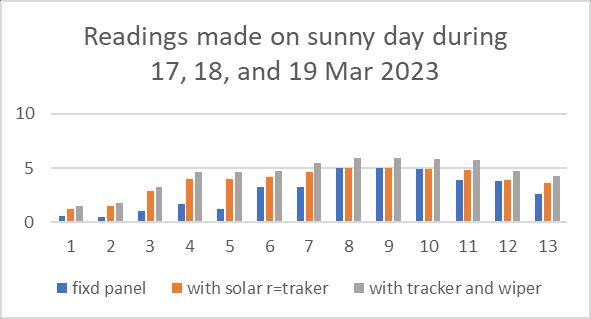
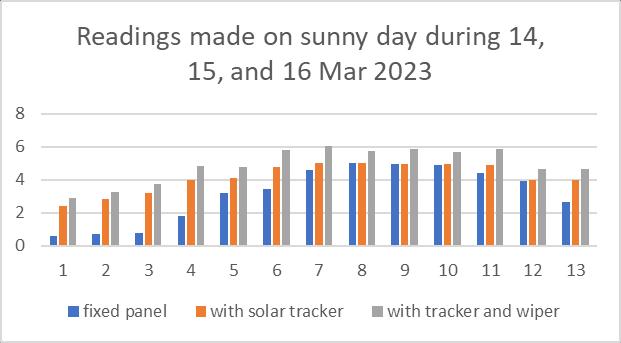
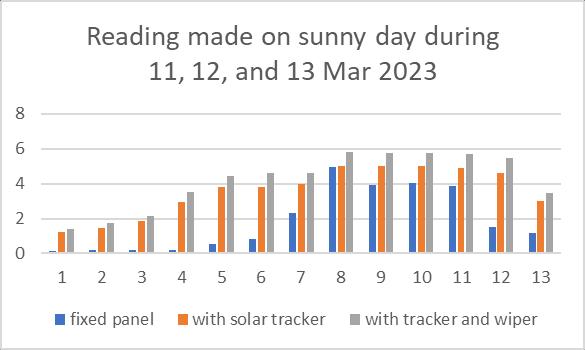
Thepowerreadingsofthefixedsolarpanelandthetracking solar panel were recorded hourly for three days in March 2022andaredisplayedintables1,2,and3.Theefficiency difference between the fixed solar panel and the
implementedsolartrackercanbeseenintheresultstaken ondifferentdays.
Table -1: showsthepowerreadingsforagloomymorning andasunnyafternoonduringMarch 2023withfixedsolar panels
Table -2: showsthepowerreadingsforagloomymorning andasunnyafternoonduringMarch2023withsolar tracking. Power reading of fixed solar panel (6W)
Table -3: showsthepowerreadingsforagloomymorning andasunnyafternoonduringMarch2023withsolar trackingandcleaningof panels.
According to the aforementioned tables, the maximum sunshine occurs around midday, with maximum values between 1200 hours and 1500 hours. The intensity of sunlightdecreasesinthemorningandlateevening,andthe values obtained are lower than those obtained during the day. To save electricity, the tracking system is turned off after sunset. It is then turned on again in the morning to continue tracking. When the numbers are the same, the panelstopsmoving,indicatingthattheLDRsgetthesame amount of sunshine. The wiper is only used once every 1 hourduringtheday.
5. CONCLUSIONS
The tracking system for solar panels was created and installed.Theexperimentalresultsrevealthatthegoalofthe solarpaneltrackingsystemistofollowthepositionofthe suninordertoimprovetheefficiencyofthesolarpanel.The implementation of solar tracker reveals considerable increaseinthepowerproduction.Further,theapplicationof wiperonthepanelenhance20%powergeneration. This work can be done on a large scale, which will benefit developingcountrieslikeIndia.Ourproposalforfuturework istoconsiderusingmoresensitiveandefficientsensorsthat consumelesspowerandarealsolessexpensive.Thiswould boostefficiencywhiledecreasingcosts.
Benefitsofthissystem:
1. Increased energy production: The solar tracking systemoptimizesenergycapturebyadjustingthe panelstofacethesunaccurately.
2. Enhancedpanelefficiency:Regularcleaningensures thatdustanddebrisdonotaccumulate,preventing efficiencylossesduetoshading.
3. Reduced maintenance: The automated cleaning processreducestheneedformanualpanelcleaning, especiallyinhard-to-reachareas.
4. Self-sustainability: The system can operate autonomously,poweredbyitsownsolarpaneland battery,makingitsuitableforremotelocations.
Implementing such a system requires careful design, programming,andintegrationofthecomponents.Regular maintenanceandmonitoringarealsoessentialtoensurethe systemoperatessmoothlyanddeliverstheexpectedbenefits overtime.
REFERENCES
[1] AdelAbdulrahmanetal“DesignandImplementationof Solar Tracking System”. International Journal of EngineeringandTechnicalResearch(IJETR)ISSN:23210869 (O) 2454-4698 (P), Volume-4, Issue-1, January 2016.
[2] MAS KamalaJetal“SolarTrackingforMaximumand EconomicEnergyHarvesting” InternationalJournalof Engineering and Technology (IJET) ISSN : 0975-4024 Vol5No6Dec2013-Jan2014.
[3] Bingol O, Altintas AO, "Microcontroller based solartracking system and its implementation," Journal of EngineeringSciences2006,vol.12,pp.243-248.
[4] Qwq Rumala S, "A shadow method for automatic tracking,"SolarEnergy1986,vol.37,pp245-247.
[5] PalavrasI,BakosGC,"Developmentofalow-costdish solar concentrator and its application in zeolite desorption,"RenewableEnergy2006,vol.3,pp.24222431.
[6] Mousazadeh,H.,Keyhani,A.,Javadi,A.,Mobli,H.,Abrinia, K., Sharifi, A.“A review of principle and sun-tracking methods for maximizing solar systems aoutput,” RenewableandSustainableEnergyReviews,Jan.2009. vol13,issue8,pp.1800-1818
BIOGRAPHIES
Srinivasa Murthy MK is Assistant Professor in the department of MechanicalEngineeringatJNNCE, Shivamogga. He is specialized in Mechatronics,RoboticsandAI