Development of a Carbon Paste Sensor for Floral Classification of Honey Samples Using ANN
Subhasis Datta1 , Kamalika Tiwari2 , Santigopal Pain31 Assistant Professor, Faculty of Management Studies, Dr. B. C. Roy Engineering College Durgapur, India

2Assistant Professor, Department of Electrical Engineering, Dr. B. C. Roy Engineering College Durgapur, India
3Controller of Examinations, Central University of South Bihar, Gaya, India ***
Abstract - Anelectronictongue(E-tongue)wasemployedfor the assessment of the different floral origins of honey using a fabricated Carbon Paste (CP) electrode and a commercially available glassy carbon (GC) electrode. Two distinct types of carbonaceous electrodes are studied as sensors for the floral classification of honey samples established on cyclic voltammetry. The transient response of both electrodes is studied and evaluated with multivariate data analysis. The principal component analysis result showed a promising response of 97.14 % variance noted for CP electrodes against 93.99 % variance for GC electrodes. The separability index of 15.78 for carbon paste electrodes seems encouraging as compared totheseparability index of 11.85forGCelectrodes. The resultant raw data is used as input variable for ANN model. The findings suggest CP sensor as a promising alternative in determining the floral type of honey as it is inexpensive, easy to fabricate, and having greater electrochemical reactivity.
Key Words: Honey, voltammetric electronic tongue, glassy carbon electrode, carbon paste electrode.
1. INTRODUCTION
Withtherisingcomplexityofliquidanalysis,innovationin the development of sensors is of prime importance. Electronictonguescomprisedofdifferentchemicalsensors based upon variations in sensing principles are used as sensorarrays [1]. The responseofanelectronictonguein qualityclassificationsolelydependsonthesensingprinciple ofthesensorandthesensingmaterial[2].
Electronictonguesareacollectionofchemicalsensorswith cross-sensitiveresponsestovariouscomponents,operating under discrete transduction mechanisms, combined with data treatment procedures to investigate intricate liquid systems. The electronic tongue helps predict the concentration of the sample's target analytes and is frequentlyusedforqualitativeanalysisofthesampleunder study.Itcomprisestwomajorfunctionalblocksi.e.,thearray ofsensorsandthedataprocessingunit[3].
An arrangement of metallic electrodes based on iridium, gold, rhodium, platinum, and palladium is often used in a standard three-electrode arrangement to create a voltammetricelectronictongue.[4-5].Usingtheelectronic
tongue system and multivariate statistical analysis techniques, several authorshave studieda more rapid assessment of the floral origin of honey [6-9]. It has been studied extensively by the authors in [10], about the chemical modification of voltammetric sensors, with different sensitivity due to chemical modification [11]. Carbonaceous materials consist of carbon nanotubes, graphene,andactivatedcarbonandarewellknownfortheir largesurfacearea,brilliantconductivityvalues,andlowcost [12]. The researchers have established the use of carbon pasteasareplacementfornoblemetals,heavilydependent onsupportelectrolytes,andflexibletobeappliedtogether withpositiveandnegativepotentiallimits.CPisaversatile electrode material, being heavily dependent on support electrolytes and able to be utilized both for prospective rangeswithpositiveandnegativevalues.Studiesof[13]also exhibited the characteristics of carbonaceous materialseasytomodifywithcontrolledcostandeaseofhandling.CP electrodes are currently utilized as a viable alternative to noblemetalsincertainapplications,relyingonthetypeof supportingelectrolyte.Thepotentialoftheelectrodescanbe utilizedinarangeofbothpositiveandnegativereferences [14]. Furthermore, the carbon electrode is convenient to prepare, inexpensive, and easy to operate. Carbon paste electrodes are easy to modify depending upon the target analyte with easy renewal and miniaturization [15-16]. Therefore, carbonaceous materials are regularly used in multi-componentelectrochemicalanalyzesduetotheireasy availabilityandhighcapacity.Theycomeinvariousforms depending on their compositions that serve as working electrodes in research using cyclic voltammetry. Glassy carbon and carbon paste electrodes are commonly used formsofcarbonelectrodes.Aglassycarbonelectrodeishard andelectrochemicallyreactivewithhighconductivity[17].
Theintentionofthisresearchistoexploretheinfluenceof commercial glass electrodes and CP electrodes on the identificationofthefloralaromaofhoneytestedaccording to the cyclic voltammetry method [9][18]. Principal ComponentAnalysis(PCA)andLinearDiscriminateAnalysis (LDA)areusedtoanalyzethetransientresponseobtained fromtheGCandCPElectrodes.
2. EXPERIMENTATION
2.1 Materials and Reagents
TheGCelectrodeispurchasedfromEDAQ,India.Aluminais purchased from Sigma Aldrich Corporation, USA. Ethanol, NaOH,Nitricacid,andacetonearepurchasedfromMerck, USA.ApHmeter(make:TANOTISPH-2011)isutilizedfor thepHmeasurementofeachfloraltypeofhoneysample.All the investigations were conducted at room temperature (25±1°C).
Graphite powder (≥99. 5% pure) and paraffin oil are procuredfromMerck,U.S.A.Allthereagentsareofanalytical grade.DoubledistilledwaterfromtheMilliporesystemwas usedfortheexperiment.Allthereagentsconsumedforthe investigationswereofanalyticgrade.
2.2 Electrode Preparation
GC electrodes [16-17] were physically polished till a mirror-likesurfaceusinganaluminaslurry,wasobtained. Then the electrodes were rinsed thoroughly with double distilledwaterandultrasonicallycleansedwithmethanol.In theend,sonicatefor5minutesinasolutionof1:1:1nitric acid(HNO3),acetone,sodiumhydroxide(NaOH),anddouble distilledwater,respectively.
TheCPelectrodecouldbesynthesizedbyhandblending 1mgofgraphitepowderwith0.20millilitersofparaffinoil asabinderinacleanmortarpestle.Ahomogenouswetpaste is obtained after thoroughly mixing for 20 minutes. After that,theresultingmixturewasthenusedtofilla3.00mm diameter glass tube. Copper wire is used for electrical contact.Beforeeachmeasurement,thesurfaceoftheGCand CP electrodes was smoothed and thoroughly rinsed with double-distilledwaterandsandpaper.
2.3 Sample Collection
Intotal,fortytrialsoffourseparatebotanicaloriginsnamely, Eucalyptus (Eucalyptus globulus, 10 trials), Leechi (Litchi chinensis,10trials),Til(Sesamumindicum,10trials),and Kholisa (regional name, 10 trials) are analyzed. Table 1 showsthedetailsofthesamplesthatwerecollectedfroma bee-keeping society at Bankura & Murshidabad, West Bengal,India.
Kholisa (Regional name) Simlapal Feb-April 10
2.4 Sample Preparation
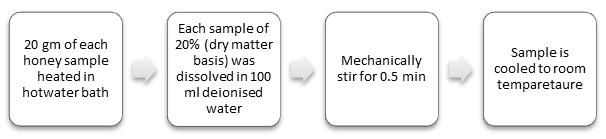
Priortoanalysis,allsamplesarestoredinglassvialsat4°C to 5°C. Each test sample is placed in hot water and dried aftergettingliquefied.Thesamplesaresetasideforaround 15minutesat25°C.Then,100mlofMilliporewaterisadded to each 20% (dry matter basis) sample, and it is mechanically agitated for 0.5 minutes [9]. Each sample of honey is subjected to voltammetric analysis using glassy carbonandcarbonpasteelectrode.
2.5 Experimental Setup
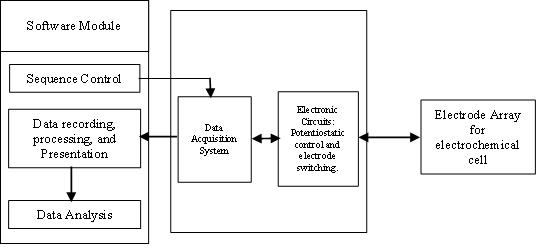
Thee-tonguesystemiscomposedofathree-electrodemultipotentiostat system working in conjunction with an electrochemical cell housing the electrode array. Fig. 2 depictstheschematicofavoltammetrice-tongue.Thethree major components of the customized e-tongue are the software module, the hardware interface module, and an electrodearrayforsensingtheanalytesofthehoneysample.
2.6 Electronic Tongue Measurement
Voltammetric methods involve a three-electrode measurement model [6-7]. Electrochemical experiments were performed using a potentiostat, a readily accessible electronicprobe(GamryInstrumentsInc.).Thepotentiostat controls the potential of the working electrode in a multielectrode electrochemical cell. GC and CP electrodes are routinelyusedaselectrodesandtheelectrodesareAg/AgCl (saturatedKCl,GamryInstrumentsInc).
Cyclicvoltammogramsareloggedbetween-0.4Vand0.7 VforGCelectrodesatascanningfrequencyof0.2V/s,and between -0.45 V and 0.7 V for CP electrodes at a scanning frequencyof0.3V/s.Thestudiesareconductedat25°C(25± 1°C)throughout.
3. RESULTS AND ANALYSIS
The voltammetric responses are observed for both electrodes.Transientresponsefromtheelectrodesvariesin accordancewiththefloraltypeandgeneratesacomplexdata setforanalysisandfloralclassification.
The383measurementpointsfromtheCPelectrodeandthe 720 measurement points obtained from the GC electrode havebeenusedinPrincipalComponentAnalysis(PCA)and LinearDiscriminantAnalysis(LDA)[19]analyses.
The supervised multivariate data analysis method PCA is usedtovisualizetheinformationcontainedandreducethe dimensionalityofthedataset.Datapretreatmentwasdone priortodimensionreductionforbothdatasetstomaximize variance and minimize correlation in the data sets. Each collection of data is converted into an uncorrelated set of principal components. LDA has been considered for both data sets. It is used for maximizing the variance between classes and minimizing the variance within the class. The maingoal istomaximizethisratiotoachieveappropriate classseparability.
3.1 Electrochemical characterization of the different honey samples using GC electrode and CP electrode.
The electrochemical analysis provides significant informationonvariousanalytesofhoney.Thedata points obtainedfromacyclicvoltammogramofGCelectrodeson40 samplesoffourdifferentfloraloriginsareshowninchart-1.
Voltammograms obtained from CP electrodes of different floraltypesofhoneysamplesshowcomplexreductionand oxidation peaks for every discrete trial. The intricate componentscontainedintheelectrolyteexhibitapositive effect on the crest position. This is because of the dissemination of different analytes that occur due to undergoing oxidation and reduction on the carbon paste electrode's surface. Chart-2 shows the voltammograms of theCP electrodes forfour different floral originsof honey samples. The main difference is the relative change in the intensitiesofthepeaks.
3.2 Multivariate Data Analysis
Principal Component Analysis (PCA) and Linear DiscriminantAnalysis(LDA)werethetwotechniquesused forthemultidimensionaldatamatrixobtainedfromtheGC andCPelectrodes.PCAhasbeenusedforclusteringwhereas ANNhasbeenusedforclassification.Adatamatrixof40× 720 for GC electrodes and 40 x 383 for CP electrodes has beenproducedfromtherawdatasetof40honeytrials.For theGCelectrode,430observationsweretakenintoaccount for training, and 290 data pointsfor testing, whereas 230 data points weretaken into consideration for the CP electrode. The entire data assessment was conducted utilizingMATLABversion7.13(MathWorks).Chart-3,Chart4 and Chart-5, Chart-6 show the PCA and LDA plots, respectively.
Asshowninchart-3andchart-4,PC1&PC2explainthetotal varianceof93.99%fortheGCelectrode&97.14%variance fortheCPelectrode.
Chart – 4: Two-dimensionalPCAplotofthehoney samplesusingcarbonpasteelectrode.

Thedistinctionbetweenthefourclassesofsamplesforboth workingelectrodesisshownbytheLDAplotinFig.6(a-b). Thisdatatransformationmethodmaximizestheratioofthe between-classvariancetothewithin-classvariance. When allfourfloralvarietiesofhoneyweresubjectedtoLDAusing CPE, the result showed a variance of about 99.27% as opposed to 74.94% when glassy carbon was used as the workingelectrode. However,theresultmaybeconsidered farbettercomparedtothatofthefloraloriginassessmenton arbitraryreportsbytheapiaries.
Theclassseparabilityindex isshowninTable2.ForGCis 11.85whereasforunmodifiedCPelectrodesis15.78.This improvementshowscarbonpasteelectrodesrespondbetter to floral classification. Table-2. demonstrates each functioningelectrode'scapacityforseparationbasedonPCA.
3.3 Artificial Neural Network
Usingneuralnetworks[20],theback-propagationmultilayer perceptronalgorithmwasusedtoclassifytherawdata,and the classifier's efficacy was evaluated using the 10-fold cross-validation method. The data set is classified using a multilayerperceptron,andtheperformanceoftheclassifier isestimatedusinga10-foldcross-validationapproach.For cross-validation,a total of 40data patternsare taken into account. One subset (containing 10% of the total data) is used as the test set, and the remaining nine subsets (containing90%ofthetotaldata)areusedas thetraining set. To determine the classifier's performance, the classificationratesarethenaveragedacrossthesefolds.The CPelectrode'scategorizationrateisnoticeablyhigherthan theGCelectrodes.Table3displaystheresults.
REFERENCES
[1] Lu,Lin,etal."Electronictongueandelectronicnosefor food quality and safety."Food Research International(2022):112214.
[2] Vlasov, Y.; Legin, A.; Rudnitskaya, A.; Di Natale, C.; D’amico, A. Nonspecific Sensor Arrays (“Electronic Tongue”) for Chemical Analysis of Liquids (IUPAC TechnicalReport.PureAppl.Chem.2005,77(11),1965–1983.
[3] Nowshad, F., Khan, M.S.: Electronic tongue for food safetyandqualityassessment.TechniquestoMeasure Food Safety and Quality: Microbial, Chemical, and Sensory,229–247(2021).
[4] Cetó, Xavier, Sandra Pérez, and Beatriz Prieto-Simón. "Fundamentals and application of voltammetric electronic tongues in quantitative analysis."TrAC TrendsinAnalyticalChemistry(2022):116765.
[5] Mohamed,S.,Khaled,S.,Dahshan,M.,Mohamed,B.,Badr, M., Hussein, K.: A review of the electronic tongue for liquidclassification.In:20222ndInternationalMobile, Intelligent, and Ubiquitous Computing Conference (MIUCC),pp.310–315(2022).IEEE

[6] Ciursa,P.;Oroian,M.VoltammetricE-TongueforHoney AdulterationDetection.Sensors,21,5059,2021.
3. CONCLUSIONS
Two separate carbon-based electrodes are examined for floral identification. Investigational outcomes of PCA and LDAreveal CP electrodehas improvedgrouping ability as evaluatedagainsttheGCelectrodeforfloralclassificationof honey test samples. The data points obtained fromcyclic voltammogramsare classified using an artificial neural network.Honeycompositiondependsuponvariousfactors among which nectar collected by bees plays an important role.Thus,makingthisapproachofclassificationusingANN quite effective. Additionally, it has been found that the CP electrode performs more effectively compared to the GC electrodeforidentifyinghoneysamples.TheCPsensorused inthisstudyshowsbetter-classifyingcapabilitycomparedto theGCelectrode.Inthefuturecustomizedmetaloxide-based CP electrodes may improve the capacity to distinguish betweendistinctfloralhoneyorigins.
ACKNOWLEDGEMENT
The "Madhu Society", Bankura, and West Bengal have graciouslyprovidedthewriterswithsamplesoftheirhoney, forwhichtheauthorsaregrateful.
[7] Leon-Medina,J.X.,Acosta-Opayome,D.,Fuenmayor,C.A., Zuluaga-Dom´ınguez, C.M., Anaya, M., Tibaduiza, D.A.: Intelligentelectronictonguesystemfortheclassification of genuine and false honeys. International Journal of FoodProperties26(1),327–343(2023).
[8] Nascimento,A.S.,Silva,F.d.L.,Machado,C.S.,Silva,S.M.P., Estevinho,L.M.,Dias,L.G.,Carvalho,C.A.L.d.:Useofthe electronic tongue as a tool for the characterization of melipona scutellaris latreille honey. Journal of ApiculturalResearch61(1),79–90(2022).
[9] Tiwari,K.,Tudu,B.,Bandyopadhyay,R.,Chatterjee,A.: Identificationofmonofloralhoneyusingvoltammetric electronictongue.JournalofFoodEngineering117(2), 205–210(2013).
[10] Kang,J.S.,Kim,S.,Kang,J.,Joo,H.,Jang,J.,Jo,K.,Park,S., Kim, H.-i., Yoo, S.J., Yoon, J., et al.: Surface electrochemistry of carbon electrodes and faradaic reactions in capacitive deionization. Environmental Science&Technology56(17),12602–12612(2022).
[11] SouzaVieira,L.:Areviewontheuseofglassycarbonin advancedtechnologicalapplications.Carbon186,282–302(2022).
[12] Choudhury,SakebHasan,etal."OxidationBehaviorof Glassy Carbon in Acidic Electrolyte."ChemElectroChem9.20(2022).
[13] Adams,RalphN."Carbonpaste electrodes."Analytical chemistry30.9(1958):1576-1576.
[14] McCreery.R.L,CarbonElectrodes:StructuralEffectson Electron Transfer Kinetics, CRC Press, 1st Edition (1990).
[15] Rebolledo-Perales, L.E., Romero, G.A.´A., Ibarra, I., Gal´an-Vidal, C.A., Flores-Aguilar, J.F., P´erez-Silva, I.: Quantitative analysis of pb (ii) based on differential pulse anodic stripping voltammetry and iip-carbon pasteelectrodes.JournalofTheElectrochemicalSociety 169(5),057504(2022).
[16] Sramkova,E.,Bystron,T.,Bouzek,K.:Quantificationof electrocatalytic activity of glassy carbon electrode. ElectrochimicaActa379,138177(2021).
[17] Zittel, H., Miller, F.: A glassy-carbon electrode for voltammetry. Analytical Chemistry 37(2), 200–203 (1965).
[18] Jiang,L.,Zheng,K.:Towardstheintelligentantioxidant activityevaluationofgreenteaproductsduringstorage: Ajointcyclicvoltammetryandmachinelearningstudy. FoodControl148,109660(2023).
[19] Umar, L., Nur Hafifah, C., Rosandi, V.A., Tamara, M.R., Suhendar,H.,Triyana,K.:Potentiometrylipidmembrane basedelectronictonguefortheclassificationofmintin tea by principal component analysis (PCA) and linear discriminationanalysis(LDA).InstrumentationScience &Technology,1–10(2023).
[20] Haykin, S., 2001. Neural Networks: A Comprehensive Foundation,seconded.PearsonEduc.,HongKong,Asia