A Neural Network Approach to Deep-Fake Video Detection
Prajwal Chunarkar1 , Vivek Upadhyay1 , Sagar Sanap1 , Anirudh Talmale , Prof. Varshapriya J N 21BTech Student, Dept of Computer Engineering and IT, VJTI College, Mumbai, Maharashtra, India
2Associate Professor, Dept of Computer Engineering and IT, VJTI College, Mumbai, Maharashtra, India ***

Abstract - Deep learning has been used to solve a variety of complex challenges, including big data analytics, computer vision, and human-level control. Deep learning developments, on the other hand, have been used to develop applications that pose a risk to anonymity, democracy, and national security. Deepfake is a recent example of a deep learning-powered technology. Deepfake algorithms can generate fake photographs and videos that are difficult to tell apart from real ones. As a result, the development of technology that can automatically identify and measure the integrity of digital visual media is critical.Using artificially intelligent software to build the DF is an easy process. However, detecting these DF poses a significant challenge. Since it is difficult to train the algorithm to detect the DF. Using Convolutional Neural Networks and Recurrent Neural Networks, we have made progress in detecting the DF. At the frame stage, the system employs a convolutional Neural network (CNN) to extract features. These characteristics are used to train a recurrent neural network (RNN), which learns to classify whether or not a video has been manipulated and can detect frame temporal inconsistencies caused by DF creationtools. Expectedoutcome as compared to a large number of fake videos gatheredfroma regular data set. We demonstrate how using a simple architecture, our system canachieve competitive results in this mission.
Key Words: Deepfake Video Detection, convolutional, Neuralnetwork(CNN),recurrentneuralnetwork(RNN)
1.INTRODUCTION
Recent advances in artificial intelligence (AI) and cloud computingtechnologyhaveresultedinrapiddevelopments inaudio,video,andimageprocessingtechniques.Deepfakes arethetermforthiskindof fakemediamaterial AI-based toolswillalsoexploitmediainmoreconvincingways,such asduplicatingapublicfigure'svoiceorsuperimposingone person's face over another's body. Deep generative adversarial models that can exploit video and audio clips generate"DeepFake."Thespreadofthe DF throughsocial media channels has become very popular, resulting in spammingandthedisseminationofincorrectinformation. ThisformofDFwouldbebad,andwillthreatenandconfuse ordinarycitizens.
TheimportanceofDFidentificationinsuchacasecannotbe overstated. As a result, we present a new deep learningbasedmethodfordistinguishingbetweenAI-generatedfake videos (DF Videos) and real videos. It’s very important to
developtechnologythatcanidentifyfakes,sothattheDFcan bespottedandpreventedfromspreadingovertheinternet
2. LITERATURE REVIEW
Deepfakevideo'sexponentialdevelopmentandillicitusage poseaseriousthreattogovernment,justice,andpublictrust. As a result, the market for fake video review, monitoring, and interference has risen. The following are some of the relevantstudiesindeepfakeidentification.
ExposingAICreatedFakeVideosbyDetectingEye Blinking[1]explainsanewapproachforexposingfakeface videos produced by deep neural network models. The approach relies on the identification of eye blinking in videos,whichisaphysiologicalsignalthatisn'twellshown in the fake videos. The method is tested on eye-blinking recognition datasets and shows positive results when it comes to detecting videos created with Deep Neural NetworkbasedsoftwareDF.
Theirsystemreliessolelyontheabsenceofblinking as an identification clue. However, other factors such as teethenchantment,linesontheforehead,andsoonmustbe noticedwhendetectingadeepfake.Allofthesecriteriaare takenintoaccountbyoursystem.
Usingcapsulenetworkstodetectforgedimagesand videos [2] uses a method that uses a capsule network to detect forged, manipulated images and videos in different scenarios, like replay attack detection and computergeneratedvideodetection.
Intheirmethod,theyhaveusedrandomnoiseinthe training phase which is not a good option. Still the model performed beneficial in their dataset but may fail on real timedataduetonoiseintraining.Ourmethodisproposedto betrainedonnoiselessandrealtimedatasets.
Luo et al. [3] introduces JPEG error analysis to determine when bitmap images have been compressed previously,approximatequantizationsteps,anddetectthe quantization table in a JPEG image. Their ability to detect JPEG blocks as small as 8x8assists in the identification of tamperedareasinanimage.Bianchietal.
J. H. Bappy et al. [4] introduce a method for manipulationlocalizationthatusesanLSTMnetworkandan encoder-decodersystemto constructa mappingfromlow resolutionactivationstopixel-wisepredictions.CNNshave
beensuccessfullyusedtoidentifyfakephotographsinrecent years.
The Biological Signals Method for Detecting SyntheticPortraitVideos[5]extractsbiologicalsignalsfrom facial regions on authentic and fake portrait video pairs. TrainaprobabilisticSVMandaCNNusingtransformations to compute spatial coherence and temporal consistency, capturesignalcharacteristicsinfeaturesetsandPPGmaps, and capture signal characteristics in feature sets and PPG maps.Theaggregateauthenticityprobabilitiesarethenused todeterminewhetherthevideoisgenuineornot.
3. DATA PREPARATION
Basic concept- Deepfakes have a very basic definition. Let'spresumewewanttoaddpersonA'sfacetoavideoof personB.
Tobegin,wegatherhundredsorthousandsofphotographs forbothindividuals.UsingadeeplearningCNNnetwork,we builtanencodertoencodealloftheseimages.Thepictureis then reconstructed using a decoder. This auto encoder (encoderanddecoder)hasoveramillionparameters,butis notevencloseenoughtorememberallthepictures.
Intuitively,theencoderdetectsfaceangle,skintone,facial expression, lighting, and other data needed to recreate individualA.
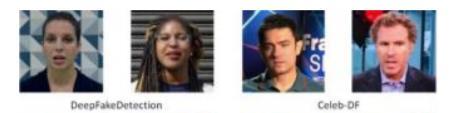
ThisresearchmakesuseofthreeofthemostrecentDeepFakevideodatasetsthatwererecentlymadepublic–
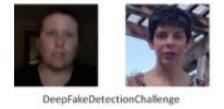
1. DeepFakeDetectionChallenge (DFDC) Preview [8]FacebookAIhascompiledthemostrecententryinthefield of Deep-Fake datasets. To prevent cross-set face swaps, a poolof66payingactorswasdividedintotrainandtestsets, and their filmed sequences were used to produce manipulated videos internally. There are 5214 videos in total,with78.125percentofthembeingmanipulated.They achievedhighmanipulationefficiencybyselectingpairsof identicalappearances,andvisualqualityisalsohigh.
2 FaceForensics is a forensics dataset made up of 1000 original video sequences that were edited using four different automatic face simulation methods: Deepfakes, Face2Face,FaceSwap,andNeuralTextures.Thedata came from 977 YouTube images, all of which have a trackable largelyfrontalfacewithnoocclusions,allowingautomatic tamperingmethodstocreatepracticalforgeries.
3.Celeb-DF[7]-TheCeleb-DFdatasetcontains590origin-al YouTubevideosofsubjectsofvariousages,ethnicgroups, andraces,aswellas5639DeepFakevideos.
:OriginalvsDeepfake
WedrawindividualBbutwiththebackgroundofAwhenwe use the second decoder to reconstruct the picture. The reconstructedimageintheimagebelowhasTrump'sfacial characterswhilekeepingthegoalvideo'sfacialexpression.
The task of Deep-Fake detection is framed as a binary classification task, with real and fake images as the two classes.WeusesupervisedlearningtotrainaConvolutional NeuralNetworkonsetsofrealandfalsesamplestoestimate thelikelihoodoftestimagesbeinginfluencedbydeep-fake manipulations.ThevariousDeep-Fakevideodatasetsused inthismethodaredescribedinthissection,aswellasthe processforcuratingimagedatasetsfortrainingandtesting.

4. PROPOSED SYSTEM
TherearemanyresourcesavailableforgeneratingtheDF, buttherearefewtoolsavailablefordetectingtheDF. Our method for detecting the DF can make a significant contribution to preventing the DF from percolating. Detection of all forms of DF, including replacement, retrenchment,andinterpersonalDF.
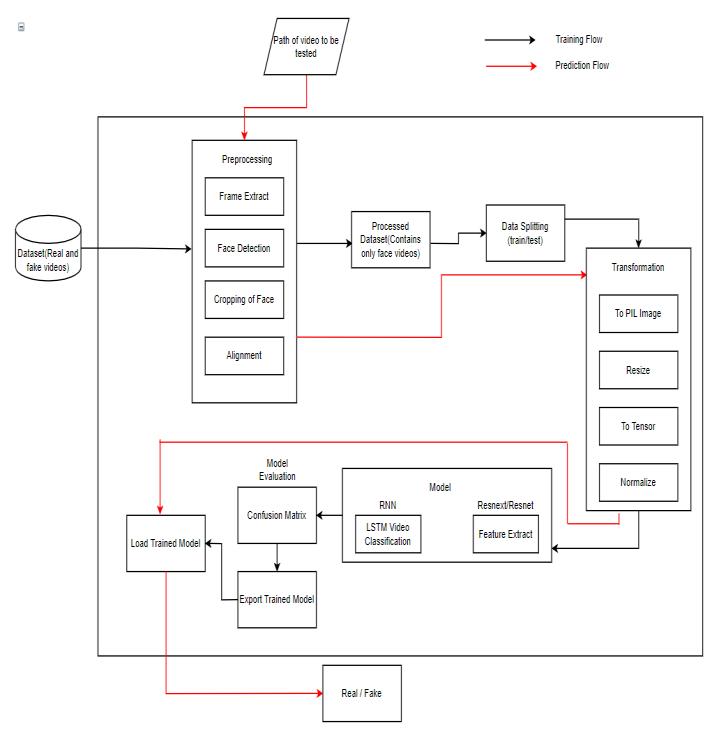
The model is made up of resnext50 32x4d and one LSTM layer.TheDataLoaderloadsthepreprocessedfacecropped videosanddividesthemintotwosets,onefortrainingand onefortesting.
Weproposethatinsteadofrewritingtheclassifier,weuse the ResNext CNN classifier for extracting features and accuratelydetectingframelevelfeatures.
Weneedtofixthede-signofamodeltorecursivelyprocess a sequence in a meaningful manner, so we use LSTM for SequenceProcessing.
We'realsousingatransferlearningapproachtoboostour model'sgeneralizabilityoverawidevarietyofdatasets.
dataset[8].Ournewlyprepareddatasetcontains48.69%of theoriginalvideoand51.31%ofthemanipulateddeepfake videos.Thedatasetissplitinto70%trainand30%testset.
B. Preprocessing:
Splitting the video into frames is part of the dataset preprocessing.Followingthat,facedetectionisdone,andthe framecontainingthedetectedfaceiscropped.Tokeepthe number of frames constant, the video dataset's mean is calculated,andanewprocessedfacecroppeddatasetwith frames equal to the mean is created. Frames that do not containfacesareignoredduringpreprocessing.
Itwilltakealotofcomputingpowertoprocessa20-second videoat25framespersecond,or500framesintotal.So,for the sake of experimentation, we recommend training the modelwithonlythefirst100frames.
C.
Model:
Themodelismadeupofresnext5032x4d/resnet50andone LSTM layer. The Data Loader loads the preprocessed face cropped videos and divides them into two sets, one for trainingandonefortesting.Inaddition,theframesfromthe processed videos are transferred to the model in mini batchesfortrainingandtesting.
D. ResNext CNN/ ResNet CNN for Feature Extraction
Instead of writing the rewriting the classifier, we are proposingtousetheResNextCNN/ResNetCNNclassifierfor extractingthefeaturesandaccuratelydetectingtheframe levelfeatures.Following,wewillbefine-tuningthenetwork by adding extra required layers and selecting a proper learningratetoproperlyconvergethegradientdescentof themodel.The2048-dimensionalfeaturevectorsafterthe last pooling layers are then used as the sequential LSTM input.
E. LSTM for Sequence Processing
A. Dataset:
Fig -III:SystemArchitecture
We are using a mixed dataset which consists of equal amount of videos from different dataset sources like YouTube,FaceForensics++[9,]Deepfakedetectionchallenge
Assumea2-nodeneuralnetwork withtheprobabilitiesof theseriesbeingpartofadeepfakevideooranuntampered video as input and a sequence of ResNext CNN feature vectors of input frames as output. The main problem we must solve is the design of a model that can recursively processasequenceinameaningfulway.Weproposeusinga 2048 LSTM unit with a 0.4 probability of dropping out to solvethisproblem,whichis capableofachievingourgoal. The LSTM is used to process the frames in a sequential mannersuchthatthevideocanbetemporallyanalyzedby comparing the frame at ‘t' second to the frame at ‘t-n' seconds.Beforet,ncanbeanynumberofframes.
F. Training:
We choose one of the 2 types of Convolutional Neural NetworkarchitectureResnet50andResnext50_32x4dwhich
aretrainedonImageNet[10]datasetwhichcontainsover14 millionimagesandcanclassifyover1000categories.Alotof low-levelfeaturescanbelearnedfromthesemodelswhich are going to help learning algorithm do better The Adam optimizationalgorithmisused,alongwithacross-entropy loss function and a mini-batch size of four videos. All the trainingisperformedontheNVIDIATeslaP100GPUs.The transfer learning aided models were initialized with ImageNetweights.TheNVIDIATeslaP100GPUsareusedfor allofthetraining.ImageNetweightswereusedtoinitialize thetransferlearningaidedmodels.Thisprocessisreferred as fine-tuning. The model is trained with a slightly lower learning rate. As compared to a model trained without Transfer Learning, this results in a substantial increase in validationaccuracyafteronlyoneepoch.
G. Predict:
The learned model is given a new video to predict. A new video is also preprocessed to incorporate the trained model's format. The video is split into frames, then face cropped,andinsteadofstoringthevideolocally,thecropped frames are transferred directly to the qualified model for detection.
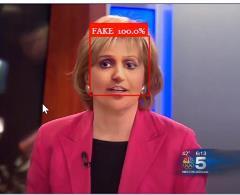

Itisinevitable.
5. Result
TableIIcanbeusedtodrawalotofinferences.Throughout thetable,TransferLearninghashadasignificanteffecton accuracies in both Resnet50 with LSTM and Resnext50_32x4dwithLSTMmodels.Withtheexceptionof one block when we used ResNext with Transfer Learning with LSTM sequence length 60, the strong influence of increasing sequence length can be seen invariably throughoutthetable.
6. Conclusion
Theresultsshowthattheintuitionbehindtheeffectiveness of Transfer Learning for Deep-Fake Detection is accurate. AnotherinterestingobservationisthatResNextCNN with LSTM is giving better results in terms of accuracies than ResNetCNNwithLSTMkeeping sequencelengthsamefor both , with the exception of only two blocks having accuracieshigher inResnet CNN withLSTMthan ResNext CNNwithLSTM.Theaccuracyincreaseratewithincreasein
sequencelengthdecreaseswithincreaseinsequencelength, but the computational cost to train the model increases tremendouslysoitisnot feasibletojustkeepincreasingthe sequencelength.
We introduced a neural network-based method for classifyingvideosasdeepfakeortrue,aswellasthemodel's trust level. Our system uses ResNext CNN for frame level identification and RNN and LSTM for video classification. Basedonthecriteriamentionedinthepaper,theproposed methodwilldetectwhetheravideoisadeepfakeornot.It can, we think, have extremely high precision on real-time data.
REFERENCES
[1] YuezunLi,SiweiLyu,“ExposingDFVideosByDetecting Face Warping Artifacts,” in arXiv:1811.00656v3. M. Young, The Technical Writer’s Handbook. Mill Valley, CA:UniversityScience,1989.
[2] Huy H. Nguyen, Junichi Yamagishi, and Isao Echizen “Using capsule networks to detect forged images and videos”.
[3] Luo, W., Huang, J., & Qiu, JPEG Error Analysis and Its Applications to Digital Image Forensics, IEEE Transactions on Information Forensics and Security, 5(3),pp480 491,2010
[4] J.H.Bappy,C.Simons,L.Nataraj,B.S.ManjunathandA. K.Roy-Chowdhury,"HybridLSTMandEncoder-Decoder Architecture for Detection of Image Forgeries," IEEE Transactions on Imageprocessing.28,no.7,pp.32863300,2019.
[5] UmurAybarsCiftci,˙IlkeDemir,LijunYin“Detectionof Synthetic Portrait Videos using Biological Signals” in arXiv:1901.02212v2.
[6] He,K.,Zhang,X.,Ren,S.,Sun,J.:Deepresiduallearning for image recognition. In Proceedings of the IEEE conferenceoncomputervisionandpatternrecognition, pages
[7] Y.Li,X.Yang,P.Sun,H.Qi,andS.Lyu,"Celb-DF:Anew datasetfordeepfakeforensics,"arXiv1909.12962,2019.
[8] B. Dolhansky, R. Howes, B. Pflaum, N. Baram, C Ferrer, "The Deepfake detection Challenge (DFDC) Preview,Dataset",arXiv:1910:08854,2019
[9] https://github.com/ondyari/FaceForensics.
[10] Deng J, Dong W, Socher R, Li L-J, Li K, Fei-Fei L Imagenet:Alarge-scalehierarchicalimagedatabase In: 2009 IEEE conference on computer vision and patternrecognition.2009.
[11] M. Torres, T. Raeder, R. Alaiz-RodiGuez, N. Chawla, F. Herrera, "A unifying view on dataset shift in classification",PatternRecognition,Elsevier,2012.
[12] R.Raghavendra,KiranB.Raja,SushmaVenkatesh,and ChristophBusch,“Transferabledeep-CNNfeaturesfor detecting digital and print-scanned morphed face images,”inCVPRW.IEEE,2017.