Progression of Radio Access Network towards Open-RAN
Varshini AR1, Vidya C Raj2
1PG student, Department of Computer Science & Engineering, The National Institute of Engineering, Mysuru570008, India
2Professor, Dean (Academic Affairs) Department of Computer Science & Engineering, The National Institute of Engineering, Mysuru-57008, India ***
Abstract - The advent of 5G technology has revolutionized communication, propelled by the transformative concept of Open Radio Access Network (ORAN), which aims to reshape the communications sector. ORAN’s innovative architecture emphasizes openness, interoperability, and virtualization, standing in stark contrast to the closed nature of traditional Radio Access Network (RAN) designs. Guided by principles of disaggregation and virtualization, ORAN separates hardware components and enables adaptable, scalable network functions. By dismantling vendor lock-in, ORAN fosters collaboration, diversity, and innovation among stakeholders. Disaggregation drives multi-vendor interoperability, creating a competitive market where network operators can select components from various manufacturers, enhancing flexibility. Virtualization further bolsters performance by transitioning from hardware to software-based solutions, im- proving costefficiency, scalability, and agility. ORAN’s strategy enhances network flexibility, allowing operators to swiftly meet changing demands and introduce new services. Through its virtualized architecture, dynamic resource allocation optimizes resource usage, enhancing user experiences. ORAN emerges as a transformative force in telecommunications, challenging conventional closed RAN models and offering a dynamic vision for the future of communication technology.
Key Words: Open Radio Access Net- work (RAN), RAN’s evolution,Open-RANarchitecture

for innovation and improved network capabilities to meet growing connection demands. Traditional RAN architectures, reliant on proprietary technology, hinder interoperability and hinder 5G’s full potential, thus prompting exploration of virtualization and disaggregation assolutions.
Disaggregation enables separation of hardwarecomponents, like baseband and radio units, fostering multi-vendor integration and a competitive market. Simultaneously, virtualization shifts processing functions to software, enhancing scalability, efficiency, and cost-effectiveness. Understanding these principles empowers operators to respond effectively to evolving needs and harness 5G’s potential. ORAN,endorsedbyplayersinthetelecomsector, isolates hardware and software, allowing top-tier solutions fromdiversesupplierstointegrateflexibly.ORANsignifiesa pivotal shift towards openness, interoperability, and virtualization in RAN design, supporting competition, innovation,andnetworkstability.Itformsthefoundationfor 5G andbeyond, promotingcooperation,standardization,and secureoperations. Throughcollaborative efforts, challenges related to interoperability and security are addressed, ensuringtheeffectivedeploymentofORAN’spromise.
2. EVOLUTION OF RAN
1.INTRODUCTION
Overthepast50years,wirelesscommunicationtechnology hasevolvedsignificantly,withrecentadvancementsinIoT and real-time applications driving a surge in wireless frameworks.OpenRadioAccessNetwork (ORAN)seeks to separate hardware and software components, facilitating adaptable integration from multiple suppliers. IoT emphasizes wide coverage and low power consumption, while real- time applications require low latency and dynamicdataprocessing,necessitatingaversatilenetwork. TraditionalRadioAccess Network (RAN) models fall short of meeting these requirements, urging the need for enhancements. Constructing separate networks for different applications isimpractical, prompting efforts to create software-driven, virtualized, intelligent, and energyefficient mobile networks. Acknowledging the transformational potential of fifth- generation(5G) wireless technology, the telecommunications industry strives
Network infrastructure design’s primary objective is secure and efficient device communication. The Radio Access Network(RAN)isafundamentalconceptintelecommunications thatplaysa vitalroleinensuringseamlessconnectivityand effective data transmission between devices and the core network.NetworkoperatorsareupgradingRANstomanage increased device connections, data traffic, and 5G- based serviceswhileoptimizingresourcesandmaintaining Quality of Service/Experience (QoS/QoE).RAN’s deployment, operations, and maintenance constitute a significant cost, promptingoperatorstofocusonreducingCapExandOpExby creating a flexible RAN that accommodates various deploymentoptionsandservices.RANiscomposedofradio resource management and radio signal transmission/reception. Traditional RANs and Distributed RANs (D-RANs)functionindependently, buttheirintegrated architecturecallsfordenserdeploymentasuserconnections increase,resultinginhighercostsforcapacityenhancement. TheCloudRAN (C-RAN)conceptemerged asa solutionto © 2023, IRJET | Impact Factor value: 8.226 | ISO 9001:2008 Certified Journal | Page657
reducecosts.C-RANintroducedRANnoderesourcesharing to address the challenges of base station deployment and operation.
2.1 C-RAN
C-RAN, also known as Centralized RAN or Cloud RAN, involves splitting the RAN into separate Remote Radio Units/Heads (RRUs/RRHs) and a centralized pool of Baseband Units (BBUs) in a cloud data center. This architecture supports centralized processing, real-time networking,andscalability,facilitatedbyanewFHinterface connecting BBUs and RUs. However, challenges include single point of failure for BBUs, security concerns, and limitations related to FH overhead, proprietary interfaces, andvendordependence.
2.2 The virtualized RAN (vRAN)
vRANutilizesvirtualizationinadditiontothesamemethodology as the C-RAN. By utilizing the NFV concepts, vRAN decouples the software from the hardware and replaces expen-sive,proprietaryhardwarewithCOTShardware.The coordi-nationofRANnodestoallocatenetworkresources forvariousservicesdependingontherequirementsofthose servicesisdifficult,thecomplexityofnetworkadministration hassub-stantiallyrisen,andaproprietaryinterface-based deploymentleadstovendorlock-in.
2.3 5G Networks
5G’s new air interface, New Radio (NR), and the Next GenerationRAN(NG-RAN)collectivelyshapethe5Gsystem.

The 5G NR employs physical connections for radio- based communicationandoperatesintwomodes:Non-Standalone (NSA)andStandalone(SA),enablingefficientdatamanagementandhigherdatarates.InSAmode,directconnectivity betweengNBandthe5GCsupportsadvancedservices,while NSAmodefacilitateseMBBclassservicesthroughaconnectionbetweenLTE,NR,andthe4GCN(EPC).
challenges remain in achieving virtualization, softwaredriven adaptability, interoperability, and energy-efficiency, which the O-RAN Alliance aims to address through open interfacesandvirtualizededgecomputinginfrastructure.
3. LITERARURE SURVEY
The concept of ”Open RAN” envisions a future for the Radio Access Network (RAN) with goals including vendorindependent and AI-driven solutions. With the complexity of new use cases introduced by 5G and beyond (B5G) networks, traditional methods impede rapid innovation and standardized AI application. The Open Radio Access Network (O-RAN) alliance proposes an architecture based on disaggregated RAN functions, managed bya RAN controller enforcing decisions via open interfaces. The O-RAN initiative employs machine learning techniques, especially deep learning, to facilitate in- telligent RAN applications that meet Quality of Service (QoS) requirements. In the context of wireless cellular networks, Device-to- Device (D2D) communication holds promise for boosting data speeds, reducing latency, and enhancing efficiency. This technology is examined in the context of fifth generation and beyond (5GB) networks, with a focus on the inband (IBD) and out-of-band (OBD) D2D modes. Integration of D2D communication with other technologies is highlighted for network performance enhancement, addressing challenges, possibilities, and future directions within the context of 5G and even 6Gnetworks.
4.
Fig -1:4Gand5Garchitectures
Fig1illustratesthearchitecturesofboth4Gand5Gsystems, where 5G’s NG-RAN allows RAN disaggregation and configurablefunctionalsplitoptions.NG-RAN’sdeployment supportscontrolplaneanduserplaneseparation,enabling flexiblescalingandavarietyofdeploymentchoices.However,
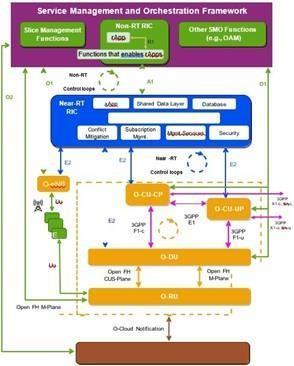
The 3GPP 5G System laid the foundation for the O-RAN architecture,enhancingRANfeaturesandintroducingopen, interoperableinterfaces.O-RANaimstodiversifythesupply chain,reducedeploymentcosts,andfosterinteroperability among vendors. Unlike NG-RAN, O-RAN incorporates new nodes,openinterfaces,andcloudinfrastructure,allowingfor a virtualized RAN with AI/ML-powered intelligent radio controllers.TheO-RANreferencearchitectureincludescomponentslikeRICs,O-CU,O-DU,O-RU,O-Cloud,O-eNB,andOUEs, interlinked through various interfaces to form a dynamicnetwork.
4.1 SMO FRAMEWORK
O-RAN’s vision for 5G RAN emphasizes adaptability, scalability,and multi-vendor interoperability,with a strong focus on management and automation. The SMO framework plays a central role in managing and orchestrating variousO-RAN components, resembling the NFV MANO entity and operating through standardized service-based interfaces to ensure interoperability, while providing FCAPS managementfunctionalities and offering orchestration, workflow management, RAN optimization, andnon-RTRICcapabilities.
4.2 O-RU (OPEN-RAN RADIO UNIT)
definedcomponents: the non-Real-Time RIC for longer-term operations and the near-Real-Time RIC for more real-time tasks. These RICs communicate through the A1 and E2 interfaces, utilizing controlloops tooptimizenetworkswith real-timeintelligence. TheO-RAN architectureprovidesnonRT, near-RT, and RT control loops, operated by the respective RICs and E2 nodes, addressing varying time scales. Thesecontrol loops useAIand ML algorithms,along with data from O-RAN functions, to automate operations, createanabstractnetworkview,andenableoptimizedRAN actions.
4.4 O-DU (OPEN-RAN DISTRIBUTED UNIT)
O-DUisa dynamic logicalnodeinO-RAN, hostingproto- col functionslikePHY-High,MAC,andRLCforbasestationtasks basedonfunctionalsplitoption7.2x.Itconsistsof twological nodes, one for PHY-High and another for MAC and RLC functions, often implementing the Small Cell Forum’s proposed standardinterfaceknownasFAPI.
4.5 O-CU (OPEN-RAN CENTRAL UNIT)
O-CU is a logical node in O-RAN that handles protocols like SDAP,PDCP,andRRC,dividedintoCU-CP and CU-UPusing the SDN-inspired concept of control plane/user plane separation. This architectural division allows for scalable andcost-effective solutions using the E1 interface, while edge cloud hosts O-DU, O-CU-CP, and O-CU-UP, with RICs capableof operating in either the edge or regional cloud.

4.6 O-CLOUD (OPEN-RAN CLOUD)
O-Cloudcomprisesphysicalinfrastructurenodes hostingORAN functions, software components, and management tasks.ItcommunicateswithO-RANfunctionsviatheO-Cloud Notificationinterface,withedgeandregionalcloudshosting RAN functionalities such as O-DU, O-CU-CP, and O-CU-UP based on latency requirements, while non-RT RIC is deployedinregionalcloud,andnear-RTRICcanbeplacedin either edge or regional cloud, all managed and coordinated byO-Cloud and SMO.
Atthephysicallayerofthenetwork, theO-RU,a radiounit foundatcell sites,transmits,receives,andprocesses radio signals.Theradiosignalsareexchanged betweenthe O-RU andtheO-DUintheO-RANreferencearchitectureusingthe OpenFHinterface. TheO-RUimplementsthePHY-Lowand Radio Frequency (RF) processing capabilities in accordance with the functional split option 7.2x, as indicatedinFig 3.
4.3 RIC’s and Closed -loop control
TheO-RAN AllianceaimstoleverageAI/ML technologiesfor automated RAN deployment and operations. It introduces two types of RAN Intelligent Controller (RIC) software-
© 2023, IRJET | Impact Factor value: 8.226 |
4.7 O-gNB (OPEN-RAN ENABLED ENB)
An eNB or ng-eNB that supports O-DU and O-RU functions withanOpenFHinterfacebetweenthemiscalledanO-eNB. Additionally, O-eNB offersoperationsandfeatureslinkedto the E2 interface, and it is connected to the near-RT RIC by E2-interface.
4.8 UE’s
ToaccessservicessimultaneouslyutilizingMR-DC,UEsare connectedtoO-RANviatheUeinterfaceandcanconnectto O-eNB and O-gNB. Smartphones used by humans and/or
5. IMPLEMENTATION OF OPEN – RADIO ACCESS NETWORK
ThetechniquesandessentialcomponentsoftheOpenRANimplementation include:
1) Define Network Management : Specify coverage, capacity, performance, and scalability requirements. Considercurrent infrastructure and future growth.
2) Planning and Strategy: Determine ORAN scope, evaluating benefits, drawbacks, and costs.
3) Vendor Choice : Select multi-vendor components (vB-BUs, RUs,controllers) forinteroperability.
4) Radio Unit Deployment: Decouple baseband and radiocomponents, flexible placement forcoverage.
5) BBUVirtualization:UseSDNand NFVforvirtualized basebandprocessing, scalability, cost-effectiveness.
6) RIC Integration: Integrate RIC with virtualizedbaseband and radio modules for centralized orchestration.
7) Testing Interoperability: Ensure components from different vendors integrate smoothly through open interfaces.
8) Deployment and Optimization: After testing, deploy ORAN network, adjust settings for desired quality.
9) Evolution and Upgrades: Evolve ORAN with new features,swiftlyupgradenetworkforincreasedflexibility andbenefits.
6. ADVANTAGES OPEN – RADIO ACCESS NETWORK
Disaggregating hardware and software allows O-RAN to createaunifiedarchitecture,whichhasalotofbenefitslike low latency and network slicing. O-RAN offers network automationaswellas thefollowing advantages:
1) Agility: Duetotheunificationofthesoftware-enabled architecture,thenetworkissuitableforbothcurrent/past andfuture generations.
2) Deployment Flexibility: Because of software associationanddis-aggregation,thenetworkisadaptable forinstallation,upgrades, and extensions.
3) Real-time responsiveness: The O-RAN softwaredriven, service-specific network gives real-time services precedence over less important services and adapts its behaviorbasedonthe service it is aimed at.
7. OPEN ISSUES AND CHALLENGES
1) Architectural Aspects : O-RAN architecture has evolvedsince2018,aimingtoalignwith 3GPP designand improve5G technologies. Adding features, blocks, and functions to enhance functionality is crucial. Future research should ad- dress O-RU termination of the O1 interface, virtualization opportunities, and coordination of multiplenear-RTRICs.
2) Performance Aspects : Virtualizing O-RAN network services offers a chance to boost performance through dynamic node transfers based on demand and failures. Managing traffic congestion, resource migration, and supporting time-sensitive use cases while maintaining qualityandservicecontinuityposechallenges inlargeand dynamic RAN deployments.
3) SecurityAspects:O-RANAllianceWorkingGroup11 researches security factors in the architecture, including threat modeling, risk assessment, security requirements, mechanisms, and testing. Security considerations for various entities, interfaces, shared cloud infrastructure, node integration, open-source software, and lifecycle managementneedfurtherexploration.
4) Energy-saving aspects: As AI and ML techniques utilizing deep neural networks demand high computationalpower,theirintegrationintoO-RANfornew services and RIC automation might raise energy consumption concerns. Balancing advanced AI/ML approaches with energy-efficient designs is important in addressing environmental impacts.
8. RESULTS
Theradiounitobtainsaspecialrelevancewithinthecontext of OpenRadioAccessNetwork (OpenRAN), resultingfrom the coordinated efforts of several manufacturers. Each element of its development requires careful attention to detail, which is provided by these firms collectively. The product’s name, a unique product number signifying its uniqueness, and a thorough explanation of the factors essential to its operational construct are some of its primary characteristics. This thorough overview also includescurrentoperationalstatusinformationfortheradio device in real-time. The Open RAN philosophy values flexibility, which is demonstrated by the radio unit’s programmableframework. Usersmay precisely modify the functionalities of the radio unit thanks to this adaptive architecture, ensuring a harmonious alignment with particular operational requirements. This adaptability supports thearchitecture’sabilitytoaccommodateavariety of use scenarios. The Open RAN’s radio unit software further enhances the radio unit’s capabilities by supplementing its hardware components. It provides information about the current Open radio unit software
version aswellas improved security features,brand-new features, and performance improvements.This software version also adds a user-friendly interface that isadjusted to the requirements of contemporary users and strengthened for compatibility with modern devices. The user interface of the program acts as a conduit for interaction with the features of the radio unit in the real world.Itsimportancein enablinga thoroughassessmentof alarm alterations within the larger context of alarm management is especially significant. This crucial task makessurethatchangesaretransparent ,improvingoverall management and control of the Open RAN’s operational integrity.
9. FUTURE WORK DIRECTIONS
TheintegrationofSDN,NFV,andothertechnologiesinto5G networks poses challenges related to decentralization, transparency,privacy,andsecurity.Blockchaintechnologyis beingexploredasapromisingsolutionduetoitsattributes likeauditability,immutability,anddistributedarchitecture. TheO-RAN AllianceisdevelopingBlockchain-enabled RAN (BE- RAN) to enhance security and authentication, aiming to overcome the centralized Certificate Authority’s single point of failure. Additionally, the O-RAN Alliance’s Next Generation RG (nGRG) is exploring Digital Twin Networks (DTNs) to address the complexity of network disaggregation, offering accurate network simulations to forecaststates,offercurrentstatus,andfacilitateinteractions withothernetworkcomponents.
10. CONCLUSION
TheOpenRadioAccessNetwork(OpenRAN)introduces an innovative approach to the telecom sector, fostering open, interoperable, and intelligent RAN solutions while improving performance and cost-effectiveness. This article presents a comprehensive overview of Open RAN’s evolution, standardization by the O-RAN Alliance, architecture, security, deployment considerations, and open-source initiatives, while also addressing unresolved challenges and future research directions. It serves as a valuable resource for understanding Open RAN’s standardization efforts and guiding further research in the field
REFERENCES
[1] AzadehArnaz,JustinLipman,MehranAbolhasan,Matti Hiltunen(IEEEAccess[Volume10]Publishedintheyear 17 June 2022 Toward Integrating Intelligence and ProgrammabilityinOpenRadioAccessNetworks.
[2] Zhirong Zhang, Jiangang Chen, Jia Hou (2021 International Wireless Communications and Mobile Computing)Publishedintheyear28June2021-02July
2021 Analysis of the Evolution Scheme of NSA RAN SharingtoSARANSharing.
[3] HuaningNiu,ClaraLi,ApostolosPapathanassiou,Geng Wu (2014 IEEE Wireless Communications and NetworkingConferenceWorkshopPublishedintheyear 06-09 April 2014 RAN architecture options and performancefor5Gnetworkevolution.
[4] Rony Kumer Saha, Shinobu Nanba, Kosuke Nishimura, Young-Bin Kim, Kosuke Yamazaki (2018 IEEE 29TH Annual International Symposium on Personal Indoor andMobileRadioCommunications(PIMRC),Pub-lished in the year 09-12 September 2018 RAN Architectural Evolution Framework toward 5G and Beyond CellularAnOverview.
[5] NischalAryal,EmmanuelBertin,NoelCrespi(202326th Conference on Innovation in Clouds, Internet and Networks andWorkshops (ICIN), Publishedintheyear 06-09 March 2023 Open Radio Access Network challengesforNextGenerationMobileNetwork.
[6] Bouziane Brik, Karim Boutiba, Adlen Ksentini (IEEE Open Journal of the Communications Society[Volume: 3]), Published in the year 28 January 2022 Deep Learning for B5G Open Radio Access Network: Evolution,Survey,CaseStudies,andChallenges.
© 2023, IRJET | Impact Factor value: 8.226 | ISO 9001:2008 Certified Journal | Page661