Studies on the Treatment of Abattoir Wastewater using a Soil Aquifer Treatment System in Conjunction with Natural Adsorbents
Sowmya. P1 , Nagarajappa D.P21PG Student, Department of Civil Engineering, U.B.D.T College of Engineering Davanagere, Karnataka, India
2Professor, Department of Civil Engineering, U.B.D. T College of Engineering Davanagere, Karnataka. India
Abstract –The main objective of this project was to determine how wellokra seed andchickenfeathers workedas adsorbents in a SAT system to clean wastewater from slaughterhouses. The goal of the study was to evaluate the removal of contaminants from wastewater, including TSS, COD, BOD, nitrate (NO3-N), phosphate (PO4), iron, andnickel. The findings suggested that okra seeds and chicken feathers could both function as effective and environmentally benign adsorbents for wastewater treatment. In a column of silty soils, the research investigated changing the adsorbent locations at different percentages (20%,40%,60%,and80%).
When silty soil was combined with okra seed powder and applied in the SAT system at a position 60 percent from the bottom of the column, the effectiveness of silt removal increased. Theadvancementofsustainablepollutionreduction is aided by this study

Key Words: Abattoir Wastewater, Soil Aquifer Treatment System, Okra Seeds, Chicken Feathers, Silty soil.
1. INTRODUCTION
Wateristhemostpreciousresourceontheplanet.Allliving things, including people and plants, depend on water for their survival. Due to the increasing population, urbanisation, industrialization, and modern agricultural practises that are leading to increased contamination of various water resources, people are today facing a water crisis.Theamountofwatercoveringthesurfaceoftheglobe is over 70.9%, with seas accounting for 97% of that total, polaricecapsfor2.4%,andotherlocalsurfacewaterbodies, such as lakes and streams, for 0.60%. The treatment of wastewater by land has been made permissible as an alternativetoconventionalwastewatertreatmentmethods inordertoaddresstheseproblems.Although thesoilwas abletopurifywastewaterbyadsorption,filtration,chemical reactions,andbiologicalprocesses[1].Theusageofwater for feeding (storm rainwater or leftover water from the treatmentplantoutput)duringsoilpassageisnowinbetter conditionthankstothecontrolledaquiferrechargemethod, also known as SAT, as well as soil section research. This method of wastewater recovery is both practical and aestheticallypleasingasystem.Theaquiferandsoilserveas natural filters. The SAT method may eliminate solids that have suspended pathogens, viruses, and other microorganisms. Percolation causes filtration, and after water gets inside the aquifer, mixing and maybe other
physiochemicalprocessesmayoccur.Thistechniquemaybe reusedtorecoverwaterorTreatedRedwater[2].
Mostwastesthatarecreated,eitherbeneficialtohumanity ordetrimental.Themostofgarbage,particularlysolidwaste, isconveyedtoRunofffromtheoutside,howevermuchruns intothesoil,transportswatertostreamsandlakes.Human activities like raising livestock and preparing meat detrimentaleffectsonthelandandwatersnaturalmakeup innumerousareasoftheuniverse.Suchsoils,naturalwater supplies to the surroundings become contaminated as a result.[3] Typically, meat processing takes place in a specialized setting called an abattoir or slaughterhouse. Wherever animals are murdered for their flesh, it takes placesinanabattoir.Anabattoirisaplacewherethegoods intendedforpeopletoconsumeprocessed,preserved,and slaughteredinahygienicmanner[7]
2.MATERIALS AND METHODOLOGY
2.1 Collection of Soil
asoilsamplefromICAR'sTaralabaluKrishiVingananKendra Davanagere. gathered to see if effluent from an abattoir could be used to treat soil specimens. A soil sample is collected in accordance with the instructions in SP 36(2). Siltysoilisthecategoryforsoilanalysis.
2.3 Adsorbents Preparation
Okraseedsarebeingpurchasedfromthenearlyfullmarket. Collectedseedsareoccasionallyrinsedwithfreshwaterto eliminatepollutantsanddebris.Thecleanedseedsareleftto naturallydryinthesunfor24hours.Thelargeseedparticles aretheneliminatedbysiftingthepowderthroughamesh sizeof600micronsaftersuchdryseedsaregroundintoa fine powder using a pestle and mortar. Combine 10g of powderthathasbeensievedwith1000mlofdistilledwater to create a 100-ml suspension. Using a fresh magnetic stirrer, thoroughly mix the suspension and let it sit for 5 minutestoextractthecomponent.Thesolutionissuspended for15minutes,filteredtoremoveanyimpurities,andthen allowedtodryfor6to8hours[4,8].
ChickenFeatherswascollectedfromkhanchickencentrein Hosadurga Washwithfreshwateranddetergent,thenair dryoutside.Blenditthoroughlywhenithasdried.Itshould
be placed in the glass beaker before being submerged in Acetone. Then stir it for another 15 minutes, filter it, and spreaditoutonatray.Ina40 ovendryitout,takeitoutof theovenonceithasdried.10gofdrychickenfeathersshould be measured.4g of NaOH should be dissolved in 1 litre of water. it has completely dissolved, combine it with 10g of chickenfeathers,stirit,andthenwait20minutes.Takethe beakerglassafter20minutes,filterthemixture[5]
2.2 Wastewater Collection
Abattoir Wastewater was collected from Gandhi Nagara ChickenandMutton,Davanagere.Grabsampling,alsocalled as catch sampling, accustomed towards gather samples predetermined intervals. Samples was taken at a single locationwithoutstandingwater.Massiveconcentrationof liquidwastefromslaughterhousesareproduced,andtheir uncorrecteddisposalcouldpotentiallyextremelyharmfulto boththewell-beingofhumansandoursurroundings[6].
2.4 Experimental Setup
Forthetests,polyvinylchloridepipe-basedpillarswerebuilt. Each pillar has an inside diameter of 15cm, a length of 1.1meters,a bottom drain,andan elevatedsidedischarge pipe. The bottom of each column was kept dry using 60micronscreentostopsoilfromevaporating.Bymaintaining thesoilsfielddensity,Columnsarefilled.Onceeffluenthas beenprovidedfromthetopmostlevelandprocessed,water is gathered using an outlet supplied at the base to every column.Afeedingtankwithawastewatersampleislocated on top of this structure. A steady ponding depth of 30cm above soil level is maintained. Columns can be filled with siltysoil.
3.RESULTS AND DISCUSSION
Theexperiment’sgoalwastoevaluatehowsuccessfullysoil column studies handled abattoir discharge both with and without adsorbents. Chicken feathers, and okra seeds are utilizedtobeadsorbentsinanexperimentandpositionedat different levels in the sample, Silty soil coloration, experimentstheyhadbeenexecutedfor0.8mofsoildepth, andthebestremovalefficiencywasfound
Table 1: PerformanceofSATforaSingleDepthofSilty SoilwithoutAdsorbent
Figure1: EfficiencyofallparametersforSATSystemof WithoutAdsorbentsforDepthofSoilis0.8m
Determined filtering efficiency as shown in table1 and figure1: Chromium has the lowest filtering effectiveness (24.62%),whileCODhastheHighest(66.66%).
Table 2: PerformanceoftheSATSystemUsingSiltySoil, WastewaterfromSlaughterHouse.0.7mofSoilDepthand Adsorbent;AdsorbentDepth;0.1matan20%Heightfrom Bottom.

Table2shows,Nitratehasthehighestremovaleffectiveness, while Nickel has the highest using adsorbent okra seed powder. The highest Iron and Lowest Nickel are removed usingchickenfeatherpowder.Ascomparetochickenfeather powderandOkraseedpowder,highestremovalefficiency occursinOkraseedpowder.
Table 3: PerformanceoftheSATSystemUsingSiltySoil, WastewaterfromSlaughterHouse.0.7mofSoilDepthand Adsorbent;AdsorbentDepth;0.1matan40%Heightfrom Bottom.
Accordingtotable3andfigure2,Ironhasthelowestremoval effectiveness,whileNitratehasthehighestusingadsorbent okraseedpowder.ThehighestPhosphateandlowestCOD areremovedusingchickenfeatherpowder.Ascompareto chicken feather powder and Okra seed powder, highest removalefficiencyoccursinOkraseedpowder.
Table3shows,CODhasthelowestremovalefficiency,while BODhasthehighestusingadsorbentokraseedpowder.The highest Phosphate and Lowest COD are removed using chicken feather powder. As compare to chicken feather powderandOkraseedpowder,highestremovalefficiency occursinChickenfeatherpowder.
Table 4:PerformanceoftheSATSystemUsingSiltySoil, WastewaterfromSlaughterHouse,0.7mofSoilDepthand AdsorbentDepth;0.1matan60%HeightfromBottom.
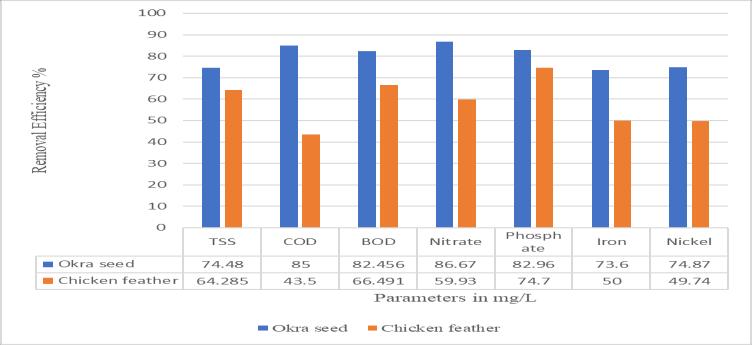
Table4shows,CODhasthelowestremovaleffectiveness, while Nitrate has the highest using adsorbent okra seed powder. The highest Phosphate and Lowest Nickel are removed using chicken feather powder. As compare to chicken feather powder and Okra seed powder, highest removalefficiencyoccursinOkraseedpowder
3. CONCLUSIONS
Useofanadsorbentincreasestheeffectivenessof theSATsystem.
The adsorbent made from Okra seed powder removed TSS (74.48%), COD (85%), BOD (82.456%),Nitrate(86.67%),Phosphate(82.96%) Iron(73.60%),Nickel(74.87%)fromeffluentfrom slaughterhouseWastewatermoreefficiency
Whencomparedtousingchickenfeatherpowderto treatabattoireffluent,okraseedspowderformhas thegreatesteliminationeffectiveness.
Thebottom60%locationoftheadsorbentismore effectivethanthetop20%,40%and80%positions
REFERENCES
[1] Vidyashree B.K, Nagarajappa D.P and Manjunath N.T“TreatabilityStudiesofDomesticWastewaterbySoil Aquifer Treatment system in Conjunction with Palm EmptyfruitBunchAdsorbent”,InternationalResearch Journal of Engineering and Technology (IRJET), vol.3(11),2016,pp.132-137
[2] RajiV.RandPackialakshmi“AssessingtheWastewater PollutantsRetainingforaSoilAquiferTreatmentusing BatchColumnExperiments”,CivilEngineeringJournals, vol.8(7),2022.
[3] Nasiru A, Osakwe C.E, Lawal I.M and Chinde A.U “AssessmentofPhysicochemicalparametersandheavy metals in Gombe Abattoir Wastewater”, American JournalofEngineeringResearch(AJER),vol.5(3),pp6469
[4] Sneha Singh and Ruchika Srivastava “Okra Seed an Efficient coagulant”, Internal Journal for Research in AppliedScienceandEngineeringTechnology(IJRASET), vol.5,2017.
[5] Sameer Al-Asheh and Fawazi Banat “Reusing Chicken Feathers to Eliminate the Heavy Metals from Wastewater is Desirable”, Journals of Cleaner Production, Vol.(11),2003,pp;321-326.
[6] MetcalfE,AsanoT,BurtonF,LeverenzH,TsuchihashiR, and Tchobanoglous G. Water Reuse: Issues, Technologies,andApplications,Mc-GrawHill.NewYork, USA.2007.
[7] Ubwa S.T, Atoo G.H and Offem J.O “The Impacts of Gboko,Nigeria,SlaughteringActivityonSeveralPhysical Characteristics and Heavy Metal Levels in the NeighbouringSoil”,InternationalJournalofChemistry, vol.5,Issue1,2013.
[8] YusufOlabodeRajiandLawalAbubakar“Evaluationof Okra Seed Extract Disintegration Effectiveness for Surface Water Treatment” , International Journal of ScientificResearch,Vol.6(2),pp;2,2015.
[9] WilsonP,MolinaJMandJarayP“AdsorptionofHeavy Metals using a Low-Cost Adsorbent”, World Applied Science,vol,28(11),pp;518-530.1995.