EXPERIMENTAL ASSESSMENT OF UNPROCESSED RICE HUSK ASH EFFECTS ON CONCRETE CHARACTERISTICS
1M.Tech (Structural Engineering), GNDEC Ludhiana, Punjab, India
2Professor and Head, Dept. Of Civil Engineering, GNDEC Ludhiana, Punjab, India
3 Assistant Professor, Dept. Of Civil Engineering, GNDEC Ludhiana, Punjab, India ***
Abstract - The manufacturing of concrete is of paramount importance in the construction sector, yet it is accompaniedby significant environmental challenges. The extraction and processing of traditionalcementconstituentssuchaslimestone and clay have a considerable impact on finite resources due to their widespread use. Moreover, the chemical reactions inherent in cementproductionresultinsubstantialemissionsof carbon dioxide, a prominent greenhouse gas responsible for climate change and globalwarming. Thisstudyaimstoaddress these environmental concerns associated with conventional cement production by investigating the viability of incorporating UnprocessedRiceHuskAsh(UPRHA)asapartial substitute for cement in concrete formulations. The research explores various concrete properties, including workability, compressive strength, split tensile strength, and water absorption, to assess the feasibility of utilizing unprocessed RHA. A comprehensive comparative analysis was undertaken, involving different substitution levels of unprocessed RHA, ranging from 10% to 30% of the cement's weight. The findings reveal that the inclusion of unprocessed rice husk ash resulted in a reduction in the workability of the concrete. Furthermore, it was observed that unprocessed RHA had a more pronounced adverse effect on the overall properties of the concrete.
Key Words: Unprocessed Rice Husk Ash, M20 Grade Concrete, Compressive Strength, Split Tensile Strength, Water Absorption
1. INTRODUCTION
The conventional process of producing concrete is associatedwithsignificantutilizationof natural resources and subsequent energy consumption, resulting in various environmentalchallenges.Notably,theproductionof1kgof aggregateislinkedtoanapproximateemissionof0.012kg CO2-eq,whiletheproductionof1kgofcementcontributesto approximately 981 kg CO2-eq (de Brito and Kurda, 2020). Theenormousglobaldemandforaggregateandcementis evident, with approximately 48.3 billion tonnes and 4.1 billion tonnes utilized in 2018, respectively (de Brito and Kurda,2020).Effortstomitigatetheenvironmentalimpact ofconcreteproductionhavepromptedresearchendeavours directedatcreatingmoreenvironmentallyfriendlyconcrete usingwastematerialsandminimizingenergyconsumption. Consequently,researchershaveexploredtheintegrationof supplementary cementitious materials as alternatives to
Ordinary Portland Cement (OPC) in concrete production (JuengerandSiddique,2015;Qinetal.,2019).Thisstrategic shift towards incorporating supplementary cementitious materials aims to reduce the reliance on OPC and its associated high carbon footprint. Rice husk ash (RHA) presentsitselfasapromisingsupplementarycementitious material, offering an alternative to Ordinary Portland Cement (OPC) in concrete production. Notably, RHA is generated through the combustion of rice husks, often duringbiomassenergy generation, a practiceprevalent in rice-producing nations. A significant amount of RHA, however,isdisposedofinlandfills,lackingvalueaddition. Recognizing this potential waste, researchers have extensivelyinvestigatedthe utilizationofRHAinconcrete productionasasupplementarycementitiousmaterial.The characteristicsofRHA,bothchemicalandphysical,exhibit variability due to factors such as the rice husk type, combustionrate,andfinenessoftheashparticles(Buietal., 2005; Ganesan et al., 2008; Nair et al., 2008). Notably, optimal conditions, such as controlled scalding, can yield highlyreactiveRHA,withamorphoussilicacontentranging from85%to95%(Cordeiroetal.,2009;Darsanasirietal., 2018;Tharshikaetal.,2019).Achievingsuchconditionsis challenging,asprecisecontrol over burningtemperatures duringbiomassenergygenerationiscomplex.RHAproduced underuncontrolledburningconditionsmighthaverelatively higher carboncontentandlowerpozzolanicreactivity. To enhancethereactivityofRHA,acommonapproachinvolves grindingtheashtoachievefinerparticles,therebyincreasing itseffectiveness(Chao-Lungetal.,2011;Venkatanarayannan and Rangraju, 2015). However, it's important to note that this refinement process necessitates additional energy consumption and incurs supplementary costs in the productionofconcreteincorporatingRHA.Hence,thedirect utilization of unprocessed rice husk ash (UPRHA) as a cementitiousmaterialinconcretedemandsacomprehensive and systematic investigation. Therefore, the primary objective of this study was to assess the influence of incorporatingunprocessedricehuskash(RHA)onvarious essential properties of concrete, spanning its fresh, hardened, and durability aspects. These properties encompassedparameterssuchasworkability,compressive strength, split tensile strength, and water absorption. The investigation aimed to determine the viability of utilizing ricehuskashinconcreteasadirectsubstituteforcement, withoutanypriorprocessing.

2 EXPERMENTAL PROGRAMME
Thesubsequentsectionsencompasstheelucidationofthe characterization process undertaken for the constituent materialsemployedintheconcretemixes,theadoptedmix designs, as well as the delineation of the procedures employedfortestingboththefreshandhardenedproperties oftheconcrete.
2.1 MATERIALS USED
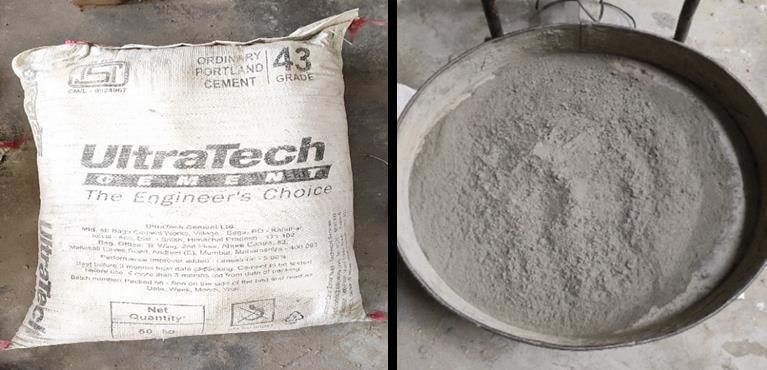
2.1.1 CEMENT
Theresearchemployed43-gradeOrdinaryPortlandcement (OPC),namelyUltraTechOPC43,instrictaccordancewith theIS:269-2015standards.Procuredfromalocalsupplierin Ludhiana, Punjab, the cement underwent a thorough evaluationofitsphysicalattributes,revealingConsistency 30%, Fineness (Retained on 90 µm Sieve) 3.2%, Initial settingtime120min,finalsettingtime223min,andspecific gravity3.13.Itisnoteworthythatutmostconsistencyand uniformity were maintained by sourcing all cement bags fromasinglebatchforthestudy.
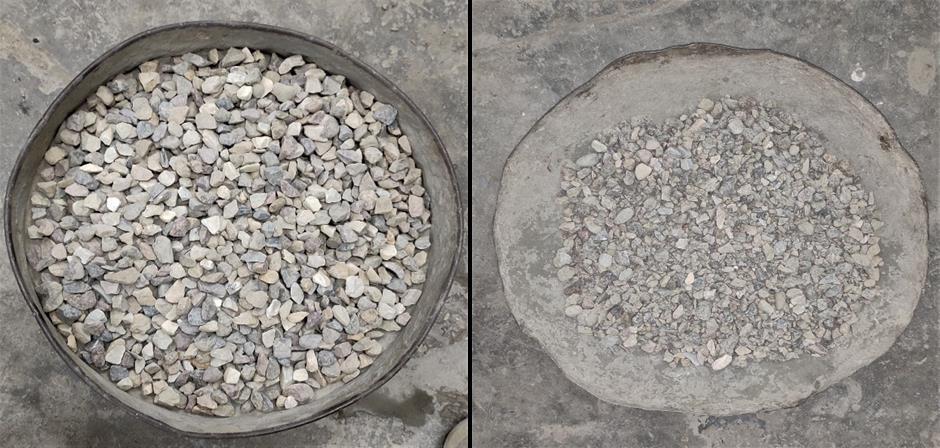
2.1.3 COARSE AGGREGATES
For coarse aggregates, crushed stone adhering to the specifications outlined in IS 383 (2016) was specifically selected.Thischoiceencompassedablendof20mmand10 mm sizes, orchestrated at a mass ratio of 60% and 40%, correspondingly.Thisparticularproportionwasstrategically chosentooptimizetheporestructureoftheconcreteinits hardenedstate.Thepracticeofincorporatingamixtureof20 mm and 10 mm crushed stone stands as a conventional approachembracedbycontemporarypractitioners,asithas demonstratedthecapacitytoyieldconcretewithenhanced performance characteristics. The specific attributes of the coarseaggregateswereasfollows:thefinenessmodulusof the20mmcoarseaggregatemeasuredat6.98,thespecific gravityat2.72,andthewaterabsorptionat0.70%.Forthe 10 mm coarse aggregates, the corresponding values were reported as 6.44 for fineness modulus, 2.65 for specific gravity,and0.84%forwaterabsorption.
2.1.2 FINE AGGREGATE
Allaggregatesemployedinthisstudywerelocallysourced fromLudhiana,Punjab.Forthefineaggregates,naturalsand adhering to the specifications of IS 383 (2016) and categorizedasZoneIIwasselected.Thepertinentphysical attributesofthefineaggregates,encompassingparameters such as fineness modulus, specific gravity, and water absorption, were methodically ascertained through appropriatetestingprocedures.Thevaluesobtainedforthis aggregate batch were 2.61 for fineness modulus, 2.55 for specificgravity,and1.07%forwaterabsorption.
2.1.4 RICE HUSK ASH
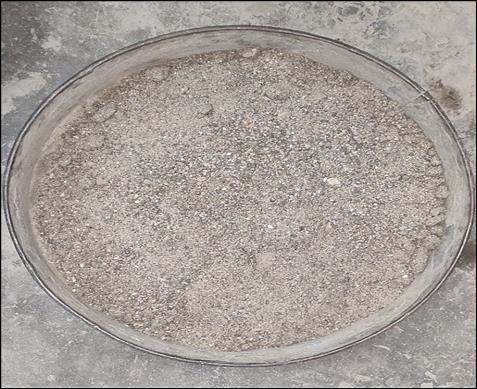
Theashutilizedinthisstudywassourcedfrom"Mohanlal Thapar&Bros."locatedinLudhiana,Punjab.Thericehusk ash, obtained directly from the rice mill following combustion,wasincorporatedintotheconcretewithoutany subsequent treatment. The ricehusks wereincinerated at temperatures around 500–600°C, a standard practice for
boiler heating in rice mills, resulting in unprocessed rice huskash(UPRHA)asaby-product.Nofurtherrefinement wasappliedtotheUPRHA.Initsnaturalstate,rawricehusk ashcomprisescoarserparticleswithacomparativelylower surfacearea.ThevisualrepresentationofunprocessedRHA isdepictedinFig 4.
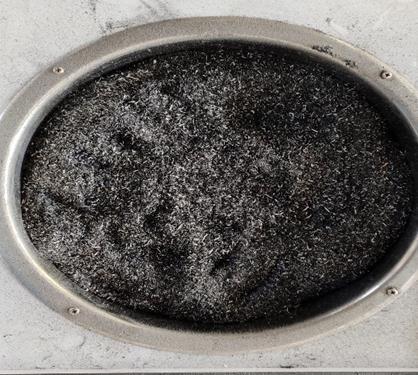
Table-1: PhysicalCharacteristicsofUPRHA
Additionally, Energy-Dispersive X-ray Spectroscopy (EDS) wasemployedforelementalanalysis,apivotaltechniqueto discernthechemicalelementspresentwithinUnprocessed RiceHuskAsh(UPRHA).EDSreportsforUPRHA,depictedin Fig.6, visually depict the elemental composition of the material.
Fig -4:UnprocessedRiceHuskAsh
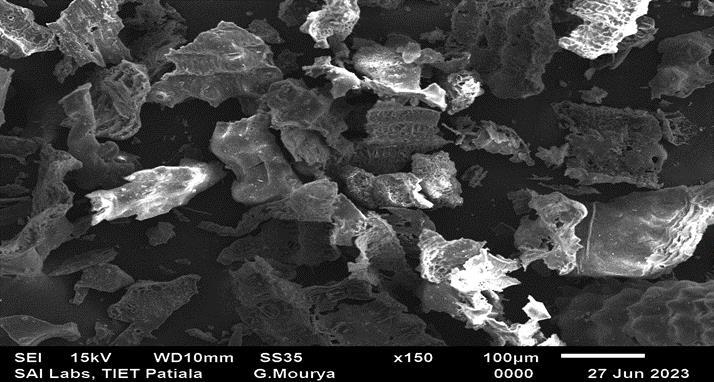
For a comprehensive understanding of the physical attributes and chemical composition of the RHA samples, ScanningElectronMicroscopy(SEM)andEnergyDispersive X-RaySpectroscopy(EDS)analyseswereconductedat"SAI LabsThaparUniversity,Patiala,Punjab,India".Theresults are meticulously documented in tabular form. The SEM image,magnifiedtox150,distinctlyillustratestheirregular shape of RHA particles. The particle size distribution characterization involved measurements extracted from variouslocationsontheSEMimagesofUPRHA,presentedin Fig 5,utilizingAxioVisionSoftware.
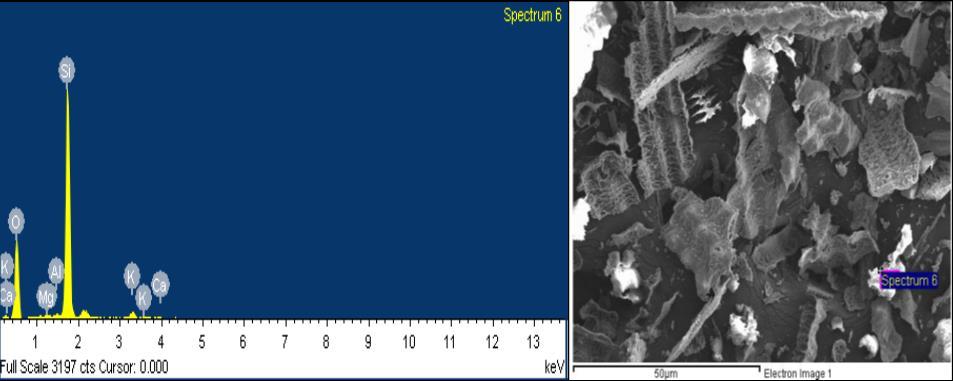
The acquired data from these analyses has been methodicallycompiledandpresentedinTable2,offeringa comprehensive breakdown of the identified elements and theirrespectiveconcentrationsinUPRHA.
Fig -5:SEMImageofUPRHA
TheSEMinvestigationsunveiledthatUPRHApossessesan angularandmicro-porousstructurewithadiverserangeof particlesizesandmultilayers.Theanalysisfurtherindicated thattheparticlesizeofunprocessedricehuskash(UPRHA) spans from 60.95 µm to 201.86 µm, with a mean size of 110.90 µm. The physical characteristics of UPRHA are summarizedinTable1.
2.2 MIX DESIGN
The research conducted herein was centered around the utilizationofM20-gradeconcrete.Adheringtotheguidelines stipulatedinIS:10262-2019,theconcretemixproportions wereupheldataratioof1:1.9:3.21byweight,accompanied byawater-to-cementratioof0.54.UnprocessedRiceHusk Ash (UPRHA) was introduced as partial replacement for cement at varying proportions of 10%, 20%, and 30% by weight respectively. Essential tests were subsequently conducted to ascertain the optimum replacement percentagesforUPRHA.Thisresearchworkutilizedatotal offourdifferentmixes,andyoucanfindthespecificdetails ofeachmixintheprovidedTable3.
fromeachconcretemixafter28daysofcuring.Theaimof thistestwastocomprehensivelyunderstandtheconcrete's abilitytoabsorbwater.
3. RESULTS AND DISCUSSION
3.1 WORKABILTY
InordertoinvestigatetheimpactofUnprocessedRiceHusk Ash(UPRHA)onconcreteworkability,aslumpconetestwas performedaccordingtothespecificationsdetailedinIS:1199 (Part2):2018.Theoutcomesofthistest,depictingvariations in slump measurements across different UPRHA concrete mixes, are documentedinTable4. To enhance clarityand enablethoroughexamination,theseresultshavealsobeen visuallyrepresentedingraphicalformatinFig 6.
45 20
2.3 TESTING METHODOLOGY
Theworkabilityoftheconcretewasevaluatedthroughthe slumptest,conductedinaccordancewiththespecifications stipulatedinIS:1199(Part2):2018.Thiswidelyrecognized industrystandardprovidesacomprehensiveframeworkfor assessingconcreteworkability.
To determine the compressive strength of concrete specimens, the testing protocol outlined in IS 516 (Part 1/Sec 1):2021 was meticulously followed. The tests were executed using a HEICO automatic electric Compression Testing machine with a maximum capacity of 3000 kN. Preciserecordingofthepeakloadwasensured,applyinga uniformloadingrateuntilthepeakloadwasachieved.The specimens, cubic in shape, measured 150mm x 150mm x 150mm. Tests were conducted at two distinct curing durations,namely7and28days.
Tensilestrength,acriticalindicatorofconcrete'sresistance totensileforces,wasevaluatedfollowingIS516(Part1/Sec 1):2021 standards. Cylindrical concrete specimens measuring150mmx300mmweretestedafter28daysof curing, utilizing a high-precision Compression Testing MachinebyHEICO,boastingacapacityof3000kN.
Toassessthewaterabsorptioncapacityofconcrete,pivotal forgaugingitsresistancetoenvironmentaldegradation,the waterabsorptiontestfollowedtheguidelinesofASTMC642 (2013).Thisinvolvedtestingthree150mmx150mmcubes
Theresearchoutcomesconsistentlydemonstratedadecline intheslumpvalueastheproportionofcementreplacement with RHA increased. The reduction in slump value can be attributedtoseveralfactorsinherenttoUnprocessedRice HuskAsh(UPRHA):UnprocessedRHAcontainsasubstantial proportion of unburned husk fragments, which impairs workability. These fragments introduce internal voids, disruptingthecohesivenessandflowoftheconcretematrix, thereby diminishing its workability. Characterized by irregular shapes and larger sizes compared to processed RHA,UPRHAparticleshinderparticlepackingandelevate water demand. Consequently, the observed decrease in workability, as indicated by the slump value, can be attributedtothesefactors.
3.2 COMPRESSIVE STRENGTH
ConcretecubescontainingdifferentproportionsofUPRHA were subjected to compressive strength testing. The obtainedstrengthvaluesforUPRHA-incorporatedconcrete after 7 days and 28 days of water curing are compiled in Table 5. Furthermore, a comparative assessment was conducted between the strength outcomes of UPRHAblendedconcreteat7daysand28days,visuallyrepresented inFig.6
Uponscrutinizingthecorrelationbetweencuringduration andtheefficacyofconcretemixtures,anumberofsignificant insights have surfaced. Principally, a conspicuous pattern has emerged indicating that the compressive strength of concreteundergoesareductionwithescalatingproportions ofUnprocessedRiceHuskAsh(UPRHA)replacement.This decrement can be ascribed to multiple intrinsic factors associatedwithUPRHA.UPRHAgenerallylackstheeffective pozzolanic properties required for optimal cementitious reactions. Consequently, the formation of additional hydration products crucial for enhancing interparticle bonding is constrained. This deficiency in pozzolanic reactivity notably compromises the overall concrete strength.Additionally,UPRHAparticles'irregularshapesand larger sizes hinder the achievement of proper particle packing.Thisleadstoagreaternumberofvoidswithinthe concrete matrix, directly impacting density and causing a reduction in compressive strength. Furthermore, the suboptimalfinenessofURHAparticleslimitstheircapacity toserveasefficientfillerswithintheconcretematrix.Asa result, increased porosity ensues, leading to reduced compressivestrengthduetoinadequateparticlepacking.
3.3
Concrete cylinders, incorporating varying proportions of UPRHA, underwent split tensile strength testing. The resultant strength values for UPRHA-blended concrete following28daysofwatercuringaresummarizedinTable 6.Additionally,theseoutcomesaregraphicallydepictedin Fig.7forenhancedvisualization.
EmanatingfromthefindingspresentedinTable4.6,itwas deduced that the split tensile strength of concrete incorporatingUnprocessedRiceHuskAsh(UPRHA)mirrors a comparable trend to the compressive strength pattern observed for UPRHA. Across all curing durations, a consistenttrendemergedwhereinthesplittensilestrength ofconcreteexhibitedadeclinewithascendingproportions of Unprocessed Rice Husk Ash (UPRHA) replacement for Ordinary Portland Cement (OPC). Significantly, the most pronounced decrease in split tensile strength was conspicuousatthejuncturewhenthereplacementlevelof OPCbyUnprocessedRiceHuskAsh(UPRHA)reached30%.
3.4 WATER ABSORPTION
Thewaterabsorptiontestwasexecutedonthree150mmx 150mmcubesforeveryconcretemixturesubsequentto28 daysofcuring.Thistestservedthepurposeofassessingthe concrete'swaterabsorptioncapacity,apivotaldeterminant influencingitsresilienceagainstenvironmentaldegradation. Theobtainedwaterabsorptionvaluesforconcreteblended withUnprocessedRiceHuskAsh(UPRHA)after28daysof water curing are concisely presented in Table 7. Furthermore, for improved visual comprehension, these resultshavebeengraphicallyillustratedinFig 8.
In the scenario involving Unprocessed Rice Husk Ash (UPRHA), it was evident that the water absorption of concrete increased proportionally with the escalation of cementreplacementbyUPRHA.Thiscanbeattributedtothe coarser particle size and heightened porosity commonly associatedwithUPRHA,promotingagreaterpropensityfor waterabsorption.Thepresenceoflargerandmoreporous particleswithinUPRHAleadstothecreationofadditional voidspaceswithintheconcretematrix,therebyfacilitating the infiltration and absorption of water. Furthermore, the unevensurfacetextureofUPRHAparticlescanserveassites for water absorption, further contributing to the overall heightenedwaterabsorptioncapacityoftheconcrete.
4. CONCLUSIONS
The study's conclusions, drawn from its comprehensive findings,canbesummarizedasfollows:
i. Aconsistentreductioninslumpvaluewasobserved as the proportion of cement replaced by RHA increased. This decrease can be attributed to inherentfactorsassociatedwithUnprocessedRice HuskAsh(UPRHA).
ii. Uponadetailedanalysisoftherelationshipbetween curing duration and concrete mixture efficacy, a notable trend emerged. Specifically, an evident pattern demonstrated that the compressive strengthofconcretediminisheswithrisinglevelsof UnprocessedRiceHuskAsh(UPRHA)substitution.
iii. In alignment with the study's findings, it was determined that the split tensile strength of concrete containing Unprocessed Rice Husk Ash (UPRHA) mirrors the observed compressive strength trend. This consistent pattern, observed acrossvariouscuringperiods,underscoresadecline in split tensile strength with increasing levels of UPRHAreplacementforOrdinaryPortlandCement (OPC).
iv. Thestudyhighlightedthatthewaterabsorptionof concrete is directly influenced by the extent of cement replacement with Unprocessed Rice Husk Ash (UPRHA), leading to an increase in water absorptionasUPRHAcontentrises.
v. The research findings unequivocally demonstrate that substituting cement with Unprocessed Rice Husk Ash (UPRHA) adversely impacts both the strength and durability of concrete at all curing stages.Assuch,thispracticeisdeemedunfavorable for cement replacement, bearing significant implicationsforconcrete'soverallperformance.
REFERENCES
[1] Ahsan,M.B.,&Hossain,Z.(2018).Supplementaluseof rice husk ash (RHA) as a cementitious material in concreteindustry.ConstructionandBuildingMaterials, 178,1-9.
[2] ASTM C642 - 13 “Standard Test Method for Density, Absorption,andVoidsinHardenedConcrete”(Vol.642). WestConshohocken,PA:ASTMInternational.
[3] Bie,R.S.,Song,X.F.,Liu,Q.Q.,Ji,X.Y.,&Chen,P.(2015). Studiesoneffectsofburningconditionsandricehusk ash(RHA)blendingamountonthemechanicalbehavior ofcement.CementandConcreteComposites,55,162168.
[4] BIS269:2015(ReviewedIn:2020)“OrdinaryPortland cement-Specification(SixthRevision)”BureauofIndian Standards,NewDelhi.
[5] BIS383:2016“CoarseandFineAggregateforConcreteSpecification”BureauofIndianStandards,NewDelhi.
[6] BIS 456: 2000 (Reviewed In: 2021) “Plain and reinforced concrete - Code of practice (Fourth Revision)”BureauofIndianStandards,NewDelhi.
[7] BIS 516 (Part 1/Sec 1): 2021 “Hardened Concrete methodsoftest.Part1TestingofStrengthofHardened Concrete Section 1 Compressive, Flexural and Split Tensile Strength” Bureau of Indian Standards, New Delhi.
[8] BIS 10262: 2019 “Concrete Mix Proportioning Guidelines”BureauofIndianStandards,NewDelhi.
[9] BIS1199(Part2):2018“FreshConcrete Methodsof Sampling,TestingandAnalysisPart2Determinationof Consistency of Fresh Concrete” Bureau of Indian Standards,NewDelhi.
[10] Bui,D.D.,Hu,J.,&Stroeven,P.(2005).Particlesizeeffect on the strength of rice husk ash blended gap-graded Portland cement concrete. Cement and concrete composites,27(3),357-366.
[11] Chao-Lung,H.,LeAnh-Tuan,B.,&Chun-Tsun,C.(2011). Effect of rice husk ash on the strength and durability characteristics of concrete. Construction and building materials,25(9),3768-3772.
[12] Cordeiro, G. C., Toledo Filho, R. D., & de Moraes Rego Fairbairn,E.(2009).Useofultrafinericehuskashwith high-carbon content as pozzolan in high performance concrete.Materialsandstructures,42,983-992.
[13] Darsanasiri,A.G.N.D.,Matalkah,F.,Ramli,S.,Al-Jalode, K., Balachandra, A., & Soroushian, P. (2018). Ternary alkali aluminosilicate cement based on rice husk ash, slagandcoalflyash.JournalofBuildingEngineering,19, 36-41.
[14] deBrito,J.,&Kurda,R.(2021).Thepastandfutureof sustainable concrete: A critical review and new strategiesoncement-basedmaterials.JournalofCleaner Production,281,123558.
[15] Ganesan,K.,Rajagopal,K.,&Thangavel,K.(2008).Rice huskashblendedcement:Assessmentofoptimallevelof replacementforstrengthandpermeabilitypropertiesof concrete. Construction and building materials, 22(8), 1675-1683.
[16] Juenger,M.C.,&Siddique,R.(2015).Recentadvancesin understandingtheroleofsupplementarycementitious materialsinconcrete.Cementandconcreteresearch,78, 71-80.
[17] Nair, D. G., Fraaij, A., Klaassen, A. A., & Kentgens, A. P. (2008). A structural investigation relating to the pozzolanic activity of rice husk ashes. Cement and concreteresearch,38(6),861-869.
[18] Padhi, R. S., Patra, R. K., Mukharjee, B. B., & Dey, T. (2018).Influenceofincorporationofricehuskashand coarse recycled concrete aggregates on properties of concrete.ConstructionandBuildingMaterials,173,289297.
[19] Qin,L.,Gao,X.,&Li,Q.(2019).Influencesofcoalflyash containing ammonium salts on properties of cement
paste. Journal of environmental management, 249, 109374.
[20] Siddique,R.,Singh,K.,Singh,M.,Corinaldesi,V.,&Rajor, A.(2016).Propertiesofbacterialricehuskashconcrete. ConstructionandBuildingmaterials,121,112-119.
BIOGRAPHIES
JUNAID BASHIR KHAN

M.TECH (Structural Engineering), GuruNanakDevEngineeringCollege Ludhiana,Punjab,INDIA
JAGBIR SINGH Professor and Head, Department of Civil Engineering, Guru Nanak Dev Engineering College, Ludhiana, Punjab,INDIA


YUVRAJ SINGH
Assistant Professor, Department of Civil Engineering, Guru Nanak Dev Engineering College, Ludhiana, Punjab,INDIA