
Music Engendering Algorithm With Diverse Characteristic By Adjusting The Parameters Of Deep Convolutional Generative Adversarial Networks
Aitik Dandapat1 , Dr. Aishwarya Dandpat21Undergraduate Student, Veer Surendra Sai University of Technology, Burla

2DNB Resident, Ramkrishna Care Hospital ***
Abstract - With the widespread development of deep learning, automatic composition has become a highly topical topic occupying the minds of music computer scientists. The paper proposes advanced arithmetic for music engenderation using Generative Adversarial Networks (GANs). The music is divided into tracks and the note segment of the tracks is expressed as a piano roll by a trained GAN model whose generator and discriminator play a continuous zero-sum game to produce high musical integrity.
In most cases, although GAN excels in image generation, the model adopts a cross-channel deep convolutional network structure in accordance with the properties of the music data in this article, producing music more closely matched tohumanhearingandaesthetics.
Key Words: Generative Adversarial Network, DGCAN, Convolutional layer, MusPy, Pianoroll
1. INTRODUCTION
Music Engenderation composes music on the computer using machine learning methods. With the increase in AI data and research, researchers have started exploring machinelearninginmusiccreation.
Deep learning is a branch of machine learning methods that can recognize patterns and make decisions without explicit programming. It shows promising results in several areas such as natural language processing for texts, computer vision for images, and speech recognition for speech. In addition, deep learning techniques in artificialmusicengenderationhavesuccessfullygenerated human-like compositions. However, most research has focused on musical composition and neglected the aspect of expressive musical performance. Therefore, musical information stored on MIDI (Musical Instrument Digital Interface) tracks, such as speed, proved useless during practice. This makes the music produced rather mechanicalandboring.
Thisdocumentconcernsthe designofa musicproduction systemthatcouldproducemusic withbuilt-inspeed,also known as musical dynamics. To do this, the training data must encode speed as well as altitude and time
information. The piano roll (a picture-like representation of data) was used to encode information, with one axis representingtempoandthe otheraxisrepresentingpitch. Eachpixelintensityintherangeof0–128wasrepresented by the note's velocity. DCGAN was chosen as the deep learning architecture used in this article. It can capture and learn the data distribution from a data set and generatea samplefromthesamedistribution.Finally,the model generates sample snippets: some are synthesized with musical dynamics and some are not. These extracts were mixed with normal music for analysis and a user studywasconducted.
2. RELATED WORK
Algorithmic composition is a subject of work that dates back to 1959. However, the recent developments of Deep Neural Networks (DNN), which have proven astonishing results in learning from big datasets, allowed this topic of music generation to be further developed. Over the past coupleofyears,tonsofproposedmodelsaddressingmusic generation have been published, all of them on deep learningalgorithms.
2.1 Recurrent Neural Network
The most popular architecture in music creation systems istherecurrentneuralnetwork(RNN).Itisafeedforward neural network, meaning that the output from the hidden layersistransmittedbacktoitandthelayerbelowit.Asa result, it has the capacity to record information and pick up knowledge from sequence data. However, because the weight matrix is updated continuously during backpropagation, RNN experiences the vanishing and explodinggradientproblem.
LongShort-TermMemory(LSTM),anRNN variant,usesa variety of gates to overcome the issue in a unique RNN. These gates include input, output, forget, and cell state gates. Information can be sent through cell states as a conduit. An applicant is chosen by the input gates. The inputgatespickacandidatefromtheinputsandchangeof any previously available pertinent data. The forget gates, on the other hand, purge the cell states of unimportant data. The information that is sent to the next concealed stateisfinallydecidedbytheoutputgates.
AGooglegroupcalledMagentautilizedLSTMtocreatethe expressive music creation system Performance RNN. It takes advantage of the MIDI tracks' velocity, pitch, and notedurations.Itwasnotedthatthemusichaddynamism and phrasing. It could not, however, show long-term structure.
2.2 Generative Adversarial Network (GAN)
Impressive results were obtained when the Generative Adversarial Network (GAN) was used to create music. It comprisestwonetworkmodelsthatareengagedinazerosumgame:ageneratorandadiscriminator.Thegoalofthe generator is to deceive the discriminator by converting a random noise input into a sample that matches the distributionoftherealsamples.Thediscriminator'sgoalis to separate a genuine sample from a produced sample, nevertheless. Following the Nash equilibrium of both networkmodels,thediscriminatoriseliminated.
The Music and AI Lab in Taiwan created MuseGAN, a systemthatcancreatemulti-trackmusicwithouttheneed forhumaninput.ItconvertedMIDIrecordings'notelength and pitch into a piano-roll format. To create the multitrack piano roll that served as the training data, various musicalinstrumentswereencodedintoseveralpianorolls andpiledtogether.
2.3 DCGAN
The Deep Convolutional GAN (DCGAN) model is no more than a GAN whose discriminator and generator networks comprehend some convolutional layers, such as CNNs do. The work of Radford, Metz, and Chintala led to the adoptionofsomealreadyprovenmodificationstotheCNN standard architecture. The major components of this model are Strided Convolutions, Fractional Strided Convolutions, Eliminating Fully-Connected Layers, Batch Normalization,GeneratorandDiscriminator.
The convolution has a favorable effect on extracting picture features and employs convolution in place of the fully connected layer. Step size convolution is used in place of the upsampling layer. More importantly, we use the full-channel lateral convolution kernel, which enables the model to learn Be more focused on musicality and converge more quickly because, since the piano roller blinds are a form of music, we don't need to worry too muchaboutthelongitudinalconvolution.
3. PROPOSED MODELS
Allofthesuggestedmodelswillbediscussedinthispaper. These adhere to the DCGAN's nature. Despite slight modifications, the convolutional approach and the suggested changes by Radford, Metz, and Chintala are adoptedhere.
All of the models provided in this paper share the core of the method. The focus now is on each network's own structurebecausethedynamicsbetweenthediscriminator and generator networks were already discussed in the previoussection.
To construct the random vector z, the method begins by selecting100samplesfromanormaldistributionN(0,1). This vector will be input into the generator network and pass through a layer of linear operations, with the bias initialized to zero and the weight matrix initialized at random from a normal distribution N (0, 0.2). The output of this linear layer is then batch-normalized, 3dimensionally reshaped, and subjected to the ReLU nonlinearity. Convolutional layers are used in the subsequent phases; their parameters will be determined later, once they vary depending on each proposed model. With the exception of the last one where the Tanh nonlinearity is used,eachconvolutionallayer'sinputisbatch-normalized, anditsoutputissubjecttotheReLUnonlinearity.
An input for the discriminator network is a threedimensional form of created or actual data. Convolutional layers are used in the subsequent phases; their parameters will be determined later, once they vary depending on each proposed model. The LReLU with a leak of 0.2 is still applied as a non-linearity after each convolutional layer, and all convolutional layer inputs with the exception of the first are batch-normalized. Following the convolutional processes, the threedimensional output shape is flattened and subjected to a linearlayer,theparametersofwhichareinitializedasthe linear layer used in the generator network, to create a single output unit. A sigmoid nonlinearity is added to this finalunit.
Three models are proposed with different approaches to theconvolutionalsteps.
3.1 Original DCGAN - Model 1
The DCGAN model from the beginning is fairly similar to Model 1. Thedepth of the networkshasto be modified to only 3 convolutional layers each due to the varying dimensions of the data. Although the filters still have relatively small spatial extents and the strides are also of the same order of magnitude, both the filter's and the stride'sdimensioninghavechanged.
Table 3.1 provides details on the corresponding convolutionallayerparameters.
various notes will be controlled by the following convolutionallayers.
Figure 2 shows the architecture of the Model 3 networks, while Table 3 details the specifications of the correspondingconvolutionallayers.
3.2 Strided Width - Model 2
In this model, it is suggested to move along the breadth, which implies that the receptive field will only take into account the entirety of the action taking place at each temporalinterval.Thismakessurethattheanalysisofthe frequency component, or the notes being played, is entirely the responsibility of the first convolutional layer. Thetemporallinkbetweeneachtimeperiodwilltherefore becontrolledbythesubsequentconvolutionallayers.
Figure 1 shows the architecture of the Model 2 networks, while Table 2 lists the parameters for the corresponding convolutionallayers.
340×1×64









Conv3 340×1×64 1×345 680×345×32
Discrimin ator Conv1 680×345×32 1×345 340×1×64
Conv2 340×1×64 3×1 85×1×128
Conv3 85×1×128 5×1 17×1×256
3.3 Strided Height - Model
Ina way,Model 3 isthe antithesisof Model 2.This model suggests "stumbling along the height," which implies that the receptive field will evaluate the whole time series while covering one frequency interval at a time. This makes sure that the analysis of the temporal component, orthedeterminationofwhichtime-stepsaparticularnote is being played, is entirely the responsibility of the first convolutional layer. Therefore, the relationship between
5. IMPLEMENTATION
The model explained in the previous section was implemented,and the resultswere captured.All thesteps involved and points taken into consideration while performing the experiment are explained under the following subtopics. Results were obtained after the experiment was evaluated to determine the precession of thestudy.
5.1 Dataset
Thereare100MIDItracksand103WAVfilesinCymatics' Oracle Hip Hop Sample Pack. We solely utilized MIDI recordings in this work since they carry musical data in a symbolicmanner.WeusedMIDItrackswithdurationsof8 or16secondsandrecordswithminortonality,asthebulk ofthesongsfellintothiscategory,inordertosimplifythe trainingdata. Thenotesarecomposedofabeat,apitch,a velocity,andaduration.
The open-source Python module MusPy, which generates symbolic music, was used to extract the MIDI data, including pitch, velocity, and note duration. With the use ofMusPytools,thisdatawassubsequentlyencodedintoa piano-rolldatarepresentation.
5.2 Data Pre - Processing
TheMIDIfileisloadedintotheprogramusingMusPytools for data pre-processing, where it is parsed into a music objectwithatemporalprecisionof12timestepsperbeat. Since the music object is inaudible to the human ear and can only be transposed to the key of C major, it was restricted by clipping its velocity to at least 40. We chose to extract just up to 4 octaves of pitches (48 notes) becausethemusicalpiecewillnotcontainall128pitches. The training data's output dimension was (N, 48, 48, 1), whereNisthenumberoftrainingsamplesand(48,48,1) isthesizeofasinglepiano-roll.
5.4 Generator and Discriminator
The generator transforms (100,1) random vectors into M*N*Casinputs.ThelettersMandN standfortheheight and breadth, respectively, and the letters C stand for the numberofchannels.Then,itgoesvia3Conv2DTranspose layerswith128,64,and1filtersthat,respectively,activate Tanh, ReLU, and ReLU. The generator's output dimension willbethesizeofapianorollwiththecoordinates(48,48, 1).
It was developed for the discriminator in the opposite order from the generator. It receives the piano-roll as input and runs it through three Conv2D layers with the LeakyReLUactivationfunction.Theoutputvaluewasthen predicted using a Sigmoid activation function after it was flattenedandpassedthroughthreedenselayers.
5.5 GAN Training
The training of the generator and discriminator uses the Adamoptimizer.TheGAN'stwosidescanbothoverwhelm the other. The generator will have trouble reading the gradient if the discriminator model is overtrained since it willoutputvaluesthataresocloseto0or1.Otherwise,it will repeatedlytakeadvantageofdiscriminatorflawsthat resultinfalsenegatives.
We discovered during the experiment that we can run as many iterations as necessary. After all, the goal of the music creation algorithm is to produce better-sounding modelsratherthanmassiveones.
GAN model training takes quite a bit, therefore, if parallel GPU training is possible, we can train GAN models more quicklythanwecouldotherwise.TheNvidiaGeForceRTX 2080graphicsprocessingunitwasutilized.
5.5 Data Post - Processing
The resulting piano roll was padded to a size of (128, 48, 1)togobacktotheoriginalpianoroll,sameasbeforedata preprocessing. MusPy library methods were used to transform the piano roll back into a MusPy music object,
which was then written into a MIDI track in order to createMIDItracksfromapost-processedpianoroll.
6. EVALUATION
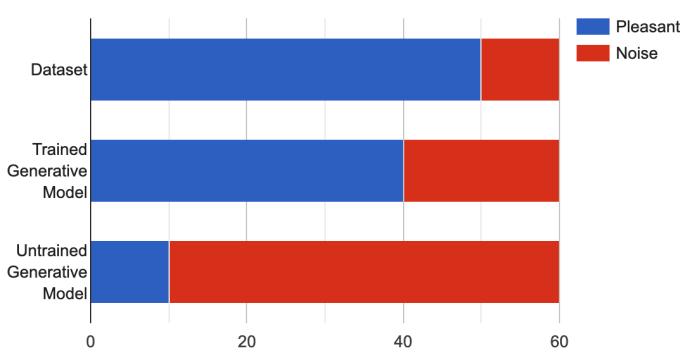
A very subjective topic is music. Right now, hearing is necessaryinordertoevaluatethemusicalquality.Wethus employ two sets of programs to assess the outcomes of our experiments. We conducted a poll with two groups: experts in the music industry and others who just sometimeslistentomusic.Weblendedinsomegenerated music by our model and a variety of song genres that we randomly listen to and untrained music. A few simple questions were posed, along with a rating system for the musiconthebasisofitssoftness.Theserepliesshowthat the method for creating music is capable of producing melodicandharmonicprogressionsthatareengaging.
Chart -1: UserStudy
7. CONCLUSION
In this study, we present a generation model for the GAN frameworktogeneratenotesequences.Weemployadeep convolutionalneuralnetworkandtuneittotheproperties of musical notes; this optimization approach allows the convolutionnetworktoconcentrateonpickingupmusical informationandconductingtestsmorequickly.Inorderto hasten the training of discriminators, we also get some understanding of common sense at the same time. Experimental results and arbitrary user assessments demonstrate the suggested model's ability to produce musically inspired sequences. The model is theoretically developed and possesses optimal qualities, despite the experimental results being below the level of human performance. A future study on the use of GAN for music production may concentrate on producing music of any durationorcollectingabiggertrainingdataset.
REFERENCES
[1] L.-C. Yang, S.-Y. Chou, and Y.-H. Yang, Midinet: A convolutional generative adversarial network for symbolic-domain music generation, 2017. eprint: arXiv:1703.10847.
[2] H.-W. Dong, W.-Y. Hsiao, L.-C. Yang, and Y.-H. Yang, Musegan: Multi-track sequential generative adversarial networks for symbolic music generation andaccompaniment,2017.eprint:arXiv:1709.06298.
[3] A. van den Oord, S. Dieleman, H. Zen, K. Simonyan, O. Vinyals, A. Graves, N. Kalchbrenner, A. Senior, and K. Kavukcuoglu, Wavenet: A generative model for raw audio,2016.eprint:arXiv:1609.03499.
[4] V. Kalingeri and S. Grandhe, Music generation with deeplearning,2016.eprint:arXiv:1612.04928.
[5] A. Nayebi and M. Vitelli, “Gruv: Algorithmic music generation using recurrent neural networks”, Course CS224D: Deep Learning for Natural Language Processing(Stanford),2015.
[6] A. Eigenfeldt and P. Pasquier, “Realtime generation of harmonic progressions using controlled markov selection”, in Proceedings of ICCC-X-Computational CreativityConference,2010,pp.16–25
[7] "Cymatics.fm - The #1 Site For Serum Presets, Samplepacks&More!"https://cymatics.fm/(accessed 4Oct,2020).