Volume: 10 Issue: 08 | Aug 2023 www.irjet.net


Volume: 10 Issue: 08 | Aug 2023 www.irjet.net
Mumbai, India. *** -
Abstract Vehicle numbers are rising together with the population. Serious accidents that occur every day are rising on the road. This paper aims to bring forward an idea of where accidents can be prevented using methodologies that include IOT and deep learning concepts. Through an extensive review of the literature, it discusses a detailed comparative analysis of the current studies and research in this field. It presents a comprehensive study showcasing that the synergistic integration of IOT and deep learning can revolutionize accident prevention strategies and enhance the safety of various environments. It sheds light on the issues causing accidents. Each issue making its own subtopic aims to tackle the issues which lead to the dangers of accidents. The IOT part uses various sensors to take input and based on that provides output based on certain threshold values. The deep learning part uses algorithms and provides an output based on the model trained. Together they provide a system that helps in accident prevention and detection. This paper illuminates the transformative impact of IoT and deep learning on accident prevention and detection.
Keywords IOT, accident prevention, alcohol consumption, drowsiness detection, crash prevention.
For adolescents and young people from five to twentynine, fatal road accidents are the main cause of mortality. An estimated 1.3 million individuals every year pass away in automobile accidents. The frequency of accidents occurring worldwide has increased recently. Vehicle numbersarerisingtogetherwiththepopulation.Thereare becoming more fatal incidents on roadways each day. In more than eighty percent of scenarios, accidents result in several deaths. 93% of the world's fatalities on the roads occur in low- and middle-income countries, even though these countries have approximately 60% of the world's vehicles.Mostly,thedailytrafficaccidentsaremostlyaimed at developing nations. The majority of nations lose three percent of their annual GDP to road accidents. The main factor is a lack of infrastructure, poor traffic management, and inadequate accident handling. According to the report "Road Accidents in India 2021," there were 4,12,432 sad incidents of crashes on roads in 2021, which resulted in 1,53,972fatalitiesand3,84,448hospitalizations.[36]
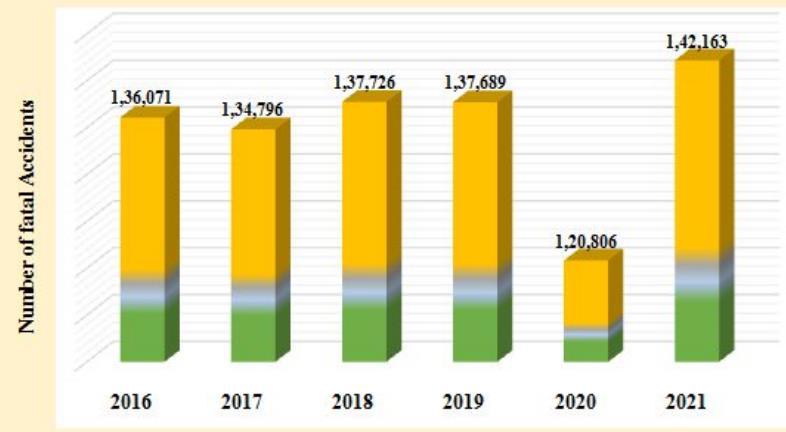
DataSource:States/UTs(PoliceDepartments).
The above graph visually explains the exact count of fatal accidents that occurred in the years from 2016 to 2021(thelatestavailable).Wecannoticeagradualincrease inthefiguresastheyearsgoby.The reasonthe year 2020 has the lowest count is due to the restrictions on traveling due to the national covid lockdown. In the year 2021 as soon as the ban lifts we can notice a sudden spike in the annualfatalaccidentcountmakingitthehighestnumberof thedecade.
Thelackofquickassistancethatmaysavesomeone'slife ina matterofmomentsisthemain factorinfatalitiesafter accidents. Lots of Accidents are happening due to the driver's mistakes. Pedestrians, bicycle riders, and bikers make up over fifty percent of all vehicular fatalities. The three primary factors that contribute to auto accidents are intoxication, sleepiness, and inattentive driving. The suggested system seeks to assist in the analysis of these elementsandthecreationofaccidentpreventionsystems.
Whenever a driver has a BAC (blood alcohol content) of 0.08 milligrams per one-tenth of liter (g/dL) or more, are regarded to be intoxicated. Therefore, every deadly crash including a driver or passenger who has a blood alcohol content (BAC) of 0.08 g/dL or above is regarded as an alcohol-impaired driving accident, and any deaths that resultfromthoseaccidentsareregardedasliquor-impaired driving deaths[20]. In India, this Blood Alcohol Content (BAC) limit is extremely strict. The allowed BAC in India is 0.03%per100mlofblood.
Giventhevariableroundedoff,numbersmaynotaddupto 100%.
Thepercentageofalcohol-impaireddrivingfatalitieswhere the blood alcohol content is more than or equal to 0.08 g/dL is 31% which is such a huge number. whereas the percentage count of traffic fatalities where the blood alcohol content is between 0.01 to 0.07 g/dL is 5%.
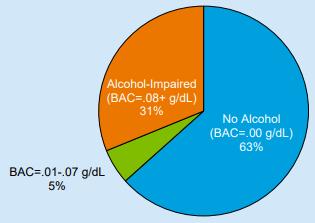
Together when combined the percentage of fatalities caused due to alcohol is 36%. No other cause has singlehandedly given such an impact on fatalities. If this issue is solved it will save millions of lives and reduce the overall damagecausedbyit.
Drowsy driving was a concern in 2.2 2.6% of all fatal collisions yearly from 2005 to 2009, according to the nationalroadvisitors'protectionagency.Numerousstudies have shown that the hours between 2:00 and 6:00 in the morning and between 14:00 and 16:30 are when many sleep-relatedcaraccidentsoccur,anditisfrequentlynoted that night shifts seem to render drivers more prone to accidents.[25] Accidents on the roads are seen to be becoming worse every year. Drivers (77%), atmospheric conditions (1%), automobile health (2%), people walking (2%), motorcyclists (1%), roadway conditions (2%), and others(14%),accordingtothegoverningbodyofIndia,are the leading causes of collisions. Due to a lack of accurate datafromlocalauthorities,itisalsofrequentlythecasethat accident sufferers do not receive medical attention [18].
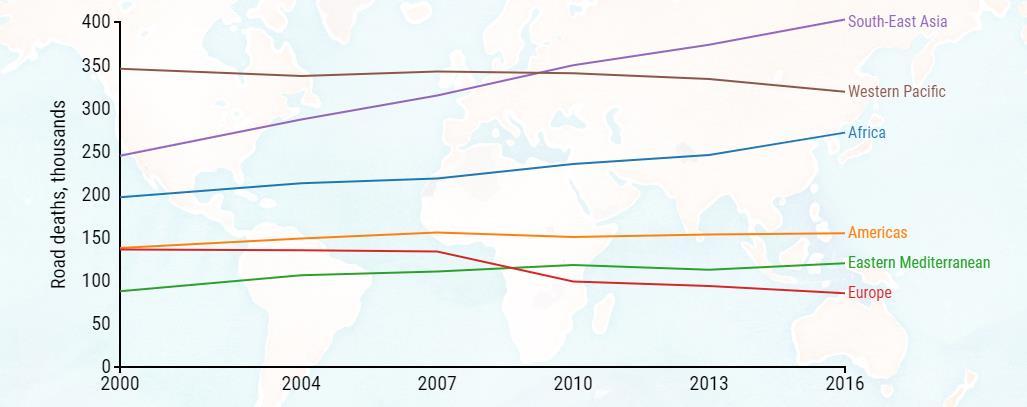
The above line graph displayed in Figure 3 with deaths caused by road accidents on Y-axis and the years from 2000-2016 on X-axis shows us the count over time. The different colors represent the various regions of the world mainly including South-East Asia, the West Pacific, Africa, America, the Eastern Mediterranean, and Europe. By glancing at the picture it is very evident that South-East Asia has an almost linear increase in road deaths. Meanwhile, Europe and the West Pacific on the opposite have a steady decline. The Eastern Mediterranean and Africa have a slow and steady increase all the while Americabeingconstant.
Since the introduction of motor vehicles, road accidents havelongbeenasourceofconcern.Variousinitiativeshave
been introduced throughout the years to improve road safety, including traffic legislation, infrastructural improvements, and car safety requirements. However, the development of IoT and Deep Learning technologies has marked a key turning point in accident prevention and detectiontactics.
1. Early Efforts (Pre-Twentieth Century): There were a few ways toavoidoridentifyaccidentsinthe earlydays of road traffic. The majority of the measures concentrated on traffic management and road signs. Police officers were stationed at key crossroads to manage traffic flow and guarantee that basic traffic regulations were followed. However, these initiatives were limited to a small geographicareaandwereunabletomeettherisingconcern abouttrafficaccidents.
2.TheRiseofTrafficEngineering(Mid-20thCentury):As a response to the rising complexity of road networks, the profession of traffic engineering evolved in the mid-20th century. To improve road safety and efficiency, engineers began designing and implementing traffic management systems such as traffic lights, pedestrian crossings, and roundabouts. Although these advancements were substantial, they still depended on passive processes and lackedreal-timedataanalyses.
3. The advent of the Internet of Things (Late 20th Century):Thelate twentiethcenturysaw the adventof the Internet of Things (IoT), which added a new dimension to road safety. IoT technology allows the internet-based linking of devices, vehicles, and infrastructure, resulting in the creation of a network capable of collecting and exchanging data in real time. Early uses included traffic surveillance cameras and vehicle-to-vehicle communication, which provided the framework for more complexaccidentpreventionanddetectionsystems.
4. Deep Learning Revolution (Early 21st Century): The early twenty-first century saw a resurgence of interest in artificial intelligence, notably in the field of Deep Learning. Convolutional neural networks (CNNs), for example, are a type of Deep Learning algorithm that has displayed astoundingabilityinpatternandpicturerecognition.These advancements opened up new avenues for utilizing data acquired from IoT devices to more efficiently detect and preventaccidents.
5. Integration of IoT and Deep Learning (Mid-Twentieth Century): As both IoT and Deep Learning technologies advanced, researchers and industry professionals saw the potential synergy of merging these strong tools for road safety applications. By the middle of the twenty-first century, a number of pilot projects and research studies had started investigating the combination of IoT sensors, cameras, and actuators with Deep Learning algorithms for real-timeaccidentpreventionanddetection.
6. Comprehensive Accident Prevention and Detection Systems (Present and Beyond): In the modern day, comprehensive accident prevention and detection systems arebeingimplemented.ThesesystemsrelyonIoT-enabled devices and cutting-edge Deep Learning algorithms. These systems have the capacity to evaluate data from several sources, such as traffic patterns, road conditions, weather, and driver behavior, in order to spot possible risks and proactively warn other road users or law enforcement. Furthermore,historicalaccidentdataandmachinelearning algorithmsaidinthepredictionofaccident-pronelocations aswellastheoptimizationofroadinfrastructure.
Looking ahead, the future of road accident prevention and detection by combining IoT and Deep Learning offers considerable potential. Even more advanced and effective solutions will probably be created as a result of ongoing technological, data analysis, and interconnectedness
developments, making our roadways safer for all users in the long run. However, concerns relating to data privacy, cybersecurity,and infrastructuredevelopment will needto be solved to ensure the effective and broad adoption of thesedisruptivetechnologies.
Since road accidents are a serious problem nowadays, researchers and engineers are considering advanced methodsofaccidentdetectionandprevention.TheInternet of Things (IoT) and deep learning are two major cuttingedgetechnologiesthathaveincreasedthepopularityofthis field. The biggest reason for IoT being a huge name in this fieldofresearchistheeasyintegrationofitscomponentsin anyrequiredsystem.TheIoT-enabledsensorsallowforthe smooth capture of real-time data from the surrounding environment which feeds the entire system. The deep learning technology excels at making detections, recognitions, and making analyses based on the input. It can skillfully process real-time data to make predictions of potential hazards and unsafe behaviors. It can provide a pattern of a list of things when given historical data. The insights gained from these can be useful for decisionmaking scenarios. It also makes the system adaptive to changes and new learnings. This leads to improved accuracyandeffectiveness.
ThissurveyoftheliteratureontheapplicationofIoTand DeepLearningtoimprove trafficsafetyandloweraccident ratesseekstogivereadersanoverviewofthecurrentstate ofthisfield'sresearch.
Driving under the influence of alcohol is one of the biggestcausesofroadfatalities.Thereforemakingitoneof the most important issues to overcome. Alcohol detection comprisesasystemthatmakesuseoftheInternetofThings (IoT) to track and find the amount of alcohol present in a particularenvironment,suchasthecar'scabinoranyother place. This method focuses on real-time monitoring and alerting based on predetermined specific threshold values ratherthandeeplearningmethods.
UsingahardwareplatformmadeupofanAlcoholsensor MQ3, an Arduino board, a GSM module, and a Global Positioning System module, an efficient method is presented for developing an intelligent system for vehicles that will monitor the driver's alcohol consumption concentration and send this data to the base unit. Alcohol Detection and Accident Prevention of Vehicle [17], this system used an alcohol-detecting sensor in vehicles that detects alcohol gases and sends messages with their locationto their relatives. This processisuseful for special purposes,notforoverallaccidentdetectionandprevention.
In order to track and curb driving under the influence, this paper [26] develops a vehicle-based liquor
identification system that uses Internet of Things innovation.TheSTC12C5A60S2single-chipmicroprocessor serves as the technique's influence core. The MQ-3 liquor sensor collects information regarding the air level of alcohol,aswellastheGU900EGPRScomponentisusedfor wireless interaction. The LCD panel shows the amount of alcohol value that has been detected. The established intoxication threshold is compared to produce the necessary control actions, including managing the relay to preventtheautomobilefrombeingdriven,alarmingwitha light and noise alert device, and executing base station placing and placing a brief message transfer with the GU900E.
Agasdetectorsystemispartofa liquortrackingsystem that tracks the operator of a vehicle and measures their bloodalcohol content.Ifthe quantityof liquorfoundin the driver exceeds a predefined threshold, a speedometer is availabletoregulatethecar'stopspeedtoapresetlevel.If thelevel ofliquorfoundinthedriverexceedsthesetlimit, the smartphone is programmed to immediately summon a distant call center. Additionally, a positioning system is set up to inform the distant contact center about the vehicle's whereabouts. In the faraway contact center, a locationbased system is set up to show the closest places for the automobile to rest, directing the person in charge to take thevehicletoanyofthoseplaces.[38]
Acompactalcoholidentificationsystemisshownin[39] and consists of an inhalation sensing device, a cell phone that operates a sensor and transmits data, and an information cloud platform [40]. You may utilize the detecting system to maintain a watch on the vehicle's operator from a distance. The respiration sensing unit is madeupoffourdistinctsensors.Thefirstcheckistoseeif the gas that's being released is breath from humans or not using a liquid vapor detector. The remaining ones are semiconductors sensors for gases that can pick up on alcohol, a compound called hydrogen. The findings of the driver's breathalyzer test are sent to a data database to be immediately processed, whichmaybeproblematic ifa link weretobreak.
A breathalyzer detector, which is often used to measure the amount of liquor in the lungs of the individual who is operating the car, may identify whether an operator is
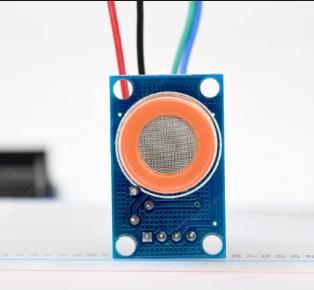
intoxicated. It operates similarly to a typical breathalyzer. Due to its low cost and simplicity of integration into systems, the MQ-3 sensor is a popular option for alcohol detection. It may respond quickly and is extremely responsive. The detector produces an analog signal accordingtothelevelofliquorintheair.Themostsensitive substance, SnO2, is used in this detector. In pure air, SnO2 has reduced resistivity.[3] Alcohol vapors create a change in the detecting element's electrical conductivity when the sensor is exposed to the air. Alcohol vapor interacts with theSnO2sensingsubstanceandlowersitsresistancewhen it is present. The sensor's circuit subsequently measures this change in resistance. The change in resistance is proportional to the quantity of alcohol vapor present, allowing the sensor to estimate the ambient alcohol concentration.
Given below table 1 discusses alternatives to the MQ-3 serveravailableinthemarket.Thereareotherfivesensors thatcanreplaceMQ-3butmaynotbethatwidelyuseddue to reasons listed in the table. We have discussed the advantages and disadvantages of these sensors. It's critical to take into account the gases you need to detect, the concentration range you want to measure, the climatic conditions,andtheoverall sensitivityandaccuracyneeded for your application when selecting an alternative sensor. As with any sensor, accurate and trustworthy findings depend on thorough calibration and testing in your applicationcontext.
MQ-2Sensor Semi-conductor gas sensing principle. Sensitive to flammable gases andsmoke.
Sensitive to a wide range of gases like methane, butane, propane, alcohol, and hydrogenaswellassmoke.
Disadvantages
Does not provide highly precise measurements of gas concentration. Calibrationandsensordriftaffects accuracyovertime.
MQ-9Sensor
Made of tin dioxide and heat coil. The small form allows easy integration.
Not suitable for detecting trace amounts but rather for high
MQ-135Sensor
Infrared(IR)GasSensors
Sensitive to a range of flammablegases.
Sensitivetoharmfulgasesand pollutants like ammonia, benzene,andcarbondioxide.
Based on the principle of infrared absorption. Measuring the absorption of infrared radiation at characteristic wavelengths whichisuniquetoeachgas.
Heavy industrial usage for multiplegasesdetection. concentrations. Crosssensitivitymay lead tofalse readings.
Useful for indoorand outdoor airquality. Exhibitsfastresponsetime.
Low cross sensitivity as comparedtoothersensors. Longer life span than other sensors leading to fewer replacements. They are not affected by dust, humidity, or oxygenlevels.
The sensor's performance can be influenced by humidity and temperature.
Effectiverangeislimitedandthus doesn’t work well with low concentration.
Designed to detect only specific gases. Requires warm-up time to stabilize and provide an accurate reading.
PID (Photoionization Detector)Sensor
Performs detections by using ultraviolet light to ionize the gasmolecules. Measures volatile organic compounds.
Highly sensitive and can detectawiderangeofVOCs. Provides immediate feedback onchanginggaslevels.
More expensive than some other gasdetectiontechnologiesmaking itnotverybudget-friendly. Typically requires a high-power source to operate the UV lamp, which limits their use in batteryoperateddevices.
MQ-3
Alcohol-sensitive semiconductor-basedsensor. Inacontrolledenvironment,it candetectvaporsuptooneto threemetersfromthesource.
The MQ-3 sensor's ability to precisely identify alcohol vaporsisitsmainbenefit.Itis sensitive to a wide range of alcohol concentrations and was created particularly for alcoholdetection.
Although the MQ-3 sensor is unique to alcohol, because of its sensitivity to alcohol vapors, it might not be able to distinguish betweendifferentformsofalcohol (suchasethanolandmethanol).
From the comparison done in the above table, they can concludethatMQ-3isthebestalcoholgassensormakingit so widely used in almost all papers. It is compact budgetfriendlyandperfecttouseforsmallspaceslikedriverspace inavehicle.
Every single day, automobile crashes result in a significant number of fatalities and injuries, some of which are due to delayed medical care and subsequent mishaps. Automated automobile recognition can, in some cases, reduce the amount of time it takes for cars and rescuing agencies to arrive at the scene of a crash, thus increasing the effectiveness of rescue efforts and the degree of roadwaysafety.Astrategyforautomaticallydetectingauto accidents based on image processing and cooperative vehicleinfrastructuresystems(CVIS)wassuggestedinthis study by [49]. In order to increase the precision of identifying accidents using smart highway equipment in CVIS, a unique picture database called CAD-CVIS is produced. To increase the self-adaptability of incident identification techniques in diverse traffic scenarios, CADCVIS has included a variety of collision categories, climate variables, and collision sites. To identify crashes, they create the YOLO-CA deep neural network structure
employing CAD-CVIS along with deep learning techniques. Toimprovetheefficiencyofidentifyingtinyitems,theyuse Multi-Scale Feature Fusion (MSFF) and the function of loss with variable values in their model. Last but not least, our test research assesses the effectiveness of YOLO-CA in identifying car crashes. The findings demonstrate that our suggestedapproachcandosoin0.0461seconds(21.6FPS) with a mean accuracy (AP) of 90.02%. Additionally, they evaluateYOLO-CAtootherobjectidentificationmodels,and the outcomes show a thorough increase in precision and actualtimecomparedtodifferentmodels.
This paper[42] demonstrated an IoT-based collision identification and categorization system that works well with any type of vehicle. By getting in touch with the appropriate parties, it produces a rapid response to incidents.Additionally,detailsabouttheaccidentaregiven, such as its location, its extent, the velocity of the vehicle at the moment of the collision, and its sides. The paper's primary achievements include An effective Internet of Things solution is used by the technology to immediately reportincidentsandclassifythemusingtheknowledgethat is most important to the investigation. To gather information on accidents, a vehicle contains a number of sensors. Utilizing an algorithm for categorization, the information is handled in a tiny computer and categorized
accordingtotheintensitydegree.Themicrocontroller uses a global positioning system (GSM) transceiver to send a distresssignalifacrashisdiscovered.Thetechnology may be utilized without an expensive vehicle or mobile. a comparison of different classifiers based on machine learning using various automotive motion metrics to see which one provides the best precise estimate of the seriousnessofaccidentlevels.TheGaussianMixtureModel
(GMM),theNaive-BayesTree(NB),theDecisionTree(DT), and the Classification and Regression Trees (CART) were four categories that were evaluated. The categorization factors that were taken into consideration were speed, collision place, & intensity, spin & height, and amounts of burn and haze. a model of the suggested system. The first version was created and put through testing using a respectableamountofcrashincidents.
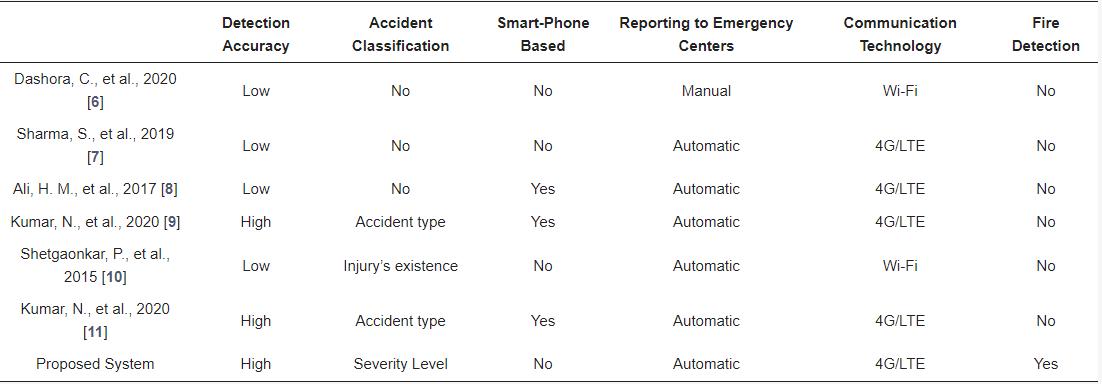
Figure5.Showsasummaryof[42]proposedmodelcomparedwiththeotherreviewedmodelwhere[6][7][8][9][10][11] refersto[43][44][45][46][47][48]respectively.
The data needed to identify a serious crash is picked up by an accelerometer. According to this study,[41] the motiondetectorwilltransmitasignalthroughtheATMEGA 8Aprocessorwhenthecarisinvolvedinacollisionorrolls over. The emergency department or the lifesaving squad getsnotificationsfromtheembeddedsystemthroughGSM. Following the receipt of the data, authorities may now link the position to the GPS. The relevant measure will then be conducted after complying with the spot in question. The person who drove can turn off the alarm signal during the collision if nobody was seriously hurt or if there was no immediatedangertoanyone'ssafety,soasnottosquander the relief team's resources. Through the usage of a motion detector,anincidentisdiscoveredusingthis.
The revised limited Boltzmann model was put forward in content [42] for detecting crashes in this work. The following are the phases of our suggested technique. They used a combination of unintentionally taken and intentionallytakenimagesasthebasisfortheirwork.Inthe following stage, they applied a deep-learning method they created called the altered limited Boltzmann model. In the thirdstep,wheremassspeedandvariableadjustmentsare conducted as an expansion procedure, we evaluate the outcome of the framework after employing different steps. Consequently, several photographs of cars are categorized as hazardous and nonaccidental. The data collection was subjectedtothesuggestedapproach,anditscontentswere divided into different training and testing proportions. For
both incidental and unintentional vehicle images, the proposed MRBM system achieves an identification precisionof98%.
The Internet of Things and the cloud's capabilities are used to suggest an emergency alert system in this paper [45]. The use of the XBee WiFi module, XBee Shield, GPS module, Seeeduino, and accident sensors to create the suggested system is covered. The main concept is to use crash sensors to pinpoint the exact site of an accident, identify it when it occurs, and then send the area's information to the closest facility via XBee WiFi and the cloud.
Inthiswork[46],agadgetiscreatedthat,intheeventof an accident where the motorist is unable to summon an ambulance, can prompt an instant reaction from the hospital. Building a tool that can improve driver and rider securityisthegoalofthisendeavor.IoTtechnologyaidsus inachievingthisgoalofeffectivelycreatingthegadget.The time it takes for the hospital to learn about an accident fromwhenithappenswillbeshortenedbythiseffort.
Table2giveninthefollowingpagesgivesacomparative study of similar papers [2][8][9][13][14] in a tabular format. These papers heavily focus on detecting accidents using different ways. Papers [8][13][14] make use of IOTbased devices to make detections. Paper [2][9] makes use of scientific algorithms to create a system that detects accidents.
[8] Accident detection and data transmission to the server are both done using vibration sensors and MEMS sensors The alarm message is sent by the ArduinoMegaControllerviaGSM andGPS.Aftercollectingthedata, a GPS MODEM is utilized to determine the victim's current location.
[2]
EXAMINE unit collects the data from CRASH MAPS and classifies road based on the probability of accident using the ML algorithm DETECTION unit where sensors in the vehicle become active and warns the driver to be cautious based on the classification. The EMERGENCY unit will contact nearby hospitals and emergency contactswithaccidents
[9] Applying YOLOv4, following the tracked road traffic movements using the Kalman filter method, and keeping an eye on their trajectoriesallowfortheanalysis of their motion patterns and the detection of dangerous irregularities that might cause minorormajorcollisions.
Inaccurate accident detection or measurements that might result from any sensor malfunction or calibration problem The system's effectiveness mainly depends on GSM and GPS connection. Sending accident alerts may experience delays or difficulties in places with low networkconnectivity.
Accuracy and reliability depending on data from CRASHMAPSleadtoincorrect risk assessments and unreliable warnings if data is incomplete, outdated, or biased False positive and negative prediction fails to detectactualrisks
To cross-validate data, use redundant sensors or several different sensor technologies Use various sensor technologies or redundant sensors to cross-validatedata.
Vibrationsensor
CrashSensor
Ultrasonicsensor
GPS
GSM
Heartbeatsensor
MEMS
GasSensor
ArduinoMega
LCD
DCMotor
In dense traffic or crowded scenarios, the Kalman filter will struggle with occlusions, whereroaduserstemporarily disappear from view or overlap with each other leading to inaccurate tracking and potentially missing hazardous behaviors. Realtime processing for tracking and trajectory analysis will introduce latency-reducing thesystem'seffectiveness
Eliminating bias and incomplete information by data verification and filtering processes along with regular updates and maintenance of CRASH MAPS ensures accuracy.
RaspberryPi4
Accelerometer
Long-range ultrasonic sensors
ML clustering algorithm(K-means)
[13] uses a GPS receiver's capacity to track a vehicle's speed, identify accidents based on that speed, andreportthepositionaswellas themomentoftheaccidenttothe Warning Service Facility using GPS data handled by a tiny computerviatheGSMnetwork
[14]
Thesensormonitorstheangle of the vehicle and indicates when anydeviationisfoundinallthree axes of the vehicle at the same time Accelerometer sensor
A steady and precise GPS signal is crucial to the system's operation. The accuracy of speed tracking andaccidentdetectionmaybe hampered in places with low GPS signal reception, including tunnels, urban canyons, or heavily wooded areas
Electromagnetic Interference (EMI) can disrupt the communication channels between different components of the accident
Advanced multi-object tracking algorithms beyond the Kalman filter, such as the DeepSORT (Deep Learning + SORT) algorithm for improved tracking accuracy and handling occlusions Offloading some processing tasks from the central system to edge devices or sensors can reduce latency and enhance real-time performance
Utilize techniques to fuse data from GPS and other vehicle sensors (eg., accelerometer) for more robust and accurate speed estimation, especially in scenarios where GPS signalsmightbenoisyor intermittent.
Protect important electronic components from external EMI sources by using electromagnetic
YOLOv4 MSCOCOdataset
The Hungarian algorithm Haversineformula GoogleMaps
GPSReceiver
GSM/GPRSModem MicrocontrollerUnit
ArduinoUNO Gyroscope Module(MEMS) NodeMCUESP8266 GSM/GPSModule
checks for any vibration or deviation in the acceleration of thevehicleinthe axes(x,y,z).
detection system, including the GPS/GSM module, NodeMCU, and cloud connectivity. EMI can corrupt data during transmission or storage and weaken or block the GPS signals received by theGPSmodule.
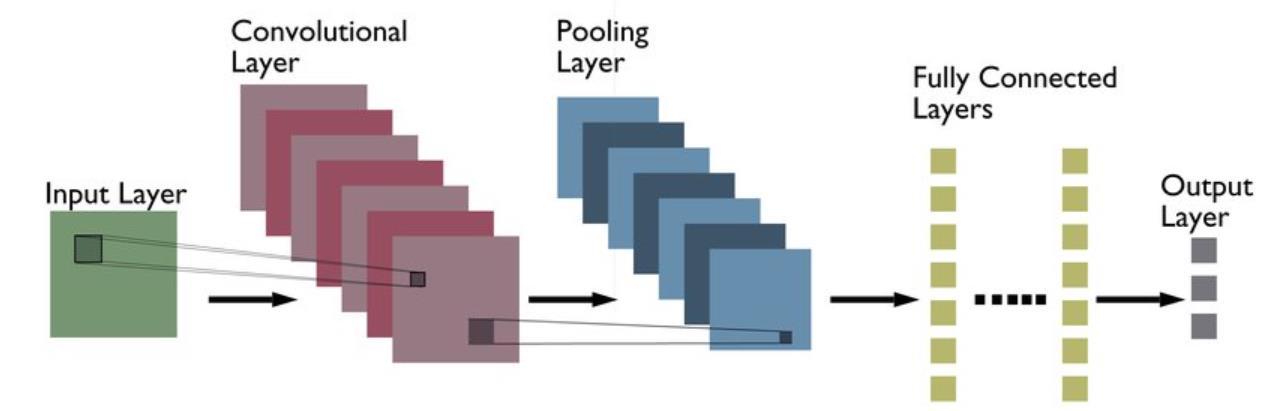
Convolutional neural networks (CNNs) in particular have dramatically revolutionized computer vision and are now a powerful tool for monitoring accidents. Convolutional Neural Networks (CNNs) are a particular kind of deep learning neural network that is frequently used for computer vision applications, natural language processing, and image and video recognition. Input data is used to train CNNs to automatically and adaptively learn spatialhierarchiesoffeatures.Therawdata,whichisoften a picture or a series of images, is delivered to the input layer. Each input picture is represented as a matrix of pixels, where the value of each pixel represents the information about color or intensity. The fundamental component of CNNs is the convolutional layer. This layer's function is to identify various characteristics contained in the input data, such as edges, textures, and patterns. The feature maps' spatial dimensions are down-sampled while
shielding. Metal enclosures and other conductivematerialscan beusedforshielding.
still preserving the most crucial data using the pooling layer. The computational complexity is decreased, and the model is strengthened against changes in the input data. Each neuron in the fully connected layer of a conventional neural network is coupled to every other neuron in the layerabove.
The convolutional and pooling layer high-level features are processed and mapped to the output classes. The probability distribution over the potential classes is generally produced by the output layer using the softmax activation function. The architecture of CNNs can vary based on the specific task and complexity of the model.
The most popular deep learning framework for processing images is CNN, as shown in Fig. 3. This design incorporates pre-processing as a transformations layer to provide a feature map, which is then concatenated to produce a data vector for the last layer that is completely connected that performs the classification.[6] With the technologicaladvancementsthearchitectureofVideofeeds fromtrafficcamerashasbeenanalyzedusingdeeplearning algorithms to detect and predict potentially dangerous situations.HandlinglargeamountsofdatafromIoTdevices is one of the biggest barriers to real-time accident
prevention.Edgecomputing,whichenablesdataprocessing at the network's edge, has become a useful way to reduce latencyandresponsetime.[4][7][9]
It is essential that technologies employed for detection provide high sensitivity and accuracy in critical circumstances like accidents. Popular instantaneous object recognition methods like YOLO are helpful in instances where immediate accuracy is essential because of their speed and precision. The YOLO method has a number of benefits, including the fact that it moves exceedingly
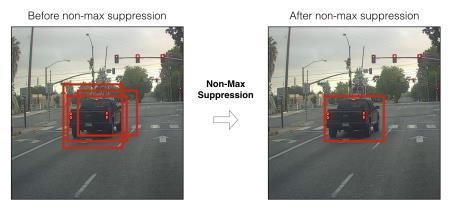
quickly (between 45 and 150 frames per second). It learns applicabledescriptionsofthingssinceitviewsthecomplete imageasopposedtoareaproposal-basedtechniques,which are useful for storing contextual information. [23] The YOLO method makes predictions about both the categorizationandlocation ofobjectsin photos(expressed asaboundingbox).Inanimage,YOLOseekstoidentifythe following elements: (bx, by) denotes the location of an item's center; (bw, bh) its width and height; c, the object's class; and Pc, the likelihood that a component of class c is present in the box. The picture is frequently divided by YOLOintoa19x19image,with5boundingboxespredicted for each cell of the following shape: y = (Pc, bx, by, bw, bh, c). This results in 19x19x5 = 1805 distinct bounding boxes for each image. Non-max suppression is the process of eliminatingthelowPcboxes,asseeninFigure6.[24]
Fig.8.ComparisonbetweenYOLOv4vsotheralgorithms.v4 performsaboutaswellasEfficientDetwhilerunningtwice asquickly.FPSreferstoframespersecond,whileAPisfor averageprecision.
YOLO predicts numerous bounding boxes for each item during the object identification phase, where each bounding box indicates a probable position and size of the object. These many bounding boxes may cover or partially enclose the same item. Non-maximum suppression is used tostopreportingrepeateddetectionsforthesameitem.
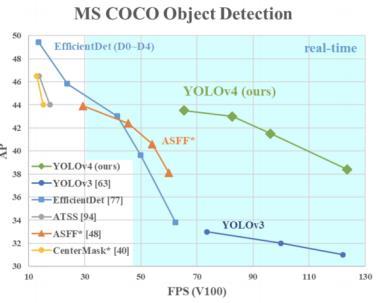
The contrast between YOLOv4 alongside different architectures' performance is presented in Figure 6, where itisclearthatYOLOv4performsbetterthanthemajorityof neural network designs in terms of overall accuracy and does so at a rate of execution which is over two times as fast. YOLOv4 stands out from the other techniques due to itsabilitytoclassify objectsinreal-timewithaccuracythat iscomparabletothatofa person.Inthiscase,CNN cantell the difference between vehicles traveling on a highway cars, bicyclists, and trucks. YOLO is extensively used and a success due to its quick speed and unexpectedly remarkableaccuracy.[24]
IoT-based traffic monitoring systems have been suggestedinseveralstudiesrecentlyandarenowinuseto reduce accidents. These systems gather real-time informationontraffic,roadconditions,anddriverbehavior usingsensors,cameras,andconnecteddevicesmountedon roadsandinvehicles.Fig7showsushowusingvehicle-tovehicle (V2V) communication in IoT systems we can warn drivers of impending crashes and enable preventative steps.Itmeasuresthedistancebetweentwocarsandbased on the result classifies the situation into categories. The ultrasonic sensors are used to measure the distance. This measurement gets updated each second.[1] The action is taken based on the category and thus can be used for preventing accidents. Hypothetically, if an accident happens,thesystemwillsendanemailasanalertwithcar detailstotheauthorityfortherescue.
One practical way to improve vehicle safety is through the use of stabilization technology to avoid accidents that can detect nearby objects. The system uses ultrasonic sensors and IoT technology to provide the driver with instant warnings of impending accidents involving objects, moving vehicles, or people. By delivering ultrasonic pulses and timing how long it takes for the pulses to bounce back after striking an object, ultrasonic sensors can measure distances.
The goal of the car Safety notification and Monitoring System [18] is to notify of a crash and car theft. Accident sites can be provided using this method. It lacks any safeguards against mishaps. The ultrasonic and brake failure detectors are utilized in the study [25] to stop vehiclecollisionsthatmayhappenasaresultofthedriver's negligence. To measure the separation between the front andrearcars,ultrasoundsensorsarealsoused.Thedriver will receive a warning to slow down the car if the distance appears to be very short. If the driver doesn't slow down,
anautonomousbrakingsystemwillkickintobringthecar toahalt.
Crash prevention using object detection is a crucial application of computer vision and deep learning technologies to enhance road safety. By leveraging object detection techniques, vehicles can identify and track potentialhazardsinrealtime,allowingfortimelywarnings
Region-based Convolutional NeuralNetwork
Description
to drivers or even autonomous intervention to avoid collisions.
Some of the key object-detecting technologies are describedinTable3.
R-CNN-based approaches typically consist of the following steps: Region Proposal, FeatureExtraction,RegionClassificationandBoundingBoxRefinement.
RetinaNet RetinaNet is a state-of-the-art object detection model that can be utilized for crash prevention in autonomous vehicles or advanced driver assistance systems (ADAS) RetinaNet is known for its accuracy in detecting objects of varying scales and has beenproveneffectiveincomplexreal-worldscenarios.
YouOnlyLookOnce(YOLO) YOLO is known for its fast inference speed and high accuracy, making it suitable for real-time applications like crash detection. YOLO-based object detection can be integratedwithothersensordata,suchasradarandlidar,toimproveobjecttracking andincreasethesystem'srobustness.
SSD employs a single-shot approach, where it predicts object bounding boxes and classprobabilitiesdirectlyfromafixedsetofdefaultboundingboxesacrossmultiple feature maps. SSD serves as a powerful and efficient object detection component within such a comprehensive system, helping to identify potential crash-related objectsinrealtimeandenablingtimelywarningsandinterventionstoenhanceroad safety.
Whilst the word "drowsiness" is frequently used, "fatigue" is also used. Nevertheless, their distinctions, exhaustion, and sleepiness are sometimes used synonymously [28]. Doing the same work for an extended amount of time or via physical or mental exhaustion may end up in fatigue [29]. However,the definition of tiredness ordrowsinessisthedesiretosleep.Drowsinessessentially results from a compelling biological urge for sleep [29]. Numerous factors, including medications, lengthy workdays,sleepproblems,insufficientorlow-qualitysleep, and prolonged periods of awake time, can cause fatigue [29]. As a result, it is clear that they are related since wearinessdirectlycausessleepiness.[27]
Deep learning techniques can be used to automatically recognize tired faces by monitoring closed eyes, yawns, or facialexpressionchanges.Inthisresearch[3],ocularwinks are measured utilizing an IR sensor component. Infrared radiation is sent by the infrared (IR) transmitter and returned to the detecting element by the infrared receiver. For people with prescribed spectacles, it is impractical to wear two eye gears. Wearing a gadget like an eye blink sensor at all times can be uncomfortable for people who
work as full-time drivers. Convolutional neural networks (CNNs) especially excel in this because they can extract hierarchicalfeaturesfromdiscretevideoimageframes.
This technology, which is addressed in the publication [50], is primarily designed to monitor the driver's facial expressions and gaze. The system will provide an alert messageifitdetectsthatthedriverhasbecomesleepy.The sound of a buzzer alerts the driver when sleepiness is identified. The pulse, blood alcohol content, and eye blinking rates are measured utilizing sensors that monitor heart rate, blood alcohol content, and eye blink rates, accordingly,inthedriver.Thereareseveralitemsavailable thatassesstheamountofdriverwearinessandareusedin numerous automobiles. A similar capability is offered by the driver sleepiness identification and wellness surveillance system but with superior outcomes and further advantages. Additionally, it warns the user when the sleepiness gauge reaches a particular point of saturation.
The approach that is being proposed here [51] is intendedtoreducethenumberofaccidentsthatoccurasa result of sleepy driving. The Raspberry Pi and Internet of Things (IoT) technologies are used to build a system that
cantrack driversleepinessandthe potential consequences ofcollisions.Anin-carPicamera maybeusedtodetectthe driver'stirednessorexhaustion.Forsensingtheextremeof an impact, the vehicle also needs to be properly installed with a collision sensor and an FSR monitor. An audio speaker alerts the driver and the proprietor of the car by mailingwhensleepinessisnoticed.Similarly,imaginethata sudden accident occurs as a result of being sleepy. In such instances, the closest hospitals to the accident site are notifiedthroughaGoogleMapslinkusingthedatagathered bythedetectorsandthenotificationofthealert.
Wavelet connectivity was used by Jemai et al. [32] to develop a method for a drowsiness warning system. With the aid of classification techniques like Wavelet Network Classifier(WNC),whichespeciallydependsonFastWavelet Transform (FWT), that network watches eyeballs by makingbinaryjudgments(awareornot).Thephysiological factors include heart rate and ECG, which are repeatedly retrieved using Babaeian et al.'s [33] wavelet conversion with regression approach for tiredness diagnosis. This theory was applied to the categorization of heart rate data using a wavelet network, which may provide an average methodforasleepinessalertsystem.[34]
Inthereview,wecouldseethat theproposedsystemsdo have the power to reduce the problem or the damage caused by it significantly. The systems may not be fully enhanced or optimized but they are proactive, intelligent, andeffectiveinreducingtheproblemtosomeextent.
There is immense potential for transformative advancements in the contributions made in this field as deep learning and IoT are two major promising areas of research.
1. EdgeComputingandIoT:Improvingtheusageofedge computing to process data closer to the source. This will help in generating responses faster and improve results. Combining cutting-edge technologies with IoT todeveloparobustsystemtotackletheissues.
2. Federated Learning: Federated Learning enables the cooperativetrainingofDL modelsacross several edge devices without the need to share raw data. In sensitive sectors like healthcare and finance, where data security and privacy are crucial, this privacypreservingstrategywillbeessential.
3. AIoT (Artificial Intelligence of Things): More autonomousandintelligentsystemswillbecreatedas a result of the combination of AI with IoT, or AIoT. AIoT devices will be able to self-optimize, self-heal, and make adaptive decisions based on ongoing environmentallearning.
4. 5GConnectivity:Thewidespreaduseof5Gtechnology will have a big influence on Internet of Things applications. 5G will make it possible to deploy more advanced IoT systems because of its faster data rates, reducedlatency,andimproveddevicecapacity.
5. Custom Hardware Acceleration: Custom hardware accelerators, such as neuromorphic chips and specializedAIprocessors,willproliferatetomatchthe computational demands of DL models, enhancing the effectivenessandspeedofDLcalculations.
6. Sustainable IoT: IoT systems will be designed to be more environmentally friendly and energy-efficient. The environmental effect of IoT deployments will be diminishedthroughthecreationoflow-powersensors andrenewableenergyoptions.
7. Ethical AI and Responsible Deployment: Addressing ethical issues and ensuring responsible AI-driven system deployment will be essential to prevent unexpectedbiasesandpotentialsocietalrepercussions asIoTandDLgrowmorepervasiveinourlives.
In order to address real-world problems and enhance the quality of life, the synergy between IoT and DL will continue to spur innovation, enhance automation, and produce more intelligent and connected systems. Road safety may be considerably improved by combining the Internet of Things (IoT) with Deep Learning (DL) technologyforaccidentdetectionandprevention.
Deploying IoT sensors by carefully planning and considering factors like sensor type, location, connectivity, andrangeinanenvironmenttoformanetworkofmultiple sensorsusedtomonitorvariousparameters.
One of the most important steps in harnessing the potential of Deep Learning (DL) algorithms is to gather real-time data from the Internet of Things sensor network and feed it into a centralized data processing system. The DLalgorithmswillusethisdataasinputsotheycanassess it and choose the best course of action. When a substantial change in the parameter is noticed, the sensors may be set up to provide data immediately or at predetermined intervals. The DL algorithms' judgments may result in immediate responses or actions. Real-time data analysis using simple computation making it faster to compute results. Using this we can drastically improve the prevention and detection capabilities. Determine any unusualtrendsthatcouldpointtoanimpendingcollisionor dangerous driving conditions. Utilize DL models to predict possible accident hotspots using both real-time and historicaldata.
Allow automobiles to connect with one another using V2V (Vehicle-to-Vehicle) protocols. By exchanging vital safety information, this communication can improve situational awareness and lower the chance of accidents.
Increase public awareness of the need of driving safely as well as the advantages of IoT and DL-based accident prevention technologies. Inform drivers, pedestrians, and other road users about safe driving habits and the value of obeyingthelaw.MakesuretheIoTandDLsystemupholds data security and privacy. Protect sensitive data from unwanted access by implementing encryption and authenticationprocedures. Accuratecapacitiesforaccident preventionanddetectionwillresultfromongoingprogress.
Finally, this paper investigated the intriguing confluence of accident prevention and detection using Internet of Things (IoT) technologies and deep learning algorithms. The creation of sophisticated systems to reduce accidents becomescrucialgiventherisingnumberofcarsontheroad and the priority that road safety is receiving. IoT devices and deep learning algorithms have emerged as a viable solutions to addressing this difficulty. We looked at a variety of academic articles and real-world applications thatdemonstratedthepotentialofIoT-enabledsensorsand deep-learning models for accident prevention and detection. These systems showed the capacity to record real-time data, examine it for possible dangers, and take promptpreventativeaction.
Letushighlightthekeyfindings:
● IOT components: The integration of IoT gadgets like cameras, GPS, gas sensors, and ultrasonic sensors made it possible to collect rich, real-time data from automobiles and the infrastructure of roads. This information is helpful in analyzing driving patterns, conditions in the environment, andpotentialrisks.
● Deep learning algorithms: DL algorithms in particular CNN are super effective in analyzing datafromIOTdevices.
● Systems to assist drivers: The combination of IoT and deep learning has led to the development of advanced systems that assist the driver in a safer ridebyprovidingreal-timefeedback.
● Emergency responses: The automated emergency responses triggeredduring riskysituations help in facilitatingquickerresponseandpotentiallysaving alife.
As these technologies continue to advance, the potential to create smarter, safer roadways becomes increasingly feasible, saving lives and improving overall road safety. However, ongoing research, testing, and collaboration between researchers, policymakers, and industries are essential to fully realize the transformative impact of IoT andDeepLearninginaccidentprevention.
[1] An IoT-Based Car Accident Prevention and Detection System with Smart Brake Control Mubashir Murshed and Md Sanaullah Chowdhury Department of Computer Science and Engineering University of Chittagong Chittagong, Bangladesh. Procs. of International Conference on Applications and TechniquesinInformationScience(iCATIS2019)
[2] Surya, S & Qadir, Abdul & Sivaraman, Arun Kumar. (2021). IoT-Based Accident Prevention System Using MachineIntelligence.10.13140/RG.2.2.33565.03047.
[3] IOT-based Accident Prevention and Detection System using GSM-GPS, Eyeblink, and Alcohol Sensor Shivani Jadhav, Sejal Nair, Seema Vidhrani, Sukanya Roychowdhury Vivekanand Education Society Institute of Technology, Chembur, Maharashtra, India International Journal for Research in Applied Science &EngineeringTechnology(IJRASET),May2020
[4] Ghoddoosian, R., Galib, M., & Athitsos, V. (2019). A Realistic Dataset and Baseline Temporal Model for EarlyDrowsinessDetection. ArXiv./abs/1904.07312
[5] Redmon,J.,Farhadi,A.(2018).Yolov3:Anincremental improvement.arXivpreprintarXiv:1804.02767.
[6] TrackingBasedonYolowithHaarCascadesandERNN Belmekki Ghizlene Amira, Mekkakia Maaza Zoulikha, Pomares Hector SIMPA Laboratory, Université des Sciences et de la Technologie d’Oran Mohamed Boudiaf (USTO-MB), Oran 31000, Alegria Dept. of Computer Architecture and Technology, CITIC-UGR Research Center, University of Granada, Granada 18071,
[7] Volume 7, Issue 6, 2021 171 You Only Look Once (YOLOv3): Object Detection and Recognition for Indoor Environment Hassan Salam, Hassan Jaleel, SalmaHameedi
[8] ACCIDENT DETECTION AND MONITORING SYSTEM USINGIOTDr.D.Karunkuzhali,D.Madhubala,Y.Nisha, S. Rajeswari, Professor1, Student Department of Information Technology Panimalar Engineering College,Chennai[2019]
[9] Real-Time Accident Detection in Traffic Surveillance Using Deep Learning Hang Shi, Chengjun Liu, Hadi Ghahremannezhad Department of Computer Science NewJerseyInstituteofTechnologyNewark,NJ07102, USA12Aug2022
[10] G, Srividhya & Sai, Tirumala & Ragul, Sha. (2022). SmartDetectionofAccidentUsingRaspberryPiBased onIOT.10.15680/IJIRSET.2019.0803175.
[11] An IOT-Based Smart System for Accident Prevention and Detection Harshada Joshi Smita Khairna Sayanee Nanda Department of Computer Engineering Pimpri ChinchwadCollegeofEngineering,AkurdiPune,India
[12] AI and IOT Based Road Accident Detection and Reporting System Varsha Patil, Adesh More, Mitali Mahajan, Hemant Gholap Department of Electronics and Telecommunication Engineering, JSPM’s, JSCOE, Hadapsar,Pune,India
[13] Accident Detection and Reporting System using GPS, GPRS and GSM Technology Md. Syedul Amin, M. B. I. Reaz,JubayerJalilDepartmentofElectrical,Electronic and Systems Engineering IEEE/OSA/IAPR InternationalConferenceonInformatics,Electronics& Vision
[14] Intelligent Accident Detection System Using IOT and Cloud Computing A.Mohamed Arif Aslam, A.Mohamed Noufal, P.Muthusreeram, Dr.L.Arulmurugan, Dr.M.Leeban Moses International Research Journal of EngineeringandTechnology(IRJET)Volume:08Issue: 05|May2021
[15] Prabha, R.Sunitha, R. Anitha “Automatic Vehicle Accident Detection and Messaging System Using GSM and GPS Modem” - International Journal of Advanced Research in Electrical, Electronics and InstrumentationEngineering,Vol.3,Issue7,July2014.
[16] Vijay Savania, Hardik Agravata and Dhrumil Patela “Alcohol Detection and Accident Prevention of Vehicle” - International Journal of Innovative and Emerging Research in Engineering Volume 2, Issue 3, 2015.
[17] Sarasvathi, Nahalingham and Fong, Jason Zu XiN (2018) “Study and Implementation of Internet of Things (IoT) Based Vehicle Safety Alert and Tracking System” - INTI Journal, 1 (10). pp. 1-11. ISSN e26007920.
[18] Das, Abhirup & Ray, Abhisek & Ghosh, Abhisek & Bhattacharyya, Swarasree & Mukherjee, Debaleena & Rana, Tapan. (2017).”Vehicle accident prevents cum location monitoring system.” 101-105. 10.1109/IEMECON.2017.8079570.
[19] Savita Soma, Swetha Bergonda, Sushmita, Shruti (2017) IoT Based “Vehicle Accident Detection and Tracking System Using GPS Modem” International Journal of Innovative Science and Research TechnologyISSNNo:-2456-2165
[20] Stewart, T. (2023, April). Overview of motor vehicle traffic crashes in 2021 (Report No. DOT HS 813 435). NationalHighwayTrafficSafetyAdministration.
[21] Team Ackodrive. (2023, January). FAQs About Drunk DrivinginMumbai.Ackodrive.RetrievedJuly29,2023, from https://ackodrive.com/traffic-rules/faqs-aboutdrunk-driving/
[22] National Center for Statistics and Analysis. (2023, June, Revised). State alcohol-impaired-driving estimates: 2021 data (Traffic Safety Facts. Report No. DOT HS 813 472). National Highway Traffic Safety Administration
[23] Agarwal, S., Terrail, J. O., & Jurie, F. (2018). Recent Advances in Object Detection in the Age of Deep Convolutional Neural Networks. ArXiv. /abs/1809.03193
[24] Ankile,L.L.,Heggland,M.F.,&Krange,K.(2020).Deep Convolutional Neural Networks: A survey of the foundations, selected improvements, and some currentapplications.ArXiv./abs/2011.12960
[25] Mithilaesh J, Santhosh Kumar K, Aswin Balaji P, Dr.S.Hemalatha, Dr.V.Subedha(2017). Proactive Accident Avoidance System Using IoT IJSRDInternational Journal for Scientific Research & Development| Vol. 5, Issue 1, 2017 | ISSN (online): 2321-0613
[26] Weiye Hu 2018 IOP Conf. Ser.: Mater. Sci. Eng. 452 042156
[27] Albadawi,Y.,Takruri,M.,&Awad,M.(2022).AReview of Recent Developments in Driver Drowsiness Detection Systems. Sensors (Basel, Switzerland), 22(5).https://doi.org/10.3390/s22052069
[28] Chacon-Murguia M.I., Prieto-Resendiz C. Detecting Driver Drowsiness: A survey of system designs and technology. IEEE Consum. Electron. Mag. 2015;4:107–119.doi:10.1109/MCE.2015.2463373.
[29] Beirness D.J., Simpson H.M., Desmond K., The Road SafetyMonitor2004:DrowsyDrivingDrowsyDriving. 2005. Available online: http://worldcat.org/isbn/0920071473[Reflist]
[30] Prashant Dhawde, Pankaj Nagare, Ketan Sadigale, DarshanSawant,Prof.J.R.Mahajan,2015,Drowsiness Detection System, INTERNATIONAL JOURNAL OF ENGINEERING RESEARCH & TECHNOLOGY (IJERT) ICONECT–2015(Volume3–Issue06),
[31] Titare, Swapnil & Chinchghare, Shubham & Hande, K.. (2021). Driver Drowsiness Detection and Alert System. International Journal of Scientific Research in Computer Science, Engineering and Information Technology.583-588.10.32628/CSEIT2173171.
[32] O.Jemai,I.Teyeb,andT.Bouchrika,“Anovelapproach for drowsy driver detection using eyes recognition system based on wavelet network,” International Journal of Recent Contributions from Engineering, Science&IT,vol.1,no.1,pp.46–52,2013.
[33] M. Babaeian, K. A. Francis, K. Dajani, and M. Mozumdar, “Real-time driver drowsiness detection using wavelet transform and ensemble logistic regression,” International Journal of Intelligent Transportation Systems Research, vol. 17, no. 3, pp. 212–222,2019.
[34] Anil Kumar Biswal, Debabrata Singh, Binod Kumar Pattanayak, Debabrata Samanta, Ming-Hour Yang, "IoT-Based Smart Alert System for Drowsy Driver Detection", Wireless Communications and Mobile Computing, vol. 2021, Article ID 6627217, 13 pages, 2021.https://doi.org/10.1155/2021/6627217
[35] Sanjay Kumar Singh, Road Traffic Accidents in India: Issues and Challenges, Transportation Research Procedia, Volume 25, 2017, Pages 4708-4719, ISSN 2352-1465, https://doi.org/10.1016/j.trpro.2017.05.484.(https:// www.sciencedirect.com/science/article/pii/S235214 6517307913)
[36] ROAD ACCIDENTS IN INDIA 2021. (2022, December). India https://morth.nic.in/road-accident-in-india MinistryofRoadTransportandHighway.
[37] Melanie Anthony, Ruchi Varia, Arjun Kapadia, Mrinmoyee Mukherjee, 2021, Alcohol Detection System to Reduce Drunk Driving, INTERNATIONAL JOURNAL OF ENGINEERING RESEARCH & TECHNOLOGY (IJERT) NTASU – 2020 (Volume 09 –Issue03),
[38] Sofer, S. (2005, February 11). US7671752B2 - Car alcohol monitoring system - Google Patents. https://patents.google.com/patent/US7671752B2/en
[39] Q. Abu Al-Haija and M. Krichen, “A Lightweight InVehicle Alcohol Detection Using Smart Sensing and SupervisedLearning,”Computers,vol.11,no.8,p.121, Aug.2022,doi:10.3390/computers11080121.
[40] Wakana, H.; Yamada, M. Portable alcohol detection system for driver monitoring. In Proceedings of the 2019 IEEE SENSORS, Montreal, QC, Canada, 27–30 October2019;Volume10,pp.1–4.
[41] S. Parameswaran, P. Anusuya, M. Dhivya, A. Harshiya Banu, D. Naveen Kumar, 2016, Automatic Vehicle Accident Detection and Messageing System, INTERNATIONAL JOURNAL OF ENGINEERING RESEARCH & TECHNOLOGY (IJERT) COCODANTR –2016(Volume4
Issue11),
[42] M.Balfaqih,S.A.Alharbi,M.Alzain,F.Alqurashi,andS. Almilad, “An Accident Detection and Classification SystemUsingInternetofThingsandMachineLearning towards Smart City,” Sustainability, vol. 14, no. 1, p. 210,Dec.2021,doi:10.3390/su14010210.
[43] Balfaqih, M.; Ismail, M.; Nordin, R.; Balfaqih, Z. Handover performance evaluation of centralized and distributed network-based mobility management in vehicular urban environment. In Proceedings of the 2017 9th IEEE-GCC Conference and Exhibition (GCCCE),Manama,Bahrain,8–11May2017;pp.1–5.
[44] Shakhovska, N.; Shakhovska, K.; Fedushko, S. Some Aspects of the Method for Tourist Route Creation. In Advances in Artificial Systems for Medicine and Education II, Proceedings of the 2018 Advances in Intelligent Systems and Computing (AIMEE2018), Moscow, Russia, 6 Octomber 2018; Springer: Berlin, Germany,2020;Volume902,pp.527–537.
[45] Raut, P.; Sachdev, V. Car accident notification system basedonInternetofThings.Int.J.Comput.Appl.2014, 107,29–31.
[46] Dashora, C.; Sudhagar, P.E.; Marietta, J. IoT based framework forthedetection ofvehicleaccident.Clust. Comput.2020,23,1235–1250.
[47] Sharma, S.; Sebastian, S. IoT based car accident detection and notification algorithm for general road accidents.Int.J.Electr.Comput.Eng
[48] Ali, H.M.; Alwan, Z.S. Car accident detection and notification system using smartphone. Int. J. Comput. Sci.Mob.Comput.2015,4,620–635.
[49] D.Tian,C.Zhang,X.DuanandX.Wang,"AnAutomatic Car Accident Detection Method Based on Cooperative VehicleInfrastructureSystems,"inIEEEAccess,vol.7, pp. 127453-127463, 2019, doi: 10.1109/ACCESS.2019.2939532.
[50] M. C, A. (2022, July 31). IOT Based Driver Drowsiness Detection and Smart Alerting System. International Journal for Research in Applied Science and Engineering Technology, 10(7), 3638–3646. https://doi.org/10.22214/ijraset.2022.45810
[51] Biswal, Anil Kumar & Singh, Debabrata & Pattanayak, Binod & Samanta, Debabrata & Yang, Ming-Hour. (2021). IoT-Based Smart Alert System for Drowsy Driver Detection. Wireless Communications and Mobile Computing. 2021. 1-13. 10.1155/2021/6627217.