COMPARATIVE STUDY OF THERMAL BEHAVIOUR OF SOCKS
MATUR ROHITH KUMAR1, A.K CHOUDHARY21 Students, Department of Textile Technology, DR. B. R. Ambedkar National Institute of Technology, Jalandhar
2 professor, Department of Textile Technology, DR. B. R. Ambedkar National Institute of Technology, Jalandhar

Abstract - Preserving the consistency in human health, regular physical activity is required. Athletes and sportspeople choose activewear of socks to attain comfort and functional support during a variety of activities like walking, stretching, jogging, etc. Every fabric intended for active wear must have the ability to manage moisture, as this determines how comfortable the fabric will be when used to make active wear of socks .The air and water vapour permeability of a fabric also affects how well it manages moisture. By making the best selection of fibers, yarns, fabrics, finishes, coatings, laminates etc. and also design elements of socks, high performance of socks can be developed to meet the fundamental and basic functional needs of users in terms of comfort, breathability, light weight, anti-static, and anti-odor qualities. The aim of the current study is to examine the relationship between the fabric's characteristics and its ability to conduct heat. It was found that the thermal conductivity of sock was positively proportional to yam count, GSM and thickness. No relevant work is done on the comparison of thermal properties of different types of socks. By this we can say which type of sockis preferable.
1.INTRODUCTION
Socks are an important part of our clothing and are necessary for everyday activities to avoid the discomfort of the foot due to moisture coupling in the shoes during continuous wearing. Socks in shoes offer less air circulation than other clothing on the body, socks need to performbetterintermsofcomfort.Thefeelingofpleasure or relaxation is defined as comfort. When heat and water vaporpassthroughthegarment,thewearerfeelscomfort. Thermo-physiological comfort is related to a garment's ability to transfer heat and moisture, which aids in the maintenance of the body's thermal balance at various activitylevels.
Objectives:
To study the influence of wales per inch and courses per inchonthethermalcomfort.
To study the influence of G.S.M on thermal comfort of socks.
Tostudytheairpermeabilityofsocks.
***
To study the influence of G.S.M and course per inch and walesperinchondryrateofsocks.
1.1 Heat Transfer
Heat is the transfer of energy from a warmer object to a coolerobject.Itcanbetransferredinthreeways:
Byconduction
Byconvection
Byradiation
Conduction is one of the modes of heat transfer that takesplacewhenthetwosurfaceshavingtemperature difference,comesincontactwitheachother.
Convectionisthemovementofheatbyafluidsuchas water or air. The fluid moves from one location to another,transferringheatalongwithit.
Heatlossbyradiationistheprocessbywhichthermal energy travels from a heated to a cold surface via electromagneticwaves.
1.2 Air Permeability
Airpermeabilityisthemeasureoftheeasewithwhichair canpassthroughafabric.Itisanimportantcharacteristic of textiles, especially in applications such as clothing, wherebreathabilityisimportantforcomfort.
1.3 Dry Rate
Theterm"drytime"inrelationtofabric,itgenerallyrefers tothelength of time it takesfor a fabrictoair dryafter it has been washed or wetted. The dry time can be affected byvariousfactorssuchasthetypeoffabric,itsweight,the levelofhumidity,andthetemperatureofthe surrounding environment.
2. Material and Methods
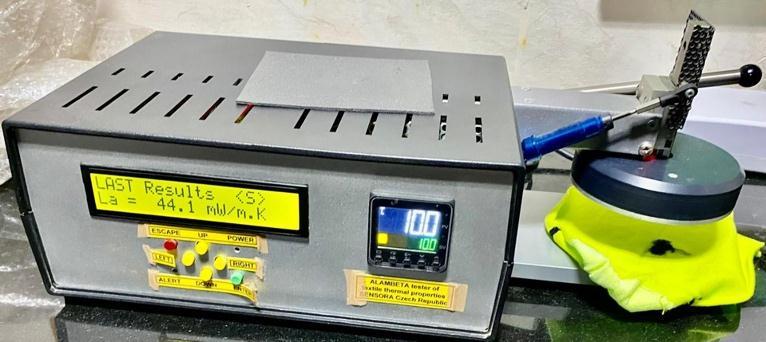
2.1 Thermal transfer properties
Sensora's Alambeta testing device, Liberec, Czech Republic, is used to determine the thermal transfer propertiesofthefabricsinaccordancewithASTMC518.
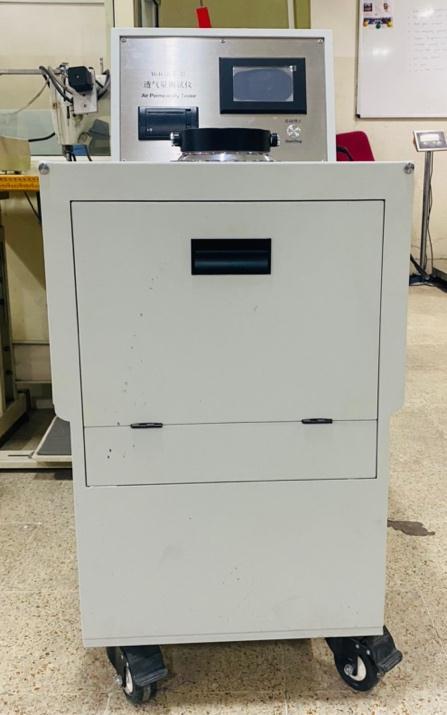
2.5 Air Permeability Tester
Air permeability is usually measured in terms of the volumeofairthatcanpassthroughaunitareaoffabricper unit time. The standard unit of measurement for air permeability is cubic feet per minute per square foot (CFM/ft2)orlitrespersecondpersquaremeter(L/s/m2).
There are different methods for measuring air permeability, but one of the most commonly used is the ASTM D737 test method. This involves placing a fabric sample in a special apparatus, known as a permeability tester,andmeasuringthevolumeofairthatpassesthrough itunderaspecifiedpressuredifferential.
The air permeability of a fabric can be influenced by factors such as its thickness, porosity, and surface roughness.Finishingtreatments,suchaswaterrepellentor water-resistant coatings, can also affect the air permeabilityofafabric.
2.2 Determination of Fabric GSM
GSM of the fabrics was measured according to the ASTM D3776. A circular knife GSM cutter is used to make the samples of diameter 13 cm Five samples from each fabric were taken and weighted on the electronic balance for 0,001 decimals. Five samples were taken randomly from different places on the fabric keeping in mind that thereisnosamesetofwaleandcourseinthesamples.
2.3 Determination of fabric thickness
The thickness of the fabric was tested according to the ASTMD1777.Thesampleswereplacedontheanvil ofthe thickness gauge and slowly the presser foot is lowered down till it comes in contact with the fabric, it takes 5-6 seconds to apply full pressure on the sample 3224 Determinationofwalesandcoursesperunitlength.
2.4 Determination of wales and courses per unit length
Wales and courses per unit length of fabrics were measured according to the ASTM D8007-15. Pick glass is theapparatususedtocountthewaleandcoursesperunit length. For counting the wales, the pick glass is placed along the width of the fabric and the number of wales is countedperincheswiththehelpofapointer.Forcounting the courses, the pick glass was placed along the length of the fabric and courses per inchare counted with help ofa pointer.
The appropriate level of air permeability for a particular applicationdependsonfactorssuchastheintendeduseof the garment or textile product, the environmental conditions in which it will be used, and the preferencesof theend-user.
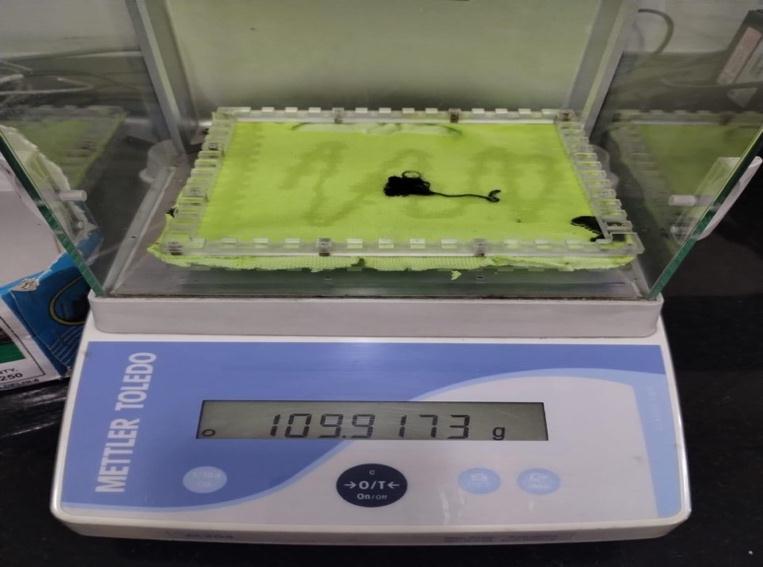
2.6 Dry Rate Tester
A dry rate tester is an instrument used to measure the rateofdryingofacoatingorpaint.Itisanimportanttoolin the quality control of coatings and paints, as the drying time of a coating affects its final appearance and performance.
Thedryratetesterusuallyconsistsofametalplatecoated withthematerialbeingtested.Theplateisthenplacedina controlled environment with specific temperature,
humidity,andairflowconditions.Theinstrumentmeasures the rate of evaporation of solvents or water from the coating and records the time required for the coating to reachaparticularlevelofdryness.
Type A sock has high thermal diffusion than B and C typesocksduetolowerGSMandlowercourseperinchand walesperinch.
3. Results and Discussion
3.1 Thermal conductivity
Thermalconductivityistheabilityofamaterialtoconduct heat.Itisthepropertythatdescribeshoweasilyheatflows througha material.Thehigherthethermalconductivityof amaterial,thebetteritisatconductingheat.
3.3 Thermal Absorbity
Absorbency is an important property of fabrics, particularly those used for clothing and textiles. Fabrics with high absorbency can absorb and retain moisture quickly, making them suitable for use in socks, towels, diapers,andotherabsorbentproducts.
Type C sock has high thermal conductivity than A and B type socks due to higher GSM, higher course per inch and walesperinch.
3.2 Thermal Diffusion
The movement of molecules, such as water vapor or gases, through the spaces between fibres or yarns in the fabric.
TypeCsock hashighthermal absorbitythanAandBtype socksduetohigherGSM,highercourseperinchandwales perinch.
3.4 Thermal Resistance
Resistance of the fabric refers to the fabric's ability to resist various external influences, such as mechanical stress, abrasion, chemicals, sunlight, and water. It is a measure of how well the fabric holds up under different
conditions and is an important factor in determining its durabilityandlifespan.
Type A socks has more thermal resistance compared withtypeBandCsocks.
Whereas thermal resistance is directly proportional to thethicknessofthefabric.
3.6 Dry Rate
The speed at which a fabric dries after being wet. It is an important property for many textile applications, particularly for clothing and other products that are exposedtomoisture.
3.5 Air permeability
Theabilityofafabrictoallowairtopassthroughit.Itis a measure of the breathability of a fabric, which is an important property for clothing and other textile applications.
TypeAsockhashighdryratethanBandCtypesocksdue tolowerGSMandlowerthickness.
Higherthicknessandgsmreducethedryrate.
4. CONCLUSIONS
Higher G.S.M offer higher isolation, higher good thermal properties.So,increasingtheG.S.Mofsockswillmakethe thermal conductivity high. Higher the course and wales per inch of socks then tightness factor increases whose effect the thermal properties. Therefore, Higher course or wales per inch will increase the thermal comforts properties of socks. Higher G.S.M and higher Wales and course per inch also increases moisture dry rate properties. Therefore, Socks clinginess, stickiness and dampness all will decrease by increasing structure tightness and G.S.M. Higher thickness and G.S.M reduces the air permeability which increases the thermal comfort propertiesofsocks.
REFERENCES
[1] D.Raja,C.Prakash,G.Gunasekaran,andC.V.Koushik, J.Text.I.,106,359(2015).
[2] M. B. Sampath, C. Prakash, and M. S. Kumar, Indian J.Fiber.Text.,45,102(2020).
TypeAsockhashighairpermeabilitythanBandCtype socks due to lower GSM and lower thickness. Higher thicknessandgsmreducestheairpermeability.
[3] C. Prakash and K. C. Karunakaran, Indian J. Fiber. Text.,44,294(2019).
[4] R. Sowmya, N. V. Raaja, and C. Prakash, J. Nat. Fiber., 14,228(2017).
[5] S. P. Mishra, “A Text Book of Fibre Science and Technology”,NewAgeInternational,India,2000.
[6] S. R. Aparecida, T. K. Mitie, G. B. Maria, S. R. Alonso, andK.J.Dib,FibresText.East.,23,19(2015).
[7] G.M.Ei-Nouby,H.A.Azzam,S.T.Mohamed,andM.N. Ei-Sheikh,Text.Pro.StateoftheArt&Fut.Dev.,2,394 (2005).
[8] Y.Wang,“RecyclinginTextiles”,WoodheadPublishing inTextiles,Cambridge,2006.
[9] M.InoueandS.Yamamoto,J.Text.Eng.,50,25(2004).
[10] M. Abbasi, M. R. M. Mojtahedi, and A. Khosroshahi, J.Appl.Polym.Sci.,103,3972(2007).
[11] Irzmanska,E.,Casestudyoftheimpactoftoecaptype on the microclimate in protective footwear, International Journal of Industrial Ergonomics, 44 (2014),5,pp.706-714.
[12] Cimilli,S.,etal.,Acomparativestudyofsomecomfortrelated properties of socks of different fiber types, TextileResearchJournal,80(2009),10,pp.948-957.