Approach to an Intelligent Based IP over MPLS VPLS Network for Packet Scheduling
Oba Zubair Mustapha1 and Tshiamo Sigwele21Department of Electrical/Electronic Engineering, Institte of Technology, Kwara State Polytechnic, Nigeria. 2 Faculty of Science, Botswana International University of Science and Technology, Botswana. ***
Abstract - Multi-Protocol Label Switching (MPLS) uses a brief bit sequence to denote a conventional Internet Protocol's Forwarding Equivalence Class (FEC), and on a hop-by-hop basis, networks decide on routing depending on header analysis. Additionally, MPLS employs a predefined routing table to manage packets with a specific FEC. type. Non-real time traffic will be used in this study to evaluate how effectively to incorporate the intelligence packet scheduling to an integrated MPLS and VPLS (Virtual Private LAN service) networks. At first, Network Simulator (NS2), a non-real-time application platform for file transfer in order to build the IP/MPLS network model, protocol is needed. The two distinct systems, Neuro-Fuzzy and Fuzzy Systems, were used for packet scheduling. This is followed by routinely put into action at the Label Switched Router (LSR) interface, which enable fast delivery of data in the network. Then, the result obtained from trace file will be used to show the critical performance of MPLS network.
Key Words: Virtual Private LAN service, Forwarding Equivalence Class, Neuro-Fuzzy Inference System, Internet Protocols/Multi-ProtocolLabelSwitching.
1.I NTRODUCTION
The opportunity for enterprises to meet client demand is growing exponentially because to the internet's accessibility, which has given rise to new methods of conducting virtual commerce. Access to network resources has significantly increased end users in an accelerating globe, which has resulted in substantial network and internet service congestion. Additionally, as noted in [1], it significantly impacts performance, which lowers service availability and quality. Traditional IPbasednetworksthatrelyonhop-by-hopheaderinspection for packet forwarding will not be able to meet the demanding network performance requirements such as shortdelay,highbandwidth,etc.givenallthesedifficulties and the growing popularity of real-time and multimedia applications, such as voice and video. The quality of services(QoS)requiredbytheseapplicationsandwillnot be able to provide such assurance [2]. Label Switched Paths (LSP) are created throughout the network by MPLS using a combination of protocols and careful traffic engineering. In order to support the fast forwarding of ernet Protocol (IP) packets, the information included in thelabelsisutilisedandaddedtothepackets[3].Inorder to get beyond network restrictions such high packet loss andexcessivedelays,itoffersscalablefunctioninaddition tocongestioncontrol[4,5].

In our previous work, we proposed service-aware LSP with fuzzy-based Packet Scheduling [6][21]. With further approach,themainobjectiveof thispaper isto perform a comparative study of fuzzy and neuro-fuzzy-based Packet
Scheduling Algorithms using IP/MPLS technology in the NS2 environment. The process of forwarding the packets is applied, which directed traffic to any route based on explicit route enabled. Then, an output of trace files yieldedtheresultsofthesimulation.
Our contributions to this paper are mentioned as follows: Firstly, packet scheduling algorithms in an appropriate network model (IP/MPLS) are chosen, defining the routers, hosts, and link characteristics using NS2 code with input parameters of the non-real time traffic such as sending rate, link bandwidth, propagation delay, etc. Secondly,weintroducethefuzzyandneuro-fuzzyrulesin the fuzzy inference system using different fuzzy input variables.Thirdly,weanalyzetrainingerroronthepacket processingalgorithmwiththeapplicationofaneuro-fuzzy basedpacketschedulingalgorithmattheinterfaceofcore routers. Later, we provide the analysis of Probability Distribution for Fuzzy and Neuro-Fuzzy Inference systems. Fourthly, an AWK script is written to interpret the obtained trace files and trace graphs are used for the illustrationofperformancemetrics.
TheremainingpartsofthispapercommencedinSection2 with the review of related work on MPLS VPLS. Next, it presents the proposed framework and analytical operations of the fuzzy inference system with a learning algorithmintheMPLSrouters.Theimplementationofthe proposed intelligence Packet Scheduling Algorithm is provided and yields the results and their discussions. Finally,conclusionsarepresentedinSection3
2. REVIEW OF RELATED WORK
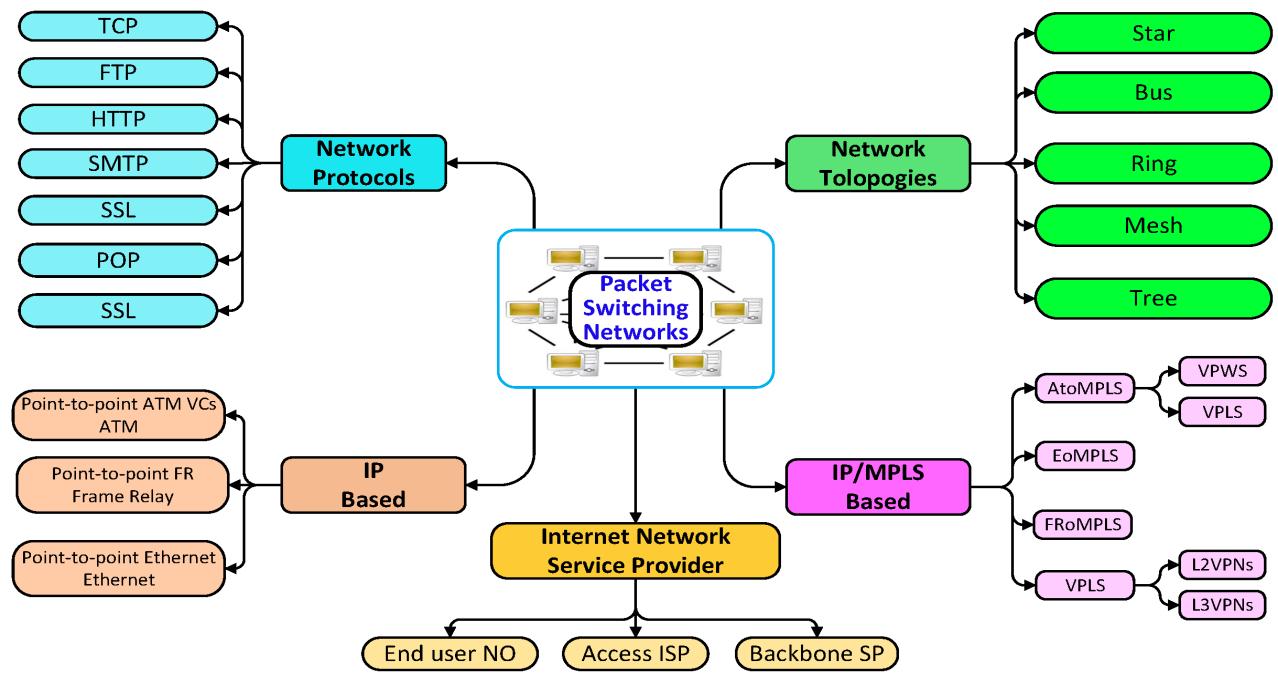
It is envisaged that by 2023, 30% of enterprise locations willuseinternet-onlyWANconnectivity,upfromlessthan 10% in 2019, to reduce bandwidth costs for MPLS connection. The traffic engineering (TE) techniques and a variety of protocols to establish pre-determined highly efficient routes in Wide Area Network (WAN) is provided by the MPLS [7]. In MPLS, the allocation of a particular packet to a particular FEC is done just once as the packet enters the network. The FEC to which the packet is assignedandencodedas a short fixedlengthvalueknown asa"label".Whenapacketisforwardedtoitsnexthop,the label is sent along with it. At subsequent hops, there is no further analysis of the packet's network layer header. Rather, the label is used as an index into a table, which specifies the next hop and a new label is given. The old label is replaced with the new label, and the packet is forwarded to its next hop [12][13]. It can be observed in the MPLS forwarding paradigm, once a packet is assigned to FEC, subsequent routers do no further header analysis; all forwarding is driven by the labels. There have been different approaches to the concept of packet-switched as showninFigure1(a).
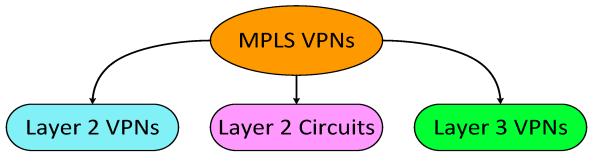
Obviously, MPLS and VPLS (Virtual Private LAN Service) are defined using point-to-multipoint topology and transport of IP packets. This can carry various different protocolssuchasL3VPNs,L2VPLS,EoMPLS,AToMPLS,and FRoMPLS [8][9][10]. VPLS is a protocol for building a virtual multipoint Ethernet network on top of an MPLS networkorIPnetwork.ItperformsthesamewayasMPLS, but it has the capability to provide more services than MPLS. However, MPLS is still a vital option for many businesses. With VPLS, customer level of achievement increases dramatically from a technical perspective. VPLS is also easier to support, which in turn reduces costs and improves the customer experience for a business. Hybrid deployment of MPLS VPLS technologies and services may bebettersuitabletomeetbusiness-criticalneeds[10].The threeprimarytypesofMPLSVPNsareshowninFigu-1(b). It is imperative to combine the services of MPLS VPLS to yield level of achievement to the customer Network Simulator (NS) possesses Tool Command Language (Tcl) for creating a simulation scenario file such as Network topology, transmission time, using the protocol, etc. It consists of an event scheduler and IP-based network components. This is written in both Object-oriented Tcl and C++ language. C++ is used for detailed protocol implementation, such as packet action and state information management, while Tcl is used for simulation configuration,suchaseventscheduling[11].Thefollowing arethestepsusedtocreateMPLSnetworkscenariosinNS environment:
Declaresimulator; Setoutputfile;
Set node and link with bandwidth and delay;
Set agents such as Transmission Control Protocol (TCP) and User Datagram Protocol(UDP); Setting applications (FTP) and Constant BitRateCBR);
Settingsimulationtimeandschedules; Declarefinish.
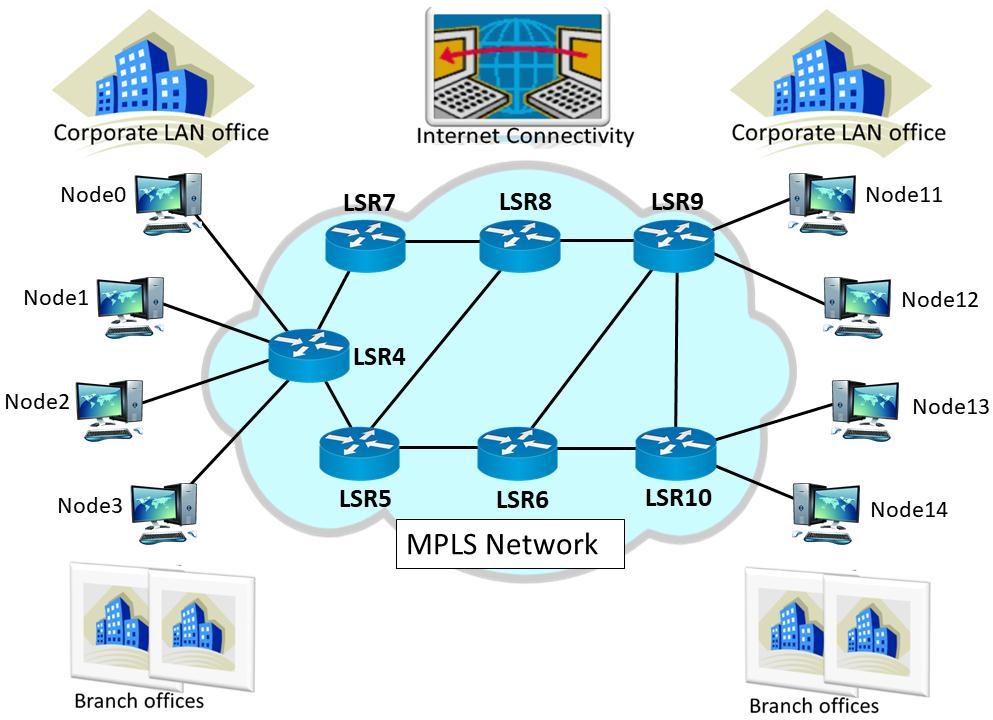
Therefore,Table-1providessimulationinformation,while the network information and architecture of the MPLS Network used in NS2 are illustrated in Fig -2(a) and 2(b), respectively.Itconsistsoffournodesasthesources,seven Label Switched Router (LSR), and four nodes as destinations.
Table -1: SimulationInformation
2.1 Forward Equivalence Class
The incoming packets are allotted with a label by a Label Edge Router (LER)according to their Forwarding Equivalence Class (FEC) in MPLS [14]. Packets are forwarded alongside an LSP where each LSR (label switch router) makes forwarding decision entirely based on the contentofthelabel,inthiswayeliminatingtheneedforthe IP address sothatthe transitional router does not haveto execute routing lookup, which is a very time-consuming process[15].
TheMPLSallowsanLSR todistributeFEClabel bindingin response to an explicit request from another LSR. This is known as Downstream on Demand label distribution. It alsoallowsanLSRtodistributelabelbindingstoLSRsthat have not explicitly requested them [12][15]. In order for MPLS to operate correctly, label distribution information needstobetransmittedreliably,andthelabel distribution protocol messages pertaining to a particular FEC need to be transmitted in sequence [16][17][18][19]. The distribution of labels and the construction of LSPs is done byexchangingLabelDistributionProtocol(LDP)messages betweentheLDPagentsofLSRnodes. (b)
2.2 Analytical Operation of Fuzzy Inference System with Neuro-Fuzzy Algorithm
ThefirstlayerandthefourthlayeroftheAdaptiveNeuroFuzzy Inference System (ANFIS) architecture contain parameters that can be changed over time. It has nonlinear premises parameters in the first layer and linear consequent parameters in the fourth layer [26]. Both of these factors need to be trained and able toadapt to their surroundingsinordertobeupdated.Inthisresearch,these parameters will be trained using a hybrid approach that Jang (1993) presented. The backpropagation technique, which was used to train the parameters in adaptive networks, was found to beproblematic, especially when it had a sluggish convergence rate and tended to become stuck in local minima. This led to the usage of this algorithm. An adaptive network using supervised learning that functions similarly to the Takagi-Sugeno fuzzy inference system model is known as the ANFIS architecture. Let's assume for the sake of simplicity that therearetwoinputs(xandy)andoneoutput(f).The"If-
Then" technique for the Takagi-Sugeno model employed thefollowingtwoprinciples[20]:
Rule1:If(Xa =A1 )and(Yb =B1 )Thenf1 =u1x+v1x+r1
Rule2:If(Xa =A2 )and(Yb isB2 )Thenf2 =u2y+v2y+r2

Rule3:If(Xa =A3 )and(Yb isB3 )Thenf3 =u3y+v3y+r3

Rule4:If(Xa=A4 )and(Yb isB4 )Thenf4 =u4y+v4y+r4
where A1, A2, B1, and B2 are the membership functions of each input x and y (part of the premises), while u1, v1, r1, and u2, v2, r2 are linear parameters in part-Then (consequentpart)ofTakagi–Sugenofuzzyinferencemodel. Layer 1: The convolution sum in (2) is equivalent to a neuralnetwork,asillustratedinFig-2,wheresmfikj canbe regarded as the weight connecting the jth element of the inputvectorpresentedtoANFIStothekthsamplepointof theithmembershipfunctioninthefirstlayer.Thisinsight provides essential guidance in deriving the gradient descentformulafortheANFISlearningalgorithm.
International Research Journal of Engineering and Technology (IRJET)
Volume: 10 Issue: 08 | Aug 2023 www.irjet.net
and
Layer 2: (Firing strength): Each node in layer 2 is a fixed nodethatoutputstheproductofitscomplexinputsas:
(2)
Every layer 2 node's output corresponds to the firing powerofafuzzyrule.Thismayalsoentailinputinteraction in the case of multivariate time series [24][25]. According to [22], the algebraic product is a complicated fuzzy intersection, which was also suggested in [23]. The circle node is marked with the letter I and every other node in this layer is fixed or non-adaptive. The signal that enters the node and issent to the following node is multipliedto createtheoutputnode.Thefiringstrengthforeachruleis represented by each node in this layer. To obtain the output in the second layer, the T-norm operator with generalperformance,suchasAND,isutilized


(3)
Layer 3: (Normalized firing strength): The output of each node labeled N in layer 3 represents the ith rule’s normalizedfiringstrength.
(4)
where isthenumberofrules,and refersto thesummationofthemagnitudeofeachweight wj
Layer4(Dotproduct):Thedotproductofeachnormalized firing strength and the total of all the outputs from the nodes in the layer before is the output of each node with the label "dp" in layer 4. Rule interference is thus implemented at this layer. Keep in mind that layer 4 outputs, all future network signals, and the network outputarealwaysreal-valued.
(5)
where is the normalized firing strength from the previouslayer(thirdlayer)and isaparameter inthenode.Theparametersinthislayerarereferredtoas consequentparameters.
Layer5: (Consequent parameters): Eachnodeiinlayer5is anadaptivenodeinthehybridlearningrule.Theoutputof eachnode i isgivenby





(2)
(6)
The equations from (1) to (6) indicate the analytical expressions of fuzzy inference system with a learning algorithm.
2.3 Proposed Framework for Intelligent Packet Scheduling
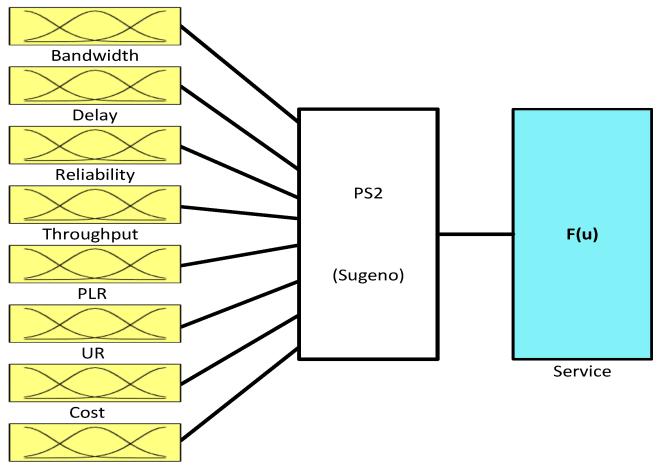
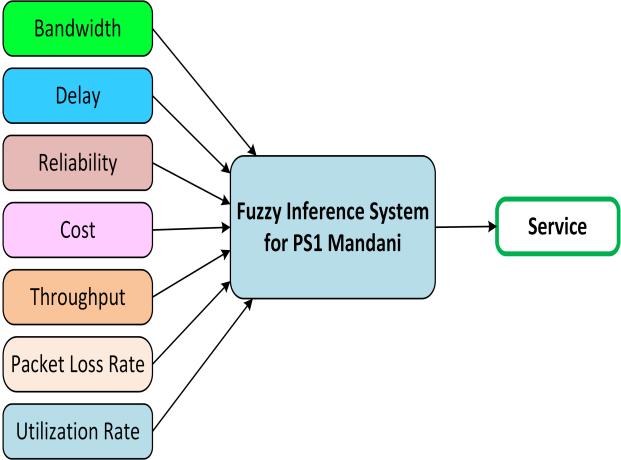
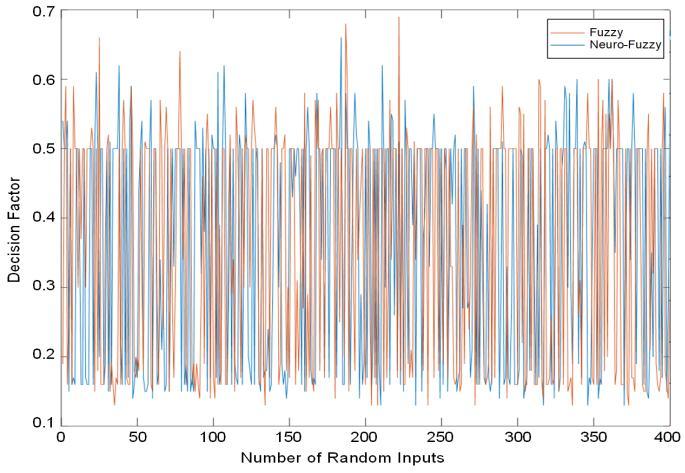
The algorithm executes the process of deciding which packet to be sent to the outgoing link for transmission. In otherwords,itisadecisionprocessusedtochoosewhich packet to be serviced or dropped. This can influence the delay (and consequently the jitter), bandwidth and loss rate. The most important task of a scheduler is to ensure the satisfaction of QoS requirements for users while efficiently utilizing the available resources. The fuzzybasedpacketschedulingalgorithmuseslogicaloperations inordertoprovidea systemwith improved performance. Therefore, the implementation of the Fuzzy Logic Control System(FLCS)andNeuro-FuzzySystem(NFS)isproposed to select paths and then schedule packets among them since there are many available paths for the same source and destination nodes. The neuro-fuzzy system, with a reduced number of rules, is trained to perform efficiently with the set of rules obtainable [27][28]. This training process of the neuro-fuzzy system adjusts the weights to produce the required output for any input pattern as showninFigure3.Theneuro-fuzzysystemparametersare adequately shown in Table -2. In the fuzzy system, the same process is carried out by tuning the membership functions, which was nearly impossible for the target packet scheduling system with such broad input parameters [29][30] as illustrated in Fig -4. Once the neuro-fuzzy system is trained, a comparison is made between the neuro-fuzzy and the fuzzy inference system with the assistance of 400 input samples for each of the seven input parameters. Each of these inputsisrandomly generated and provided to the neuro-fuzzy and the fuzzy inference system. Finally, the obtained decision factors
from both neuro-fuzzy and fuzzy inference systems are plottedtocomparetheoutputofeachsystem,asshownin both Fig -3 and Fig -4, respectively. The scheduler can be implemented as a fuzzy and neuro–fuzzy controller with inputs such as bandwidth, delay, cost, reliability, packet lossrate,andresourceutilizationrate. Theoutputdefines the LSP that queue from which the next packet will be transmittedFig-3and4depicttheimplementationsofthe Fuzzy logic control system and Neuro-Fuzzy system for packetschedulingusingMATLAB,respectively[32].
2.4 Results and Discussions
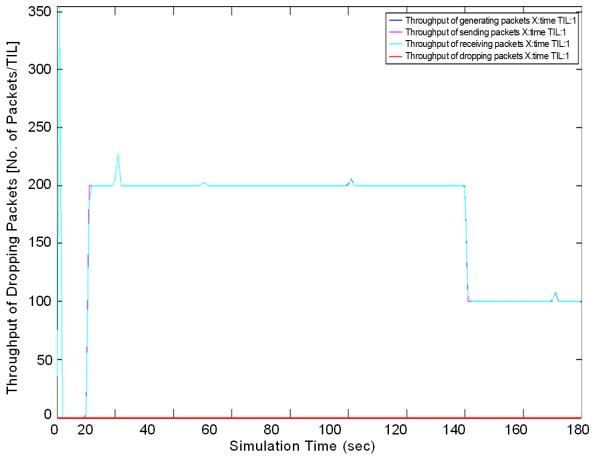
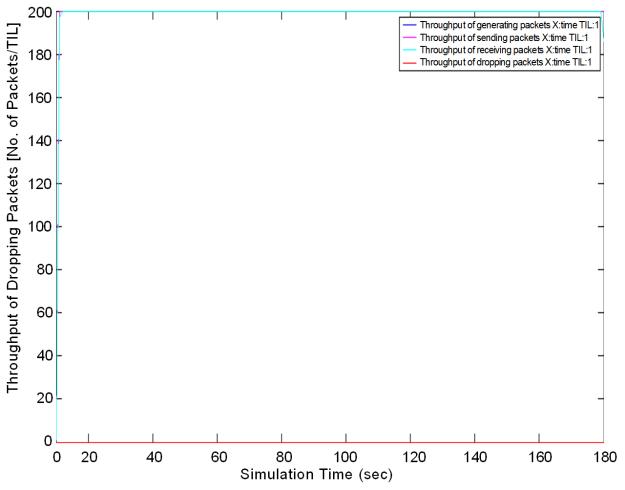
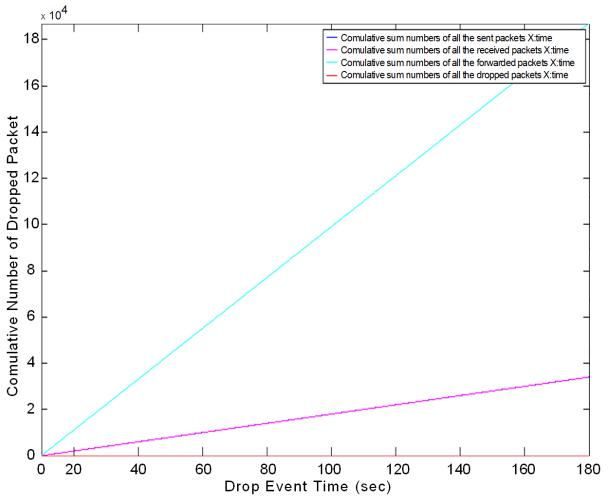
Network Simulator is used to implement the IP/MPLS VPLS,whichincludesthecomponentsforthecreationof a wired network, suchasnodesand the link ofsimplexand duplex types. Each link is configured with the parameters such as bandwidth, propagation delay, and queue type. Data communication between nodes is configured with transportandapplicationlayeragentsthatarerequiredto beattachedtobothsenderandreceivernodes.Theresults obtained are plotted using a trace graph. In Fig -5 and 6, there is a wide disparity between the cumulative sum of packets generated with that of packets forwarded and dropped in IP/MPLS VPLS networks. This indicates that therearemorefastforwardingpacketsinMPLSthaninan IP network. The comparison of average throughput received in IP/MPLS with Weighted Fair Queuing (WFQ) using FTP is shown in Fig -7 and Fig -8. FTP traffic is created on top of a TCP connection between node 0 and node 10. It can be seen that MPLS performed better than IP with the scheduling algorithm as a result of its fast packet forwarding process. Furthermore, it is apparent thatthisfiguregivesanimprovedthroughputwithWFQin IP/MPLS networks. Similarly, a further improvement is observed as a result of fuzzy and neuro–fuzzy applied intermittently at the interface of LSR routers. In this scenarioofusingthedecisionfactor,apeakvalueofabout 69% is obtained with neuro-fuzzy and an approximation of 66% for the fuzzy. An increment of about 3% shows better performance at 220 random input samples. It continues to reiterate at various random input samples. The graphical illustration of 400 samples at the interface withpacketschedulingalgorithmsisshowninFig-9.
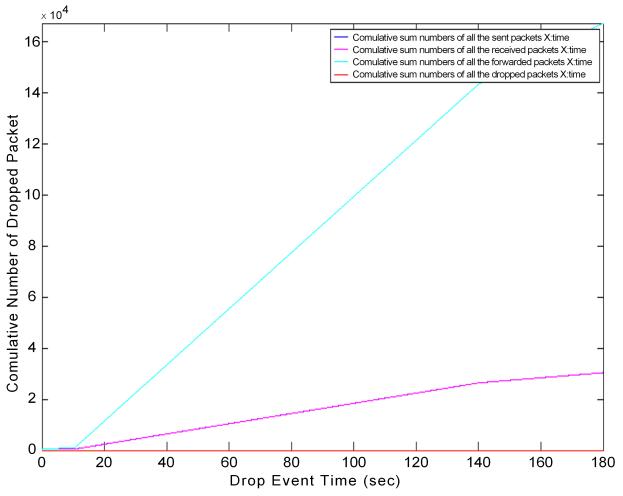
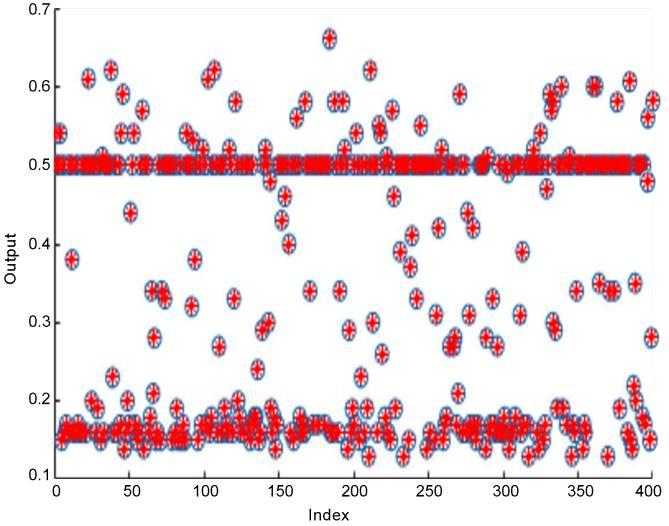
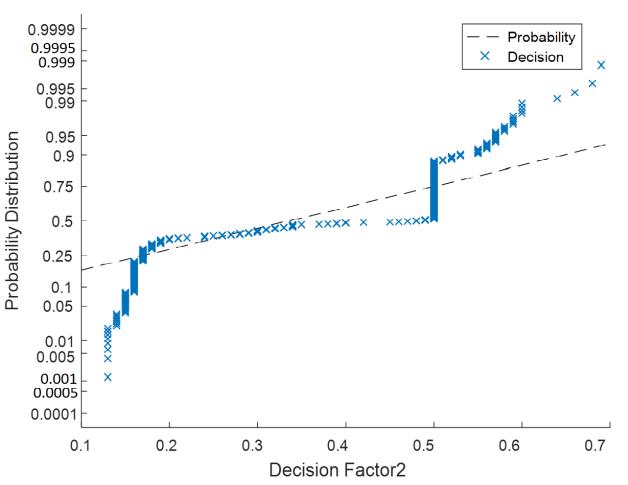
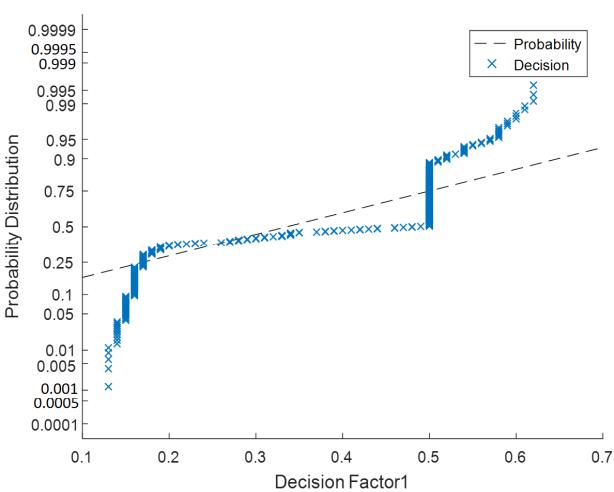
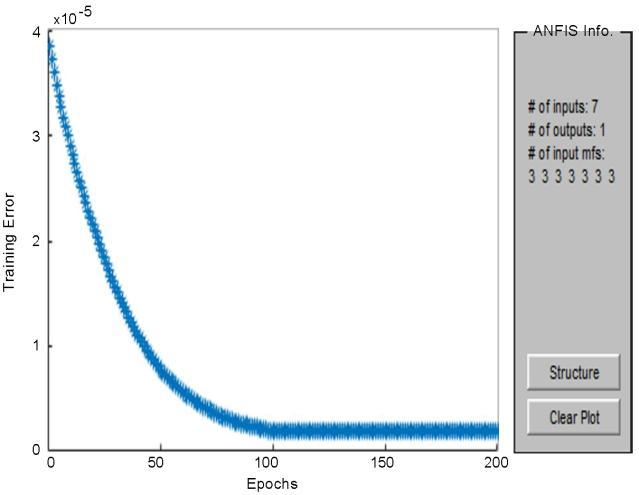
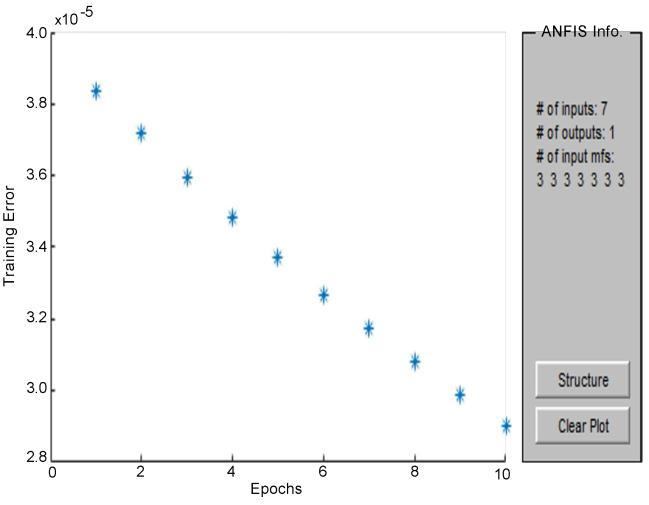
Fig-10showstheimpactofsubjectingtheinputstotheFIS for both algorithms, which later result in some linear FIS outputs while others were scattered basedon the random inputs. Fig -11 andFig-12 show the training errors of the neuro-fuzzy inference system. It is observed that the training errors of the neuro-fuzzy inference system with two different epochs (10 and 200) are decreasing as the number of iterations increases, which indicates that the module is working well in terms of performance. Subsequently, to evaluate further the probability distribution of both decisions is plotted with the peak probability values of 0.995 and 0.999 to ascertain if there will be a remarkable difference between these inference systems. This is as shown in Fig -13 and Fig -14 respectively.
3. CONCLUSIONS
Inconclusion,thecomparativestudyofFLCSandNFSwas achieved, which shows an improved performance when using a combination of Fuzzy and Artificial neural algorithms in the IP over MPLS VPLS networks. It is observedthatthehigherthenumber of epochs,thelower the training error. Furthermore, computed fuzzy and neuro-fuzzy-based service-aware LSPs for forwarding scheduled packets are obtained to avoid the situation of underutilization and overutilization of paths. Therefore, combined FLCS and NFS have a remarkable impact in making the decision for the selection of satisfactory service.
REFERENCES
[1] A. Alia and K. Ghassan, "Analysis of MPLS and IP Networks Performance to Improve the Qos using Opnet Simulator” Journal of Emerging Trends in Computing and InformationSciences,vol.8,pp.1-9,2017.
[2] O.M.Heckmann,ThecompetitiveInternetservice provider: network architecture, interconnection, traffic engineeringandnetworkdesign:JohnWiley&Sons,2007.
[3] Q. Zheng and G. Mohan, "Protection approaches for dynamic traffic in IP/MPLS-over-WDM networks," IEEE Communications Magazine, vol. 41, pp. S24-S29, 2003.
[4] O.Akinsipe,F.Goodarzi,andM.Li,"Comparisonof IP, MPLS and MPLS RSVP-TE Networks using OPNET," International Journal of Computer Applications, vol. 58, 2012.
[5] R. S. Naoum and M. Maswady, "Performance Evaluation for VOIP over IP and MPLS," World of
Computer Science and Information Technology Journal (WCSIT),vol.2,pp.110-114,2012.
[6] O.Z. Mustapha, Muhammed Ali, Y.F. Hu, R.A. AbdAlhameed, “Service-aware LSP selection with fuzzy based packet scheduling scheme for non - real time traffics”, International Journal of Informatics and Communication Technology (IJ-ICT) Vol.10, No.2, pp. 126~139, ISSN: 2252-8776,DOI:10.11591/ijict.v10i2.,2021.
[7] Forecast Analysis: Enterprise Networking Connectivity Growth Trends, Worldwide 2019, available: https://www.gartner.com[Accessed: Feb,2020].
[8] Exponential-e. MPLS vs VPLS. Available: https://www.exponential-e.com/about-us/whyexponential-e/mpls-vs-vpls[AccessedSept2017]
[9] Shopforbandwidth. MPLS | Multiprotocol Label Switching. Available: https://shopforbandwidth.com/mpls/ [Accessed: Sept 2017]
[10]
Huawei.VPLS.Available:http://support.huawei.com/enter prise/docinforeader!loadDocument1.action?contentId=DO C1000009655&partNo=100102[Accessed:Oct2018]
[11] T. Issariyakul and E. Hossain, "Introduction to Network Simulator 2 (NS2)," in Introduction to Network SimulatorNS2,ed:Springer,2009,pp.1-18.
[12] G. R. Ash, Traffic Engineering and QoS Optimization of Integrated Voice & Data Networks: MorganKaufmann,2006.
[13] O.Z. Mustapha, Y.F. Hu, R.A. Abd-Alhameed, H.S. Abdullahi,“Approach to Label Distribution Protocol Signaling using Multimedia Services for Bandwidth Allocation,”IEEEUKSim, CambridgeUK, pp157-162,DOI: 10.1109/UKSim.2018.00039,2018.
[14] Reyadh Shaker Naoum and Mohanand Maswady, “Performance Evaluation for VOIP over IP and MPLS”,World of Computer Science and Information Technology Journal (WCSIT), Vol. 2, No. 3, p110-114, 2012.
[15] M. Khan, "MPLS Traffic Engineering in ISP Network,"InternationalJournalofComputerApplications, vol.59,2012.
[16] M. N. Soorki and H. Rostami, "Label switched protocol routing with guaranteed bandwidth and end to endpathdelayinMPLSnetworks,"JournalofNetworkand ComputerApplications,vol.42,pp.21-38,2014.
[17] Sydney, A., Nutaro, J., Scoglio, C., Gruenbacher, D., &Schulz,N.,“Simulativecomparisonofmultiprotocollabel switching and openflow network technologies for transmission operations Smart Grid”, IEEE Transactions on,4(2),pp.763-770,2013.
[18] Vassilis Foteinos, et al, “Operator-Friendly Traffic Engineering in IP/MPLS Core Networks,” IEEE Transactions On Network And Service Management, Vol. 11,No.3,September2014.
[19] NishaChauhanandVivekKumar“ADetailReview on Multiprotocol Label Switching (MPLS)”, International Journal ofAdvancedResearchinComputerEngineering & Technology(IJARCET),Volume4Issue4,2015.
[20] Suparta W, Alhasa KM, “A comparison of ANFIS and MLP models for the prediction of precipitable water vapor", IEEE international conference on space science andcommunication(IconSpace),pp243–248,2013.
[21] O.Z.Mustapha,Muhammed Ali, Y.F.Hu,R.A.AbdAlhameed, “Fuzzy based Packet Scheduling Scheme using Non-Real time Traffic in IP/MPLS Networks,” IEEE FiCloud, Istanbul Turkey, pp 385-392, DOI 10.1109/FiCloud.2019.00063,2019.
[22] S. Dick, “Towards complex fuzzy logic,” IEEE Trans.FuzzySyst.,vol.13,no.3,pp.405–414,Jun.2005.
[23] G. Zhang, T. S. Dillon, K.-Y. Cai, J. Ma, and J. Lu, “Operation properties and delta-equalities of complex fuzzysets,”Int.J.Approx.Reason.,vol.50,pp.1227–1249, 2009.
[24] S. Dick, “Towards complex fuzzy logic,” IEEE Trans.FuzzySyst.,vol.13,no.3,pp.405–414,Jun.2005.
[25] J. D. Mallapur, S. Abidhusain, S. S. Vastrad, and A. C. Katageri, "Fuzzy based bandwidth management for wirelessmultimedianetworks,"inInformationProcessing andManagement,ed:Springer,pp.81-90,2010.
[26] M.-Y. Chow, S. Altug, and H. J. Trussell, "Heuristic constraints enforcement for training of and knowledge extraction from a fuzzy/neural architecture. I. Foundation," IEEE Transactions on Fuzzy Systems, vol. 7, pp.143-150,1999.
[27] S. Mitra and Y. Hayashi, "Neuro-fuzzy rule generation: survey in soft computing framework," IEEE transactions on neural networks, vol. 11, pp. 748-768, 2000.
[28] M.Brown,K.Bossley,D.Mills,andC.Harris,"High dimensionalneurofuzzysystems:overcomingthecurse of dimensionality," in Proceedings of 1995 IEEE
International Conference on Fuzzy Systems, pp. 21392146,1995.
[29] C. Chrysostomou, A. Pitsillides, L. Rossides, M. Polycarpou, and A. Sekercioglu, "Congestion control in differentiated services networks using Fuzzy-RED," Control Engineering Practice, vol. 11, pp. 1153-1170, 2003.
[30] P. M. L. Chan, R. E. Sheriff, Y. F. Hu,P. Conforto, C. Tocci, and Alenia Spazio, “Mobility Management Incorporating Fuzzy Logic for a Heterogeneous IP Environment,”IEEECommunicationsMagazine,2001.
[31] Ali, Muhammad. "Load balancing in heterogeneous wireless communications networks. Optimized load aware vertical handovers in satelliteterrestrial hybrid networks incorporating IEEE 802.21 media independent handover and cognitive algorithms.", SchoolofEngineering,DesignandTechnology,2012.
[32] O.Z. Mustapha "Intelligent based Packet SchedulingSchemeusingInternetProtocol/Multi-Protocol LabelSwitching(IP/MPLS)Technologyfor5G.Designand Investigation of Bandwidth Management Technique for Service-Aware Traffic Engineering using Internet Protocol/Multi-Protocol Label Switching (IP/MPLS) for 5G",FacultyofEngineeringandInformatics,2019.