A Proposed Methodology to Reduce Congestion in Vehicle Ad-hoc Networks by Determining the Direction of Vehicles in Aleppo city
Mohammad Hammadi1 , Souheil Khawatmi2 , Bader eddin Kassab31pursuing a M. S. Computer Networks at the Faculty of Informatics Engineering, University of Aleppo, Syria.
2associate professor at the Faculty of Informatics Engineering, University of Aleppo, Syria.

3associate professor at the Faculty of Informatics Engineering, University of Aleppo, Syria. ***
Abstract - Thedynamicnatureofvehicularadhocnetwork (VANET) induced by frequent topology changes and node mobility, imposes critical challenges for vehicular communications. Aggravated by the high volume of information dissemination among vehicles over limited bandwidth, the topological dynamics of VANET causes congestion in the communication channel, which is the primary cause of problems such as message drop, delay, and degraded quality of service To mitigate this congestion, congestioncontrolalgorithmswereusedinvehiclenetworks. These algorithms depend on several factors to reduce congestion,includingthemessagesendingpowerfactororthe message sending rate factor. In some algorithms, the two factors were combined together. In this article, an improvementmechanismwasproposedonanalgorithmbased onthepowerfactortocontrolcongestion.Theresultsshowed the effectiveness of the mechanism and its positive impact on thevehiclenetwork,whichpositivelyaffectstheperformance of vehicle networks in general.
Key Words: VANETs, congestion control algorithm, NCaAC, SAE-DCC, Adaptive Power Level Control Algorithm
1.INTRODUCTION
AVehicularAdHocNetwork(VANET)isatypeofmobile ad hoc network (MANET) that enables communication among vehicles and between vehicles and roadside infrastructureusingwirelesscommunicationtechnologies. VANETshaveemergedasapromisingsolutiontoimprove road safety, traffic efficiency, and passengers' comfort, amongotherbenefits.
In a VANET, each vehicle is equipped with a wireless communicationdevicethatallowsittoexchangeinformation withothernearbyvehiclesandroadsideinfrastructure.The communication can be either vehicle-to-vehicle (V2V) or vehicle-to-infrastructure (V2I) depending on the type of communicationandthenetwork'sarchitecture.Vehiclescan shareinformationsuchastheirlocation,speed,acceleration, anddirection,aswellastrafficconditions,roadhazards,and weatherconditions.
VANETs can be classified into two types: infrastructurebased and infrastructure-less. In an infrastructure-based VANET,communicationisfacilitatedthroughroadsideunits (RSUs)thataredeployedalongtheroadnetwork.RSUsact asaccesspointsandrelaymessagesbetweenvehiclesand thecentralinfrastructure.Incontrast,inaninfrastructureless VANET, communication is entirely peer-to-peer, and vehiclesself-organizeandcoordinatetheircommunication withouttheneedforanycentralizedinfrastructure.
VANETs face several challenges, including limited bandwidth, high mobility of vehicles, and security and privacy issues, among others. Nevertheless, VANETs have thepotentialtorevolutionizethetransportationsystemby enabling various applications such as collision avoidance, trafficmanagement,emergencyresponse,andinfotainment services.
Overall,VANETsareanexcitingandrapidlyevolvingfieldof research,andtheirpotentialbenefitsmakethemapromising technologyforthefutureoftransportation.
2. System architecture and network operation
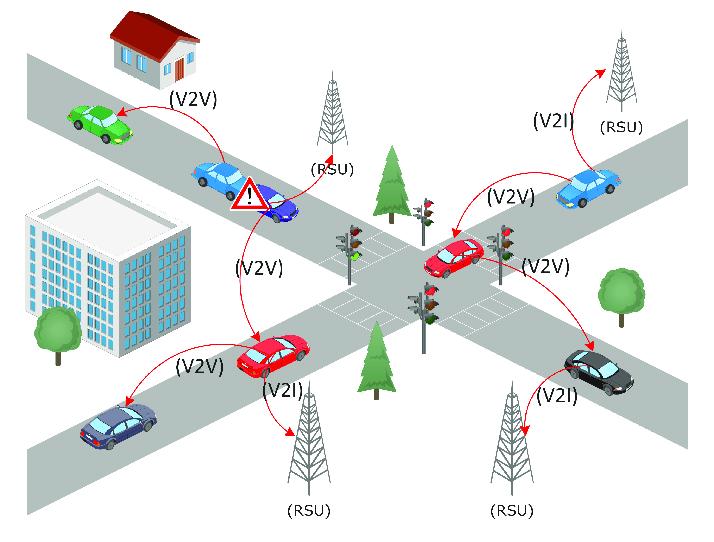
The VANET consists of many vehicles (nodes), and the number of vehicles connected to VANETs exceeds 750 million vehicles worldwide daily [2]. These vehicles need a central controller to control them, and they can communicatewitheachotherbyusingshortwaves(5.9GHz) asanad-hocconnection.Theroutersusedtohelpvehiclesto communicate are called Road Side Units (RSUs). They forward packet between vehicles all the way, and at the same time, they are connected to other VANET networks. Each vehicle contains an On-Board Unit (OBU) communicationunitthatcanconnecttoRSUviashort-range radio signals, Dedicated Short-Range Communications (DSRC),andotherdevices.AsshowninFig.1,vehiclescan communicatewitheachotherandwithroadsideunits.
3. Congestion in VANET
The significant number of connected vehicles can cause congestionduetothemessagesexchangedbetweenvehicles [3],whichinturncausesabottleneckinthenetwork,leading to ahigh packet loss rate and time delays in data transmission. For this reason, many researchers have proposed some solutions to mitigate preventing network throttling,eitherbyimprovingexistingroutingprotocolsor bydevelopingalgorithmsthatdetectandcontrolcongestion [4]
4. Related works
In[5]theresearchersreliedontherateofmessagessent andthepriorityofthesemessages,sothattheyareclassified intotwoparts,creatingaframeforeachtypeofmessage: ThefirsttypeisSafety_message,andthistypeisgivenhigh priority.Thesecondtypeistherestoftheothermessages Other_messageItisgivenlowerprioritythanpublicsafety messages.Allmessagesareplacedinbothframesdepending onthetypeofmessageandthenthemessagesinthehighest priorityframearesentatahighrate,whiletherestofthe messages are ignored or transmitted at a low rate. The researchersusedproductivitycoefficients(Throughput)and E2Eend-to-endtimedelayandpacketdeliveryratio(PDR) asperformancemetricsforthisproposedalgorithm,which showedanoverallperformanceincreasebutincreaseddata losswhentheproportionofcarsinthenetworkincreased. In[6]theresearcherspresentedaproposedalgorithmthat dependsonbalancingtheloadinthenetworkusingtheRSU, thatis,whenacertaincongestionoccurswithinthescopeof acertainRSU,loadbalancingoccurswithanotherRSUso thatthevehiclesarelaterdirectedtolesscrowdedroadsor paths, and thus the congestion in the network has been reduced. The research used performance measurement parameters(throughput,delay,andtherate ofdeliveryof datapackets)andanimprovementinnetworkperformance wasnoted,butoneofthemostimportantdisadvantagesof thisalgorithmliesinthelongdistancebetweenRSUsorthe presence of obstacles such as buildings, and it was not
implemented on the V2V network structure, as it was achieved Only in V2I architecture and therefore the proposedalgorithmisnotsuitableforurbanenvironment. In[7]ThisalgorithmproposedbyresearcherWeiisahybrid algorithm that uses transmission rate and transmission powertogether.Itadjuststhetransmissionrateofmessages according to the vehicle density and thus maintains the stability of the channel state. Important messages such as public safety messages are sent at the highest capacity availabletobedeliveredintherequiredtimeandwithouta significant time delay. The simulation results showed the abilityoftheproposedalgorithmtocontrolthechannelwell andimprovethenetworkperformance,butatahighdensity of vehicles there was a relatively large percentage of data loss,andthispercentageincreaseswiththeincreaseinthe number of vehicles. In [8] the researcher relied on the messagetransmissioncapacityfactor,sothatmessagesare sentwithdifferentcapacitiesdependingonthestateofthe channel. That is, if congestion occurs, the transmission capacity is reduced, and thus the message does not reach long distances in the network, and thus congestion is reduced.Theresultsofbenchmarkingthealgorithmshowed good performance in the case of cities and high vehicle density,butinlowdensityareasoronhighways,therewasa percentageofdataloss,whichnegativelyaffectedtheoverall network performance. In [9] he researchers based the algorithmproposedhereonthestrategyofprioritizingthe deliveryofBSMmessagestonearbyvehicles,whichcanbe achievedbyusingalowtransmissionpowerlevelinsteadof continuoustransmissionatapowerof200mw Whenusing less transmission capacity, network congestion will be reduced and packet delivery will be increased, but the awarenessofdistantvehicleswillbereduced,andtherefore vehicles will not be able to know if a specific incident has occurredinordertotakeappropriateaction.
5. Suggested method
Thebasicalgorithminthisresearchisbasedonadjusting thepowerrateofsendingmessagesbasedonthenetwork conditionandthestateofthecommunicationchannel Ifthereisnocongestioninthechannel,itsendsmessages withahighpowerofapproximately(20milliwatts),andif congestionoccursinthechannel Itreducesthetransmission powerto(5milliwatts),buteventransmittingwithapower of5milliwattstoallvehiclesinthenetworkwithinaspecific transmission range, it will lead to congestion in the communication channel when the number of vehicles reaches a certain limit because the algorithm sends to all vehicleswithinthetransmissionrange[10].
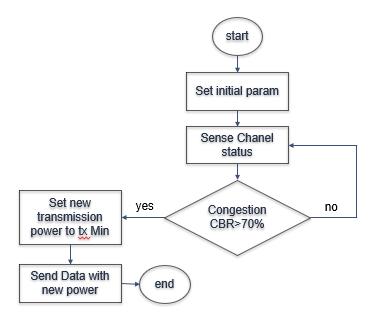
Therefore,wewillmodifythealgorithmsothatitdoesnot send to vehicles traveling in the opposite direction of the vehicle, and therefore we will reduce the number of messagessentwithinthenetwork,andthusthiswillreduce congestioninthenetwork.Figure(2)showstheflowchartof thebasicalgorithmwithoutmodification,andwenotethat
thealgorithmsendstoallvehiclesregardlessofthevehicle's direction.
•HighcapacityBSMmessageslocatedatadistancegreater thanthespecifiedrange.
•YouwillnotreceiveanyBSMmessagesifthedistanceis greaterthanthespecifiedrange,atlowpower,orwhenin theoppositedirection.
6. Determine the direction of the vehicle
Thedirectionofthevehicleisdeterminedusingoneoftwo methods:
6.1 The traditional way :
Figure (3) shows the proposed method for modifying the basic algorithm so that the algorithm first determines the directionofvehiclesbeforesendingmessages,andthenonly sendsmessagestovehiclesthatareinthesamedirection.

It is calculating the distance between vehicles using the Euclidean method, which depends on calculating the distancebetweentwopointsduringcertaintimeintervals, sothatifthedistanceisdecreasing,thismeansthatthetwo vehicles are in opposite directions, and in this case the messageisnotsent;Andifthedistanceisalmostconstant, then this means that the two vehicles are in the same direction,andthusthemessagewillbesent[12].
Thereareseveralcasesthatneedtobediscussed:
Ifonevehicleisfasterthantheotherandtheyarein thesamedirection,thedistancewilldecrease(notransmissioncondition)butthemessagemustbe sent because the two vehicles are in the same direction.
Thetwovehiclesareinoppositedirections,butthe distanceisincreasing.Thatis,afterthetwovehicles intersect,thedistancebetweenthemwillincrease (inthecaseofsendingamessage),butinthiscase themessageshouldnotbesent.
The initialization phase begins with determining the near and far transmission ranges in meters for the current vehicle.In practice, theTxtransmission capacitydoes not dependsolelyonthetargetdistance,butalsoonadditional factors such as weather conditions, obstacles, and vehicle density. The distance between vehicles is calculated dependingontheenergyofthevehicle'stransmissionusing the inverse square law [11], which is a physical law that describesthedecreaseintheradiationpowerortheforce resultingfromthetransmissionbyaninverseamountofthe squareofthedistancebetweenthesourceandthereceiver, anditappliestovarioustypesofradiationandtransmission, including Electromagnetic radiation and transmission in vehicle networks. We certainly expect that vehicles at a distance d relative to vehicle v will receive a Basic Safety Message(BSM)asfollows:
•AllBSMmessagesareatadistancelessthanorequalto thespecifiedrangeandwheninthesamedirection.
Thetwovehiclesgooneway(transmissionstate).
Thetwovehiclesareinoppositedirections(incase ofnon-transmission).
Tosolvethisproblem,weproposedinthisresearcha mathematical model that depends on the distance betweenthetwovehiclesbydeterminingthedirection in order to be able to determine the status of the messageifitisinastateoftransmissionornot.
First,wewilldeducethemodelbythephysicalmethod, andthesymbolsusedinthelawsare:
If X is the coordinate of the mover, which is the algebraicdistancefromtheprincipleonthehorizontal axis.Wewillhaveforexample:
Xa1isthecoordinateofcaraatthefirstmomentt. Xb2isthecoordinateofcarbatt+1second.
V: is the speed of the mover, and it is a positive algebraicvaluewhenthecarismovingtowardstheaxis andnegativeintheoppositedirection.Wewillhavefor example:
Vbisthespeedofthesecondcar(+15withtheaxleand -15againsttheaxle).
Thetimefunctionofuniformrectilinearmotionisgiven by:
X=Vt+X_0 (1)
Andforthefirstcaraattimet:
X_a1=V_at+X_a (2)
WhereX_aisthecoordinateofthefirstcaratthestart oftime(notimportant).
Asforthemoment:t+1
X_a2=V_a(t+1)+X_a
X_a2=V_at+V_a+X_a (3)
Forthesecondcarbattimet:
X_b1=V_bt+X_b(4)
Where X_b is the coordinate of the second car at the startoftime(notimportantandwilldisappear).
Asforthemoment:t+1
X_b2=V_b(t+1)+X_b
X_b2=V_bt+V_b+X_b (5)
Subtracting(2)from(4),weget:
X_b1-X_a1=V_bt-V_at+X_b-X_a (6)
Subtracting(3)from(5),weget:
X_b2-X_a2=V_bt-V_at+V_b-V_a+X_b-X_a (7)
Substituting(6)into(7),weget:
X_b2-X_a2=X_b1-X_a1+V_b-V_a (8)
Andwecanputanabsolutevalueontheresultasthe distance difference between the two cars if we don't careaboutthesignofthedistancedifference. Nowwewillderivefourequationsfromrelation(8) thatexpressthedirectionofthecompounds: Wecalculatethefourgeneralequationsthat determinethedirectionofthetwovehicles,whichare asfollows:
First:thetwovehiclesgooneway
X_b2-X_a2=|(X_b1-X_a1)-|(V_a-V_b)|| (9)
X_b2-X_a2=(X_b1-X_a1)+|(V_a-V_b)| (10)
Second:Thetwovehiclesareindifferentdirections
X_b2-X_a2=|(X_b1-X_a1)-(V_a+V_b)| (11)
X_b2-X_a2=(X_b1-X_a1)+(V_a+V_b) (12) where:
X_b2-X_a2Thedistancedifferencebetweenthetwo vehiclesatt+1.
(X_b1-X_a1)Thedistancedifferencebetweenthe twovehiclesattimet.
Suppose we have two vehicles a and b as shown in Figure (8) the speed of the first vehicle ���� = 10 m/s andthespeedofthesecondvehicle����=15m/s


Thevehicleistravelinghorizontallyononeaxis(Xaxis).
Letthepositionofthefirstcomponent����=2andthe positionofthesecondcomponent����=10
Sothedistancedifferencebetweenthetwovehiclesat timetis������ ������=8
Byapplyingthevalues,theequationsbecomeas follows:
X_b2-X_a2=|8-(10+15)|=17
X_b2-X_a2=|8-(|10-15|)|=3
X_b2-X_a2=8+(10+15)=33
X_b2-X_a2=8+(|10-15|)=13
Now,aftercalculatingthefourequations,wecalculate thedistancebetweenthetwovehiclesdependingonthe signal strength between them, and we compare the valueresultingfromcalculatingthedistancewiththe valuesresultingfromthefourequations,andaccording tothevaluecorrespondingtotheequationnumber,we determinewhetherwesendthemessageornot?
ItisaprotocolbasedonlocationinformationthroughGPS, sowewilltakeadvantageofthisinformationtodetermine the direction of the nodes, and therefore, before the node sendsdata,itwilldeterminethedirectionofthenode;Ifitis in the same direction as the sender, it will send data and establishaconnection,andifitisintheoppositedirection,it willnotsendanydata,astheconnectionwillbeinterrupted duetothedistancebetweenthetwovehicles.Inthiscase, therewillbeasignificantreductioninthenumberofdata transmittedwithinthenetwork,andthustheconnectionwill beestablishedforaverylongtime[13].
7. Results and discussion:
Tools and programs for wireless networks in general and vehicle networks in particular within a simulated environment based on the map of Aleppo, the University Squarearea,andthesetoolsare:
1- OpenStreetMap_Itisatoolthatconvertsanymap intoXMLfilestoimplementtherequiredsimulation [14]
2- SUMO:Itisaprogramforvehiclenetworksbased on creating a special network to implement simulations based on the map that was exported fromthepreviousprogram[15].
3- NS2: It is the famous simulation program for wirelessnetworks,whichisbasedonestablishing connectionsbetweennodesandimplementingthe proposedalgorithm[16]
Thesimulationwasbuiltbasedontheparametersshownin thefollowingTable(1):
Table -1: experimentparametersusedinthesimulation
Fromchart(1)wenoticeanimprovementinthedelaytime compared to the basic adaptive algorithm for a variable numberofvehiclesrangingfrom20to100vehiclesinthe simulationarea.


Chart -1:EndToEndDelay
7.1.2. Packet Delivery Ratio (PDR)
The packet delivery ratio is the rate of the average number of packets received at the destination to the total numberofpacketssentfromthesourcetothisdestination. The results show that the percentage of data delivery increases with the number of vehicles to a certain extent. However,whenahighdensityisreached,thePDRdecreases due to the large number of exchanged messages and network congestion. Chart-2 shows the simulation results forPDR.
Thealgorithmwillbesimulatedintwophases.Thefirst phasewillapplytheaforementionedmathematicalmodelto determinethevehicle’sdirectionanddiscussandcompare the results. In the second phase, we will apply the LAR protocoltodeterminethevehicle’sdirectionandanalyzethe results.
7.1. Results of applying the mathematical model:
7.1.1 End To End Delay
TheE2Edelayofeverysinglepacketisdefinedasthesumof the delays that occurred in a series of nodes the whole way from the source to the destination. As the number of vehiclesincreases,thedelayincreasesduetotheincrement inthenumberofmessagesexchangedbetweennodes.
Chart -2:PacketDeliveryRatio
7.1.3. Throughput
Network throughput is the amount of data successfully transferredfromoneplacetoanotherduringagivenperiod of time, usually measured in bits per second (bps) and its multiples. Throughput tells the user how often messages successfullyreachtheirdestination,representingapractical measure of actual packet delivery rather than theoretical
packetdelivery.Thethroughputincreasesdirectlywiththe number of vehicles. According to the results in Chart-3, wenoticeanimprovementinthroughput
Chart -2:Throughput
7.2. Results of applying LAR protocol
We re-tested the proposed algorithm within the LAR protocol,andwenoticedanimprovementinthedelaytime, which in turn was reflected in improved throughput and improved data access rate compared to the improved algorithmwithinthebasicprotocolintheemulator,asshown inthefollowingcharts:
7.2.1 End to End Delay
chart(4)showstheresultsofthetimedelayvaluesforthe arrivalofBSMmessagesbetweenvehiclesaccordingtothe proposedalgorithmbasedontheLARprotocol.Comparison withthebasicalgorithmandthetwoalgorithmsin[5]and [7].
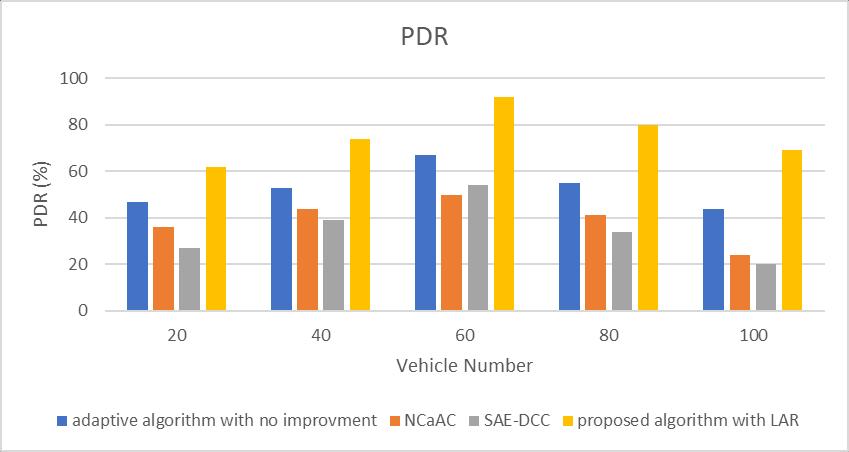

Chart -5:PacketDeliveryRatio
7.2.3. Throughput
Chart (6) shows the results of the throughput analysis according to the adaptive algorithm and the optimized algorithmaccordingtotheproposedalgorithmbasedonthe LARprotocol.Comparisonwiththebasicalgorithmandthe twoalgorithmsin[5]and[7].
Chart -4:EndtoEndDelay
7.2.2. Packet Delivery Ratio (PDR)
Chart(5)showstheresultsoftheanalysisoftheratioof packets between vehicles according to the proposed algorithmbasedontheLARprotocolComparisonwiththe basicalgorithmandthetwoalgorithmsin[5]and[7]

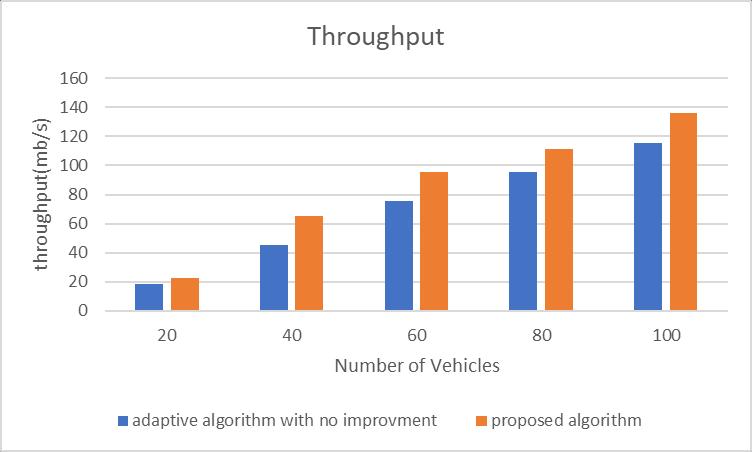
Chart -6:Throughput
Fromtheabove,wenoteasignificantimprovementin theresultscomparedtoboththebasicalgorithmandthetwo algorithmsinpreviousstudies,butwemustmentionsome notesontheresults:
With regard to the end-to-end delay, we note the superiorityoftheproposedalgorithm,butwealsonotethe increaseintimewiththeincreaseinthenumberofvehicles, forthefollowingreasons:
1- The increase in the volume of traffic within the studied area, and thus the delay in data transmission betweenvehicles
2- Increasing the number of hops that the banners mustjumpthroughtoreachthereceivingvehicle,andthe higherthenumberofhops,thegreaterthedelay
3- Increasing the number of vehicles within the networkrequiresastrongerandlargerinfrastructuretobe
abletodealwiththevolumeofdataandthelargenumberof vehicles. This infrastructure may need updates and developmenttobeabletodealwiththevolumeofdataand theincreasingnumberofvehicles.
As for the PDR packet delivery ratio, we also note the superiority of the proposed algorithm, and the ratio gradually increases with the increase in the number of vehicles to a certain number of vehicles, then the ratio decreases when a relatively large number of vehicles is reached.
The reason for increasing the ratio when reaching a certainnumberofvehiclesisduetoimprovingthequalityof communication between vehicles and increasing the available bandwidth within the network, as well as to the availability of energy. With an increase in the number of vehicles, energy use can be reduced and the power of sendingmessagescanbereduced,whichleadstoanincrease intherateofpacketdelivery.
Asforthereasonforthelowpercentagewhenreachinga relativelylargenumberofvehicleswithinthenetwork,itis duetothefollowingreasons
1- Increased signal interference and radio wave interference,andthisaffectsthequalityofcommunication andincreasesthenumberoferrorsinreception,whichleads toadecreaseinthesuccessrateofreception
2- Increasedtrafficvolume,thiscancausetrafficjams anddatainterferencebetweenvehicles
3- UnavailabilityofenergyAsthenumberofvehiclesin thenetworkincreases,energyuseincreases,andenergymay becomelimitedinsomevehicles
Finally, with regard to productivity, we note the superiority of the proposed algorithm over the basic algorithm. We notice an increase in the productivity rate with the increase in the number of vehicles, due to the followingreasons:
1- Reducingthedistancebetweenvehicles:Thegreater thenumberofvehiclesinthenetwork,thelessthedistance between them, which leads to higher signal strength and fastercommunicationspeedsbetweenvehicles,andthusan increaseinthroughput.
2- Increasingrouteoptions:Whenthenumberofvehicles increases,thenumberof lanesavailable betweenanytwo vehicles increases, which contributes to improving route selectionalgorithmsandchoosingtheoptimalrouteinterms ofperformanceandthusincreasingproductivity
8. Conclusion
Throughtheresultsthatappearedwithus,weconcludethat ifmessagesarenotsenttovehiclestravelingintheopposite
direction, we notice an improvement in the measured parameters,andthisinturnleadstoanimprovementinthe performanceofvehiclenetworksandthusanimprovement in safety applications and an increase in the safety and securityofpassengers.
REFERENCES
[1] Agrawal, R ., Faujdar, N., Romero, C., Sharma, O., Abdulsahib, Gh ., Khalaf , O., Mansoor, R., Ghoneim.O. "Classification and comparison of ad hoc networks: A review".EgyptianInformaticsJournal.2022.
[2] Fuentes,J.,González-Tablas,A.,Ribagorda,A."Overview of security issues in Vehicular Ad-hoc Networks ".ResearchGate.2011
[3] Silva,C.,Masini,B.,Ferrari,G.,Thibault,I."A Surveyon Infrastructure-Based Vehicular Networks.". Hindawi. 2017
[4] "Vehicular Ad Hoc Networks: Architectures, Research Issues, Methodologies, Challenges, and Trends.". Hindawi.2015
[5] WANG, Shujuan; ZHANG, Qian; LU, Shuguang. NCaAC: Network Coding-aware Admission Control for prioritized data dissemination in vehicular ad hoc networks. Wireless Communications and Mobile Computing,2020,2020:1-14.
[6] Liu, Xiaofeng, Ben St. Amour, and Arunita Jaekel. "Balancing awareness and congestion in vehicular networks using variable transmission power." Electronics10.16(2021):1902.
[7] Wei,Yongyi."SAE-DCCevaluationandcomparisonwith popular congestion control algorithms of V2X communication."(2017).
[8] Facchina, Caitlin. Adaptive Transmission Power Level withVehicleSpeedApproximationofDensityforVANET Congestion Control. Diss. University of Windsor (Canada),2020.
[9] Liu, X., St Amour, B., & Jaekel, A. (2021). Balancing AwarenessandCongestioninVehicularNetworksUsing VariableTransmissionPower.Electronics,10.
[10] Facchina,C."AdaptiveTransmissionPowerLevelwith Vehicle Speed Approximation of Density for VANET Congestion Control". Thesis master of Science at the UniversityofWindsor.canada.2020.
[11] A. C. Newell And M. L. Crawford, Planar Near-Field Measurements On High Performance Array Antennas, 1stEd.Colorado:InstituteForBasicStandardsNational BureauOfStandards,2010
[12] Maria,E.,E.Budiman,andM.Taruk."Measuredistance locating nearest public facilities using Haversine and Euclidean Methods." Journal of Physics: Conference Series.Vol.1450.No.1.IOPPublishing,2020.
[13] Rana, Kamlesh Kumar, Sachin Tripathi, and Ram ShringarRaw."Opportunisticdirectionallocationaided routingprotocolforvehicularad-hocnetwork."Wireless PersonalCommunications110(2020):1217-1235.
[14] Mooney, Peter, and Marco Minghini. "A review of OpenStreetMap data."Mappingand thecitizensensor (2017):37-59.
[15] Lim,KitGuan,etal."SUMOenhancementforvehicular ad hoc network (VANET) simulation." 2017 IEEE 2nd international conference on automatic control and intelligentsystems(I2CACIS).IEEE,2017.
[16] Issariyakul, Teerawat, et al. Introduction to network simulator2(NS2).SpringerUS,2009.
BIOGRAPHIES
MohammadHammadireceivedhisB.S. degreefromtheFacultyofInformatics Engineering, AlBaath University, Syria in2018.HeiscurrentlypursuingaM.S. Computer Networks at the Faculty of Informatics Engineering, University of Aleppo, Syria. His current research interests include VANET communication.


Souheil Khawatmi received his B S. degree from the Faculty of Computer Engineering,UniversityofAleppo,Syria in 1982 and PhD degrees from the Institute of saint-Petersburg for Communication,Germanyin1989.Heis currentlyan associateprofessoratthe Faculty of Informatics Engineering, UniversityofAleppo,Syria Hiscurrent research focuses on Computer NetworksandWirelessCommunication
Bader aldin Kassab received his B. S. degree from the Faculty of Computer Engineering,UniversityofAleppo,Syria in 1986 and PhD degrees from the Institute of saint-Petersburg for Communication, Russia in 1992. He is currentlyan associateprofessoratthe Faculty of Informatics Engineering, UniversityofAleppo,Syria.Hiscurrent research focuses on the management telecommunicationcenters.