STABILIZATION OF EXPANSIVE SOIL USING WATER HYACINTH ASH
1Assistat Professor, St. Thomas college Of Engineering & Technology, Chengannur, Kerala, India
2U.G Student, Dept. of Civil Engineering, St. Thomas college Of Engineering & Technology, Chengannur, Kerala, India ***

Abstract - Strengthofsoil isanimportantcriterionwhile constructing a structure over it. Expansive soils are soils that have low strength and bearing capacity. This project focuses on stabilizing the expansive soil in Kuttanad region. Weakness of soil in this region is hazardous to both the agricultural and domestic life of people residing there. In this project the stabilization is done using an easily available and cost-effective material, water hyacinth ash. Water hyacinth, being a threat to the water bodies, is made to ash andusedto treat the soil to increase its stability. The soil will be treated using WHA (0.25%,0.5%,0.75%,1%,1.25% & 1.5%). Optimum percentage of WHA will be determined by comparing the result of UCC test. To determine the effect of curing on the material tests will be conducted on soil treated with optimumpercentageofWHAaftercuringitfor3&7days.
Key Words: Water Hyacinth Ash, stabilization, economic material,Kuttanad,Optimummoisturecontent
1.INTRODUCTION
Construction is a necessary activity in today's world, but suitablelandforconstructionislimited.Soilplaysacrucial roleindeterminingthefeasibilityofbuildingstructuresin a particular area. Some natural soil deposits are suitable for construction, while others require treatment due to their problematic nature. Soil stabilization is the process of improving soil properties to make it capable of sustaining the loads imposed by structures. This field has seencontinuousdevelopmentandchangesovertime,with agrowingemphasisonenvironmentalsustainability.
To achieve sustainable soil stabilization, recycled materials have been introduced. Construction and demolition waste, as well as broken brick powder, are being reused for stabilization purposes. Additionally, plastic waste, which poses significant environmental challenges, can be recycled and employed for soil stabilization, benefiting both soil properties and reducing plasticwaste problems. Waterhyacinth,an invasive weed causing transportation difficulties and disrupting aquatic ecosystems, can be converted into ash and utilized for stabilization, representing a new sustainable approach in soilstabilization
1.1 SOIL IN KUTTANADU
Expansive soils can shrink, swell, and change in volume duetomoisturevariations.Theycontainclaymineralslike smectite or vermiculite that absorb water and expand whenwet,leadingtostructuralheaving.Conversely,when theydryout,theycontract,causingdifferentialsettlement. These soils are weak and have significant engineering drawbacks, necessitating soil treatment prior to construction.IntheKuttanadregion,themainissuecaused by expansive soil is bund breaching, resulting in agriculturallossesandflooding.
1.2 Soil stabilization
Soil stabilization transforms soil properties for longterm strength gains. It involves increasing shear strength and bearing capacity, forming a solid monolith that reduces permeability, shrink/swell potential, and freeze/thawdamage.Expansivesoilscanexpand byup to 10%, causing significant structural harm. Stabilization eliminatestheneedforcostlyremovalandreplacementby improving soil in situ. Chemical methods, such as lime or Portland cement, form permanent bonds between soil particles. Pre-project testing ensures sufficient material for permanent floor stabilization. Various materials are usedforsoilstabilization.
2. METHODOLOGY
2.1 General
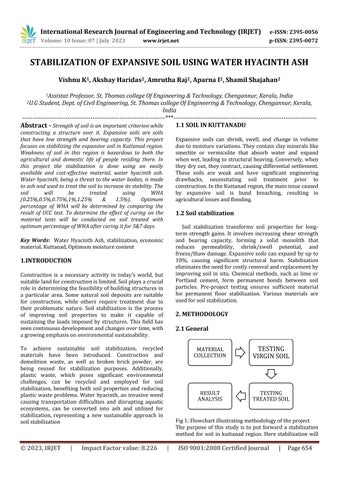
MATERIAL COLLECTION TESTING VIRGINSOIL TESTING TREATEDSOIL
Fig1:Flowchartillustratingmethodologyoftheproject
The purpose of this study is to put forward a stabilization method for soil in kuttanad region. Here stabilization will
be done by treating the soil with water hyacinth ash. By doing so,the pollution caused by water hyacinth, which is an unwanted weed in water bodies can be reduced First thebasicpropertiesofthesoilcollectedwillbedetermined usingsometests.Thus,thecharacteristicsofthesoilinthat region can be determined. Then ucc tets will be used to determine the effect of WHA on the strength ofsoil.Effect ofcuringonthematerialwillalsobestudied.Theteststhat willbeconductedare:
•HydrometerAnalysis-IS-3104:1965
•SpecificGravitytest–IS2720(PartIII)-1980
•AtterbergLimittest–IS2720(PartV)-1985
•Standardproctortest–IS2720(PartVII)-1974
• Unconfined Compressive Strength test – IS 2720 (Part II)-1973
•CaliforniaBearingRatiotest–IS:2720(PartXVI):1987
2.2 Materials used
2.2.1 Water hyacinth ash
Waterhyacinthisaweedwhichgrowsinwaterbodies.Itis now invading almost all water bodies in Kerala. It is very harmful for aquatic life and is also causing transportation problems in water bodies. It can be dried and burnt to ashes. These ashes contain main compounds which are beneficial for stabilization of soil. From various studies conducteditturnedouttobewaterHyacinthashcontains calcite, quartz, Zeolite etc. These materials have a good binding property. So, it is good to use it for stabilizing the weakexpansivesoil.
2.3 Preparation of testing soil
Soil sample collected will be mixed with water hyacinth ash.Waterhyacinthashismadebyburningthesun-dried water hyacinth plant collected from nearby water bodies. Percentages of WHA that will be added to the soil are 0.25%,0.5%,0.75%,1%,1.25%&1.5%
3. BASIC PROPERTIES OF VIRGIN SOIL


• HydrometerAnalysis
2.2.2 Expansive soil
The clayey soil was collected from Kuttanad taluk, Alappuzha district, Kerala. The soil founded is expansive soil, that is it will show high shrinkage and swelling. this soil has very low strength, and all the engineering propertiesrequiredforconstructionisverylow.Instability of this soil is the main reason for bund breaching in the agriculturalfieldsofKuttanad.
Liquidlimit


•
4.
Soil treated with different percentages of WHA and their corresponding unconfined compressive strength value is givenbelow


Thus the optimum percentage of water hyacinth ash obtainedis1%
5.
ThemaxvalueofOMCwasobtainedwhencuredfor3days, the max value of compressive strength was obtained for uncured soil, the max CBR value was obtained for soil curedfor3days
6.
Kuttanad region consists of clayey soil which has verylowstrength.
Stabilization of Kuttanad soil is necessary before usingitforanykindofconstructionpurpose.
Study focuses on stabilizing the Kuttanad soil usingwaterhyacinthash.
Themaximumcompressivestrengthwasobtained as 1.8 KPa when 1% of water hyacinth ash was added.
The percentage increase in compressive strength for 1% water hyacinth ash was found out to be 50%
Theresultsofcertaintestsalsoindicatedthatsoilqualities areaffectedbycuring.
The max value of OMC was obtained when cured for3days.
The max value of dry density was obtained for uncuredsoil.
The maximum compressive strength was obtained for uncured soil which implies curing is notfavoredingreatstrengthapplications.
Max CBR value is obtained for 3 day cured soil, which suggests that 3 days of curing is required forstrongsubsoilstrength.
Thus, it is clear that strength of clayey soils like Kuttanadan soil can be increased by treating it with pozzolanic materials like water hyacinth ash. Water hyacinthash is onlyan example of one such material. Butcuringofthistreatedsoilcanonlybeproposedas per the requirement. If the requirement needs good subsoilstrengthlikeroadconstruction,thencuringis preferred. Butin case ofapplication which need good compressive strength like bund construction then uncuredsoilispreferred
REFERENCES
[1] Arulrajah, J. Piratheepan,T. Aatheesan and M. W. Bo, M.ASCEinjournalofmaterialsincivilengineeringvol. 23, No. 10, October 1, 2011. ©ASCE, ISSN 08991561/2011/10-1444– 1452. DOI: 10.1061/(ASCE)MT.1943-5533.0000319Geotechnical Properties of RecycledCrushedBrick in PavementApplications.
[2] Akshay Kumar sabat in Electronic Journal of Geotechnical Engineering (2012) vol. 17 https://www.researchgate.net/publication/2896508 96 - Stabilization of Expansive Soil Using Waste CeramicDust.
[3] Chijioke Christopher Ikeagwuani, Donald Chimobi Nwonu in Journal of Rock Mechanics and Geotechnical Engineering 11 (2019) 423e440 https://doi.org/10.1016/j.jrmge.2018.08.013Emerging trends in expansive soil stabilisation: A review.
[4] Dharmendra Barman, Sujit Kumar Dash in Journal of RockMechanicsandGeotechnicalEngineeringvol.14. 1319- 1342(2022) https://doi.org/10.1016/j.jrmge.2022.02.011Stabilization of expansive soils using chemical additives:Areview.
[5] Fazal-E-Jalal,YongfuXu,BabakJamhiri,andShazim Ali Memon in Advances in Materials Science and Engineering Volume 2020, Article ID 1510969, 23 pages https://doi.org/10.1155/2020/1510969 2020 -OntheRecentTrendsinExpansiveSoilStabilization UsingCalcium-BasedStabilizerMaterials(CSMs):
[6] Lee Jones in Encyclopedia of Engineering Geology (2018) https://doi.org/10.1007/978-3-319- 121277_118-1-Expansivesoils.
[7] Nitin Tiwar, Neelima Satyam, Anand J. Puppala in Transportation Geotechnics 29 (2021) 100556 https://doi.org/10.1016/j.trgeo.2021.100556Strength and durability assessment of expansive soil stabilizedwithrecycledashandnaturalfibers.
[8] Rajkumar Nagle, Prof. R.Jain, Prof. A.K. Shinghi in International Journal of Engineering & Science Research ISSN 2277- 2685 IJESR/May 2014/ Vol4/Issue-5/252-255- comparative study of density of soil,reinforcedwithnaturalwasteplasticmaterial.
[9] Soumendra K. Mohanty ,Pradip K. Pradhana and Chitta R. Mohanty in Geomechanics and Engineering, Vol. 12, No. 1 (2017) 111-125 DOI: https://doi.org/10.12989/gae.2017 .12.1.111Stabilizationofexpansivesoilusingindustrialwastes.
[10] Shelema Amena in Heliyon 7 e08278 October 2021 Stabilization of Expansive Soil using water hyacinth ash Department of Civil Engineering STCET, Chengannur
https://doi.org/10.1016/j.heliyon.2021.e08278Experimental study on the effect of plastic waste strips and waste brick powder on strength parametersofexpansivesoils
[11] V. Murugesh, Ruth Keziah .M in Indian Journal of Advanced Botany(IJAB)ISSN: 2582-9475, Volume-1
Issue-1,April2021DOI:10.54105/ijab.B2003.041121
- Chemical Analysis of Water Hyacinth Ash by XRD andSEM
[12] IS: 2720 (Part VII-1980) (Reaffirmed 2011)BUREAU OF INDIAN STANDARDSMethods of test for soils part (vii) - determination of water content-dry densityrelationusinglightcompaction.
[13] IS: 2720 (Part XVI – 1987) (Reaffirmed 2002) –BUREAU OF INDIAN STANDARDS - Methods of test forsoilpart16-laboratorydeterminationofCBR