International Research Journal of Engineering and Technology (IRJET) e-ISSN:2395-0056

Volume: 10 Issue: 07 | July 2023 www.irjet.net
International Research Journal of Engineering and Technology (IRJET) e-ISSN:2395-0056
Volume: 10 Issue: 07 | July 2023 www.irjet.net
Department of Applied Engineering Technology
Virginia State University
1 Hayden St, Petersburg, VA 23806 USA
***
Abstract
In the past decades, mechanical metamaterials have attracted extensive attention due to their unusual mechanical and physical propertieswith simple structures, as well as their unique potential applications in various fields, including engineering,aerospace,biomedicalengineering,robotics,sportsequipment,andtextiles,etc.Auxeticmetamaterialsareaclass of materials that exhibit negative Poisson’s ratio, meaning they contract in the direction perpendicular to the applied force when compressed. In this work, agroup of unit cell structures fortwo-dimensional auxetic metamaterials was designed and fabricated using 3D modeling and printing technology, with the unique feature of adjustable Poisson’s ratio. The Poisson’s ratioswereevaluatedexperimentally,numericallyandanalytically,andtheresultswerefoundtobeinagreementeachother. Specifically,asthephaseshiftdifferencedecreasedfromπ tozero,thePoisson’sratiosofthematerialsincreasedfrom-2.8to -0.19. This study provides insights into the design and fabrication of auxetic materials with tunable Poisson’s ratios, which couldhaveapplicationsinavarietyoffieldsincludingengineeringandmedicine.
Keywords: Auxeticmetamaterials,3Dprinting,NegativePoisson’sRatio
Introduction
Mechanical metamaterials are engineered structures that possess unusual mechanical properties and functionalities. The unusual properties include the extraordinary values of familiar mechanical parameters, such as density, Poisson’s ratio, and compressibility [1]. The exotic functionalities include pattern and shape transformations in response to mechanical forces, unidirectional guiding of motion and waves, and reprogrammable stiffness of dissipation [2]. Materials and structures with negative Poisson’s ratio exhibit uncommon mechanical properties that materials either expand or contract in all directions when a force is applied. Resulting from this uncommon behavior, many desired properties are discovered. Auxetic materials havepotentialapplicationsinthefieldsofmilitary,biomedical,aerospace,andtextiles.However,therearealimitedstructures in current literature, which possess negative value of Poisson’s ratio, such as re-entrant structure [3], chiral structure, and rigid rotating structure [4] In addition, there are a few general analytical methods to analyze the relationship of Poisson’s ratio,theparametersofgeometry,andbasematerialconstants.Inthisstudy,wedesignedagroupof3Dmodellingofunitcell structures with design software. The specimen of the structures based on the units cells were fabricated using 3D printer. Mechanical properties of these structures were analyzed by finite element methods, COMSOL 5.4, Structural Mechanics Module The Poisson’s ratios of the structures were measeured by Instron machine. Furthermore, one model of mechanical propertiesofthesestructureswascreatedtoestimatethePoisson’sratioofthesestructures(thedetailstobepublishedinthe other paper). By the comparison of the analytical values of the Poisson ratio with the analytical values from the model, they are found to be in agreement with each other. In particular, the Poisson ratios of the structures are increasing from -2.8 to0.19 as the phase difference decreasing from π to zero. The insights pave the way for modeling and fabrication of auxetic metamaterialswithtunablePoisson’sratio.
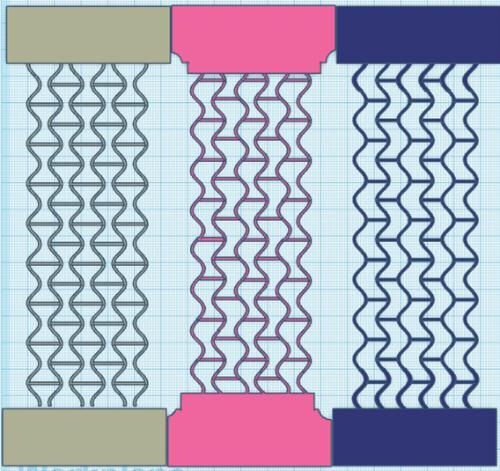
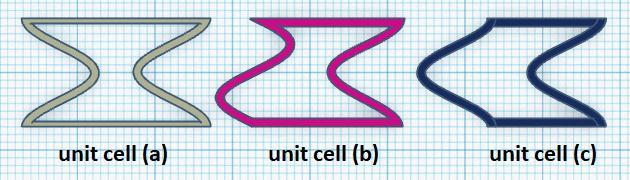
Thethreetwo-dimensionalcellularstructuresweredesignedwithTinkerCadandMatlabsoftware. Thestructures(a),(b),(c) andtheirunitcellsareshowninFig.1.Theshapesoftheunitcellsareconstructedwithtwostraightlinesandtwocurvedlines. Thesizesoftheunitcellsareheight11mm,thewidth9mm,thedepth6mm,andthethickness0.5mm.Thetwocurvedlines ineachunitcellaresinecurve
withtheattitudeof3.5/2mm,andtheperiodof11mm Thegeometriesoftheunitcellsdifferintermsofthephaseshiftofthe twosinecurvesineachunitcellintheverticaldirection.Inthestructure(a),thephaseshiftofthetwosinecurvesintheunit cellintheverticaldirectionisπ.Inthestructure(b),thephaseshiftisπ/2andinthestructure(c),thephaseshiftiszero.The sizesofthestructure(a),(b),and(c)are15cmX4cmwithdepth6mm,respectively.
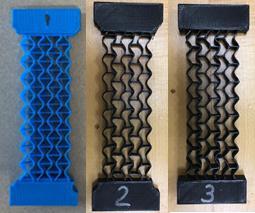
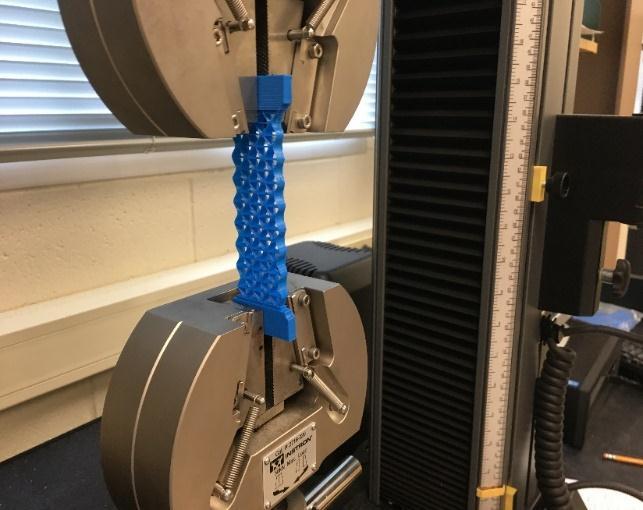
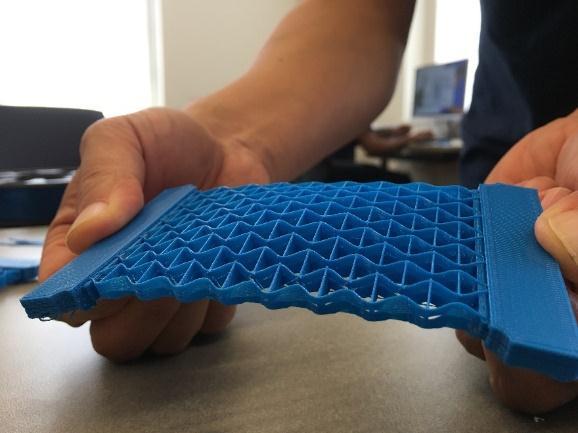
Matlabwasusedtodrawthe sinecurvesintheunitcellsand TinkerCad3Dsoftwarewasappliedtodesignthe structuresin 3D modeling. MakerBot Replicator Z18 3D printer was implemented to fabricate the structures with PLA filament. The mechanical and physical properties of the PLA filament (Polylactic Acid) are listed in Table 1. The printed specimens, structures (a), (b), and (c), are shown in Fig.2 Instron 5969 was used to measure the Poisson’s ratio of the structures displayedinFig.3.Whenbendingoutofplane,thesampleofthestructure(a)showedsynclasticcurvatureshape
International Research Journal of Engineering and Technology (IRJET) e-ISSN:2395-0056
Volume: 10 Issue: 07 | July 2023 www.irjet.net p-ISSN:2395-0072
ItindicatesexperimentallythatthesamplehasnegativePoisson’sratio,asshowninFig.4. Table1showsthemechanicaland physicalpropertiesofPLAfilament(PolylacticAcid).
Table1MechanicalandPhysicalPropertiesofPLAfilament(PolylacticAcid)
Mechanical and Physical Properties of PLA filament (Polylactic Acid)
MechanicalProperties
TensileStrength 60Mpa
Young’sModulus 3GPa
ElongationatBreak 5-10%
Poisson’sratio 0.37
PhysicalProperties
Density 1.24g/cm3
MeltingPoint160-180 oC
GlassTransitionTemperature55-60 oC
Table2 ExperimentalValuesofthePoisson’sratiooftheThreeStructures(a),(b),and(c).
Experimental Values of Poisson’s Ratio of the Three Structures
Structure(a)
Structure(b)
Structure(c)
Poisson’sRatio -2.85 -0.85 -0.19
The table 2 displays the experimental values of the Poisson’s ratio of the three structures (a), (b), and (c), increasing from0.28to-0.19asthephasedifferencedecreasingfromπtozero.ThevaluesofthePoisson’sratioweremeasuredusingInstron 5969. In the measuring process, mount the specimen between the clamps of Instron machine, stretch out the specimen one millimeter eachtimeand measure thelengthandthe widthofthe extended specimenseveral times in different positions.In the elastic deformation region of the specimen, (the elongation of the sample is less than 4 millimeters), the value of the Poisson’sratiowascalculatedasthenegativeaveragevaluesofthetransversestraintoaxialstrain.
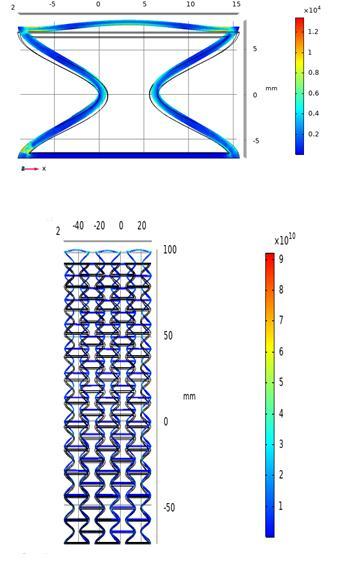
StructuralMechanicsModule,COMSOL5.4wasappliedtotheunitcell(a)andthestructure(a)tosimulatethebehaviorofthe structureunderanaxialload Insimulation,onesideofthestructuresisfixedandthegraduallyincreasingforcesareapplied totheothersideofsamples Thedeformationsandstressdistributionofthestructure(a)anditsunitcell(a)aredisplayedin Fig.5. The deformation the unit cell (a) demonstrate the obvious extension in the center part of the unit cell (a). This proves thenegativePoisson’sratiooftheunitcell(a).Thedeformationsofstructure(a)alsoshowsauxeticeffects.
Inaddition,one model wascreatedtocalculate thePoisson’sratiosofthestructures andtheresultsshownin Table3.They sharethesametrendasthemeasuredPoisson’sratio,increasingfrom-2.95tozeroasthephasedifferencesdecreasingfromπ tozero.WenotedthatI.G.MasterandK.E.EvansandF.K.Abd-Sayed, etc.methodsinthereferences[5]and[6] wereassumed thatthesidesofcellularmaterialsarelinearelasticbeams.Weusedageneralizedmodeltodealwiththecurvedbeamsinunit cells[tobepublished]
Analytical Values of Poisson’s Ratio of the Three Structures
Inthisstudy,agroupofnewauxeticstructureswasdesignedandmodeledusing3Dmodelingsoftware.Thedesignswerethen fabricated using a 3D printer and the Poisson’s ratio of the specimens was measured. The measured values of Poison’s ratio rangedfrom-2.8to-0.19,indicatingthatthestructures (a)and(b)areauxeticsandthePoisson’sratioofthestructure(c)is
International Research Journal of Engineering and Technology (IRJET) e-ISSN:2395-0056
Volume: 10 Issue: 07 | July 2023 www.irjet.net
closetozero.ThevaluesofnegativePoisson’sratioareincreasingtozeroasthephasedifferenceinthestructuresdecreasing fromπtozero.Inaddition,theresultswerecomparedwithoneanalyticalmodel(tobepublished),andthevaluesofPoisson’s ratio were found to be consistent with the prediction of the model, increasing from -2.95 to 0 as the phase shift decreasing fromπtozero Furthermore,COMSOLsimulationswereperformedonthestructures,andtheresultsdisplayedauxeticeffects aswell.
Theresultsofthisworkdemonstratethesuccessfuldesignandfabricationof agroupofauxeticstructuresusing3Dmodeling andprinting techniques. Themeasuredvalues of Poisson’s ratio are increasingfrom -2.8 to-0.19 asthe phase differencesin the structures decreasing from pi to zero. This indicates that the group of structures exhibit auxetic effects, and COMSOL simulationsconfirmtheseresults.Moreover,thegoodagreementbetweentheexperimentalandanalyticalresultssuggeststhe designed structures are reliable and accurate. These findings have important implications for the development of new materials and structures with unique mechanical properties, which have applications in fields such as aerospace, medicine, and engineering. Overall, this study contributes to the growing body of research on auxetic materials and provides a foundationforfuturestudiesinthisarea.
Theresearchissupportedbythefunding,DE-NA0004007
1. Xian Cheng, Yi Zhang, etc, Design and Mechanical characteristics of auxetic metamaterials with tunable stiffness, InternationalJournalofMechanicalSciences,Volume223,IJune2022,107286.
2. Bertoldi,K.,Vitelli,V.,Christensen,J. et al. Flexiblemechanicalmetamaterials. Nat Rev Mater 2,17066(2017).
3. Xiangwen Zhang and Deqing Yang, Mechanical Properties of Auxetic Cellular Material Consisting of Re-Entrant HexagonalHoneycombs,Materials(Basel),2016Nov;9(11):900,Publishedonline2016Nov7.
4. H.M.A.Kolken,A.A.Zadpoor,AuxeticMechanicalMetamaterials,RSCAdv,2017,7,5111-5129.
5. I.G.Maters&K.E.Evans,Modelsfortheelasticdeformationofhoneycombs,CompositeStructures35(1996)403-422.
6. F.K.AbdEl-sayed,R.JonesandI.W.Burgers,Atheoreticalapproachtothedeformationofhoneycombbasedcomposite materials,Composites,October,1979.