Formulating a Foldable Electric Bicycle
Madhusuthan A V1 , Adithya Kamilla2 , Arockya Marklinse U3, Aldrin Jose Peter4Abstract - The objective of this endeavour is to develop and build a folding electric bicycle for modern commuters that is lightweight, inexpensive, and convenient to use. The bicycle incorporates an Electric Hub motor into its transmission system, enhancing its functionality and efficiency. The vehicle is designed to accommodate only one rider at a time and utilises a regular chain drive system that is manuallyoperated by the rider. The main structural component of the bicycle is a single rigid square pipe, upon which various kinematic linkages are made. It features two kinematic systems, one at the front supporting the front wheel and the other at the rear, supporting the saddle. The primary material used for construction is aluminium alloy (6061), ensuring the stability and durability. In addition to the Electric Hub motor, the main components of the bicycle include cylindrical tubes, a pair of wheels, a power transmission chain, a freewheel, anda regular rim-type braking system. The foldable design of the bicycle is optimised for portability and ease of storage, making it convenient for commuters.
Key Words: Bicycle,Kinematicstructure,Hubmotor,Chain drive,FoldingMechanism.
1. Introduction
1.1 Background of Bicycle
Thebicycle,atwo-wheeledhuman-poweredvehicle,hasa rich and diverse background rooted in the quest for transportation efficiency and personal mobility. Its origins canbetracedbacktotheearly19thcentury,wheninventors andinnovatorssoughttocreateamodeoftransportationthat was faster and less strenuous than walking. Over time, variousdesignsanditerationsemerged,eachbuildingupon the previous to improve performance and comfort. The introductionofchaindrivesystemsinthelate19thcentury revolutionised the bicycle industry, enabling riders to efficiently transfer their energy to the wheels. As technological advancements continued, bicycles became more accessible, affordable, and widespread, becoming a popular means of transportationanda symbol offreedom andindependence.Today,bicycleshaveevolvedtocaterto different needs, with specialised designs for commuting, racing,mountainbiking,andmore.Theycontinuetoplaya vitalroleinmodernsociety,offeringenvironmentallyfriendly transportation options, promoting physical fitness, and servingasaversatileandpracticalmeansofgettingaround.
1.2 Background of Foldable Electric Bicycle
In recent years, there has been a growing demand for innovativeandversatiletransportationoptionsthatcaterto theneedsofmoderncommuters.Onesuchsolutionthathas gained significant attention is the foldable bicycle. The conceptoffoldablebicyclesoriginatedfromtheneedfora compact,portable,andconvenientmodeoftransportation that could easily be stored and carried when not in use. Thesebicycleshavequicklybecomepopularamongurban dwellers, commuters, and individuals seeking an ecofriendlyandcost-effectivemeansoftravel.Thedevelopment of foldable bicycles has been driven by advancements in materials, engineering, and design, aiming to strike the perfect balance between functionality, durability, and compactness.Withtheirlightweightconstruction,foldable bicycles offer a practical solution for users who face challengeswithlimitedstoragespaceortheneedformultimodal transportation. Additionally, technological advancements such as the incorporation of electric hub motorshavefurtherenhancedtheefficiencyandusabilityof foldablebicycles,makingthemanattractiveoptionforthose seeking an effortless and eco-conscious commuting experience.
2. Problem Identification
The increasing demand for sustainable and efficient modesoftransportationinurbanareashasledtoasurgein interest in foldable electric bicycles. However, there are several challengesthatneedtobeaddressedinthedesign andimplementationofthesebicycles.Theproblemliesinthe lack of optimized and affordable solutions that strike the right balance between portability, durability, and performance.Currentfoldableelectricbicyclesonthemarket often face limitations in terms of weight, cost, range, and overall design, hindering their widespread adoption and practicality for modern commuters. Therefore, there is a pressingneed toconductresearchanddevelop innovative approaches to overcome these challenges, focusing on the design, construction, and optimization of foldable electric bicycles that offer enhanced portability, extended range, improvedaffordability,andaseamlessintegrationofelectric propulsion systems. By addressing these issues, we can unlock the full potential of foldable electric bicycles as a sustainableandconvenientsolutionforurbantransportation.

3. Proposed solution
Toaddressthechallengeshinderingthepracticalityand adoption of foldable electric bicycles, this research paper proposesacomprehensivesolution.Thesolutioninvolvesa multidisciplinary approach, integrating expertise from materials science, mechanical engineering, electric propulsion systems, and human factors design. It aims to explore advanced materials and structural designs for the bicycle'sframe,maximizingthestrength-to-weightratiofor durabilityandportability.IntegrationofefficientElectricHub motorswithinthetransmissionsystemwillbeinvestigatedto ensure seamless power delivery and enhanced efficiency. Battery technologies and management systems will be exploredtoextendrangeandimproveperformance.Human factorsandergonomicconsiderationswillinformthedesign process,resultinginacomfortableanduser-friendlyfoldable electric bicycle. Prototyping and testing, along with user feedback, will validate the solution, leading to highly functional and affordable bicycles. The research will contribute to sustainable and convenient urban transportation, addressing challenges of congestion and pollution while providing individuals with an eco-friendly modeoftravel.
4. Methodology
Athoroughanditerativedesigntechniquewasusedto create the folding electric bicycle. It begins with extensive research and data collection, including a literature review anddataonuserpreferencesandmarkettrends.Basedon thisresearch,theconceptualdesignandideationphasestake place, generating innovative ideas for the bicycle's design. Solidworks CAD software is then used to develop detailed digital models, which are analyzed through structural analysisandsimulationstoensurethebicycle'sintegrityand safety. Physical prototypes are built and undergo rigorous testing to evaluate performance and the user experience. Feedback from testing informs iterative refinement and optimizationofthedesign.Costanalysisandmanufacturing considerationsaretakenintoaccounttoensureaffordability andfeasibility.Byfollowingthismethodology,theaimisto createa well-designed,efficient,anduser-friendlyfoldable electricbicyclethatmeetstheneedsofmoderncommuters.
5. Selection of Materials and Hardware
Byidentifyinglightweightyetdurablematerialssuchas carbonfibercompositesandhigh-strengthalloys,alongwith evaluating hardware components like drivetrains, braking systems,foldingmechanisms,andelectricalcomponents,the goal is to develop foldable electric bicycles that are lightweight, robust, cost-effective, and user-friendly. Performanceandcompatibilityanalysiswillbeconductedto assessfactorssuchasstrength,stiffness,fatigueresistance, andoverallmechanicalbehavior.Theresearchoutcomeswill contribute to the development of foldable electric bicycles
thatofferanefficient,convenient,andeco-friendlymodeof transportationformoderncommuters.Furtherduetolower cost,lowerweightandhigherstrengthwechooseAluminium alloy(6061)asourmaterialasshowninTable1.
Table -1: MaterialSelection
Electrichubmotorprovideseamlessandefficientpropulsion for foldable electric bicycles, enhancing their performance and ease of use by integrating the motor directly into the wheelhubandtheirspecificationisinTable2.
Motor
Motor
Motor
Upto10,000km
In addition to the structural analysis and design considerations,thechoiceofbatterytechnologyisacritical aspectofafoldableelectricbicycle.IncorporatingaLithiumIonbatteryprovidesnumerousadvantages,suchasimproved energy storage capacity and minimal power losses. The propertiesofthebatterypack,asoutlinedinTable3,playa vitalroleindeterminingtheoverallperformanceandrange of the electric bicycle. Table 3 presents key specifications includingvoltage,capacity,weight,andchargingtime,which are essential for assessing the battery's suitability for the foldable electric bicycle design. By utilizing a Lithium-Ion battery with the specified properties, the foldable electric
bicycle can achieve enhanced energy storage capabilities, efficient power utilization, and extended riding range, ensuringareliableandpracticalmodeoftransportationfor moderncommuters.
Specification Value
BatteryType LithiumIon

BatteryVoltage 36V
BatteryCapacity 13Ah
BatteryRange Upto30km
BatteryChargingTime 4-6hours
BatteryWeight 2.5kg
BatteryLifespan Upto1,000cycles
6. Design and Modeling of Foldable Electric Bicycle
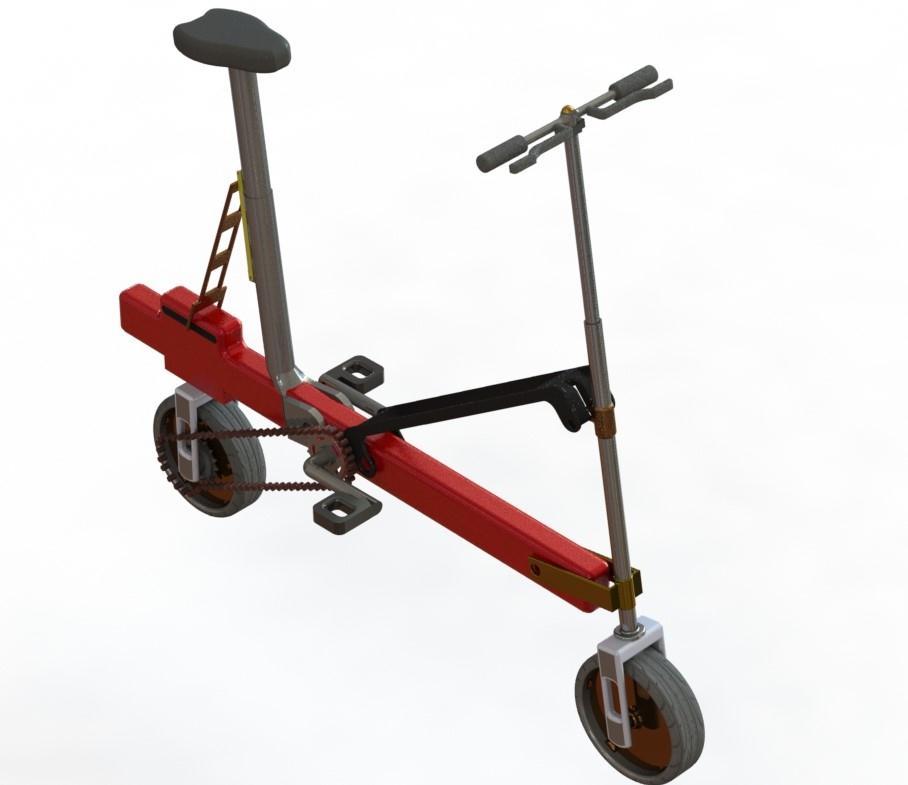
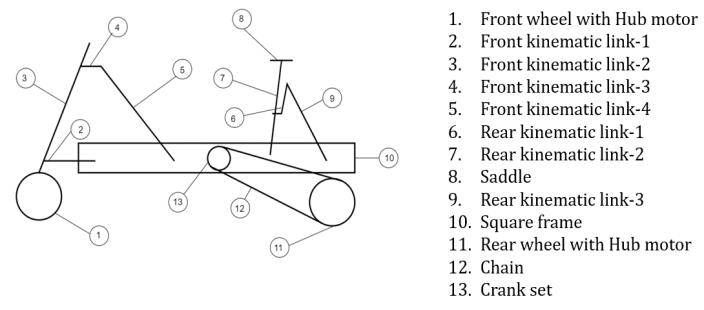
The design of a foldable electric bicycle encompasses various aspects that are crucial for its functionality,practicality,andaesthetics.Startingwithframe geometry,carefulconsiderationisgiventoshape,angles,and dimensions to ensure optimal weight distribution, riding posture,andhandlingcharacteristics.Fig1givestheskeletal sketchofourdesign.Thefoldingmechanismsplayapivotal role, allowing for easy and secure folding and unfolding, striking a balance between compactness and stability. EfficientintegrationofcomponentssuchastheElectricHub motor, battery system, drivetrain, brakes, and controls is essential, considering space optimization and structural integrity.

manufacturability are integrated throughout the design process, with prototyping, testing, and user feedback contributingtocontinuousrefinement.Byconsideringthese design principles, a well-engineered and user-friendly foldableelectricbicyclecanbeachievedasshowninFig2-5
Ergonomicsarecarefullyaddressedtoprovideridercomfort and usability, incorporating adjustable handlebars, saddle position,andergonomicplacementofcontrolsanddisplay panels. Aesthetics are also considered to create a visually appealingdesignthatattractsusers.Safety,durability,and
7.1 Bending moment and Shear force calculation
TheBendingmomentandShearforcediagramsplay crucial rolesinthedesignandanalysisoffoldableelectric bicycles.Thesediagramsprovidevaluableinsightsintothe structuralbehaviorofthebicycle,aidinginitsoptimization and ensuring its safety and performance. The Bending moment diagram helps engineers understand the distribution of bending stresses along the frame and components, identifying critical points that require reinforcement.ThismakestheDesignengineertogetidea onmakingthedesiredchangesbyinterpretingthediagram.
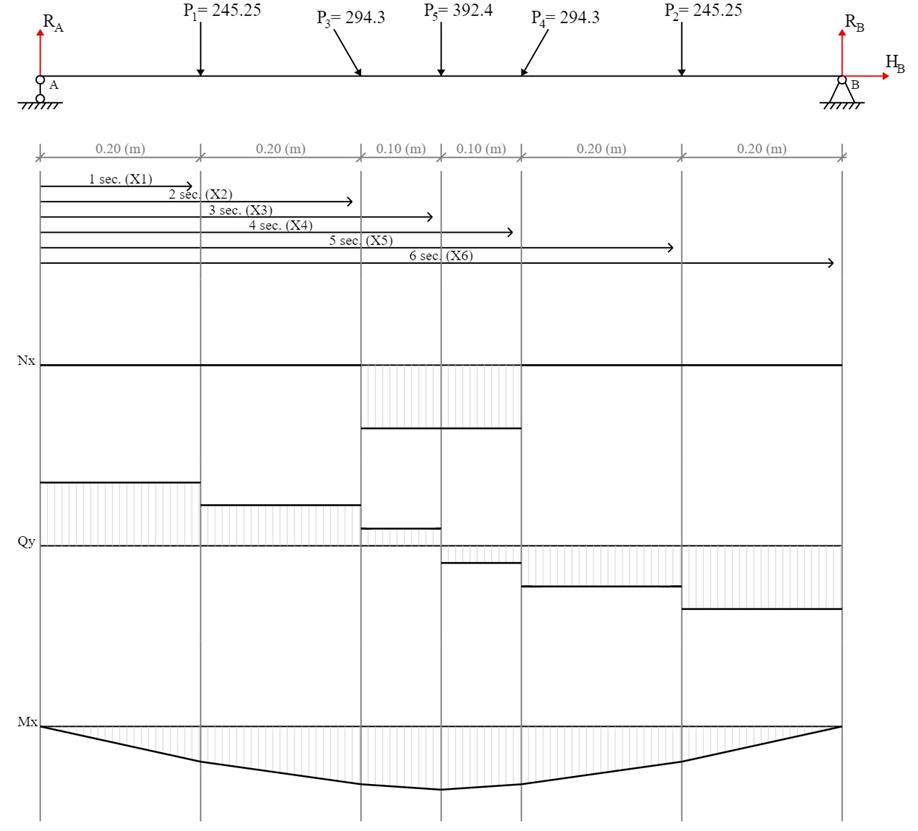
Intheanalysisofthefoldableelectricbicycle,real forces of 245.25 N, 294.3 N, 392.4 N, and 245.25 N are applied at specific distances from the front wheel. These forcesaredistributedatdistancesof0.2m,0.4m,0.5m,0.6m, and0.8m,respectively,basedonthe1mwheelbaselengthof the bicycle. Fig. 6 provides a diagram illustrating the appropriateBendingmomentandShearforcedistribution. Thisdiagramhelpsanalysethestructuralbehaviourofthe bicyclebyconsideringthebendingmoment,whichindicates thetendencytobend,andtheshearforce,whichrepresents the internal resistance to shearing forces. Analysing the bendingmomentandshearforceiscrucialforensuringthe foldable electric bicycle's structural integrity, as it guides material selection and design modifications to ensure optimal strength, rigidity, and overall performance of the bicycleundertheappliedforces.
7.2 Chain calculation
Input data
N1=100rpmZ1=48teethZ2=18teethN2=?
Weightofrider=75kg
Weightofbicycle=15kg
Radiusofwheel=0.5588m
Torque(T)=(Weightoftherider+Weightofbicycle)×9.81 ×Radiusofthewheel
⇒T=(75+15)×9.81×0.5588=493.36Nm
Torque=493.36Nm
Power=(2πNT)/60
⇒Power=5.166KW
CentreDistance(a)=550mm Gear ratio= (N1/N2) = (Z2/Z1)
⇒N2=37.5RPM
STEP 1: Determination of pitch:
OptimumCentreDistance(a)=(30to50)Pa =550mm Pmin =18.33mmPmax =131mm

StandardPitch=12.7mm
STEP 2: Determination of length of chain:
Length=lp *p
Approximatecenterdistance,ap =a0/p=43.3mm
Lengthofcontinuouschain:
Lp=2*ap+((Z1+Z2)/2)+((Z2-Z1)/(2πap))2
Length=1770mm
STEP 3: Determination of Sprocket Diameter:
Tipdiameterda1 =((P)/(180/��1))+(0.6*P)=201.38mm
Tipdiameterda2 =((P)/(180/��2))+(0.6*P)=76.65mm
InputSprocketdiameterda1 =((P)/(180/��1))=194.18mm
OutputSprocketdiameterda1=((P)/(180/��2))=73.14mm
STEP 4: Verification of centre distance:
a ’=(da1+da2)/2=140mm
amax1=1.2*a’=168mm
amax2=80*p=1016mm
amax1 <amax2
Designissafe
Final center distance corrected to number of pitches, a=344.69mm
STEP 5: Determination of breaking load:
Q=((��.102.��.����)/v)
Forpitch=12.7
N=7
Ks = K1.K2.K3.K4.K5.K6
ValuessuitablyassumedKs=2.34
Q=26523Kgf
Summary:
ISO20B-3/RolanTR3119 Pitch,P=31.75mm
RollerDiameterDr=19.05mm Width between inner
Plates min = 19.360 mm Pin body diameter Max Dp = 25.60mm BearingArea=7.74cm2
WeightperMeter=11.9kgf OveralljointmaxA1,A2,A3= 121.4mm
7.1 Wheel Design calculation
Designing a wheel for a bicycle requires several factorstobetakenintoconsiderationsuchastheloadacting onit,thediameterofthewheel,thematerialofthewheel, thenumberofwheels,andthespeedofthebicycle.
Step 1: Calculate the load per wheel:
Sincethebicycleisdrivenby2wheels,weneedtocalculate theloadactingoneachwheel.Therefore,theloadperwheel is:
Loadperwheel=Totalload/Numberofwheels
Loadperwheel=110kg/2=55kg
Step 2: Calculate the required load-bearing capacity of the wheel:
The load-bearing capacity of the wheel is the maximum weightthatthewheelcansupportwithoutgettingdamaged. Tocalculatetheload-bearingcapacityofthewheel,wecan usethefollowingformula:
Load-bearingcapacity=Loadperwheel/Safetyfactor
Here,weassumeasafetyfactorof1.5,whichistheindustry standard.
Load-bearingcapacity=55kg/1.5=36.67kg
Step 3: Determine the material of the wheel:
Given that the material of the wheel is steel, we need to choose a suitable steel grade that can withstand the loadbearingcapacitycalculatedinStep2.
Step 4: Calculate the wheel dimensions:
The diameter of the wheel is given as 0.1524 meters. To calculate the width of the wheel, we need to use the followingformula:
Load-bearing capacity = Wheel width x (0.5 x Wheel diameter)xMaterialstrength
Here, Material strength is the maximum stress that the material can withstand without getting deformed or damaged.Assumingamaterialstrengthof600MPa,wecan calculatethewheelwidthasfollows:
Wheel width = Load-bearing capacity / (0.5 x Wheel diameterxMaterialstrength)
Wheelwidth=36.67kg/(0.5x0.1524mx600MPa)
Wheelwidth=0.015metersor15mm
8. Cost Estimation
In order to produce a folding electric bicycle that achievesbothcost-effectivenessandhigh-qualitystandards, thecostestimationprocessencompassesseveraltechnical considerations.Thisincludesevaluatingthecostofmaterials such as the frame, wheels, drivetrain components, and batterysystem..Aftercarefulanalysis,theestimatedcostfor the folding electric bicycle is ₹ 16,400.00, as depicted in Table4.Thiscostestimationallowsforabalancebetween affordability and delivering a product of excellent quality, ensuringthatthefoldingelectricbicycleremainsaccessible toawiderangeofusers.
9. Future work
The folding electric bicycle will require more development and invention in a number of areas. To improve energy storage, range, and charge times, battery technology developments are included in this. Further reducing weight and increasing portability can be accomplishedbyinvestigatinglightweightmaterialssuchas sophisticated alloys and carbon fibre composites. The functionality and user experience may be improved by integrating smart features and connection possibilities. Continuousadvancementsinfoldingtechnologymayresult inmorestreamlinedanduser-friendlydesigns.Sustainability concerns, improvements to user-centric design based on feedback,andadvancementsinelectricpropulsionsystems are also crucial. By pursuing these options, the foldable electric bicycle might develop into a more effective, convenient, and environmentally friendly means of transportation, satisfying the demands of contemporary commutersandencouraginggreenerurbanmobility.
10. Conclusion
Inconclusion,ourdiscussiononthefoldableelectric bicyclehighlightsitssignificanceasamodernandpractical mode of transportation for commuters. The design of a foldable electric bicycle involves considerations such as frame geometry, folding mechanisms, component integration, ergonomics, and aesthetics, all aimed at achievingabalancebetweenfunctionality,portability,and user satisfaction. Additionally, the analysis of bending momentandshearforcediagramscontributestoensuring the structural integrity and safety of the bicycle. The application of an Electric Hub motor enhances its performanceandefficiency,whiletheuseofaLithium-Ion batteryprovidesbetterenergystoragewithminimallosses. Cost estimation factors into materials, components, manufacturing methods, and assembly, enabling the production of an affordable yet high-quality product. The foldableelectricbicycleoffersasustainable,convenient,and eco-friendly solution for urban commuters, addressing challenges related to congestion, pollution, and limited storagespace.Withfurtherresearchanddevelopment,the foldable electric bicycle has the potential to revolutionise urbantransportationandprovideanefficientandenjoyable commutingexperienceforindividualsworldwide.
REFERENCES
[1] Arunachalam M., Arun Prakash R. and Rajesh R. “Foldable Bicycle: Evaluation of existing design and
novel design proposals”,ARPNJournal ofEngineering andAppliedSciences,Vol.9,No.5,May2014.
[2] Saravanan. M, “Design and Fabrication of foldable bicycle“,Researchgatepublication-may2017
[3] Design Data Book By PSG College of Technology Coimbatore
[4] Saptarshi,Vishal,etal."DesigningandConstructionofEFoldable Bicycle." International Research Journal of Engineering and Technology (IRJET) 7.12(2020).
[5] Saptarshi,Vishal,etal."DesigningandConstructionofEFoldable Bicycle." International Research Journal of Engineering and Technology (IRJET) 7.12(2020).
[6] Mohan, Kushagra Vishwa, Mansij Paritosh, and D. B. Jadhav. "Design and Fabrication of Hybrid Electric Bicycle."(2021).
[7] Kudale,NVSuraj,PranavDiyewar,andNandkumarVele. "DesignandAnalysisofElectricBikeChassis,”." Int. Res. J. Eng. Technol 4(2020):309-311.
[8] Suneetha, M., and K. Gayatri. "FABRICATION OF PLYWOODBICYCLE."(2020).