Effect of Process Parameters and Nano particles on Friction Stir Welding of Dissimilar Aluminium Alloys: Review
K C Mahendra 1 , Channaveera Swamy J M 2 Javeed S 3,
,
Pavan Kumar B K 4,
Prince Kumar Singh 5 , Raghavendra M 61 Assistant Professor, Department of Mechanical Engineering, RYM Engineering College, Ballari, Karnataka, India

2 Technical Staff, Department of Mechanical Engineering, RYM Engineering College, Ballari, Karnataka, India
3-6 UG Students, Department of Mechanical Engineering, RYM Engineering College, Ballari, Karnataka, India ***
Abstract - Friction stir welding (FSW) is an advanced joining technique used in the industrial sector to connect various materials. It is a solid-state connection technology that utilizes a non-consumable tool to join work piece materials. FSW can be applied to similar and dissimilar materials, including ferrous, nonferrous, and polymers, enabling the development of sustainable products. It finds applications in the automobile and aerospace industries for lightweight designs and enhanced the performance. This papercomprehensivelysummarizesthemostrecentliterature related to the friction stir welding of dissimilar aluminum alloys with nano-particle addition. The research field of the friction stir welding of aluminum with different alloys is analyzed and investigated from the aspects of welding technology,microstructureandmechanicalproperties,aswell as innovations and improvements in the welding process. In view of the exploration status of this field, the authors put forward their views and prospects for its future, aiming to provide a basis for researchers in this field.
Key Words: Aluminumalloys;Nano-particles;frictionstir welding; Microstructure characteristics; Mechanical properties
1. INTRODUCTION
Thechallengesinmetaljoiningtechnologyareincreasingin various industries, as new materials are being introduced andthereisaneedtodevelopinnovativejoiningmethods whileensuringthequalityandstrengthoftheproducts.One emergingtrendincardevelopmentistheuseoflightalloys suchasaluminumandmagnesiuminordertoimprovethe efficiencyandeconomyofautomobiles.Frictionstirwelding (FSW) technology has been implemented in automotive production since 2012, providing satisfactory results in joining aluminum-steel alloys and offering benefits like improved driving characteristics and shorter production time.
Ontheotherhand,thereisgrowinginterestintheweldingof dissimilar materials due to the demand for complex parts and the need to maximize the advantages of different materials.Compositepartsjoinedusingdissimilarmaterials canmeetvariousperformancerequirementswhilereducing costs.Theweldingofdissimilarmaterialsisbeingemployed
in industries such as power generation, chemical, petrochemical, aerospace, transportation, electronics, and military. Examples include aero-engines, aerospace propulsionsystems,metalductingstructures,andbimetal componentsforaerospaceinstruments.
Whenitcomestoweldingdissimilarmaterials,challenges ariseduetothedifferencesintheirpropertiesandbehavior during welding. For instance, welding copper (Cu) and aluminum (Al) presents difficulties because of their significantly different melting points and limited mutual solubility.Theformationofintermetalliccompounds(IMCs) is common during welding, but thicker IMCs can cause diffusion and continuous thickening, affecting the performance of the joint. Additionally, oxidation and the differenceinlinearexpansioncoefficientsbetweenAlandCu canleadtodefectslikecracksandstressintheweldedjoint.
Insummary,whilethechallengesinmetaljoiningtechnology areintensifyingacrossindustries,advancementsinjoining methods like friction stir welding have shown promising resultsinjoininglightalloys.Simultaneously,theweldingof dissimilar materials is gaining importance due to its potentialtooptimizematerialadvantagesandmeetdiverse industryneeds.However,addressingthespecificchallenges associated with dissimilar material welding, such as the formation of intermetallic compounds and managing differences in properties, remains a focus of research and developmentinthefield.
1.1 Friction Stir Welding
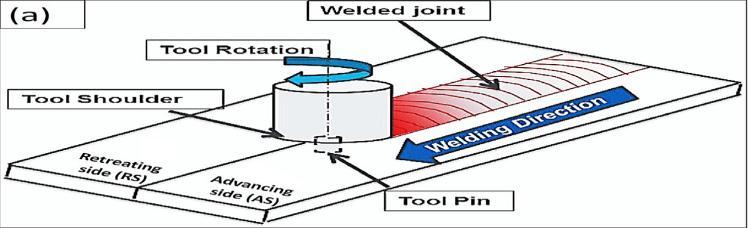
FSWisasolid-state,hot-shearjoiningprocessinwhicha rotatingtoolwithashouldermovesalongthebuttingsurface of two rigidlyclamped plates placed on a bucking plate as showninFig.1.Itwasdevelopedintheearly1990sbyThe Welding Institute (TWI) in the United Kingdom. FSW is particularlywell-suitedforjoiningaluminumanditsalloys, although it can also be used for other materials such as copper,titanium,andsomesteels.
The process involves a non-consumable tool, typically made of a hard material like tungsten carbide, which is rotated and plunged into the joint between the two work pieces. The tool generates frictional heat as it rotates,
softeningthematerialwithoutreachingitsmeltingpoint.The softenedmaterialisthenstirredtogetherasthetoolmoves alongthejointline.
FSW has found applications in various industries, including automotive, aerospace, shipbuilding, and rail transportation. It is used for joining components such as panels, frames, heat exchangers, and structural members. Overall,frictionstirweldingoffersseveraladvantagesover traditional welding methods, making it a versatile and reliabletechniqueforjoiningmetals.
2 LITERATURE SURVEY
The process involves a non-consumable tool, typically made of a hard material like tungsten carbide, which is rotated and plunged into the joint between the two workpieces.Thetoolgeneratesfrictionalheatasitrotates, softeningthematerialwithoutreachingitsmeltingpoint.The softenedmaterialisthenstirredtogetherasthetoolmoves alongthejointline.
Thekeyadvantagesoffrictionstirweldinginclude:
Reduceddefects:FSWproduceshigh-qualitywelds withminimaldefectssuchasporosity,solidification cracks,ordistortions.Sinceitisasolid-stateprocess, thereisnofusionorsolidification,whicheliminates issues associated with traditional welding techniques.
Improved mechanical properties: FSW can create welds with excellent mechanical properties, including high tensile strength, fatigue resistance, andgoodcorrosionresistance.Theprocessrefines the grain structure of the material, resulting in enhancedproperties.
Lowdistortion:FSWproducesminimaldistortionin the work pieces compared to traditional welding methods. The absence of molten metal reduces shrinkage and thermal stress, leading to less deformation.
Joining dissimilar materials: FSW is effective for joiningdissimilarmaterialsthataredifficulttoweld usingconventionalmethods.Itallowsforthejoining of materials with different melting points and thermalproperties.
Environmental benefits: Friction stir welding is a moreenvironmentallyfriendlyprocesscomparedto conventionalweldingtechniques.Itdoesnotrequire fillermaterials,andthereisminimalornoreleaseof fumes,gases,orspatters
Farhad Bakhtiari Argesi et al.[2021]: Inastudyonfriction stir welding (FSW) of pure copper and AA5754 alloy, SiC nanoparticleswereusedtomitigatethenegativeeffectsof intermetallic compounds. Tensile tests, micro-hardness experiments, scanning electron microscopy, and X-ray diffraction analysis were conducted to analyze the joint properties. The best results were obtained with a travel speedof50mm/minandarotationspeedof1000r/min.The additionofnano-sizedSiCparticlesreducedthegrainsizeof aluminumandcopperintheNuggetzone(NZ). Thejoint's tensile strength with SiC nanoparticles reached approximately240 MPa,about 90%of the basealuminum strength.Themicrohardnessoftheweldzonesignificantly increased from HV160toHV 320withthe addition ofSiC nanoparticles.HigherheatgenerationinFSWledtoincreased formationofintermetalliccompounds(Al4Cu9andAl2Cu).
Kush Mehta et al. [2021]: Exit-holes in dissimilar aluminum-copper (AleCu) friction stir welds can be effectively repaired using probeless tools, which force the surrounding material to fill the cavity. The repair process involves two steps using probeless tools of different diameters.Experimentaltests,includingtensiletests,micro hardnessmeasurements,scanningelectronmicroscopy,and energy dispersive x-ray spectroscopy, were conducted to evaluatetheeffectivenessoftherepair.Resultsshowedthat usingprobelesstoolswithshoulderdiametersof12and19 mmresultedinarepairedjointwithultimatetensilestrength about13%higherthansteady-stateweldbeadsamples.The hardnessvaluesoftherepairedzonewerewithintherange observedinpreviousstudiesonfrictionstirwelding.
Mohammad Syahid Mohd Isa et al. [2021]: Friction stir welding(FSW)isapromisingtechniqueforjoiningdissimilar metalslikealuminumandcopper,allowingfortheutilization of their unique properties. This comprehensive study summarizesvariousaspectsofFSWbetweenaluminumand copper, including process parameters, microstructural characterization, mechanical properties, and electrical characteristics of the joints. It also discusses the use of additivesandnewtechniquestoenhancethejointproperties. The report delves into numerical modeling of FSW to understandtheeffectsofprocessparametersontemperature gradientsandmicrostructureevolution.Thestudyconcludes withrecommendationsforfutureresearchtoadvanceand improveFSWstudiesbetweenaluminumandcopper.
F.M.Selamat et al. [2016]: This study focuses on the applicationoffrictionstirwelding(FSW)forjoiningsimilar and dissimilar aluminum alloy plates. The welding parameters remained constant for both types of joints. Microstructureanalysisrevealedthepresenceofan"onion ring" structure in the nugget zone of similar joints, while dissimilar joints exhibited wavy and distorted patterns. Tensiletestsshowedthatfracturesoccurredinthethermomechanicallyaffectedzone(TMAZ)forbothtypesofjoints. Thetensilestrengthofthejointswaslowercomparedtothe basemetals.Overall,FSWdemonstratedpotentialforwelding aluminumalloys,butfurtherimprovementsareneeded.
Tanvir Singh et al.[2020]: Thisstudyinvestigatedtheeffect of adding novel nanoparticles to 2.5 mm thick 6061-T6 aluminum alloy sheets joined using Friction Stir Welding (FSW). The distribution of nanoparticles in different FSW zones was analyzed using optical and SEM micrographs. Vickers micro hardness tests focused on the nugget zone (NZ).ResultsshowedthatweldswithAl2O3nanoparticles hadsmoothsurfaces,whileTiO2weldshadroughsurfaces withflashformation.Al2O3weldshadamorerefinedgrain structure in the NZ, with homogenous nanoparticles dispersion,whileTiO2weldshadclustersandlargergrain sizes. Al2O3 welds had significantly higher NZ micro hardness (88Hv) compared to TiO2 welds (76Hv) and the basematerial(61Hv)duetograinrefinementanduniform nanoparticlesdistributionintheNZ.
Ashwani Kumaretal.[2014]:FrictionStirWelding(FSW)is ajoiningprocessthatutilizesplasticdeformationratherthan materialmelting.Thisuniquecharacteristicmakesithighly suitable for joining materials with varying mechanical properties,chemicalcompositions,andmaterialstructures. Inthisreview,weaimtoexplorethefeasibilityofFSWasa technique for joining different materials and alloys, highlightingitsadvantagesinachievingreliableandrobust joints.Byavoidingtheneedformelting,FSWoffersenhanced controloverthejoiningprocess,resultinginimprovedweld quality and integrity. With its versatility and potential for joining dissimilar materials, FSW emerges as a promising solutionforvariousindustrialapplications.
Arun M et al. [2021]: Purpose–Instructuralapplications, the utilization of dissimilar materials is crucial for withstanding diverse loads and imparting multifaceted propertiestothefinalstructure.Aluminumalloymaterials areextensivelyemployedinaerospaceandmarineindustries due to their ability to offer high strength and protection againstsevereenvironmentalconditions.Thisstudyaimsto develop a novel material with exceptional strength to effectively withstand and overcome challenging environmental conditions. By exploring innovative approaches and incorporating advanced materials, the objectiveistoenhancetheoverallstrengthanddurabilityof thedevelopedmaterial.
Kittipong Kimapong et al. [2005]: A5083aluminumalloy and SS400 steel lap joint was made by using Friction Stir Welding(FSW)techniquewithvaryingprocessparameters suchasrotationalspeed,traversespeed,andpindepth[8]. The different welding parameters resulted in distinct interfacesandsignificantlyinfluenced the jointproperties. Higherrotationalspeedsledtoadecreaseinshearloaddue to the formation of a thick FeAl3 intermetallic compound (IMC)attheinterface.Increasingtraversespeedincreased shearloadastheIMCthicknessdecreased,butexcessively high speeds resulted in incomplete interfaces. Greater pin depthresultedinathickerFeAl3IMCphaseandincomplete interfaces,adverselyaffectingtheshearloadofthejoint.
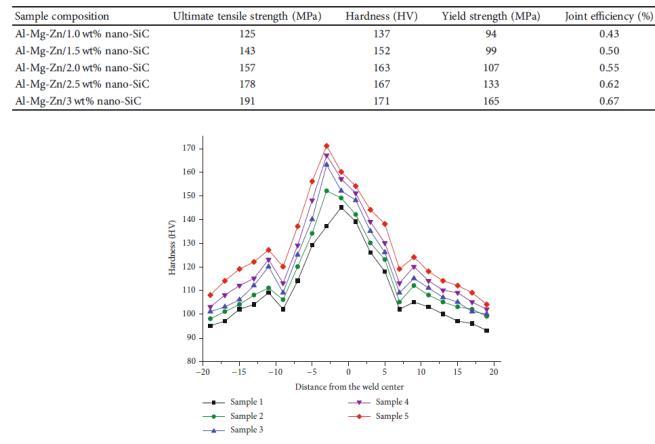
Natrayan et al. [2021]: Friction Stir Welding (FSW) is an effective solid-state technique for joining Al-Zn-Mg alloys, whicharewidelyusedinvariousengineeringapplications. This research focuses on characterizing the unique mechanicalpropertiesofAl-Zn-Mgalloyreinforcedwith1to 3wt%nano-SiCparticlesusinganovelinterlockfriction-stir welding method. The chosen process parameters were a rotationaltoolspeedof1100rpm,weldspeedof25mm/min, and triangular pin profile. Tensile strength, yield strength, andhardnesswereevaluatedaccordingtoASTMstandards, whileXRD,optical,andscanningelectronmicroscopywere used to study the microstructure of the weld joints. EDS analysisconfirmedthepresenceofsilicaparticlesintheweld jointsandtheiruniformdistribution.Al-Zn-Mgwith3wt% nano-SiCresultedthehighesttensilestrength,yieldstrength, and nugget hardness (191 MPa, 165 MPa, and 171 HV, respectively).Themicrostructuresoftheweldsindicateda pinning mechanism resulting from the use of nano-SiC particlesasreinforcementduringfrictionstirwelding.
Tanvir Singh et al.[2020]: Thisstudyinvestigatedtheeffect of adding novel nanoparticles to 2.5 mm thick 6061-T6 aluminum alloy sheets joined using Friction Stir Welding (FSW). The distribution of nanoparticles in different FSW zones was analyzed using optical and SEM micrographs. Vickers micro hardness tests focused on the nugget zone (NZ).ResultsshowedthatweldswithAl2O3nanoparticles hadsmoothsurfaces,whileTiO2weldshadroughsurfaces withflashformation.Al2O3weldshadamorerefinedgrain structure in the NZ, with homogenous nanoparticles dispersion,whileTiO2weldshadclustersandlargergrain sizes.Al2O3weldshadsignificantlyhigherNZmicrohardness (88Hv) compared to TiO2 welds (76Hv) and the base material (61Hv) due to grain refinement and uniform nanoparticlesdistributionintheNZ.
Ashwani Kumaretal.[2014]:FrictionStirWelding(FSW)is ajoiningprocessthatutilizesplasticdeformationratherthan materialmelting.Thisuniquecharacteristicmakesithighly suitable for joining materials with varying mechanical properties,chemicalcompositions,andmaterialstructures. Inthisreview,weaimtoexplorethefeasibilityofFSWasa technique for joining different materials and alloys,
highlightingitsadvantagesinachievingreliableandrobust joints.Byavoidingtheneedformelting,FSWoffersenhanced controloverthejoiningprocess,resultinginimprovedweld quality and integrity. With its versatility and potential for joining dissimilar materials, FSW emerges as a promising solutionforvariousindustrialapplications.
Mahendra K C et al. [2019]: Frictionstirwelding(FSW)is anadvancedjoiningtechniqueusedintheindustrialsectorto connectvariousmaterials.Itisasolid-statebondingprocess that utilizes a non-consumable tool to join workpiece materials. FSW can be applied to similar and dissimilar materials, including ferrous, nonferrous, and polymers, enabling the development of sustainable products. It finds applications in automotive and aerospace industries for lightweightdesignsandimprovedperformance.Thispaper aims to research and analyze the influence of critical parameters in FSW, focusing on different material combinations such as ferrous, non-ferrous, and dissimilar materials.TheweldingparametersaffectingFSWoperations and their impact on mechanical properties are discussed, including tensile testing, hardness inspection, and macro/micro structural evaluations. The potential applicationofFSWinpolymericmaterialsisalsosuggested forfurtherresearch.
Nikitha Veligotskyi et al. [2022]:Thisstudyfocusesonthe application of friction stir welding (FSW) for joining dissimilar aluminum alloys, specifically AW 5083 and AW 6082.Theweldingprocesswasconductedatdifferentweld speeds, and the resulting joints were subjected to metallographic analysis, hardness testing, and destructive static tensile tests. When using the lowest weld speed, an inadequatemixingofmaterialsledtoanoticeablegapatthe joint and reduced joint strength. However,at medium and highweldspeeds,thejointsexhibitedmechanicalproperties comparabletothebasematerial.Metallographically,thebond betweenthematerialsdisplayedadefect-freeinterface.
R N Shubhavardhan et al. [2017]: Friction Stir Welding (FSW)isanadvancedsolid-statejoiningtechniquethatoffers theadvantageofjoiningdissimilarmaterialswithdisparate physicalandmechanicalproperties,whicharechallengingto weld using conventional fusion welding methods. Tensile sheartestingiscommonlyemployedtoassessthemechanical strengthoffrictionstirlap(FSL)weldsunderstaticloading conditions, with fracturestrength (σLap) being the widely acceptedstrengthparameter.Inthecaseofdissimilarmetals with significant differences in melting temperatures, FSL welding establishes a metallurgical bond by forming interfacial intermetallic compounds. However, these intermetallic compounds are typically brittle and lack ductility, thereby potentially compromising the fracture strengthofthewelds.Thisresearchaimstoinvestigatethe influenceofFSWparametersontheinterfacestructureand how the resultant interface structure impacts fracture behaviorinAl-SteelandAl-TiFSLwelds.
Rocio Saldaña-Garcés et al. [2020]: FrictionStirWelding (FSW)isasolid-statejoiningprocessthatweldslightweight materials like aluminum and magnesium alloys without melting them. In their work, AA6061-T6 and AZ31B-H24 alloyswerejoinedusingFrictionstirweldingwithdifferent parameters:rotationalspeedsof400,800,1200,and1600 rpm,weldingspeedsof30and60mm/min,andtiltanglesof 1°and3°.Microstructureanalysisrevealeddissimilarwelds achievedbyplacingAA6061-T6ontheadvancingsideunder two conditions: without a tool offset (welding speed: 30 mm/min,rotationalspeed:400rpm,tiltangle:1°)andwitha tool offset (welding speed: 30 mm/min, rotational speed: 1200rpm,tiltangle:3°).IntermetalliccompoundsAl3Mg2 andAl12Mg17wereobservedinthestirzone.JointM7had varying hardness (76-129 HV) and tensile strength (88.2 MPa), while joint M3 exhibited hardness (95-153 HV) and tensilestrength(18.95MPa).
S. Hassan et al.[2015]: Inthisresearchpaper,thedissimilar A319andA356castaluminumalloyplatesjoinedbyfriction stirwelding(FSW)microstructureandmechanicalproperties ofwerestudied.Theinfluenceoftoolrotationalandwelding speeds, as well as post-weld heat treatment (PWHT), was examined. PWHT involved solutionizing at 540°C for 12 hours followed byaging at 155°C for 6 hours. The welded zone(WZ)exhibitedhigherhardnesscomparedtotheparent alloys in the as-welded condition. Increasing the tool rotationalspeedand/orreducingtheweldingspeedresulted in increased hardness attheWZ. Conversely, the PWHTed specimensshowedlowerhardnessattheWZcomparedto theparentalloys.Increasingthetoolrotationalspeedand/or reducingtheweldingspeedledtodecreasedhardnessatthe WZinthePWHTedcondition.Tensiletestingrevealedthat fracturesoccurredontheA356sidewithminimalhardness fortheas-weldedspecimens,whilefracturesoccurredatthe WZ for the PWHTed specimens. Increasing the rotational speedreducedbothtensilestrengthandyieldstrengthsbut improvedthejoint'sductility.
2.1 Problem Definition
Theprobleminfrictionstirwelding(FSW)canbedefinedas follows:
FSWinvolvesthejoiningofmaterialsthroughasolid-state welding process, without melting the materials. However, thereareseveralchallengesassociatedwithFSWthatneedto beaddressed:
Defectsandimperfections:FSWcanresultindefects such as voids, porosity, and inadequate bonding betweenthematerials.Thesedefectscannegatively impact the mechanical properties and structural integrityoftheweldedjoint.
Heatgenerationanddissipation:DuringFSW,heatis generatedduetothefrictionbetweentherotating tool and the work piece. Efficient heat generation
anddissipationarecrucialtoavoidexcessiveheataffectedzones,materialsoftening,anddistortion.
Material compatibility: FSW is often used to join dissimilar materials with different mechanical properties, chemical compositions, and material structures.Ensuringpropercompatibilitybetween the materials is essential to achieve a strong and reliablejoint.
Process optimization: The selection and optimization of process parameters, such as rotational speed, traverse speed, and tool design, playacrucialroleindeterminingthequalityofthe weld. Finding the optimal set of parameters for specific material combinations and joint configurationsisacomplextask.
Microstructurechanges:FSWcaninducechangesin themicrostructureoftheweldedmaterials,suchas grain refinement, intermetallic formation, and texturealterations.Understandingandcontrolling these micro structural changes are important to achievedesiredmechanicalpropertiesinthewelded joint.
Addressingtheseproblemsinfrictionstirweldingrequires advanced research, process optimization, and materialspecific considerations to ensure high-quality, defect-free weldswithoptimalmechanicalproperties.
3. OBJECTIVES
To study the various dissimilar materials used in frictionstirwelding.
Tostudytheeffectofprocessparametersusedinthe frictionstirwelding.
TostudytheeffectofreinforcedNanoparticleson materialbehavior.
Tostudythemicrostructureoftheweldjoint.
To study the material characterization of various mechanicaltesting.
To identify the scope for further investigation in dissimilarmaterialscombination.
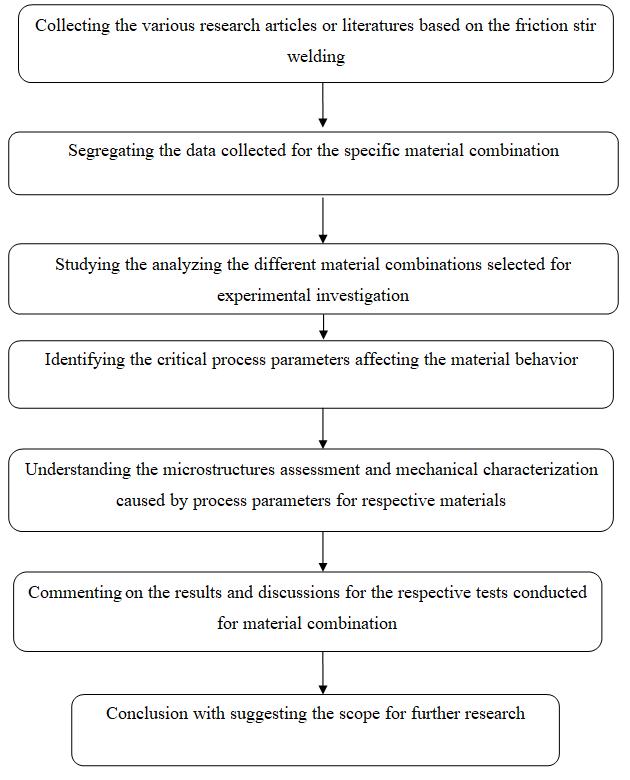
4. METHODOLOGY
5. STUDY ABOUT FRICTION STIR WELDING OF DISSIMILAR ALUMINUM ALLOYS
Frictionstirwelding(FSW)ofdissimilaraluminumalloys involvesjoiningtwoormorealuminumalloysheetsorplates withdifferentcompositionsusingtheFSWprocess.FSWisa solid-state welding technique that uses frictional heat generatedbyarotatingtooltojoinmaterialswithoutmelting them.Theprocessoffersseveraladvantagesovertraditional fusion welding methods, including improved mechanical properties,reduceddistortion,andenhancedweldquality.
Whenitcomestodissimilaraluminumalloywelding,FSW hasshownpromiseinovercomingthechallengesassociated withconventional fusion weldingtechniques. The primary challenges in dissimilar alloy welding arise from the differencesinmeltingtemperatures,thermalproperties,and metallurgical behavior of the alloys involved. These differencescanresultindefects,suchascracks,solidification defects, and intermetallic compound formation, which can compromisetheintegrityandperformanceoftheweldjoint.
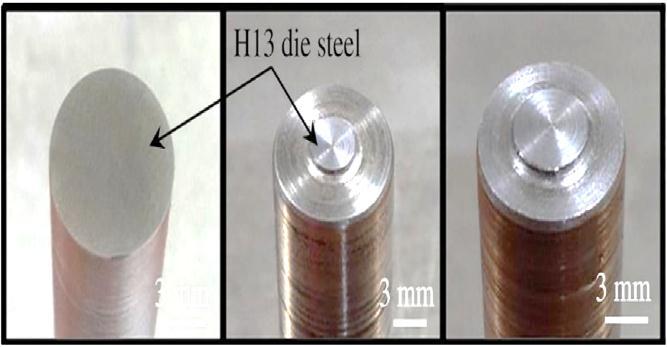
FSW addresses these challenges by utilizing a rotating toolwithaspeciallydesignedgeometry.Thetoolconsistsofa shoulder, which provides downward pressure, and a threadedorcylindricalpin,whichgeneratesfrictionalheat andfacilitatesmaterialmixing.Thetoolplungesintothejoint line between the two work pieces, creating frictional heat thatsoftensthematerialandallowsforplasticdeformation. Asthetoolmovesalongthejointline,itmechanicallystirs andforgesthematerial,resultinginasolid-statebond.
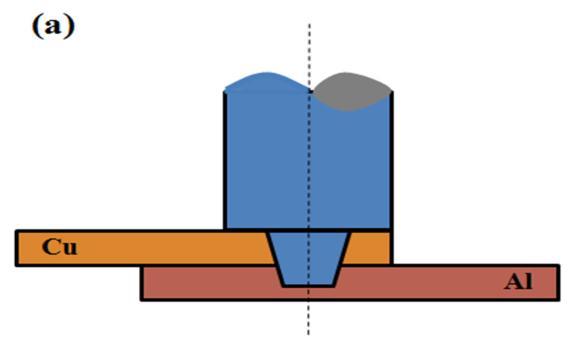
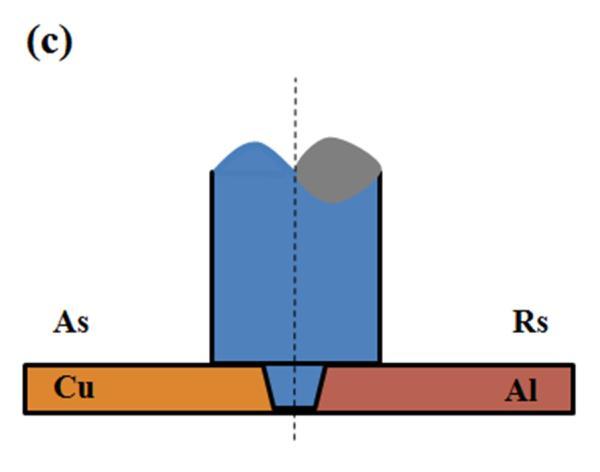
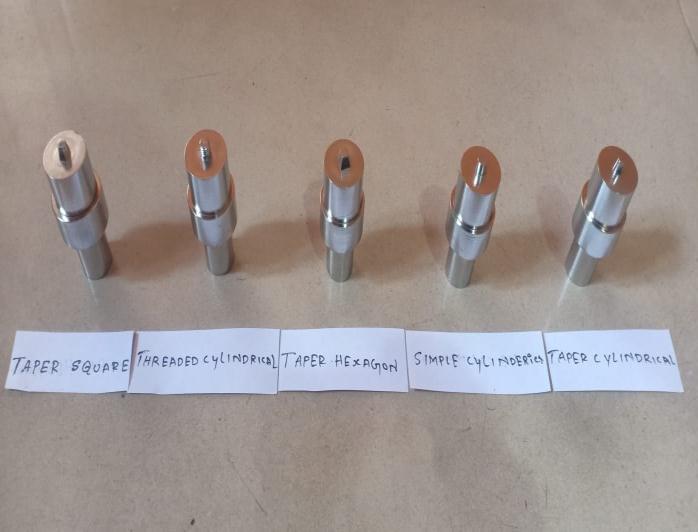
TosuccessfullywelddissimilaraluminumalloysusingFSW, severalfactorsneedtobeconsidered:
MaterialCompatibility:Theselectedaluminumalloys shouldhavecompatiblemetallurgicalproperties,such as similar solidification temperatures, thermal conductivities, and mechanical properties. This ensuresthatthealloyscanbeadequatelymixedand forgedduringtheweldingprocess.
Tool Design: The tool geometry, including the pin profile and thread design, plays a crucial role in achievingasoundweld.Thetoolshouldbedesigned to promote effective material mixing and plastic deformation, enabling the formation of a homogeneousbondbetweenthedissimilaralloys.
Welding Parameters: Optimal welding parameters, such as rotational speed, traverse speed, and axial force, need to be determined for each specific combination of dissimilar alloys. These parameters affect theheatgeneration,material flow,and defect formationduringtheweldingprocess.
Intermetallic Compound Formation: Dissimilar aluminumalloysmayformintermetalliccompounds at the weld interface, which can affect the joint's mechanicalproperties.Theformationanddistribution ofintermetalliccompoundscanbeinfluencedbythe weldingparameters,materialcomposition,andpostweldheattreatment.
Researchanddevelopmenteffortshavebeenfocusedon understanding the fundamental aspects of dissimilar aluminiumalloyweldingusingFSWandoptimizingthe process parameters to improve the quality and performanceoftheweldjoints.Varioustechniqueshave been explored to enhance the properties of dissimilar FSWjoints,including:
NanoparticlesReinforcement:Addingnanoparticles, suchasSiC,Al2O3,andTiC,duringtheFSWprocess can improve the mechanical and tribological propertiesoftheweldjoints.Thesenanoparticlesact asreinforcementsandenhancethestrength,hardness, wearresistance,andcorrosionresistanceofthejoint.
Hybrid Approaches: Combining FSW with other weldingtechniques,suchasfrictionstirspotwelding (FSSW), can create surface composites and tailor specific properties of the joints. By strategically placingthespotwelds,differentregionsofthejoint can have varying properties, offering flexibility in designandperformance.
Post-Weld Heat Treatment: Heat treatment processes, such as artificial aging or solution heat treatment, can be appliedtotheweldjointtomodifythemicrostructureand
improve the mechanical properties. This is particularly relevant for dissimilar alloys with significant differences in precipitation hardening response.
Table -2: WeldingParameterConsidered
6. RESULTS AND DISCUSSION
Researchonthemicrostructureandmechanicalpropertiesof joints:
In the field of welding, researchers often analyze the microstructureandmechanicalpropertiesofweldedjoints throughresearchmethodsinordertoexplorethemechanism of microstructure evolution, the formation and causes of defects, and the influence of parameters on mechanical properties during welding. In the previous studies on the Friction Stir Welding Aluminum (Al) dissimilar materials, researchers selected the welding technology and the appropriate welding parameter window based on the macroscopicmorphologyandtensilestrengthofthewelded joint.Theyfurtheranalyzedandstudiedthemicrostructure andmechanicalpropertiesoftheweldedjoint.
Basedonthepresentresearchstatus,itcanbeconcludedthat currentresearchismainlyfocusedonthefollowingaspectsin the field of Friction Stir Welding of Aluminium dissimilar alloyswithreinforcedmaterials:
Microstructure of the joint: Researchers investigatethemicrostructureoftheweldedjointto understand the grain structure, phase distribution, andthepresenceofdefectssuchasvoids,cracks,or inclusions.Themicrostructureplaysacrucialrolein determiningthemechanicalpropertiesofthejoint.
InterfaceIntermetallicCompounds(IMCs)ofthe joint:TheformationandcharacterizationofIMCsat the Cu-Al interface are of particular interest. Researchers aim to understand the composition, thickness,anddistributionoftheseIMCs,astheycan significantly influence the joint's mechanical properties.
Tensile strength: The tensile strength of the welded joint is an important mechanical property that determines its structural integrity and loadbearing capacity. Researchers analyze the factors affecting tensile strength, such as welding parameters,heatinput,andmicrostructuralfeatures, to optimize the welding process and improve the joint'smechanicalperformance.
Micro-hardness: The micro-hardness of the welded joint is a measure of its resistance to indentationordeformation.Researchersinvestigate thecorrelationbetweenmicrostructureandmicrohardness to gain insights into the strengthening mechanismsanddeformationbehaviorofthejoint.
Insummary,thecurrentresearchinthefieldofFSWofCu and Al dissimilar materials primarily focuses on the microstructure of the joint, interface IMCs, tensile strength, and micro-hardness. These studies aim to improve the understandingof the welding processand enhancethemechanicalpropertiesoftheweldedjoints
Forpracticalapplications.
6.1 Microstructure Characteristics
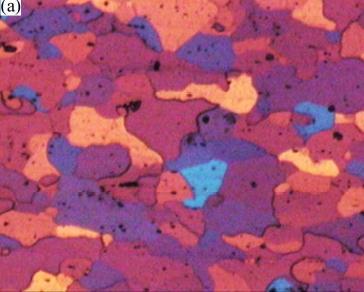
Intheanalysisofmaterialstructureandproperties,the examination of microstructure is considered a fundamentalresearchaspectthatsignificantlyinfluences mechanicalproperties.Inexistingliterature,researchers have conducted observations and analyses of the microstructureinAl-CudissimilarFrictionStirWelding (FSW) joints using various techniques such as optical microscope(OM),scanningelectronmicroscope(SEM), and transmission electron microscope (TEM). It is important to note that the authors will not provide a detailedexplanationofthesetechniquesinthispaperbut willratherfocusonanalyzingspecificnoteworthycases.
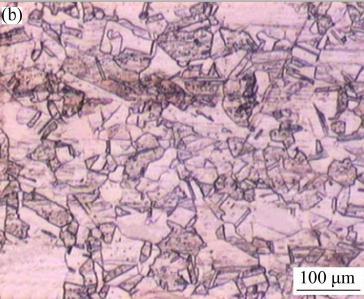
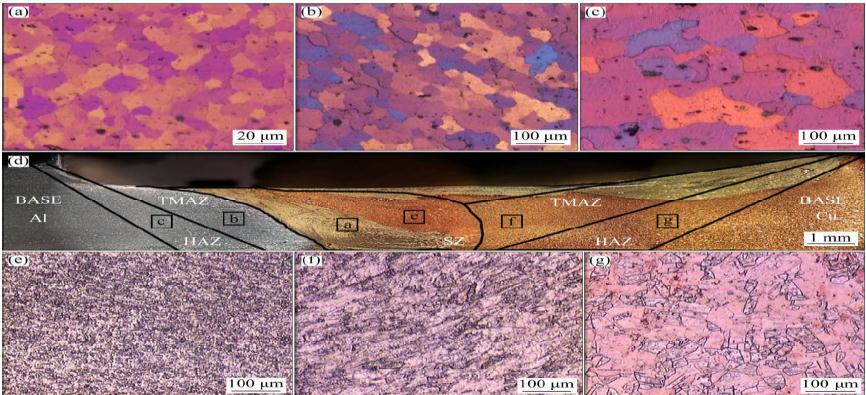
The microstructures of commercially pure copper and AA5754-H114 alloy are shown in Fig-5 The microstructureofaluminumconsistingofnon-equiaxed grains, and the copper microstructure shows several annealed twins, as can be noticed within the copper grains.Thegrainsizesofaluminumandcopperwere52 and36μm,respectively[1].
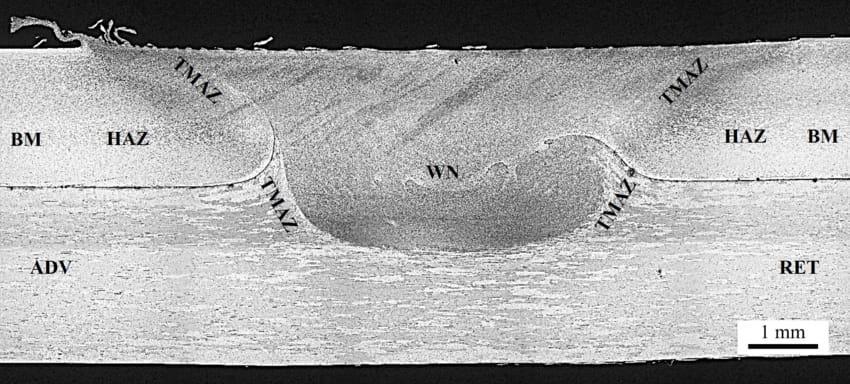
OverallFARHADBAKHTIARIARGESIetal[1]statedthatthe microstructure of FSW could be categorized into three regions, including SZ, thermo-mechanical affected zone (TMAZ)andheat-affectedzone(HAZ).Thesethreeregions for1000-50pspecimenareshowninFig.4,IntheSZ,more refined grains are observed because of severe plastic deformation. The tool rotation caused the presence of elongatedgrainsintheTMAZ.IntheHAZ,thegrainsgrowin FSWduetotheheatgenerationandnoplasticdeformation.
As discussed, FSW involves the intense stirring of the material at which formed four distinct zones, i.e. Weld zone/Stir zone(SZ), Thermo-mechanically affected zone(TMAZ), Heat affected zone(HAZ) and the Base metal (BM). The material in direct contact with the tool and shoulderatStirzonewillexperiencethehighesttemperature duetothefrictionalheatandthehigheststrainenergy.Inthe Stirzone,thegrainsizeismuchfinerthanthebasemetals duetothedynamicrecrystallisation.Dependingonprocess parameters,thegrainsizecanbereducedupto96%.Asa result,themicrohardnessandtensilestrengthoftheSZare thehighest.
Insomecases,aquasi-spiralshapecanbeobservedinSZ, whichiscalledanonionring.Tongueetal.suggestedthatthe complex material flows from the rotational and traversing tool movement producing alternating layers of high and averagestrainrate,whichthendepositthestirredmaterials behindthepin.NextnearestzonetothetoolisTMAZ,where highheatfromtheSZflowsandinducessmalldeformationto thegrain.However,lackofplasticstrain,ascomparedinthe Stirzone,limitsthedeformationofthegrainstructure.The
materialinthiszoneisalsorealisedoutwardsinthedirection ofmaterialflow.Moreoveroutwardmaterialsflow,calleda flashdefect,indicatestheunsuitableparametersusedduring theweldingprocess.Inflashdefect,removingmaterialfrom the welding zone reduces the material intermixing, hence reducingthejointstrength.
InHeataffectedzone,onlytheresidualheatpresents,and grain structure slightly deforms depending on the zone's temperature.Ontheotherhand,thegrainstructureintheBM does not change since there is a lack of heat input and no strain energy in the region to induce any deformation. Therefore,thesizeofthethreedifferentaffectedzonescanbe controlled/maintainedwithsuitableparameters.Fig-6shows thedifferentmicrostructuralpropertiesatdifferentzonesfor theAleCuweldedsampleswiththelapconfiguration.
Indissimilarfrictionstirweldingofcopperandaluminum withtheadditionofnano-particles,dynamicrecrystallization, reinforcement of nano-particles, and heat generation influence grain size in the stirred zone (SZ). These factors compete to affect the grain size. Dynamic recrystallization causes the formation of new grains, reducing grain size. Reinforcement of nano-particles restricts grain boundary movement and promotes fine grain structure. Heat generation,primarilyfromfrictionbetweenthesampleand rotatingtool,canleadtograingrowthintheSZ.Increasing heat generation enhanced grain size and promoted the formationofintermetalliccompounds(IMCs)likeAl4Cu9and Al2Cuinthestirzone(SZ).
WiththeadditionofnanoSiCparticles,grainsizesofAl andcopperintheweldzonereducedfrom38.3and12.4μm to12.9and5.1μm,respectively.
N.F.M.Selamat et al. Observed that, Smooth surface welding on the joints depended on sufficient heat input applied during the FSW process, which was related to the transverseandrotationalspeed. Fromthemicrostructural study it is observed that the formation of ‘onion ring’ structurewasfoundinthenuggetzoneofsimilarjoints,while wavyanddistortedpatternsappearedindissimilarmaterial joints.Kittiongetal.proposedthat,Increasingtherotational speeddecreasedtheshearloadofthejointduetoproducing athickFeAl3intermetalliccompound(IMC)attheinterface. Whentraversespeedincreased,theshearloadincreaseddue toIMCthicknessattheinterfacedecreased,however,when thespeedwassohigh,anincompleteinterfacewasformed. TheincreasedpindepthformsathickFeAl3IMCphaseand anincompleteinterfacethatdirectlydeterioratedtheshear loadofthejoint.
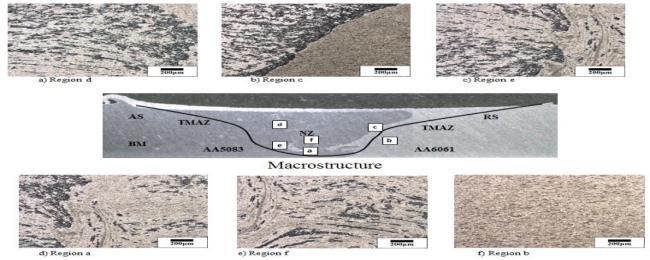
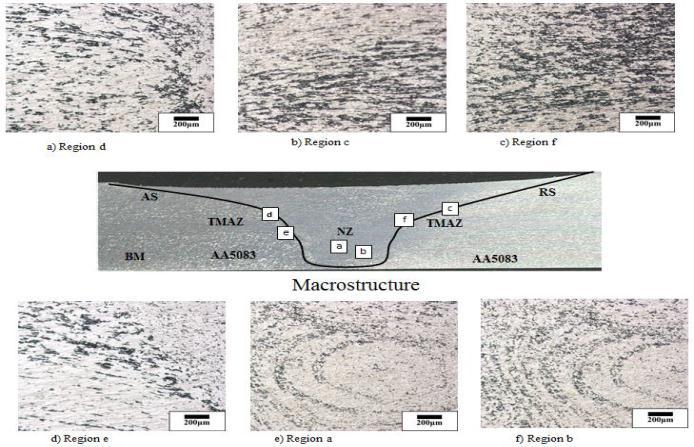
A. S. Hassan,et al. The average size of the Si particles increases with increasing the tool rotational and the reduction of welding speeds. No coarsening in the size or change in the distribution of primary Si particulates was observed at the welded regions after heat treatment. DissimilarFSWofcastAlalloysA356andA319producedan
irregular shaped regions in the WZ. These regions have structureandcompositiondifferentfromthetwobasealloys. Several combinations between the tool rotational and welding speeds led to different regions at the WZs with severalchemicalcompositions. RocioSaldaña-Garcésetal, ThereresultsuggeststhatwhenplacingtheAluminiumalloy on the retreating side, aluminum is not able to deform enough to be blended with the Mg alloy, which can be elucidate by the less deformation of the material on the retreatingside.
6.2 The Study of Tensile Strength and MicroHardness
Tensilestrengthisthemostbasicmechanicalpropertyof theFSWofCu–Aldissimilarmaterials,whetherinthelapor buttjointforms.Researcherstookthetensilestrengthasthe mostbasicstandardtojudgethemechanicalproperties.In everyexperiment,thestrengthoftheweldedjointwastested. They mainly recorded the tensile strength, the tensile fracturepositionofthespecimenandobservedthefracture morphologybyusingSEM.Becausethebasicconditionsof eachexperimentaredifferent,whetheritisthethickness,the materialofthespecimen,ortheweldingparametersofthe test, the results obtained are all different, and there is no regulation to follow. Therefore, the authors will not enumeratetheresultsofeachtensiletestinthispaper,but thereareseveralresultsthatareworththinkingaboutand willbeoffurtherhelpinthefollowingresearch.
FarhadBakhtiariArgesietal.commerciallypurecopper plates99.99wt.%(C10100OFHC)and5754-H114Alalloy were used for the FSW with a thickness of 4 mm. Microhardnessofthefrictionstirweldedcopper−aluminum jointswasdirectlyrelatedtotheamountofreinforcingSiC nano-particles,intermetalliccompounds,andgrainsize.The highest microhardness of SZ in the absence of SiC nanoparticleswasHV120,whichsignificantlyincreasedtoHV320 in the presence of SiC nano-particles, for the 1000-100p specimen.ThesynergiceffectofSiCnano-particlesandIMCs resulted in an increase in the microhardness peak. The highesttensilestrengthswereobtainedinjointspreparedby 50mm/mintravelspeedand1000r/minrotationspeed,asit was239MPa(i.e.,92%ofthestrengthofaluminumbase).
AdditionofthereinforcingSiCnano-particles,increased thetensilestrengthfrom169to239MPa.Theadditionofthe SiC nano-particles led to fine grains size in the SZ and increasedboththepinningeffectsandthetensilestrength. The highest tensile strengths were obtained in joints prepared by 50 mm/min travel speed and 1000 r/min rotationspeed,asitwas239MPa(i.e.,92%ofthestrengthof aluminum base). Addition of the reinforcing SiC nanoparticles,increasedthetensilestrengthfrom169to239MPa. TheadditionoftheSiCnano-particlesledtofinegrainssizein theSZandincreasedboththepinningeffectsandthetensile strength.
L.Natrayanetal.intheirwork,Al-Zn-Mgalloyreinforced with1to3wt%ofnanosiliconcarbideusedandresultsAlZn-Mg/3 wt% nano-SiC (sample 5) shows better yield strength,tensilestrength,andhardness.Thehighesttensile strength was reported as 191 MPa, and hardness was reportedas171HV.
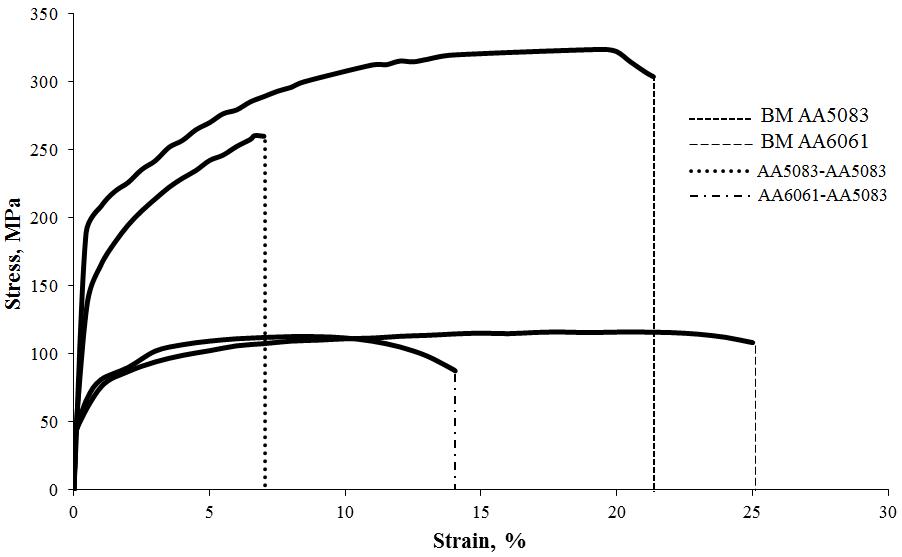
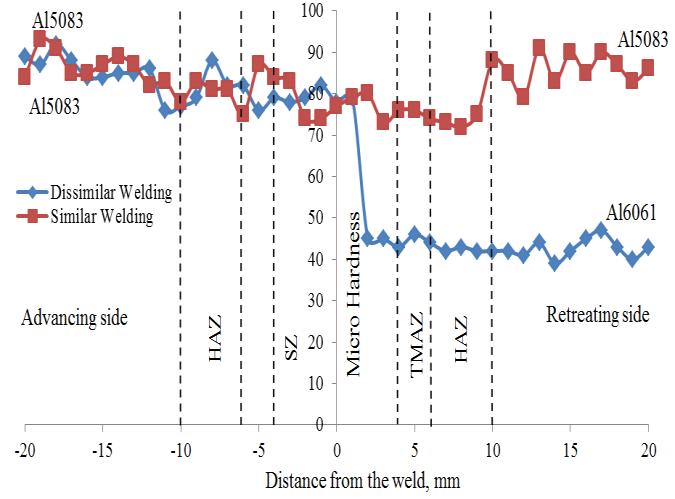
N.F.M.Selamatetal.similaranddissimilar5mmaluminium alloy plates used in there work and following results are obtained, Micro-hardness indentation exhibited different hardnessprofiles,inwhichlowhardnesswasobtainedatthe weldingcentre.TheSimilarjointplotshardnessatthebase metal as 90HV and reduced to 76HV at the weld centre. Meanwhile, AA6061-AA5083 resulted reduced microhardnessattheweldingcentrefrom80HVto35HVduetothe mechanicalpropertiesofAA6061ontheretreatingside(RS). TheweldingefficiencyofAA5083- AA5083was77%from AA5083basemetal,whereastheefficiencyofjointAA6061AA5083 was 93% and 34% compared to AA6061 and AA5083, respectively.For future studies, it is suggestedto usedifferenttypesofpinforthesameweldingparametersto comparetheweld-abilityofjoints.
A.S.Hassanetal.wereusedTwotypesofmaterialsinthe currentinvestigation,typically,A356(Al–Si–Mg)andA319 (Al–Si–Cu)castAlalloys.TheascastFSWZsexhibitedhigher hardnessvaluesthanbothA319andA356basealloys.After the heat treatment, the welded regions showed lower hardness than the base alloys. In both as welded and PWHTed joints, the hardness at the WZs increases with increasing the welding speed and/or decreasing the tool rotational speed. The as welded FS joints exhibited better mechanicalpropertiesthantheascastA356andA319base alloys. However, the PWHTed joints showed lower mechanicalpropertiesthantheheattreatedbasealloys.The maximum strength of the PWHTed joints was ,83% of the strengthoftheheattreatedA356basealloy.ThePWHTed jointsultimatetensileandyieldstrengthsdecrease,however, theductilityincreases,withincreasingtoolrotationalspeed and/ordecreasingthetoolweldingspeed.
ArunMetal.conductedexperimentonaluminumalloy materialsAA6061andAA5083wereusedasbasematerials in the form of plates of dimensions 200_100_6mm. The FrictionstirweldingofdissimilarAA6061–AA5083/La2O3 resulted in the maximum hardness value of 118 HV at SN region.Thisis8.3%&32.6%higherthanAA6061–AA5083/ CeO2 & AA6061–AA5083 materials correspondingly. This couldbeduetothehigerhardnessofLa2O3particles.Rocio Saldaña-Garcésetal.,conductedstudyon AA6061-T6and AZ31B-H24 alloys with different tilt angles and following resultsobtained. Thehigherhardnessvalues(95-153Hv) resultedintheM3jointcomparedtotheM7weld(76-129 Hv), can be related to a higher amount of Inter metallic component. Under uniaxial tensile conditions, welds are fracturedinthestirzoneandexhibitabrittlebehavior,which is results in defects such as lack of penetration, tunnel, insufficientmixing,andthepresenceofcompoundsAl3Mg2 andAl12Mg17intermetalliccompounds.Thehighesttensile strengthisshowedintheM7joint(88.2MPa),andthelowest (18.95 MPa) in the M3 weld. This behavior is related to a higher amount of Inter metallic component when using a higherrotationalspeed.
TanvirSinghetal.MicrohardnessdistributionintheNZ forAl2O3/FSWweldsishigher(88Hv)thanTiO2/FSWwelds (73Hv) which is attributed to the more intense uniform nanoparticle.
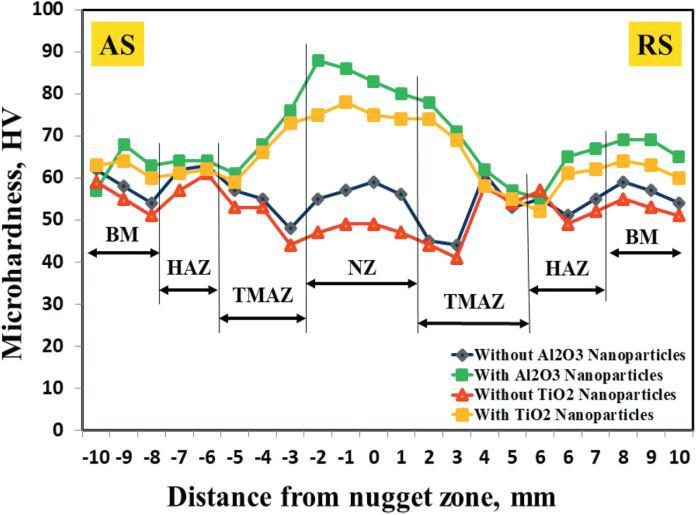
Fig -10: MicrohardnessofFSWweldswithandwithout nanoparticlesadditionmeasuredalongthehorizontal sectionofweldmentsonbothsidesoftheweldcenterline
Distributioninthe NZthatcausesgrainrefinementandin turn increase the hardenability. While the existence of nanoparticleagglomerationalongwiththeNZandHAZfor weldswithTiO2nanoparticlesresultsintheoccurrenceof cracknucleationsitesatthegrainboundariesthatleadstoa decreaseinthemicrohardnessalongtheprocessednugget zone.
7. CONCLUSION
Many researchers have been already carried out to demonstrate the extensive work on joining similar and dissimilarmaterialandonFSWweldingparameters,butvery few investigations have been elaborated on nano particles addition, microstructure characteristics and mechanical properties
With the adequate heat generation at higher tool rotational and lower transverse speed results in completefragmentationofintermetalliccomponents andnanoparticlesinAl2O3/FSWweldscomparedto partialfragmentationoccurredinTiO2/FSWwelds.
IntenseuniformnanoparticlesdistributionintheNZ thatcausesgrainrefinementandinturnincreasethe hardenability
IncreasedparticipationCuinNZleadstothepresence oflargebulkyfragmentsintheNZimpairingasound materialflowleadingtoformationofdefectssuchas micro-voidsandcracksobserved.
An increase in heat generation resulted in an enhancement in the grain size and significantly promotedthenumberofIMCs.
Addition of the reinforced SiC nano-particles led to finegrainssizeintheSZandincreasedboththepining effectsandthetensilestrength.
Microhardnessofthefrictionstirweldedjointswas directlyrelatedtotheamountofSiCnano-particles, intermetalliccompounds,andgrainsize.
Smooth surface welding on the joint depended on sufficientheatinputappliedduringtheFSWprocess, whichwasrelatedtothetransfersandtherotational speed.
Pinrotationduringthestirringprocessresultedinthe formationofonion-ringandwavydistortionintheNZ forsimilaranddissimilarfrictionwelding.
Increasingtherotationalspeedofatooldecreasedthe shearloadofthejointbecausethehigherrotational speed.
TheadditionofSiCwithbasematerialalsoimprove themicrohardnessvalve,whiletheLa2O3(lanthanum oxide) displays good tensile and wear resistance properties.
REFERENCES
[1] Farhad bakhtiari argesi, Ali shamsipur, seyyed ehsan mirsalehi[2021]. Preparation of bimetallic nanocompositebydissimilarfrictionstirweldingofcopper to aluminum alloy, Elsevier Ltd & Science Press ,DOI: 10.1016/S1003-6326(21)65583-8.
[2] Kush mehta, antonnello astarita, pierpaolo caelone, roberta della gatta, hardik vyas, pedro vilac¸ a fausto tucci[2021]. Investigation of exit-hole repairing on dissimilaraluminum-copperfrictionstirweldedjoints, Elsevier Ltd & Science Press, DOI.org/10.1016/j.jmrt.2021.06.019.
[3] Mohammad Syahid Mohd Isa, Kaveh Moghadasi, MohammadAshrafAriffin,SufianRaja,MohdRidhabin Muhamad,[2021].Recentresearchprogressinfriction stirweldingofaluminiumandcopperdissimilarjoint:a review, Elsevier Ltd & Science Press, DOI.org/10.1016/j.jmrt.2021.09.037.
[4] N.F.M. Selamat, A.H. Baghdadi, Z. Sajuri and A.H. Kokabi[2016], Friction stir welding of similar and dissimilaraluminiumalloysforautomotiveapplications, International Journal of Automotive and Mechanical Engineering,DOI.org/10.15282/ijame.13.2.2016.9.0281
[5] Tanvir Singh , S.K. Tiwari & D.K. Shukla[2020], Novel methodofnanoparticleadditionforfrictionstirwelding of aluminium alloy, Tylore & francis group, DOI: 10.1080/2374068X.2020.1855397.
[6] AshwaniKumarandRSJadoun[2014],FRICTIONSTIR WELDING OF DISSIMILAR MATERIALS/ALLOYS: A REVIEW, International journal of mechanical engineeringand roboticsresearch,ISSN2278 – 0149, SpecialIssue,Vol.1,No.1,January2014.
[7] ArunM,MuthukumaranM,BalasubramanianS[2021], Tribological characterization of frictio stir welded dissimilaraluminumalloyAA6061–AA5083reinforced with CeO2 and La2O3 nanoparticles, Industrial LubricationandTribology.DOI10.1108/ILT-01-20210009.
[8] Kittipong Kimapong* and Takehiko Watanabe[2005], LapJointofA5083AluminumAlloyandSS400Steelby Friction Stir Welding, The Japan Institute of Metals, MaterialsTransactions,Vol.46,No.4(2005)pp.835to 841.
[9] L.Natrayan,m.Ravichandran, dhinakaranveeman, p. Sureshkumar, t. Jagadeesha, r. Suryanarayanan, wubishet degife mammo[2021]: Enhancement of MechanicalPropertiesonNovelFrictionStirWeldedAlMg-ZnAlloyJointsReinforcedwithNano-SiCParticles, Hindawi Journal of Nanomaterials, DOI.org/10.1155/2021/2555525.
[10] MahendraKC,SreenivasaC.G.,VeerabhadrappaAlgur, Virupaksha Gouda H[2019], Preparation of bimetallic nano-composite by dissimilar friction stir welding of copper to aluminum alloy, International Journal of Engineering and Advanced Technology, ISSN: 2249 –8958,Volume-9Issue-2.
[11] Nikita Veligotskyi , Ján Viňáš, Anna Guzanová[2022], Friction stir welding of dissimilar materials based on aluminum alloys, International scientific journal "innovations", web issn 2603-3771; print issn 26033763.
[12] R.N. Shubhavardhan and S. Surendran[2017], Microstructureandfracturebehavioroffrictionstirlap welding of dissimilar Metals, Engineering Solid MechanicsDOI:10.5267/j.esm.2017.12.001.
[13] RocioSaldaña-Garcés,DanielaHernández-García,Felipe García-Vázquez, Emmanuel José GutiérrezCastañeda[2020], Friction Stir Welding of Dissimilar AA6061-T6toAZ31B-H24Alloys,Soldagem&Inspeção, DOI.org/10.1590/0104-9224/SI25.25.
[14] S. Hassan, T. S. Mahmoud, F. H. Mahmoud & T. A. Khalifa[2016],FrictionstirweldingofdissimilarA319
andA356aluminiumcastalloys,Tylore&francisgroup, DOI.org/10.1179/136217110X12720264008358
BIOGRAPHIES
Mahendra K C Completed
Master’s of Technology in Production Engineering and Systems Technology, in the Year 2014 from Visvesvaraya TechnologicalUniversity,Belagavi .WorkingasanAssistantProfessor in the Department of Mechanical Engineering. R.Y.M.E.C Ballari. Having 9 years of teaching experience. Pursuing doctoral degree in Visvesvaraya TechnologicalUniversity–Belagavi onFrictionStirWelding..
Channaveera Swamy J M obtained master’s degree in Production Managment from Visvesvaraya Technological University –Belagavi Having 03 years of teaching experience and 02 years of industry. Presently working as Technical Staff in Department of Mechanical EngineeringatRYMEngineering College,Ballari.






JaveedS
UGStudent
MechanicalEngineering
RYMEngineeringCollege,Ballari
PavanKumarBK
UGStudent
MechanicalEngineering
RYMEngineeringCollege,Ballari
PrinceKumarSingh
UGStudent
MechanicalEngineering
RYMEngineeringCollege,Ballari
RaghavendraM
UGStudent
MechanicalEngineering
RYMEngineeringCollege,Ballari