Removal of Hexavalent Chromium by Adsorption using low-cost Adsorbents and Activated Carbon
Abstract - The removal of heavy metal ions from water and wastewater has received a lot of attention. Although the methods that are most frequently used to treat contaminated water are adsorption ones. The current study's objective was to look into the viability of using low-cost natural-material adsorbents in these kinds of technological applications. The percentage removal of hexavalent chromium was evaluated under two process batch and column process. Batch adsorption was carried out with a variety of parameters, including pH, contact time, and adsorbent dose. Rice husk silica in the batch process eliminated a larger percentage of hexavalent chromium, or 64.25%, than rice huskandsawdust. We performed column adsorption with various flow rates and bed heights. Results show that rice husksilica removed98.08% of the hexavalent chromium better thanrice huskandsawdust under the best conditions, which were a lower flow rate (1 mL/min) and a higher bed height (15 cm). When batch and column studies are compared, columnstudies are favoredover batch treatments. Comparing it with activated carbon it was seen to be around 98.32 % where the reduction using the above process shows reduction of 98.08% using the low-cost adsorbent. Thus, the rice husk silica in this study showed a good potential for the removal of hexavalent chromium in both batch and column process.
Key Words: Ricehusksilica,sawdust,hexavalentchromium, columnadsorption,batchprocess,columnprocess
1.INTRODUCTION
Water being the significant resources of the biosphere as usedindaytodaylife,whereafterusethewaterispolluted leadingtowatercontamination.Nowthisisagraveproblem, inwhichwastewatercomprisingheavymetalscontinuously releasedintoenvironment.Infewages,thereissignificantly upsurge in the ecological and global public health fear associatedwithaquaticpollutionusingthesemetals.
Outofninetymetals,tenmetalssuchasNi,Co,Mn,Zn,Cr,Cu, Se,Ti,andSbareprimepublicconcernasperWorldHealth organization(WHO).Thesemetalsareavailablefromearth’s crustinverylowconcentrationandfoundintheirmetallic, elementalformorchemicalboundedwithotherinorganic materials like carbonate, sulphate, oxide or rock. Metal is consideredasaoneofthepotentialpollutantsafterdye,asit islethalevenatverylowconcentrations,lastlongeffect,and

persistent nature non‐biodegradable. Due to their highly solubility in aquatic environments, heavy metals are spontaneously immersed by fishes and vegetables. When thesemetalsareencounterhuman,theyarepenetratingour body by water, air, food or absorption through skin. (HimanshuPatel,2020)
Chromium is a typical pollutant that is discharged into naturalwatersasaresultofvariousindustrialwastewaters. On the other hand, chromium-based catalysts are also typically used in a variety of chemical processes, such as selective hydrocarbons being oxidized. As per the World Health Organization (WHO), According to drinking water regulations, 0.05 ppm of total chromium is the highest permissiblelevel.mgl−1.(MojdehOwlad,2008)Themetal chromium, which is the chromium (0) form, is used for makingsteel.Chromium(VI)andchromium(III)areusedfor chrome plating, dyes and pigments, leather tanning, and woodpreserving.(MojdehOwlad,2008)
RemovalofChromium(VI)ionsfromindustrialwastewater is achieved principally by the application of several conventional processes such as reduction followed by chemical precipitation, absorption, activated carbon, electrochemical processes, ion exchange, biological operations, catalytic oxidation, and membrane processes. These methods require large amounts of chemical substancesandenergy,generationof toxicsludge,fouling, high capital and operational costs, expensive equipment requirementandefficientmonitoringsystem,(Sivakumar, 2015). The need of safe and economical methods for the removalofheavymetalionsfromcontaminatedwaterhas developed interest towards the Adsorption process with low-costadsorbents(Nabakumar,2014).
2. MATERIALS AND METHEDOLOGY
The rice husk is a byproduct in rice mill. The rice husk is selected as one of the adsorbents for the removal of chromium. The rice husk is collected from the rice mill in Devadurga Raichur district. The sawdust isa byproductof wood working operations in sawmill. The sawdust is also consideredasadsorbentfortheremovalofchromium.The sawdustiscollectedfromthesawmillinDevadurgaRaichur district. Activated carbon is product from carbonaceous sourcesmaterialssuchascoconut,nutshells,coalandwood. All the chemicals used were analytical reagent grade.
Potassium dichromate was used for preparation of stock solutions. Hydrochloric acid and sodium hydroxide were usedtoadjustthesolutionpH.Formaldehydewasusedfor preparationofadsorbent.Diphenylcarbazidewasusedfor determinationofchromiumasperstandardmethodsforthe examinationof water and wastewater.Distilled water was usedthroughouttheexperimentalstudies.
2. 1 ADSORBENT PREPARATION
Tocreateahomogenouscombination,thericehuskthatwas takenfromthericemillwascombined.Then,toremovemud and filth, a homogeneous combination of rice husk was thoroughlywashedwithtapwater.100gofthethoroughly cleanedricehuskweremixedwith1litreof1.0MHCl,and the mixture was then heated for two hours to 100 °C. The treatedricehuskwasrinsedintapwatertoremoveanylast residues of HCl acid after the 2-hour reaction. It was then driedfor24hoursat130°Cintheoven.Ricehuskash,which isblackincolor,wasmadeduringthistimeperiodfromrice husks.Togetsilica,thericehuskashwasadditionallyroasted for 6 hours at a temperature of 650 °C. (Shivakumar et al 2015).
Aricemillprovidedthericehusk.500grammesofricehusk werewashedinwaterseveraltimes,driedat60degreesfor 24 to 48 hours, and then kept at room temperature for furtherresearch.Tofitthrougha1mmfilter,ricehuskwas crushed.Asdepictedinfig.3.2,(Sobhanardakanietal.2013).
The sawdustused inthis experiment wascollectedfroma local sawmill and dried in sunlight until almost all the moisture evaporated. It was ground to a fine powder and sievedto125–250_msize.Sawdustcontainedwater-soluble compounds like tannin, which gave brown color to the effluents during the treatment. Chemical treatment with formaldehyde led to polymerization of the compounds responsible for colorization. Sawdust (50 g) was washed repeatedlywithdistilledwaterandsubsequentlydriedfor24 h at 233K to washout the coloring materials. To improve uponthephysicalcharacteristicsfurther,itwastreatedwith 1%formaldehydeintheratioof1:4(sawdust:formaldehyde, w/v) and100 ml of 0.2N H2SO4. Itwas heated with coveroverhotplateat323Kfor6hwithoccasionalstirring.The productwascooledandwashedseveraltimeswithdistilled waterandfinallydriedat333Ktoeliminatealltoxicitydueto thepresenceofformaldehyde.(Saroj
Baraletal,2006)2. 2 METHOD USED FOR ADSORPTION PROCESS FOR CHROMIUM (VI) REMOVAL
Batchprocessandfixedcolumnbedprocesswereusedfor adsorptionprocess.Theexperimentwascarriedoutinthe EnvironmentalLaboratoryofCivilEngineeringDepartment, UVCE,BangaloreUniversityJnanabharathicampus,560056. InBatchProcessapre-determinedamountofadsorbentis mixed with the sample, stirred for a certain time and subsequentlyseparatedbyfiltration.
Anuninterruptedflowofchromium(VI)solutionwaspassed tothecolumnsbygravity.Thedischargefromthecolumnis
collectedinacontainerbelowandanalyzedforthechromium (VI)concentration.
3 RESULTS AND DISCUSSION
Thecontacttimehasaninfluenceintheremovalprocessas it can be observed that at a certain time the adsorption processishigherandafterthistimethereisreductioninthe adsorption of the metal. This was probably due to the availability of a larger surface area over this stage of the adsorption process. However, as the number of available surface adsorption sites diminished, the uptake rate was controlled by the rate at which the adsorbate was transported from the exterior to the interior sites of the adsorbentparticles(Shivakumaretal,2015).
The effect of dosage is important as increase in dosage increasestheremovalpercentthismayoccurduetothefact thatthehigherdoseofadsorbentsinthesolutionprovides the greater availability of exchangeable sites for the ions. This result also suggests that after a certain dose of adsorbent,theequilibriumconditionsreachedthenumberof ionsboundtotheadsorbentandthenumberoffreeionsin thesolutionremainconstantevenwithfurtheradditionof thedoseofadsorbent(Sobhanardakanietal,2013).
TheeffectofpHisimportantasincreasedinpHfrom1to4 increasestheremovalpercentagelaterfurtherincreasefrom 5to8leadstodecreaseinremoval percentage because at lowpHhydrogenwasnotallowingtheiontoadherewith binding sites, at high pH becomes basic released more hydroxyl groups making basic as a result ion was not adheringintobindingsites(AhmedElNemretal,2007).
Table -1: RemovalpercentofchromiumbyBatchand FixedBedColumnprocessforricehusksilica,ricehusk, sawdust,activatedcarbon
Theflowratehasaninfluenceinthecolumnprocesswhere itisinverselyproportionaltotheremoval.Becausewhenthe flowrateincreaseswhichleadstoloweredtimeofcontact betweentheadsorbentandthechromiumsolution.(Sobhy yakoutetal,2019)
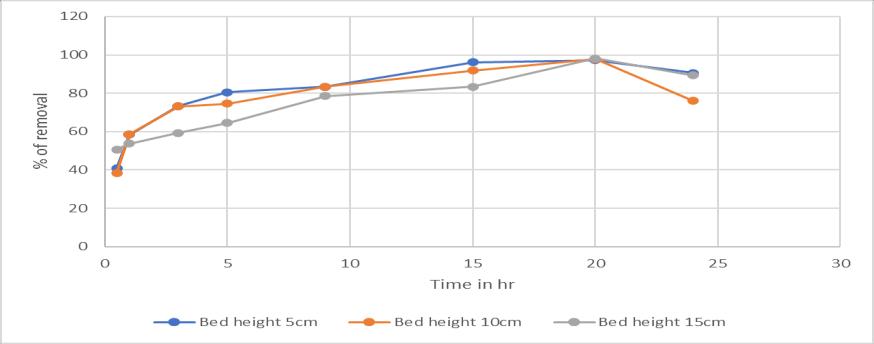
The bed height also has a greater influence in the column processwheregraterthebedheighttheremovalisgreater. Thisisduetotheavailabilityofspecificsurfacearea.(Tedi Hudayaetal,2018)
Chart -1:EffectofFlowrate:onricehusksilicawithFlow rate1,3,5ml/mininremovalofchromium(VI)
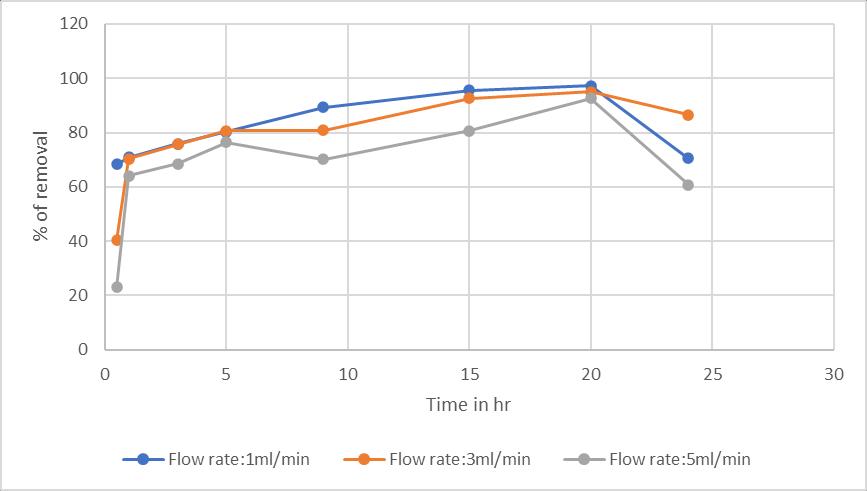
Chart -5:EffectofFlowrate:onSawdustwithFlowrate 1,3,5ml/mininremovalofchromium(VI)
Chart -2:EffectofBedheight:onricehusksilicawithBed height5,10,15cminremovalofchromium(VI)
Chart -6:EffectofBedheight:onSawdustwithBedheight 5,10,15cminremovalofchromium(VI)
Chart -3:EffectofFlowrate:onricehuskwithFlowrate 1,3,5ml/mininremovalofchromium(VI)
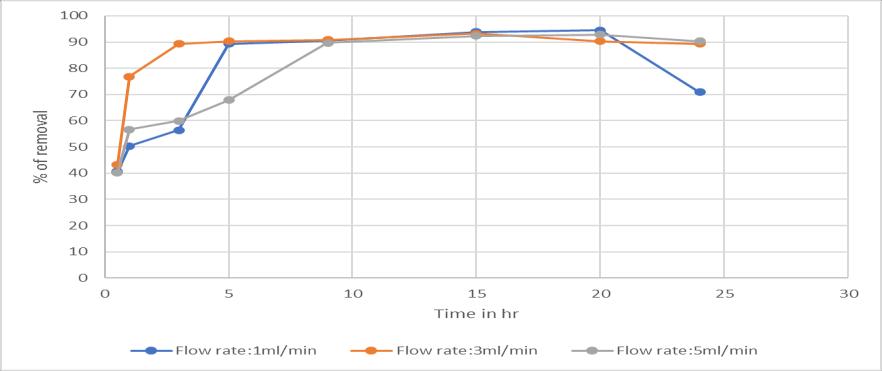

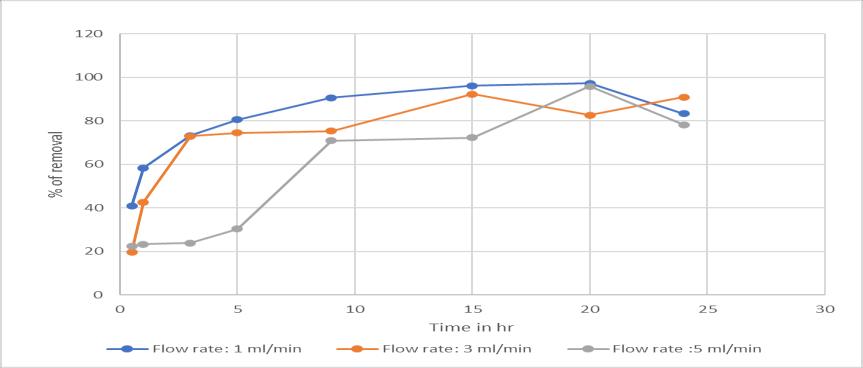
Chart -7:EffectofFlowrate:onActivatedcarbonwith Flowrate1,3,5ml/mininremovalofchromium(VI)
Chart -4:EffectofBedheight:onricehuskwithBed height5,10,15cminremovalofchromium(VI)


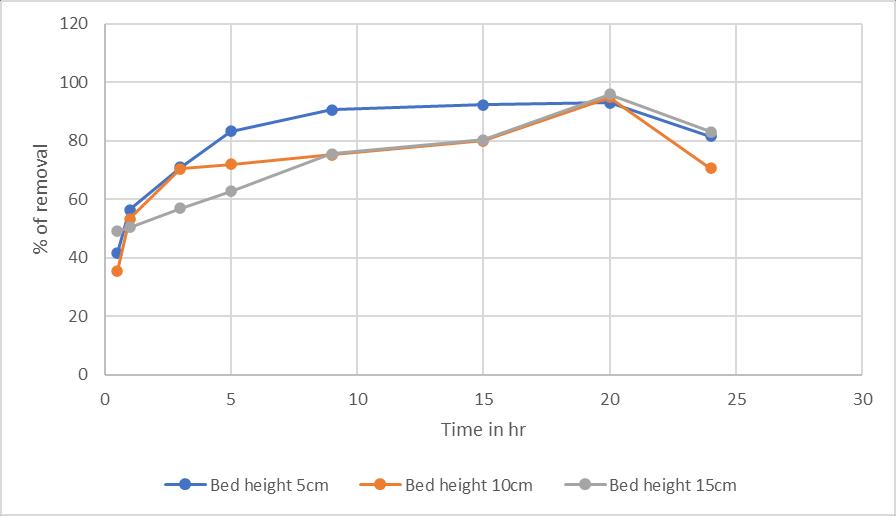
Chart -8:EffectofBedheight:onActivatedcarbonwith Bedheight5,10,15cminremovalofchromium(VI)
4. CONCLUSIONS
BATCHPROCESS
1. Ricehusksilicaremovalefficiencywas64.25%,with optimumconditionbeing90mincontacttime,2gm dosageandpH4.
2. Rice husk removal efficiency was 52.65%, with optimumconditionbeing90mincontacttime,2gm dosageandpH5.
3. Sawdust removal efficiency was 57.85%, with optimumconditionbeing50mincontacttime,2.5gm dosageandpH3.
4. Activated carbon removal efficiency was 82.65%, withoptimumconditionbeing70mincontacttime, 2gmdosageandpH2.
COLUMNSTUDY
1. Ricehusksilicatheremovalefficiencywas98.08% for1mL/minwith15cmbedheight.
2. Ricehuskstheremovalefficiencywas95.95%for 1mL/minwith15cmbedheight.
3. Saw dust the removal efficiency was 96.35% for 1mL/minwith15cmbedheight.
4. Activatecarbontheremovalefficiencywas98.32% for1mL/minwith15cm
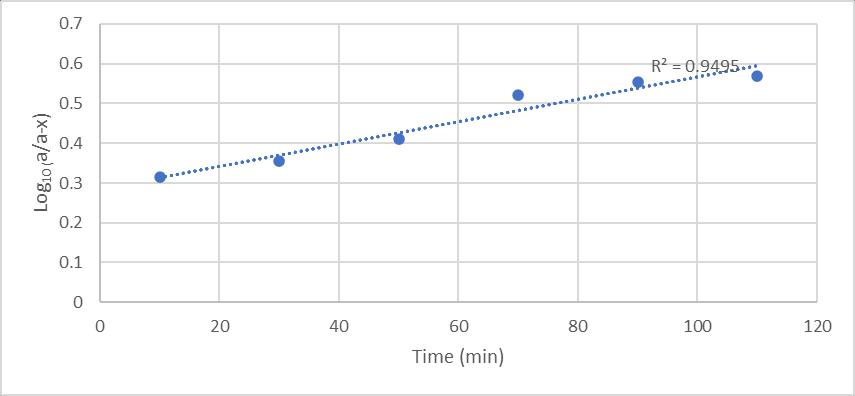
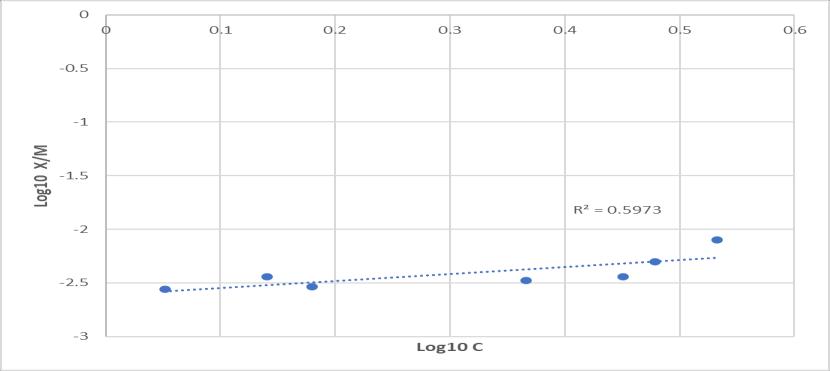
Oncomparingboththebatchandfixedbedcolumnprocess thecolumnprocessgavehigherremovalofchromium.The rateofadsorptionofchromium(VI)obeysfirstorderrate equation.TheresultfallowsFreundlichisothermindicating singlelayeradsorptionofchromium(VI)andprovestobea favorable adsorption. But it does not obey the Langmuir isotherm

REFERENCES
[1] APHA, 23rd edition of "Standard Methods for the Examination of Water and Wastewater", Washington, DC.
[2] A.R.Rahmani,M.T.Samadi,andR.Noroozi."Hexavalent ChromiumfromAqueousSolutionsbyAdsorptiononto Synthetic Nano Size Zero Valent Iron (nZVI)", World Academyofscience,Engineering,andTechnology,
[3] A.R. Asgari, F. Vazeri, S. Nasseri, O. Dordelmann, A.H. Mahvi, and E. Deghani Fard, "Removal of Hexavalent Chromium from Drinking Water by Granular Ferric Hydroxide,"Iran.J.Environ.Health.Sci.Eng.Vol.5,No.4, (2008).
[4] Chulsung Kim, Yeqing Lan, and Baolin Deng, "Kinetic Study of Hexavalent Cr (VI) by Hydrogen Sulphide through Goethite Surface Catalytic Reaction", GeochemicalJournal,Vol.No.41(2007).5)
[5] Cristina Modrogan, Cristina Costache "Removal of Hexavalent Chromium from Aqueous Solutions by Adsorption on Pearch Kernel and Nutshell", The first InternationalproficiencyTestingConference(2007).
[6] Devaprasath P.Martin, Solomon J.Samu, "Adsorption characteristics studies on removal of Cr (VI) from aqueous solution by using Casuarina equisetifolla”, International Journal of Research in Chemistry and Environment,Vol.1No.2(2011).
[7] Erhan Demibras, Mehmet Kobya, Elif Sentruk, "adsorption Kinetics for the removal of Cr (VI) from aqueous solutions on the activated carbons prepared from Agricultural Wastes", Water SA, Vol. 30. No. 4 (2004).
[8] Hasan.M.Z. Pandey.S.P, "Heavy Metals in Aquatic Environmental"JIWWA,Vol.18.No.2(1996).
[9] Hassan Masoudi, Samaneh Akbarzadeh and Morteza, "RemovalofChromium(VI)andCadmiumfromAqueous SolutionUsingOrangePeelasaCheapSorbent"(2012).
[10] Hunter.D.M, Timerding, Effects of isopropyl alcohol, ethanol,andplotethyleneglycol/Industrialmethylated spiritsinthetreatmentofacutephenolburns,Annalsof EmergencyMedicine(1992).
[11] K.Swarna Lata, "Adsorption Studies of Cr (VI) on Activated Carbon Derived from Royal Poinciana (Gulmohar) Shell". M.Tech. Env. Engg. Dissertation Work,P.D.A.C.G,(2005-2006).
[12] M.Nameni, M.R.Alavi Moghadm, "Adsorption of HexavalentChromiumfromaqueoussolutionsbywheat bran",Int.J.Environ.Sci.Tech,Vol.5No.2,(2008).
[13] M.Shirzad Siboni, M.R.Samarghandi, S.Azizia, "The Removal of Hexavalent Chromium from Aqueous Solutions using Modified Holly Sawdust : Equilibrium and Kinetics Studies", Environ. Eng.Res, Vol.16. No.2 (2011).
[14] Maher Jabari, Fathi Aqra, Safa Shahin, Khatib, "The Treatment of Chromium Tanning Wastewater using Marl",Chemical Speciation andBioavailability,Vol.21. No.3(2009)
[15] Manjunath.D.C., "Adsorption Studies of Cr (VI) on Fuller's Earth and Laterite Soil" M.Tech. Env. Engg. DissertationWork,P.D.A.C.E.G,(2011).
[16] Mohamed Al-Meshragi and Mohamed M. Abobboud, "EquilibriumandKineticsofChromiumAdsorptionon CementKilnDust",WCES(2008).
[17] N.Ahalya, R.D.Kanamadi, T.V.Ram "Removal of HexavalentChromiumusingCoffeeHusk",Vol.X(2010).
[18] N.M.Rane,Dr.R.S.Sapkal,Dr.V.S.Sapkal,M.B.Patil,"Useof NaturallyavailablelowcostAdsorbentsfortheRemoval ofCr(VI)fromwastewater",Vol.1.No.2(2010).
[19] P.K.Pandey,S.K.Sharma,"KineticsandEquilibriumstudy ofChromiumAdsorptiononZeoliteNaX",Int.J.Environ. Sci.Tech,Vol.7.No.2(2010).
[20] R.M.JayabalakrishnanandS.Mahimaraja,"Adsorptionof Cr(VI)ontoRawVermicultureGradesasafunctionof solution concentration", Journal of Applied Science Research,Vol.3.No.11(2007).