Design and Calculation of standalone system for Devon valley (TQ14 OEY) near Shaldon, England
SUBHASH HANUR DINESH BABU (A0161279)
Masters Student, MSc Electrical Power and Energy Systems, Dept. of Electrical and Computing Engineering, Teesside University, Middlesbrough, United Kingdom ***
ABSTRACT - Harnessing solar energy to run electric appliances begins with turning solar energy into electricity. Thedirectconversionofsunlightintoelectricityiscalledsolar power. Energy from the sun can be used in almost any applicationusingphotovoltaicmodules.Tacklingsun-oriented energy for home use is a strategy for changing over the sunbasedenergydischargedbythesunintopowermost,ifnotall, homes and apartment appliances. Devon valley (TQ14 OEY) near shaldon, England. It is a small cottage house does not have grid connection, moreover it will run with diesel generator will produce more Co2 emission cause effect on environment and more expensive to overcome this effect the standalone solar roof system was installing. Building a photovoltaic framework is the process of planning, choosing and computing the rating of the hardware’s utilized in the stream. This cycle relies upon various factors like topographical area, sun-oriented illumination and load necessities. In this report will focus on the design and calculation of solar standalone system by using PVGIS software from the previous Irradiation data. Moreover, calculation for inverter, solar panel design, charge controller andloadcalculationwithrespecttodailyloadconsumptionof the cottage house in Devon valley
Key Words: Standalone, Solar Irradiance, Load Consumption,InverterandPanelSizing
1.Introduction
The sun supplies the energy needed to support life in oursolarsystem.Theearthreceivessufficientenergyrays fromthesunforanhourtosustainitselffornearlya year (Ventre,2003).Theimmediatechangeofthedaylightinto power is called photovoltaics. It is an alluring option in contrasttocustomarypowerhotspotsconsideringmultiple factors,includingitisprotected,quiet&non-contaminating; itislikewisesustainable;itisexceptionallyparticularinthat limitcanbestepbystepexpandedtoobligeexpandingloads: and solid, with negligible disappointments rates and anticipatedexistenceof20-30years(R.W.Ritchie,1999)& (Sonnenenergie, 2007). No special training is required to operate.-Nomovingparts.Extremelyreliableandvirtually maintenancefree.Canbeplacedalmostanywhere.Timeof day,season,locationandwhetheraffecttheamountofsun thatbreachestheearth.Irradiance,whichrepresentstotal energyonadailyoryearlybasis,representstheintensityof
thesun.irradianceismeasuredinWattspersquaremeter perdayorWh.m-2perday.
1.1 PVGIS software
PVGIS uses high-grade, high-structural & nuptialresolutionsolarraydatafromsatelliteimageryandambient temperatureandwindspeedfromclimatereanalysismodel. MeasurementsofcommercialmodulesattheJRC’sEuropean solar test facility validated the PVGIS Energy yield model (ESTI). For all solar materials, ESTI is a photovoltaic calibrationlaboratoryapprovedtoISO17025.
1.2 Case Study: A Residence in Devon Valley, Shaldon, England (TQ14 0EY)
TheDevonvalley,Shaldon,England(TQ14OEY)has latitudeof50.541°&longitudeisarelativelysun-richregion with a yearly solar irradiation about 1284. 822kWh.m-2. Thismeansthatsolarenergysystemsareefficientpartofthe world. Additionally, since this problem in a stand-alone system design that powers all energy consuming home appliances.
2. Literature Review

2.1 Paper 1
Oneofthebestrenewableenergysystemsthatisnot onlyeconomicalbutalsoenvironmentallygoodisthesolar powersystem.Usinganoff-gridbusshelterasanexample, theseapproachesforstudy are explained,alongwithhow theymightberelevanttootheroff-gridapplications.These arecommonlyinregionswithconstrainedgetentrytogrid infrastructureandareavailablenumeroussizes.Theoff-grid bussafehasundertakingwilltotallyrelyuponsunenergy, with sun photovoltaics producing energy to strength LED lighting, wi-fi network & billing for advertising. In the occasionoftheworstweather,abatterybackupmightoffer a regular strength source. This paper will concentrate on how off-grid systems/stand-alone systems technique can helptolessenourrelianceonthegridandenableustolive independentlyofanypublicutility.Tofurtherillustratethe idea,aPVsystemwillbecreatedforanEIUbusshelter(Bai, 2018)
Paper 2
Manyresearchershavepublishedvariousstudieson thedesignofself-containedPV(Solarsystem)overthepast decade. However, after reviewing several studies on solar systems,weearthedthatsomeparameterswereoverlooked in the system’s design. Variables such as geographical location, weather type, solar radiation, and, ultimately, powerconsumptionhavethegreatestimpactontheprocess. In this section, we look at a detailed description of the process, breaking down each step of a stand-alone photovoltaic system for all weather scenarios and typical energy requirements, furthermore, this white paper examines the installation and maintenance costs of photovoltaicmodulesovertheirlifetime.Whilethereport will emphasis the high initial investment, it will also highlightthesystem’slifetimeROIandsignificantbenefits. Theresourcesprovidedareusefulresourcesfordeveloping andinstallingSPVsforruralandmetropolitanareas(Adithya Ballaji,August2022)
3. Block diagram of Standalone Systems
3.1 Standalone Systems
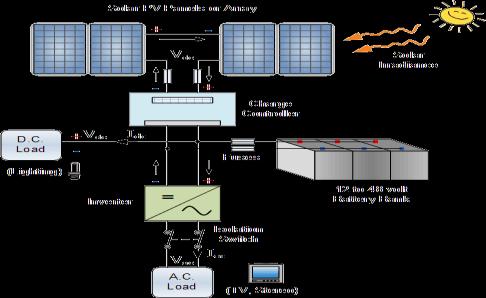
Standalone PV systems are ideal for remate rural areas and applications where other power sources are impracticalorunavailabletopowerlighting,appliances,and other uses. The standalone system depicted in fig 1 is designedtooperateindependentlyofthepowergridanditis generally designed and sized to supply certain DC & AC electricalload(K.Sopian,2021).
autonomousdays(alsoknownassunlessodarkdays)when thesundoesnotprovideenoughradiation.Thesebatteries, which are typically lead-acid, are designed to be slowly dischargeandrechargehundredsoftimesto80%capacity. Car batteries should be discharged to about 20% of their capacitybeforebeingusedinPVsystems.
3.4 Inverter
It will convert direct current (DC) power solar or wind energy sinusoidal AC power. It will be used I AC appliancesorfedbackintothegrid.Solarpanelsgenerate direct current voltage and thus one of the fundamental componentsofthesolarenergysystem.Invertercomeina varietyofoutputwaveforms,outputpowerandinstallation configurations. Because it changes the form of electric power, it is known as power conditioner. When the load demandexceedsapproximately50%oftheratedload,the efficiency of all inverters reaches its rated value, which is approximately90%.
3.5 Load
Itiselectricalcomponentsthatisconnectedtosolar systemssuchasLED-light,LEDT.V,laptopandothers.
4 Methodologies for the PV systems designs
Step1:Loadanalysisofthehouse
Step2:IrradiationcalculationbyusingPVGISsoftwaretool
Step3:Solararraysizinganddesignlayout
Step4:Specificationofcontrolcharger
Step5:Estimationofbatterycapacity
Step6: Selectionofinverter
Step7:AnalysistheresultbyusingPVGISsoftwaretool
4.1 Step 1: load analysis of the house:
As per the daily load consumption of electrical equipment, the load analysis has been calculated for the Respectivehouseasshownintable1
Sunlight is converted into electricity by the semiconductor device. Solar energy is converted into DC electricitybythePV.ThemostpopularPVmodulesaremade ofamorphoussilicon,singleandpolycrystallinesilicon,and newmaterialsarebeginningtoenterthemarket
3.3 Battery
When required, the stored energy can be used to power electronic devices. A battery bank is a system component that provides energy during the night or
4.2 Step 2: Monthly Irradiation Data using
By entering the postcode address or latitude/longitude,thesolarirradiationdatawillbegivenin themonthlydatabyselectingtheyearfrom2011to2020as showninthegraphicalprestationinbelowfromthiswecan gettheaverageirradiationdataasshowntable2.
Fromtheabovetabularcolumn,Forthedesignof solarstandalonesystemmostprefersistheworstmonthi.e., the low solar power from the sun. In the above table the December is the worst irradiation month in a year with respecttolocationofweather.
4.3 Step 3: Standalone PV sizing
Typically,fromthedatasheet
Efficiency of inverter = 96 %; Efficiency of REG/ MPPT = 97%;Efficiencyofbattery=80%
EnergyrequiredfromthePVarray=dailyload(KWh)/Eff. OfInverter,batteryandMPPT/REG
EnergyrequiredfromthePVarray=26.78/0.96*0.97*0.80= 35.94KWh/day
Weareselecting500WBifacialDualGlassMonocrystalline Module:
Maxpoweroutput:500W(1panel)+;Maxeff:21%
Moduledimensions=2.187×1.102=2.410Modulearea.
HighReliability;EnergyYield;HighCustomervalue.
500W=2.410modulearea
1000W=X
X=1000×2.410/500=4.82modulearea,kWh/kW
Nos of solar panel in a array = Daily load consumption in Wh/selectedsolarpaneli.e.500W
Nosofsolarpanelinaarray=40932/500=54
Next process will be choosing the operating voltage Vdc, typicallymultipleof12v.let’schooseVdc=48v
Nosofseriesmodule=Vdc/Vm=48/12=4
Nosofparallelmodule=28299/500×4=14
4.4 Step 4: Specification of control charger
Fromthe500Wsolarpaneldatasheet,shortcircuitcurrent Isc = 12.13A
F-safe=1.25- Thesafety factoris usedto ensurethatthe regulatorcanhandlethemaximumcurrentgeneratedbythe arrangementthatmayexceedthetablevalues.Youcanalso useadditional devices tohandlehigherthanplanned load currents, for example. In other words, this safety factor allowsthesystemtobeslightlyexpanded.
I=Isc×Np×Fsafe
I=12.13×14×1.25
I=212.75A
N controller (no’s of charge controllers) = Array short currentinamps/ampseachcontroller
Ncontroller=212.75/80=3
4.5 Step 5: Estimation of battery capacity
For no city power areas, the battery pack can be chargedbysolarpanelsandusedfornightlighting;forthe areasthatcitypowerisexpensive,thebatterypackcanbe chargedduringtheelectricityvalleyvalueperiodandusedat thepeakpowerperiod;fortheareaswhichpowerofffrom timetotime,thebatterypackcanbeusedasUPS,toavoid information loss caused by sudden power outage. The batterypackisapplicabletocommerciallighting,industrial lighting,industriallighting,homelighting,outdoorlighting, campingtourism,farming,planting,thenightmarketstalls, etc.
Battery=LiFePO4Batterypack(castaluminiumversion); standardcapacity=24v/200Ah;storagecapacity=5120Wh; delayprotection=1000ms;warranty=5yrs.
Choose autonomy (n = 5 days) i.e.,thebatterywillcharge5 daysinaweek.therefore,thecapacityofbatteryformulais shownbelow
Cb = n × daily load consumption / depth of discharge permitted
Cb=5×26781/0.8=167382Wh
W,k,t , power (p)= voltage (v) ×current(I) = 24× 200 = 4800Wh
Noofbatteries=batterycapacityinWh/selectedbatteryin Wh
Noofbatteries=167382/4800=36
Noofbatteriesinseries=2
Noofbatteriesinparallel=18
4.6step6:SelectionofInverter
Thefirststep, whensizinganinverteristo determinethe actual power consumption of the loads operating simultaneously. The inverter cost is high for the safety purposeweareassumingthe25%extrapowerconsumption isaddedasshowninbelowequations
Inverter=powerconsumptioninaday/powerfactor×25%
Inverter=5823/0.8×1.259910VA
IntermsofInverterwatt=InverterinVA×powerfactor
IntermsofInverterwatt=9910×0.8=8000W
4.7 Step 7: Analysis of the result by using PVGIS software tool
Fromallabovecalculations, Installed peak power = selected PV panel (500W) × No of modulesinPVarray
Installedpeakpower=500×50=2700Wp
Fromthebatterycapacity, Capacityofbattery=167382Wh
Slopeangle=38deg(obtainedfromthestep1)
Dailyload=26781Wh
EntertheaboverespectivevaluesinPVGIS/OFFgrid,weget visualizationdatatobuiltstandalonesystemforlocationfig 2

The above graph analysis is about the power production estimation for the OFF-Grid PV systems. The purple bar indicatesthat,theoutputenergyistheenergyrequiredfor thebatterymeettheloaddemandfromthesolarpower.The bluebarchartindicates theamountofPVpowerobtained

fromthesunatthelocationshaldon,England.Accordingto thegraphabove,theamountofsunlightavailabletocharge the battery to meet the load is low from November to January. Aside from that, the energy power supply (from, MarchtoOctober)willmeettheload.
ForthePVcalculationanddesign,weareconsideringthe monthofDecemberi.e.,worthmonth.
house to overcome the desiel generation expenses and becomeenviromentalfriendly.
5 Future scope
Fromtheanalysis,wecanseethatfromtheNovemeberto Febuarythelowsolarenergyso,stillthecottagerequired deisel genration in this month . furthermore, the solar energy is not captured during the months of march to october.Toovercomethisitwillrequiredsomemethodsto includeforfutureendevours.
1. We can see the fig 4&5 from the month of march to octoberthebatterywillfulfilledtheenergywithrespect toloaddemandremaingsolarenergywillbewastedto overcomethistheycanaddmorebatterybankstostore the energy or connect the neighbour house load and utilze for the following month to avoid the deisel genrator.
Fig4:Batteryperformanceanalysis
ThegraphwilltalkaboutthebatteryperformanceintheoffgridPVsystem.Theredbarindicatesthenumberofdaysin amonththatthebatteryisnotcharged.Thegreenindicates thatthe respective month hasa full charge.As mentioned above,thesunlightisverylowinthemonthsofNovember, December, January, and February. In other months, with enough sunlight, the battery will charge completely in 5 days.
2. HybridEnergy
Fig5:probabilityofbattery-chargestate
Theabovewillrepresentstheprobabiltyofbaterychargeat theendoftheday.Inadaythestateofbatterypercenatgeis 92
100(i.ethebattreywillchargeuptothisperenatgeina day.Cbwillbethe52%meansthepercenatgeofdaysina monththebatterywillbeinchargestate.Thelowestcharge state at the end of the day is 20-28 % and 4% days in a month the battery will be in charge state as shown in the abovefigrespectively.
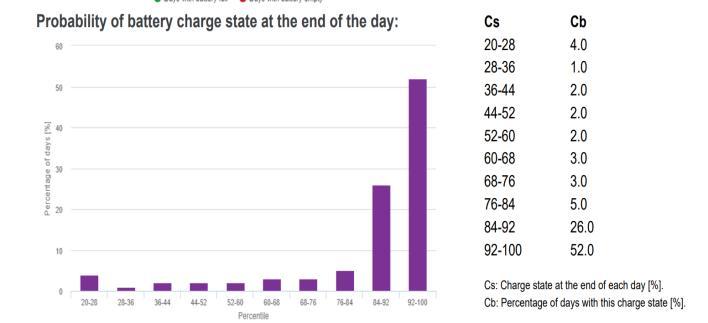
Fromthis,theaveragepercernatgeofbatterywith full charge is 68.15% and average percernatge of battery withemptychargeis3.98%.AsaEngineer,Iwillsuggestto install the standlone system in the devon valley cottage
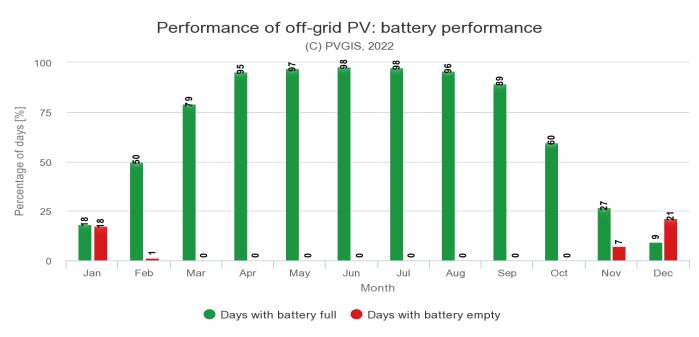
Fig6:HybridTechnology
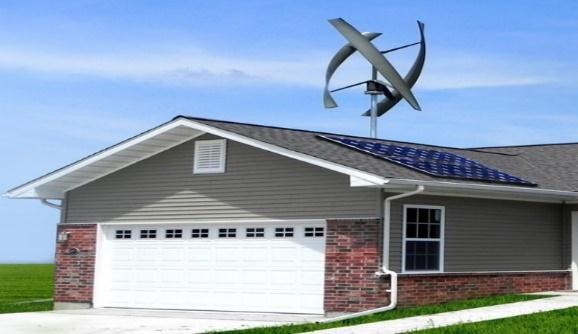
During the month of December, the insufficient solar irradiation the battery is 21 days empty in a month by installingthesmallwindturbinewithsolarwithrespectto houseasshowninfig6.Fromthisimplementationofhybrid technology, we can solve this issue during the low irradiationatlocation.Moreover,theaveragewindspeedin Devonis14.1mph. Thishybridtechnology will have more economicbenefitsandlesscost
Conclusion:
The geographic location of England’s (TQ14 OEY) Devon valleyisarelativelySunnyareawithannualsolarradiation exceeding1284.822kWh.m-2.Thereisapronenessforthe use of Standalone photovoltaic stations distributed in remote areas due to the known benefits of this source of energy. The selection of battery is economical cheap and 90% is recyclable with full charge efficiency of 68.15%. Advanced inverter is implemented that will check the batteryvoltageandsupplyviasmartphone.Moreover,from this standalone installation in the location will reduce the useofdieselgeneratorandsustainableenergywithsystem lifespanofaround15-25years.
References
[1] Abdel_Salam, M. & Swify, m., 2011. Design and implementation of stand-alone residential PV system.
[2] AdithyaBallaji,R.D.R.H.e.a.,August2022.Design of a standalone PV system for the all weather. Banglore.
[3] Bai,D.R.,2018.DesignMethodologyofOff-GridPV SolarPoweredSystem
[4] Belona,I.A.&MArtinvich,M.V.,2021.Modelingofa Stand-Alone Photovoltaic System Using an IntelligentControlSystemBasedonArtificialNeural Network.
[5] Bhattacharya, A. & Bhattacharyya, B. K., 2016. A standalone solar photovoltaic power generation system with automated bidirectional battery chargingdischargingcontrol
[6] K. Sopian, S. M. &. M. R., 2021. Desgin & sizing of standalonesolarpoweratIraq
[7] R. W. Ritchie, 1999. Using Sunlight for Your Own solarElectricity.
[8] Sonnenenergie, D. G. F., 2007. Planning and Installingphotovoltaicsystems.
[9] Ventre, R. A. M. a. J., 2003. Photovoltaic systems engineering
BIOGRAPHIES
SUBHASH HANUR DINESH BABU (A0161279)master’sstudentinMSc ElectricalPowerandEnergySystem with Advanced Practices from TeessideUniversity,Middlesbrough, UnitedKingdom.