Automated Fish Species Detection
R. Kranthi Kumar1, D Ashritha2, D Siddharth3, D Neeraj Ashish4, M Akshara51Assistant Professor, VNR Vignana Jyothi Institute of Engineering & Technology, Hyderabad

2345Under Graduate Student, VNR Vignana Jyothi Institute of Engineering & Technology, Hyderabad
***
Abstract - Fish species detection is essential for many different uses, including managing fisheries and monitoring aquatic ecosystems. In this research, we present a deep learning-basedmethodforprecisefishspeciesidentification using MobileNetV2 architecture. The MobileNetV2 is a compact and effective convolutional neural network (CNN) model that successfully strikes a compromise between precision and computational effectiveness, making it especially ideal for contexts with limited resources. We assembled a large collection of fish photos from various species with different lighting, backdrops, and orientations in order to evaluate our method. We demonstrate the efficiency of our approach in attaining accurate fish species detection and categorization through comprehensive training and evaluation. Notably, our methodology maintains computational economy while delivering competitive performance compared to cutting-edge technologies, enabling its use in real-time scenarios. By presenting an automated system for fish species detection, our proposed application aims to streamline and enhance the efficiency of monitoring aquatic ecosystems. This, in turn, contributes significantly to the conservation of biodiversitybyprovidingamorepreciseandefficientmeans ofassessingandmanagingfishpopulations.
Key Words: (Fish species detection, MobileNetV2, CNN, Aquaticecosystems.)
1.INTRODUCTION
Fish species detection plays a crucial role in the field of aquaculture, which is the cultivation of aquatic organisms such as fish, shellfish, and aquatic plants for various purposes. The essence of aquaculture lies in its ability to meet the increasing global demand for seafood, alleviate pressureonwildfishstocks,andpromotesustainablefood production.
Inordertoeffectivelymanageaquacultureoperationsand ensureoptimalgrowthandhealthof fishpopulations,itis essential to accurately identify and monitor the different fish species present. This is particularly important in situations where multiple species coexist within the same aquatic environment, such as in fish farms or natural waterbodiesusedforaquaculturepurposes.
Accurate species detection in aquaculture has several benefits. It enables aquaculturists to maintain speciesspecific environmental conditions, feed formulations, and
disease management strategies. It also aids in ensuring proper fish health and welfare, preventing the spread of invasive species, and facilitating the breeding and genetic improvementofspecificfishspecieswithdesirabletraits
Fish species detection involves the use of various techniques and technologies to identify and classify different fish species based on their physical characteristics, genetic markers, or behavioral patterns. These methods can range from traditional visual identification by experienced aquaculturists to advanced technologies like DNA analysis, computer vision, and machinelearningalgorithms.
This research provides an extensive examination of the latest techniques and advancements in automated fish speciesdetection.Ourfocusisspecificallydirectedtoward exploring the utilization of the MobileNetV2 architecture. MobileNetV2 is an efficient and lightweight convolutional neural network (CNN) model that effectively balances accuracyandcomputationalefficiency.
The primary objective of this paper is to provide researchers, practitioners, and enthusiasts with a comprehensive understanding of the current methodologies, challenges, and future directions in automated fish species detection using MobileNetV2. We also discuss the underlying principles, network structure, and transfer learning strategies employed in adapting MobileNetV2forthisspecificapplication.
Through this research paper, we aim to provide researchers and practitioners with a valuable resource that can guide future developments in automated fish species detection, foster collaborations, and promote advancementsinthiscriticalfieldofstudy.
2.
LITERATURE SURVEY
2.1. Research on fish identification in tropical waters under unconstrained environment based on transfer learning[2022]:
The paper focuses on fish detection in tropical waters using transfer learning in an unrestricted environment. The method begins with pre-processing of the images using affine transformation to improve the data. Then, a RestNet50 deep convolutional neural network is built usingtransferlearning. The effectivenessoffishdetection and recognition is compared prior to and following
transfer learning. The results demonstrate that using the pre-trained model from ImageNet as the network’s starting weight gives better accuracy and lower loss compared to non-transfer learning approaches. After training the model for 150 epochs, the indicators start to link up, indicating that the model is able to better accomplish the identification of fish in tropical seas amid thedifficultunrestrictedenvironment.
2.2. Automated Detection, Classification, and Counting of Fish in Fish Passages With Deep Learning[2022]:
Fishes are the main part of the marine ecosystem.Most of the people in the world depend on fish for their diet. The data is collected by using acoustic devices, visual and active sonar, and optical cameras. To analyze this data to detect count and classify fish species they generated an automatedsystembyusingYOLOv3andMask-RCNNdeep learning models which can detect and classify the fish species.DataiscollectedfromDIDSONdevicetodetectand classifythefishes,butthisdatasethaveonly8typesoffish species to classify.The highest mean average precision value achieved by using YOLO is 0.73 and by using MaskRCNNis0.62.
2.3. Fake Hilsa Fish Detection Using Machine Vision[2022]:
Hilsa is the national fish of Bangladesh and it has more value in the market. Some businessmen started selling fake hilsa fishes for more profits. Fake hilsa cannot be detected just by looking it or by traditional methods because the they have similar features like original one with very slight differences like eyes, scales hence an automated system is required to generate identify the original and fake one, so they proposed a system that can detect original and fake hilsa fish. They collected the data whichhas16,622images.Todetectthefakeonetheyused five different types of CNN models they are Xception, VGG16, Inception V3, DenseNet201, NASANetMobile. All these five models have different accuracies where NASANetMobile show less accuracy of 86.75% whereas DenseNet201showhighaccuracyof97.02%.
2.4. A Scalable Open-Source Framework for Machine Learning-Based Image Collection, Annotation, and Classification: A Case Study for Automatic Fish Species Identification[2022]:
Non-commercial inland and coastal fisheries, which offer numerous societal benefits andhavesignificant ecological effects, often lack sufficient data and assessments. To address this gap, this study aims to promote the widespread utilization of computer vision tools in fisheriesandecologicalresearch,encompassingtaskssuch as large-scale image database, efficient handling, accurate innovation, and automated classification. To achieve this
objective, we employed technologies such as Tensorflow litemodelmakerlibrary,transferlearningtechniques,and convolutional neural network (CNN)layers. This research mainly focuses on data preprocessing, annotations, data augmentation, and model building. The best performance wasachievedwhenthemodelwastrainedonEfficientNetLite0model withbatchsize 32and20epochswhichgave an precision of 91%. This study also pointed out many problemslikehecticmanualannotation,lowavailabilityof publicdatasets,andoverlappingfishimages.
2.5. Fish Detection and Classification Using Convolutional Neural Networks[2020]:
Fortheconservationoffishspeciesitisimportanttoknow about the size and diversity of every species. For this an automated system is required to detect and classify the captured species. To perform these tasks CNN is used. In this project they used a dataset which has 3777 images divided into 8 categories. This dataset is divided into training phase and testing phase where its validation accuracy is 90% and took about 6hrs to train the model. This project have better results compared to the traditional image processing techniques but the whole processisslow.
2.6. Fish detection and species classification in underwater environments using deep learning with temporal information [2020]:
Marine scientists need to estimate the abundance of fish species and also observe the changes in population of fishes.Thedatacollectedintheformofvideoshenceithas manychallengesbecauseoffishcamouflage,backgrounds, shape and deformations of swimming fish and subtle variations between some fish species. To overcome these problems they proposed a model based on YOLO deep neural network.ByusingYOLOtheycombineoptical flow andGaussianmixtures.Usingtemporalinformationthatis obtained from Gaussian mixture and optical flow models they detect the moving fishes. They used two types of datasets and they got F-scores as 95.64% and 91.2% and accuracies as 91.64% and 79.8% on each datasets respectively.
2.7. Underwater Fish Detection with Weak MultiDomain Supervision [2019]:
Underwater fish detection is challenging because of low froma coupleofdomains,consistingofsyntheticand real underwater pictures. This overcomes barriers of scarce actual-global classified facts. The approach includes a
visibility, changing lights, and occlusions. Traditional computerimaginativeandprescienttechniquesconflicton this domain. The reviewed paper introduces a novel method using susceptible multi-domain supervision. This method combines categorized and unlabeled information
domain version community and a fish detection network. The domain version community aligns visual traits thru hostile schooling, facilitating know-how switch from artificial to real underwater pictures. The fish detection network employs a CNN and an RPN. The CNN extracts excessive-degree features, while the RPN localizes and classifies fish regions. Integration improves accuracy. Evaluation uses a complete dataset of actual underwater snap shots. The method outperforms present day strategiesinaccuracyandrobustness.Weakmulti-domain supervision proves effective. Significance lies in packages to underwater exploration, marine biology, and environmental tracking. Accurate fish detection aids in analyzingecosystems,assessingbiodiversity,andtracking human effect on aquatic existence. The technique offers advancements for stepped forward information and managementofunderwaterenvironments.
2.8 Assessing fish abundance from underwater video using deep neural networks[2018]:
Marine biologists are an increasing number of adopting the use of underwater cameras or videos to evaluate fish diversity and abundance. However, processing videos manually for estimation through human analysts is both time-taking and labour intensive. To deal with this challenge and obtain cost and time efficiency, automated video processing strategies may be used. The primary objective is to broaden the accurate and dependable system for fish detection and recognition, that's specificallyvital for autonomousrobotsystems.However, this challenge provides numerous challenges which includes complicated backgrounds, deformations, low decision, and the propagation of light. The recent improvements in deep neural networks have paved the mannerforactual-timeobjectdetectionandreputation.In this have a look at, an quit-to-stop deep studying-based totally architecture is brought, surpassing the performanceofexistingstrategiesandpioneeringthefield of fish evaluation. The technique combines a Region Proposal Network (RPN) from the Faster R-CNN object detector with three classification networks for detecting andrecognizingfishspeciescapturedbymeansofRemote Underwater Video Stations (RUVS). The experiments achievedanimpressiveaccuracyof82.4% (MeanAverage Precision), considerably surpassing the performance of formerlyproposedmethods.
3. METHODOLOGY
Theframeworkdevelopedinthisstudyisdividedintofour main modules: Dataset collection and preprocessing; ModelArchitecture;Transferlearningandfine-tuning;and TrainingandEvaluation.
3.1. Dataset Collection and Preprocessing:
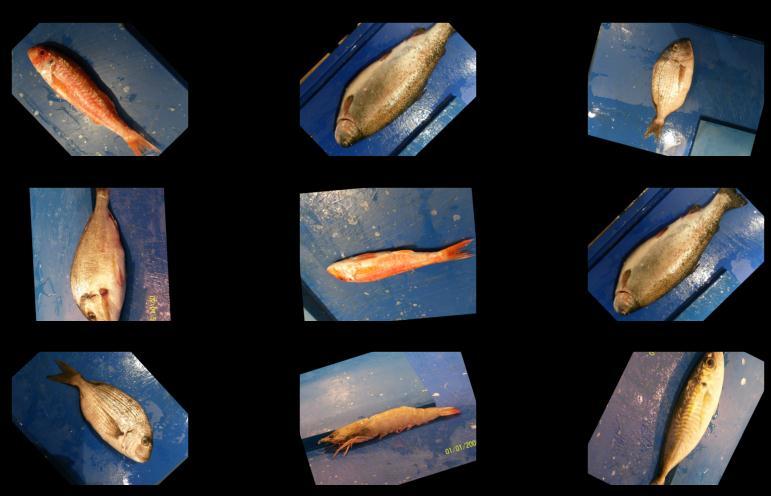
To assess the performance of our proposed approach, we curated a dataset of fish images encompassing multiple species, varying lighting conditions, and different orientations. The dataset was collected from Kaggle [1]. Thisdatasetcontains9differentfishtypes.Thereare1000 augmented images in each class, along with their paired enhancedgroundfacts.Eachimagehasaresolutionof590 x445pixels.Carewasalreadytakentoensurea balanced representationofdifferentfishspeciestoavoidbiases.The collected dataset underwent preprocessing steps to enhance the performance for training the deep learning model. Data Transformation techniques were applied to increase the dataset size and improve the model's generalization ability. Moreover, manual annotation was performedtolabeleachimagewiththecorrespondingfish species.
3.2. Model Architecture:
MobileNetV2, a lightweight and efficient convolutional neuralnetwork(CNN)model,waschosenasthebackbone architecture for fish species detection. MobileNetV2 is specifically designed to achieve a stability between precision and computation effectiveness, making it wellsuited for resource-constrained environments such as underwater monitoring systems. The MobileNetV2 architecture consists of 53 convolution layers, which significantly decrease the count of variables and computational complexity compared to commonly used CNN layers. This allows the model to achieve high accuracy while minimizing the computational resources requiredforinference.
3.3. Transfer Learning:
To leverage the representation learning capabilities of MobileNetV2, we employed transfer learning. The predetermined weights of MobileNetV2, trained on a largescale dataset such as ImageNet, were used as the initialization for our fish species detection task. By initializing the model with pre-trained weights, we benefitedfromthelearnedfeaturesthatwereeffectivefor general image recognition tasks. After initialization, we fine-tuned the MobileNetV2 model using our curated fish speciesdataset.Fine-tuninginvolvedupdatingthemodel's weights by training it on our dataset, while keeping the earlylayersfrozentoretainthegeneralfeatureextraction capabilitiesofthepre-trainedmodel.Thisprocessallowed the model to alter the specific characteristics and variationspresentinourfishspeciesimages.
3.4. Training and Evaluation
The training process involved feeding the preprocessed and augmented fish species dataset into the MobileNetV2 model. A categorical cross-entropy loss function is used forthisclassificationtask.Adamoptimizerisemployedto optimize the model's parameters during training. To evaluate the performance of our approach, we employed various evaluation metrics, including accuracy, precision, recall, and F1 score. The dataset is split into training, validation, and testing sets in the ratio (70%-15%-15%), ensuring that images from the same fish species were present in multiple sets to assess the model's generalization ability. Extensive experiments were conductedtofindoptimalhyperparametersandassessthe model'sperformanceunderdifferentscenarios.
4. UML DIAGRAMS
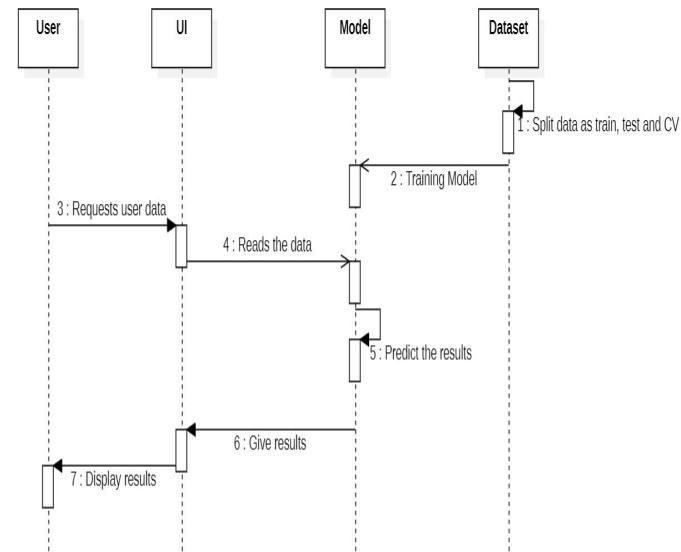
Fig -2: Usecasediagram
In the use case diagram shown in Fig 2, the user is requestedtouploadtheinputfishimage,theUIreadsthe input data and data is pre-processed while training and
testing the model. The Api builds a model to detect fish speciesandtheresultsaredisplayedintheUI.
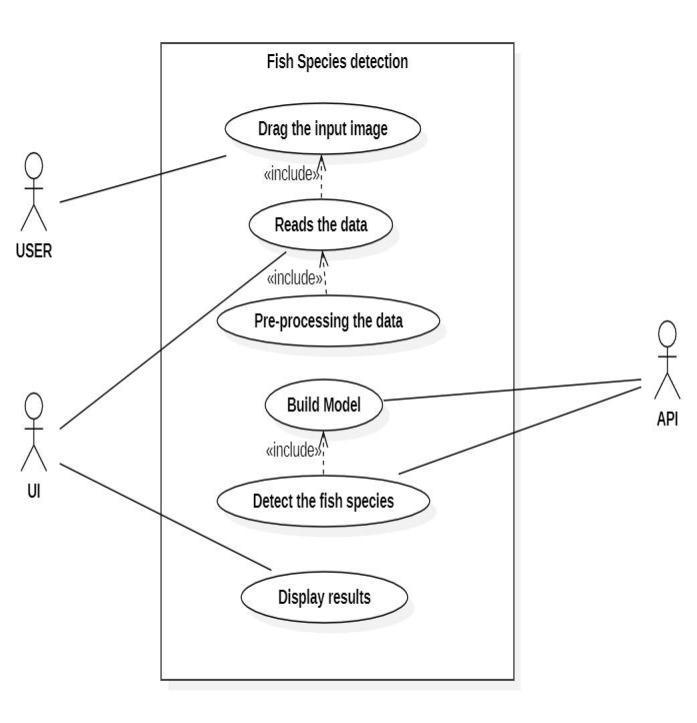
Fig -3: Sequencediagram
In the sequence diagram as shown in Fig 3, the lifelines are:
● User
● UI
● Model
● Dataset
The dataset is split into three parts as train, test and cv data.Trainingdatasetisusedtotrainthemodel.Theuser sends a request to the UI for data. The model reads the data and detects the fish species. The model predicts the results.TheresultsaresenttoUIanddisplayedtotheuser
5. RESULTS
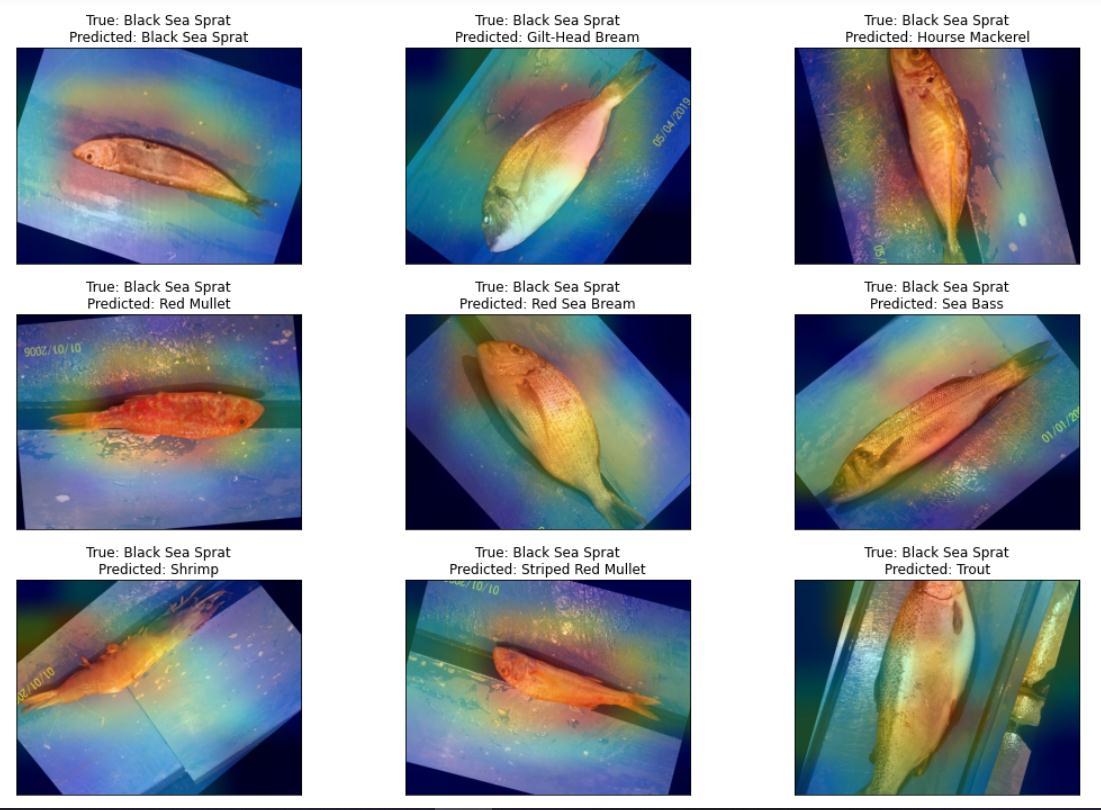
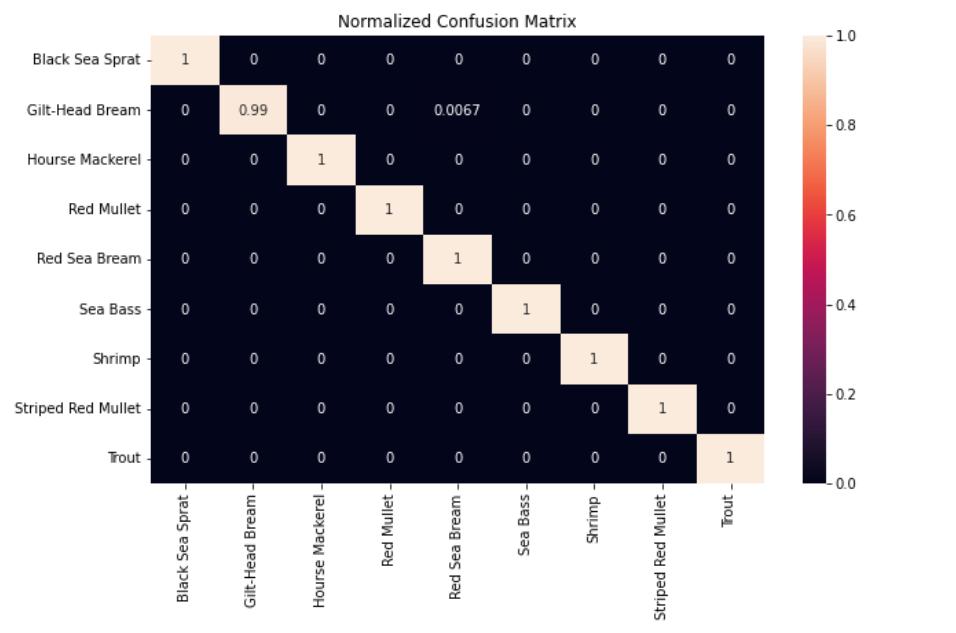
Our experiments demonstrated the effectiveness of the MobileNetV2-based approach for fish species detection. The model achieved competitive performance compared to modern approaches while maintaining computational efficiency.Theresultsindicatedanaccuracyof99%onthe test data. From the confusion matrix in Figure 4, we can observe that the precision, recall, and F1 score values of each class are surprisingly high validating the robustness andeffectivenessofourproposed methodology.Theclass activation map in Figure 5 has highlighted the regions in the images that contribute the most to the predicted classes.
6. DISCUSSIONS
The fine-tuning process with transfer learning facilitated faster convergence and improved generalization ability, enablingthemodeltoaccuratelyclassifyfishspecieseven with limited training data. Moreover, our approach demonstratedcomputationalefficiency,makingitsuitable for real-time scenarios and resource-constrained environments. The lightweight natureof the MobileNetV2 architecture enabled fast inference times without compromising accuracy, facilitating its deployment in applications where real-time fish species detection is essential.
Visualizationtechniquessuchasactivationmapsandclass activation mapping (CAM) provided valuable information about the regions that contributed most to the model's predictions. This insight helps in understanding the model'sdecision-makingprocess.
Although the model is highly accurate and efficient, the effectivenessofanymachinelearningmodelheavilyrelies on the quality and representativeness of the training dataset. One of the major reasons for the high accuracy resultsisduetothesimpleandcleandataset.Buttherealtime monitoring imposes various challenges in terms of lightingconditionsandcomplexenvironments.
Based on this study, some of the future directions are discussedbelowtoadvancetheaquaculturefield.
● Data Collection is crucial: In extensive fish detection studies, open-source data is relatively small due to various factors like difficult environment and internal traits of fish species. Therefore, most studies have been supervised under controlled conditions. Toward real-life applications, there is a need for more realistic imagesinaquaculture.
● Interpreting intrinsiccharacteristicsofthe fish:A majority of studies focused on fish-counting and bio-mass estimation in high-density scenarios. A futuredirectionwouldinvolvemethodswhichnot only used to count fish but can also present the spatialdistributionoffishintheimage.
● Developing Commercial applications: Implementing the usage of underwater cameras and sensors to monitor aquatic ecosystems and fisheriesmanagement.
7. CONCLUSIONS
In this research paper, we introduced a deep learningbasedapproachutilizingtheMobileNetV2architecturefor accuratefishspeciesdetection.Ourcomprehensivesurvey examined the latest techniques and advancements in
automated fish species detection, with a specific focus on theutilizationofMobileNetV2.
Through extensive training and evaluation, we demonstrated the effectiveness of our approach in achieving precise fish species detection and classification. The lightweight and efficient nature of the MobileNetV2 architecture made it well-suited for resource-constrained environments, enabling real-time fish species detection applications.
By automating fish species detection, our proposed application contributes to the efficient monitoring of aquatic ecosystems, fisheries management, and biodiversity conservation. The ability to accurately identify fish species provides valuable insights into population dynamics, habitat health, and ecosystem assessments, ultimately aiding in the conservation of biodiversity.
We hope that this research paper serves as a valuable resource for researchers, practitioners,and enthusiastsin the field of automated fish species detection. The survey, methodology, and results presented here provide a foundationforfurtheradvancementsinthiscriticalareaof study. By leveraging the strengths of the MobileNetV2 architecture and addressing the identified challenges, future research can continue to improve the accuracy, efficiency, and interpretability of fish species detection systems
REFERENCES
[1] O.Ulucan, D.Karakaya, and M.Turkan.(2020) A largescale dataset for fish segmentation and classification. InConf.InnovationsIntell.Syst.Appli.(ASYU)
[2] Zhang, S., Liu, W., Zhu, Y. et al. Research on fish identification in tropical waters under unconstrained environment based on transfer learning. Earth Sci Inform15,11551166(2020),https://doi.org/10.1007/ s12145-022-00783-x
[3] Kandimalla V, Richard M, Smith F, Quirion J, Torgo L and Whidden C (2022) Automated Detection, Classification and Counting of Fish in Fish Passages With Deep Learning. Front. Mar. Sci. 8:823173. doi: 10.3389/fmars.2021.823173.
[4] Silva, C.N.S.; Dainys, J.; Simmons, S.; Vienožinskis, V.; Audzijonyte, A. A Scalable Open-Source Framework for Machine Learning-Based Image Collection, Annotation and Classification: A Case Study for Automatic Fish Species Identification. Sustainability 2022, 14, 14324. https://doi.org/10.3390/su142114324
[5] Islam,M.,Ani,J.F.,Rahman,A.,Zaman,Z.(2021).Fake Hilsa Fish Detection Using Machine Vision. In: Uddin, M.S., Bansal, J.C. (eds) Proceedings of International Joint Conference on Advances in Computational Intelligence. Algorithms for Intelligent Systems. Springer, Singapore. https://doi.org/10.1007/978981-16-0586-4_14
[6] Rekha, B.S., Srinivasan, G.N., Reddy, S.K., Kakwani, D., Bhattad, N. (2020). Fish Detection and Classification Using Convolutional Neural Networks. In: Smys, S., Tavares, J., Balas, V., Iliyasu, A. (eds) Computational Vision and Bio-Inspired Computing. ICCVBIC 2019. Advances in Intelligent Systems and Computing, vol 1108. Springer, Cham. https://doi.org/10.1007/9783-030-37218-7_128
[7] AhsanJalal,AhmadSalman,AjmalMian,MarkShortis, FaisalShafait,Fishdetectionandspeciesclassification inunderwaterenvironmentsusingdeeplearningwith temporal information, Ecological Informatics, Volume 57, 2020, 101088, ISSN 1574-9541. https://doi.org/10.1016/j.ecoinf.2020.101088.
[8] D. A. Konovalov, A. Saleh, M. Bradley, M. Sankupellay, S.MariniandM.Sheaves,"UnderwaterFish Detection with Weak Multi-Domain Supervision," 2019 International Joint Conference on Neural Networks (IJCNN), Budapest, Hungary,2019,pp.18,doi:10.1109/IJCNN.2019.8851907.
[9] R. Mandal, R. M. Connolly, T. A. Schlacher and B. Stantic, "Assessing fish abundance from underwater video using deep neural networks," 2018 International Joint Conference on Neural Networks (IJCNN), Rio de Janeiro, Brazil, 2018, pp. 1-6, doi: 10.1109/IJCNN.2018.8489482.
[10] Yang,L.,Liu,Y.,Yu,H.etal.ComputerVisionModelsin Intelligent Aquaculture with Emphasis on Fish Detection and Behavior Analysis: A Review. Arch Computat Methods Eng 28, 2785–2816 (2021). https://doi.org/10.1007/s11831-020-09486-2